# THE MOUNTAIN MAN BOUGHT A BRIDE FOR TWENTY DOLLARS — BUT WHAT HE DID WHEN HE SAW HER CORSET CHANGED EVERYTHING
**Chapter One: The Thing in His Hands**
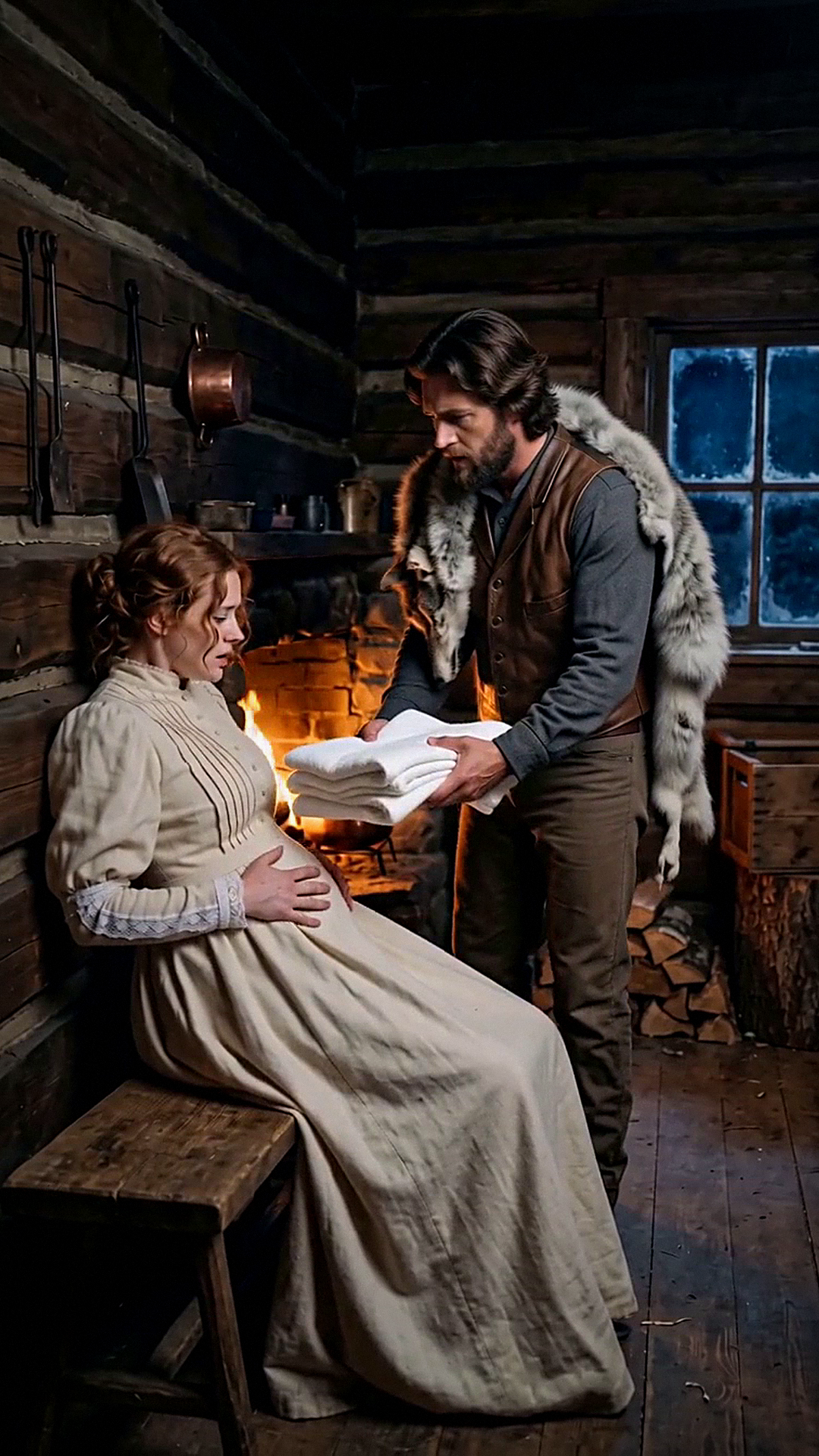
Harlan turned from the chest with a pale bundle in his hands.
Josephine stared at it, unable to decide whether she should be relieved or frightened. Her fingers remained pressed against the front of her dress, and her breathing came in small, painful bursts.
The mountain man stopped several feet away.
“It’s a dress,” he said.
His voice was deep, but quieter than before.
Josephine looked down at the folded material. It was a simple cotton garment, pale blue, with long sleeves and a modest neckline. Beside it lay a thick wool blanket.
“Your wedding dress is cutting off your breathing,” Harlan explained. “And that corset is doing worse.”
Josephine’s cheeks burned.
He glanced toward the fireplace rather than at her.
“I don’t mean to frighten you. I need you to get those stays off before you faint.”
She swallowed.
“Why did you say it like that?”
Harlan looked at her.
“Like what?”
“Like I was supposed to take everything off.”
For the first time, something resembling embarrassment crossed his weathered face.
“I should have explained.”
He placed the folded dress and blanket on a wooden chair.
“There’s a screen behind the door. You can change there. I’ll wait outside until you say you’re ready.”
Josephine looked at the screen.
Then she looked at the door.
“Will you leave?”
“I’ll stand on the porch.”
“What if I don’t open the door?”
“Then I’ll keep standing there until you do.”
He picked up his coat, opened the door, and stepped into the falling snow.
Josephine listened until she heard the door close behind him.
Only then did she allow herself to breathe.
She moved toward the chair and touched the pale blue dress. The fabric was clean, soft, and carefully folded. It smelled faintly of cedarwood and soap.
She had not expected kindness from this house.
She had not expected anything except another place where she would be reminded that she was unwanted unless she made herself useful.
Slowly, she moved behind the wooden screen.
The first attempt to loosen the corset failed. Her fingers were trembling, and the tight knot sat between her shoulder blades where she could barely reach it.
She tried again.
A sharp pain ran along her ribs.
Josephine closed her eyes.
She remembered her aunt’s fingers pulling those laces tighter that morning. She remembered Lydia telling her that discomfort was the price of looking respectable.
But she could barely breathe.
With a frustrated cry, Josephine pulled at the laces until one finally loosened. She worked at the remaining knots, stopping whenever the pain became too much.
When the corset finally fell away, she nearly collapsed.
Her lungs expanded.
Air entered her chest in a deep, almost frightening rush.
She stood behind the screen for several moments, simply breathing.
Then she removed the stiff wedding dress and changed into the blue cotton garment. It was slightly loose around her shoulders and comfortably wide at the waist.
The blanket was large enough to wrap around her.
She gathered the discarded clothes and stepped toward the door.
“Harlan?”
The door opened almost immediately.
He entered only after she had moved away from the screen.
His eyes went first to her face.
“Better?”
Josephine nodded.
“Much better.”
“Can you take a full breath?”
She inhaled slowly.
For the first time that day, it did not hurt.
Harlan gave a small nod.
“Good.”
He picked up the corset from the floor and examined its rigid shape.
“Who tied this?”
“My aunt.”
“Did she know it hurt you?”
Josephine looked down.
“Yes.”
His jaw tightened.
But he did not ask another question.
He carried the corset to the hearth and placed it beside the fire.
Josephine watched him.
“What are you doing?”
“Making sure you don’t put it back on.”
The flames caught the edge of the fabric.
Josephine stared as the thing that had caused her so much pain began to burn.
She should have felt satisfaction.
Instead, she felt something close to grief.
That corset represented every year she had spent trying to become acceptable to people who had already decided she never would be.
Harlan noticed her expression.
“Was it expensive?”
“No.”
“Then why are you looking at it like that?”
She shook her head.
“Because I spent my whole life trying to make people stop saying things about me.”
Harlan remained quiet.
Josephine pulled the blanket closer around her shoulders.
“And it didn’t work.”
He looked at the fire.
“Some people don’t stop because you change. They stop only when they no longer have someone to hurt.”
It was not a comforting answer.
But it was the first time anyone had spoken to her as though the cruelty might belong to someone other than herself.
**Chapter Two: A Marriage of Twenty Dollars**
Harlan placed a wooden cup on the table.
“Drink this.”
Josephine approached carefully.
“What is it?”
“Warm water with a little honey.”
She took the cup.
The warmth spread through her fingers.
“Thank you.”
He nodded and returned to the stove.
The cabin was larger than it had first appeared. One side held a kitchen table, two chairs, shelves, and a narrow cupboard. The other contained a bed, a wooden chest, and a heavy chair positioned beside the hearth.
There were no decorations except a small carved bird on the mantel.
Josephine wondered who had made it.
She also wondered why Harlan had purchased a wife when he appeared to have everything he needed.
“May I ask you something?” she said.
“You may.”
“Why did you marry me?”
Harlan stopped stirring the pot.
For several seconds, he did not answer.
“Your father came to me.”
Josephine lowered her eyes.
“I know.”
“He said you wanted to leave home.”
Josephine looked up.
“What?”
“He told me you were willing to marry a man who could provide a house and food.”
Her fingers tightened around the cup.
“I never said that.”
Harlan turned.
“He also said you had agreed to the arrangement.”
“I was never asked.”
The cabin became silent.
Harlan slowly set the spoon down.
“What did he tell you?”
Josephine swallowed.
“That you paid twenty dollars and two horses.”
Harlan’s expression hardened.
“Twenty dollars and two draft horses?”
“Yes.”
He stared at her as though the words had struck him.
Then he walked to the table and pulled out a chair.
“Sit down, Josephine.”
She hesitated before sitting.
“I didn’t buy you.”
She looked at him.
“I paid your father because he said it was necessary to settle an agreement involving your family’s debt.”
“My father has debts?”
“He said he owed money to a merchant in town. He told me the horses and money would settle what he owed, and that you wanted to come here.”
Josephine felt her stomach turn.
“So he sold me to pay his debt.”
Harlan did not answer immediately.
“I didn’t know he had described it that way.”
“Did you think I would simply arrive and be grateful?”
“No.”
“Then what did you expect?”
He looked toward the window.
“I expected a woman who had chosen to leave a house where she wasn’t wanted.”
Josephine let out a bitter laugh.
“You expected a woman who didn’t exist.”
Harlan accepted the words without argument.
“You’re right.”
She had prepared herself for anger.
She had prepared herself for insults, commands, and perhaps even violence.
She had not prepared herself for a man who could admit he was wrong.
Harlan pulled another chair away from the table.
“I should have spoken with you before the ceremony.”
“Yes.”
“I should have asked what you wanted.”
“Yes.”
“I didn’t.”
“No, you didn’t.”
He nodded.
“I won’t pretend otherwise.”
Josephine stared at the cup.
“Are you going to send me back?”
“Do you want to go back?”
The question frightened her more than any command could have.
She pictured her father’s house, her aunt’s narrow mouth, and the neighbors who would know she had returned after only a few hours.
She imagined Lydia asking whether the mountain man had discovered how disappointing she was.
“No,” she whispered.
“Then you won’t be sent anywhere.”
Josephine looked at him.
“What if I don’t want to be your wife?”
Harlan’s eyes remained steady.
“Then you don’t have to be.”
She searched his face for some hidden condition.
“But the money?”
“I’ll settle that with your father.”
“And the horses?”
“They’re mine to deal with.”
“But what about the marriage?”
Harlan leaned back.
“We can live under the same roof without pretending you owe me anything.”
Josephine could hardly believe what she was hearing.
He continued.
“You’ll have your own room. I’ll sleep in the loft until you decide what you want. No one will touch you without your permission.”
Her throat tightened.
“Why?”
Harlan frowned slightly.
“Why what?”
“Why would you do that?”
He looked toward the fire.
“Because being married doesn’t give me ownership of another person.”
Josephine lowered her eyes.
The words were simple.
But she had never heard them spoken by a man before.
**Chapter Three: The House on the Mountain**
That evening, Harlan prepared a meal of venison stew, potatoes, and thick slices of bread.
Josephine offered to help.
“You should rest,” he said.
“I can do more than sit in a chair.”
“I don’t doubt that.”
“I’ve cooked for my family for years.”
Harlan considered her for a moment.
“Then you can tell me whether the stew needs salt.”
She almost smiled.
He placed a bowl in front of her.
Josephine tasted it.
“It needs a little.”
He handed her the salt.
She added a small amount and returned the bowl.
Harlan tasted it.
“Better.”
“Much better,” she corrected.
He looked at her.
Then, unexpectedly, he laughed.
It was not a loud laugh. It was a short, rough sound that seemed unfamiliar even to him.
Josephine found herself smiling.
They ate together without speaking much.
Afterward, Harlan showed her the small room behind the kitchen. It contained a narrow bed, a washstand, a wooden chest, and a window overlooking the pine forest.
A clean quilt lay folded at the foot of the bed.
“It’s yours,” he said.
Josephine looked around.
“Who slept here before?”
“My sister.”
“Where is she now?”
“Dead.”
His answer was quiet.
Josephine felt sorry for asking.
“I didn’t mean to—”
“You don’t need to apologize.”
He pointed toward the washstand.
“There’s water in the pitcher. I’ll bring more in the morning.”
She nodded.
At the doorway, he stopped.
“There’s a rifle above the kitchen door. Don’t touch it unless you know how to use one.”
Josephine looked at him.
“Do you think something will happen?”
“No.”
“Then why tell me?”
“Because I don’t want you frightened if you see it.”
He stepped into the hallway.
“Good night, Josephine.”
“Good night, Harlan.”
The door remained open until he reached the main room.
Then she heard his footsteps crossing the floor and climbing the ladder to the loft.
Josephine sat on the bed.
She had been married for less than a day.
Yet the man who was supposed to be her husband had not asked her to share his bed.
He had not demanded affection.
He had not even asked her to call him anything other than his name.
She removed the blanket and lay down.
Outside, the wind moved through the pine branches.
For the first time in years, Josephine fell asleep without worrying about what someone might say about her body the next morning.
But the peace did not last.
At dawn, she awoke to a sharp crash from the main room.
She sat upright.
Another crash followed.
Then a man’s voice.
“Damn it!”
Josephine hurried out of bed and opened her door.
Harlan stood beside the stove, holding his left hand.
A kettle lay on the floor.
“What happened?”
“Nothing.”
Blood ran down his palm.
Josephine stepped closer.
“That’s not nothing.”
“I caught it on the edge of the iron.”
“Sit down.”
Harlan looked at her.
She pointed toward the chair.
“Sit.”
For a moment, he appeared almost surprised to be given an order.
Then he obeyed.
Josephine fetched a clean cloth from the cupboard.
“Let me see.”
He opened his hand.
A deep cut crossed the base of his thumb.
She pressed the cloth against it.
“Hold this.”
He did.
“Where do you keep your bandages?”
“Second drawer.”
Josephine found the box and brought it to the table.
Inside were clean strips of cloth, a small bottle of alcohol, and a tin of salve.
She cleaned the wound carefully.
Harlan barely moved.
“Does it hurt?”
“Not much.”
“You’re a terrible liar.”
He glanced at her.
“I’m a terrible patient.”
“That makes two of us.”
She wrapped the bandage around his palm.
When she finished, she tied it firmly but not too tightly.
“There.”
Harlan looked down at his hand.
“Thank you.”
“You’re welcome.”
He watched her return the supplies.
“You know how to do that.”
“My mother taught me.”
“Was she a nurse?”
“No. But she knew how to keep people alive when there wasn’t a doctor nearby.”
Harlan nodded.
Then he noticed the kettle.
“Breakfast is ruined.”
Josephine looked at the spilled water.
“No, it isn’t.”
She fetched another pot.
“I can make porridge.”
Harlan moved as if to stand.
“Let me help.”
“You have one good hand. Sit down.”
This time, he did not argue.
**Chapter Four: A Woman Who Knew Her Worth**
The next several days passed quietly.
Snow continued to fall across the mountain. Harlan chopped wood, checked his traps, and brought supplies from a small storage shed behind the cabin.
Josephine learned the layout of the house.
She discovered that Harlan kept his tools clean, his food carefully stored, and his accounts in a leather-bound book.
One morning, she noticed several entries that did not make sense.
“Did you buy flour from Miller’s store in October?”
Harlan looked up from repairing a harness.
“Yes.”
“You paid twelve dollars?”
“That’s what he charged.”
Josephine turned the book around.
“You bought the same quantity in August for seven dollars.”
“Prices change.”
“Not by that much.”
She examined the page again.
“There are three other entries like this.”
Harlan approached the table.
“Show me.”
She pointed to the figures.
“This one is written twice. You paid for the same delivery on two different dates.”
Harlan studied the page.
“I never noticed.”
“Do you keep receipts?”
“Some.”
“Then we should compare them.”
He looked at her with renewed interest.
“You know accounting?”
“I know enough to recognize when someone is taking advantage of you.”
He pulled out a chair.
“Show me.”
Josephine spent the next hour reviewing the book.
By the time she finished, she had identified several mistakes and two suspicious charges.
Harlan leaned against the table.
“You found nearly twenty dollars.”
“Twenty-three dollars and forty cents.”
He stared at her.
“That much?”
She nodded.
“You should ask Miller to explain the entries.”
Harlan looked at the figures again.
“I never thought I’d need someone to examine my accounts.”
“Everyone needs someone to examine their accounts.”
He gave her a thoughtful look.
“You could help me keep them.”
Josephine blinked.
“You want me to?”
“If you want to.”
She looked at the ledger.
A strange feeling spread through her chest.
For years, her father had relied on her to manage the household money. Yet he had never allowed her to decide how it should be spent.
Her aunt had called her useful only when there was work to be done.
Harlan was asking for her judgment.
Not her labor.
Her judgment.
“I would like that,” she said.
“Then it’s settled.”
He returned to the harness.
Josephine opened the ledger again.
That afternoon, she reorganized the accounts, separated the household expenses from the trading records, and wrote down the names of the people who owed Harlan money.
By evening, she had created a system that made the entire book easier to understand.
Harlan examined it.
“Looks better than anything I’ve managed.”
“You only need to keep it this way.”
“I’ll try.”
“You’ll do more than try.”
He looked at her.
Then he smiled.
It was the first genuine smile she had seen on his face.
Josephine discovered that she liked it.
**Chapter Five: The Man Beneath the Wolf Fur**
One afternoon, Josephine found a small wooden box beneath the bed in the spare room.
She was searching for extra blankets when she noticed it.
The box was old, with a brass latch and a faded ribbon tied around it.
She lifted it carefully.
Inside lay a woman’s photograph, a folded letter, and a small silver brooch shaped like a pine branch.
Josephine recognized the woman immediately.
She was young, with dark hair and a gentle expression.
The photograph had been taken many years earlier.
Josephine closed the box.
She had no right to examine another person’s private belongings.
But when she returned it beneath the bed, she noticed the name written on the back of the photograph.
**Martha Creek.**
That evening, Harlan noticed her looking at the box.
“Did you find it?”
Josephine felt her cheeks warm.
“I was looking for blankets. I didn’t read the letter.”
He nodded.
“It’s all right.”
“Was she your wife?”
“My younger sister.”
Josephine looked up.
“I thought you said your sister was dead.”
“She is.”
Harlan sat beside the fire.
“Martha died twelve years ago. She was twenty-three.”
Josephine waited.
“She lived in town with her husband. He was a violent man. I told her she could come here whenever she wanted, but she believed he would change.”
His voice became rough.
“One winter, he struck her during an argument. She fell down the stairs.”
Josephine’s hand moved to her chest.
“I’m sorry.”
Harlan stared into the fire.
“I arrived too late.”
He rubbed his thumb against the side of his hand.
“I carried her here. She lived three more days.”
Josephine said nothing.
“She made me promise something before she died.”
“What?”
“That I would never mistake a woman’s silence for agreement.”
Josephine looked at him.
Harlan continued.
“I didn’t understand what she meant until I grew older.”
He glanced toward the photograph.
“She had spent years believing that keeping peace meant accepting whatever happened to her.”
Josephine lowered her eyes.
“I understand that.”
Harlan looked at her.
“Your father?”
She nodded.
“And your aunt?”
She nodded again.
He did not ask for more.
Instead, he reached for the kettle.
“Would you like some tea?”
Josephine nodded.
They sat together until the fire burned low.
For the first time, she understood that Harlan’s silence did not always mean anger.
Sometimes it meant grief.
And sometimes it meant he was trying to remember something he could not change.
**Chapter Six: The First Journey to Town**
Three weeks after the wedding, the snow finally began to soften.
Harlan needed flour, lamp oil, and medicine for his injured hand.
Josephine asked to accompany him.
“You don’t have to,” he said.
“I know.”
“The road is rough.”
“I’ve traveled worse.”
He considered her.
“Then we’ll leave after breakfast.”
The journey took nearly two hours.
Josephine sat beside him in the wagon, wrapped in a thick brown shawl. The mountains opened into a valley where a small town stood beside a frozen creek.
There were perhaps thirty buildings.
A general store, a blacksmith’s shop, a church, a doctor’s office, and several wooden houses lined the main road.
People turned when the wagon entered.
Some recognized Harlan.
Others stared at Josephine.
She heard a woman whisper.
“That’s the bride.”
Another voice answered.
“Poor thing.”
Josephine looked straight ahead.
She had heard those words before.
At the general store, Harlan helped her down.
“Stay close if you want,” he said. “Or look around. Whatever makes you comfortable.”
She nodded.
Inside, the store smelled of coffee, leather, tobacco, and dried herbs.
The owner, Mr. Miller, approached.
“Harlan Creek. Haven’t seen you since autumn.”
“I need flour, lamp oil, and salt.”
Miller looked past him.
“And this must be your new wife.”
“Josephine.”
Miller gave her a quick glance.
“Pleasure.”
Josephine nodded politely.
While Harlan examined the supplies, she approached the counter.
“I’d like to see your account book.”
Miller frowned.
“Why?”
“I noticed several charges in my husband’s ledger that don’t match his receipts.”
Harlan turned.
Miller’s expression changed.
“There’s probably been a mistake.”
“Perhaps.”
Josephine opened her small notebook.
“On October ninth, you charged him for two sacks of flour. On October twelfth, you charged him again for the same delivery.”
Miller shifted.
“I’d have to check.”
“I would appreciate that.”
He looked toward Harlan.
“Your wife keeps accounts?”
“She does.”
Miller seemed displeased.
Josephine waited.
After several minutes, he produced his ledger.
The error was there.
So were the other charges.
Miller cleared his throat.
“Looks like I made a mistake.”
“Then you can correct it.”
He wrote the amount down.
Josephine thanked him.
When they left the store, Harlan looked at her.
“You handled that well.”
“He was hoping I would be embarrassed and leave.”
“Were you?”
“No.”
Harlan smiled.
“Good.”
They walked toward the blacksmith’s shop.
Near the church, Josephine noticed three women standing beside the steps.
One of them was Lydia.
Josephine stopped.
Her aunt turned.
For a moment, neither woman spoke.
Then Lydia looked Josephine up and down.
“Well,” she said. “So the mountain hasn’t swallowed you.”
Josephine felt her stomach tighten.
“Aunt Lydia.”
Lydia’s eyes moved over the blue dress and brown shawl.
“You look different.”
“I am wearing comfortable clothes.”
Lydia gave a thin smile.
“Your husband hasn’t complained?”
Harlan moved closer.
“Is there a reason you are speaking to my wife?”
Lydia looked at him.
“So this is the famous Harlan Creek.”
“That’s what people call me.”
She folded her arms.
“I hope Josephine understands that a marriage requires more than eating at another person’s table.”
Josephine felt her cheeks grow hot.
Harlan remained calm.
“Then I hope you understand that a conversation requires more than insulting someone.”
Lydia’s mouth tightened.
“I was speaking to my niece.”
“Then speak respectfully.”
Josephine looked at her aunt.
For years, she had wished someone would say those words.
Now that they had been spoken, she realized she did not need to hide behind them.
“Aunt Lydia,” she said, “I am doing well.”
Lydia stared at her.
“You don’t know what you’re saying.”
“I do.”
“You were lucky to find a man willing to marry you.”
Josephine looked directly at her.
“I did not ask to be traded for two horses.”
Lydia’s face changed.
Harlan said nothing.
Josephine continued.
“And I will never again allow you to decide what I should be grateful for.”
She turned away.
Her hands were trembling.
But she kept walking.
Harlan followed beside her.
He did not touch her arm or tell her to calm down.
He simply stayed close.
After several steps, Josephine whispered, “I thought I would feel stronger.”
“You were strong.”
“I was shaking.”
“Courage doesn’t require steady hands.”
She looked at him.
He continued walking.
And Josephine realized that she would remember those words for a long time.
**Chapter Seven: The Father Who Came for His Money**
Two days later, someone rode up the mountain.
Josephine was kneading bread when she heard the horse.
Harlan was outside repairing a fence.
She looked through the window.
A familiar figure dismounted near the porch.
Her father.
Josephine’s hands went cold.
She wiped the flour from her fingers and stepped toward the door.
Harlan saw the visitor.
He straightened.
“Stay inside if you prefer.”
Josephine shook her head.
“No. I want to hear what he has to say.”
Her father climbed the porch.
He was a thin man with a narrow face and a tired expression. His coat was too light for the weather, and his boots were covered in mud.
He looked at Harlan first.
“Creek.”
“Mr. Bell.”
Then his eyes moved toward Josephine.
“There you are.”
Josephine stood beside the door.
“Father.”
“I need to speak with your husband.”
“You can speak with both of us.”
Her father frowned.
“This is a private matter.”
“It concerns me.”
He looked annoyed.
Then he turned toward Harlan.
“I’ve come about the agreement.”
Harlan folded his arms.
“What agreement?”
“The marriage arrangement. The money and horses.”
“You received what we agreed upon.”
“Not enough.”
Josephine stared at him.
Her father continued.
“I have another debt coming due. I need five more dollars.”
Harlan’s expression did not change.
“No.”
Her father blinked.
“What?”
“I said no.”
“You can’t refuse. This arrangement was made between us.”
Harlan stepped forward.
“You made an arrangement about your daughter’s life without asking her.”
Her father flushed.
“She is my daughter.”
“She is not your property.”
The words seemed to strike him harder than a blow.
Mr. Bell looked at Josephine.
“Tell him to stop.”
She did not move.
“Josephine.”
She remained silent.
Her father stepped closer.
“After everything I have done for you?”
Josephine looked at him.
“What have you done for me?”
His face tightened.
“I raised you.”
“And I worked for you.”
“I gave you a home.”
“I cooked your meals, washed your clothes, kept your accounts, and cared for the animals.”
“You were supposed to help your family.”
“I did.”
Her voice shook.
“I helped until there was nothing left for me.”
Her father looked away.
“You’re being ungrateful.”
Josephine felt the old fear rise inside her.
But it no longer controlled her.
“You accepted twenty dollars and two horses for me.”
“I was trying to secure your future.”
“You never asked what future I wanted.”
Mr. Bell looked toward Harlan.
“You have no idea what she was like at home.”
Harlan’s voice became colder.
“I know what she is like here.”
Her father looked confused.
“She works hard. She keeps honest accounts. She cooks better than I do, and she has more sense than most men I’ve met.”
Josephine’s eyes filled.
Harlan continued.
“And she owes you nothing.”
Mr. Bell stared at them.
Then he turned toward Josephine.
“You’ll regret this.”
“Perhaps,” she replied. “But it will be my regret.”
He mounted his horse and rode away.
Josephine remained on the porch until the sound of his horse disappeared.
Then she sat down on the wooden step.
Harlan waited beside her.
After a moment, she began to cry.
Not loudly.
Not dramatically.
The tears simply came.
Harlan stood several feet away.
“Would you like me to leave you alone?”
She shook her head.
“Would you like me to sit?”
She nodded.
He sat beside her.
They remained there until the cold began to settle around them.
**Chapter Eight: The Winter That Tested Them**
March brought heavier storms than January.
The snow melted during the day and froze again at night. The mountain road became dangerous, and the creek rose beneath the ice.
Harlan warned Josephine not to travel alone.
She agreed.
Then, one afternoon, a neighbor arrived on horseback.
His name was Samuel Reed.
He was a young farmer who lived several miles down the mountain.
“My wife is sick,” he told Harlan. “She’s been coughing blood.”
Harlan immediately reached for his coat.
“Have you sent for the doctor?”
“Doctor Whitmore is away. I thought you might have medicine.”
Josephine stepped forward.
“What are her symptoms?”
Samuel looked at her.
“She has a fever. Her chest hurts. She can barely stand.”
Josephine glanced at Harlan.
“Bring her here if you can.”
Samuel shook his head.
“She can’t sit in a wagon.”
“Then I’ll go to her,” Josephine said.
Harlan looked at her.
“The road is dangerous.”
“I know.”
“You’ll be in the cold for hours.”
“I know.”
He studied her face.
Then he nodded.
“Get your coat.”
They traveled together.
Samuel rode ahead while Harlan drove the wagon. Josephine carried a small medical bag with clean cloth, a bottle of fever medicine, and a jar of salve.
When they reached the farmhouse, they found a young woman lying in bed.
Her name was Ellen.
She was pale and sweating.
Josephine checked her breathing and asked questions about the illness.
She could not diagnose the problem, but she recognized that the woman needed a doctor urgently.
“She needs medical attention,” Josephine said. “We must send someone down the valley.”
Samuel looked frightened.
“I can’t leave her.”
“I’ll stay with her.”
Harlan stepped forward.
“I’ll ride to town.”
The journey would take hours in the snow.
Josephine knew the danger.
“Harlan—”
“I’ll bring Whitmore back.”
He left before she could argue.
Josephine spent the next several hours caring for Ellen.
She changed the cloth on her forehead, helped her drink water, and kept the room warm.
She spoke gently whenever Ellen became frightened.
“You’re not alone,” she whispered.
By midnight, the doctor arrived with Harlan.
He examined Ellen and prepared medicine.
“She has a severe infection,” he explained. “We were fortunate to reach her tonight.”
He looked at Josephine.
“You did well keeping her comfortable.”
Josephine lowered her eyes.
“I only did what I could.”
The doctor shook his head.
“Sometimes that’s exactly what saves someone.”
They returned to the cabin near dawn.
Harlan looked exhausted.
His coat was wet, and his beard held tiny pieces of ice.
Josephine placed a bowl of stew in front of him.
“You should eat.”
He looked at her.
“You were up all night.”
“So were you.”
He began eating.
After several spoonfuls, he stopped.
“You were good with Ellen.”
Josephine sat opposite him.
“My mother used to help sick neighbors.”
“You learned from her.”
“Yes.”
Harlan nodded.
“You should consider doing more of that.”
She looked uncertain.
“What do you mean?”
“People in this valley need someone who knows how to care for them. The doctor can’t be everywhere.”
Josephine looked toward the window.
“I don’t know whether anyone would trust me.”
“I would.”
She looked back at him.
That simple statement stayed with her long after breakfast.
**Chapter Nine: A New Purpose**
Spring slowly arrived.
The snow retreated from the lower slopes, revealing brown earth and patches of green grass.
Josephine began helping families in the valley.
At first, she only visited women who needed assistance with cooking, cleaning, and caring for sick children.
Then the doctor invited her to observe him during a few visits.
He taught her how to recognize dangerous symptoms, clean wounds, prepare bandages, and understand which conditions required professional treatment.
He also made it clear that she should never pretend to be a physician.
Josephine agreed.
She wanted to help.
She did not want to claim knowledge she did not possess.
Harlan built her a small wooden cabinet for her supplies.
He placed it beside the kitchen table.
“Your own medicine cupboard,” he said.
Josephine ran her hand along the smooth wood.
“You made this?”
“Who else?”
She smiled.
“It’s beautiful.”
“It’s a cupboard.”
“It can be both.”
Harlan looked at her for a moment.
Then he returned to his work.
Over the following months, Josephine became known throughout the valley.
Women began sending messages whenever someone needed assistance. Some came to the cabin for advice, while others invited her to their homes.
Not everyone welcomed her.
A few still whispered about her marriage.
Some believed she had been foolish to marry a mountain man.
Others believed she had been fortunate that anyone wanted her.
Josephine learned to let those opinions pass.
She had a life now.
She had work that mattered.
And she had a home where nobody measured her worth by the shape of her body.
One evening, Harlan found her sitting beside the fire with a book.
“What are you reading?”
“A book about plants.”
“Planning to become a botanist?”
She smiled.
“I am planning to learn which plants can help people and which ones can harm them.”
He sat in the chair opposite her.
“Sounds useful.”
“It is.”
She turned a page.
“Did you know willow bark has been used to relieve pain?”
“I knew it could help.”
“And yarrow can be used on wounds.”
“I’ve used it.”
Josephine looked at him.
“You know more than you pretend.”
Harlan shrugged.
“I’ve lived alone a long time.”
She studied his face.
“Does it ever become lonely?”
He looked at the fire.
“Yes.”
The answer was so honest that she had no immediate reply.
After a while, he added, “I got used to it.”
Josephine closed her book.
“Getting used to something isn’t the same as wanting it.”
Harlan looked at her.
For a moment, neither spoke.
Then he nodded.
“No. I suppose it isn’t.”
**Chapter Ten: The Man Who Wanted Her Back**
In early June, Josephine received a letter.
It came from her father.
She recognized his handwriting immediately.
The envelope was thin and badly folded.
She opened it at the kitchen table.
The letter contained only a few lines.
Her father wrote that his debts had grown worse. He claimed that the merchant had threatened to take the family property. He asked Josephine to persuade Harlan to send money.
He also wrote that Lydia had been ill.
Josephine read the letter twice.
Then she placed it on the table.
Harlan entered carrying a basket of vegetables.
“Something wrong?”
“My father wants money.”
Harlan set down the basket.
“How much?”
“Ten dollars.”
“Do you want to send it?”
Josephine looked at the letter.
“I don’t know.”
Harlan pulled out a chair.
“You don’t have to decide today.”
“He says Lydia is sick.”
“Do you believe him?”
Josephine hesitated.
“I don’t know.”
She remembered the way Lydia had tied the corset.
She remembered every cruel remark.
But she also remembered the woman who had once sat beside her mother’s bed during a fever.
People were rarely only one thing.
“I don’t want her to suffer,” Josephine said.
“Then perhaps we can find out whether she’s truly ill.”
Harlan offered to ride into town.
Josephine agreed.
The following day, he returned with news.
Lydia had been sick, but she was recovering. The doctor had treated her, and she did not need money for immediate care.
Her father, however, had lost much of his property through gambling and unpaid debts.
Josephine listened quietly.
“He didn’t tell me the truth.”
“No.”
“Did he ask about me?”
Harlan removed his gloves.
“He asked whether you were happy.”
Josephine looked up.
“What did you say?”
“I told him that was a question he should ask you.”
She nodded.
That evening, she wrote a reply.
She explained that she would not send money to cover debts she had not created. She also offered to help Lydia with necessary medical expenses if the doctor confirmed they were needed.
She did not apologize.
She did not promise to return.
She signed her name.
Josephine Bell Creek.
When she finished, she looked at the page.
It was the first letter she had ever written without worrying about whether her father would approve.
**Chapter Eleven: A Difficult Confession**
Summer brought warm days and long evenings.
Harlan repaired the roof, Josephine planted herbs near the kitchen window, and the two of them settled into a comfortable routine.
They had become companions.
They shared meals, worked together, and sometimes sat by the fire reading separate books.
Yet something remained unspoken.
One evening, Josephine found Harlan standing outside beneath the stars.
He was looking toward the distant mountains.
She stepped onto the porch.
“Can’t sleep?”
“Not tonight.”
She stood beside him.
The air smelled of pine and damp earth.
After several minutes, she asked, “Do you regret marrying me?”
Harlan turned.
“Why would you ask that?”
“Because we never chose this.”
He looked toward the dark forest.
“No. We didn’t.”
Josephine folded her arms.
“You could have married someone who wanted to live here.”
“Perhaps.”
“Someone who knew how to hunt.”
“Perhaps.”
“Someone who wasn’t afraid of your size.”
Harlan looked at her.
“Are you afraid of my size?”
“Not anymore.”
He nodded.
“Then I suppose we’ve made some progress.”
Josephine smiled faintly.
But her expression soon became serious.
“I don’t want you to feel trapped.”
Harlan studied her.
“Josephine, I’ve spent years living alone. I know what it feels like to be trapped by silence.”
He paused.
“You haven’t made this house smaller. You’ve made it feel like a home.”
She looked down.
“That’s kind of you to say.”
“It’s true.”
A quiet moment passed.
Then Harlan spoke again.
“I need to tell you something.”
Josephine looked up.
“I don’t know when it began. Perhaps when you corrected my accounts. Perhaps when you stood up to your aunt. Or perhaps when I found you sleeping peacefully in that little room and realized I was glad you were here.”
Her heart began to beat faster.
Harlan continued.
“I have grown fond of you.”
Josephine said nothing.
“I won’t ask you to feel the same. And I won’t use the marriage to demand anything from you.”
He looked directly at her.
“But I wanted you to know.”
Josephine felt tears gathering in her eyes.
She had expected affection to feel like a debt.
She had expected a man to offer kindness and then demand something in return.
Harlan had offered his feelings without asking her to carry them.
“I’m fond of you too,” she whispered.
His expression softened.
“But I’m still learning what that means.”
“Then we can take our time.”
She nodded.
They stood together beneath the stars.
Harlan did not reach for her hand.
Josephine was grateful.
And when she finally stepped closer, it was because she wanted to.
**Chapter Twelve: The Promise on the Porch**
In August, Reverend Stokes returned to the mountain.
Josephine was surprised to see him.
He climbed down from his wagon and removed his hat.
“Mrs. Creek.”
She looked at him.
“Reverend.”
Harlan came out of the cabin.
“Stokes.”
The reverend glanced between them.
“I came to speak about the marriage.”
Josephine felt her stomach tighten.
“What about it?”
Stokes cleared his throat.
“There are questions in town about the arrangement. Your father has been telling people that you were unwilling to marry Harlan, and that you were forced to leave.”
Josephine stared at him.
“He arranged the marriage.”
“I understand.”
“Did you?”
The reverend looked uncomfortable.
“I believed I was helping secure your future.”
“You never asked me whether I wanted that future.”
He lowered his eyes.
“No. I did not.”
Harlan stood beside the porch post.
“What do you want now, Stokes?”
The reverend looked at Josephine.
“I wanted to offer an apology.”
She was silent.
“I should have spoken with you before the ceremony. I should have asked whether you understood the arrangement. I should not have left you here without making certain you were safe.”
Josephine looked at him.
“Why didn’t you?”
He hesitated.
“Your father said you had agreed.”
“And you believed him.”
“Yes.”
Josephine took a slow breath.
“I don’t know whether I can forgive you.”
The reverend nodded.
“I understand.”
“But I am safe here.”
He looked relieved.
“I’m glad.”
Josephine continued.
“And if you ever help arrange another marriage, you must speak to the woman herself. Not her father. Not her aunt. Her.”
Reverend Stokes lowered his head.
“You are right.”
After he left, Harlan looked at Josephine.
“You handled that well.”
She gave a small smile.
“I am beginning to get used to speaking.”
“Good.”
She looked toward the road.
“I used to think people with authority were always right.”
Harlan shook his head.
“Some are. Some aren’t.”
“And sometimes they simply don’t want to admit they were wrong.”
“That happens more often.”
Josephine laughed.
The sound carried across the porch.
**Chapter Thirteen: The Day She Chose**
Autumn arrived with golden leaves and cold mornings.
Josephine had been living at the cabin for almost a year.
Her medicine cabinet was full. The garden had produced enough herbs to last through winter, and the account books were neat and accurate.
She had also begun teaching several young women how to keep household accounts.
One of them was Samuel Reed’s sister, Margaret.
Margaret had never been allowed to handle money in her father’s home.
Josephine showed her how to record purchases, calculate expenses, and keep receipts.
“You make it look easy,” Margaret said.
“It becomes easier with practice.”
“Your husband must be proud.”
Josephine smiled.
“He is.”
That evening, she returned to the cabin carrying a small bundle of flowers.
Harlan was repairing a chair.
He looked up.
“Those from the valley?”
“Margaret brought them.”
Josephine placed them in a jar.
“They’re pretty,” he said.
“They are.”
She washed her hands and prepared supper.
Harlan worked quietly until the meal was ready.
Afterward, Josephine sat across from him.
“I’ve been thinking.”
He looked up.
“About what?”
“About us.”
He placed his spoon down.
“All right.”
“I know we never chose this marriage.”
“No.”
“And I know I came here because my father made a decision for me.”
“Yes.”
“But I don’t feel trapped anymore.”
Harlan remained still.
Josephine continued.
“I want to stay.”
He looked at her carefully.
“Because you have nowhere else to go?”
“No.”
“Because you feel you owe me?”
“No.”
“Because you’re afraid of what people will say?”
She shook her head.
“Because I want to build a life with you.”
Harlan looked down at his hands.
For a long moment, he said nothing.
Then he looked at her again.
“Are you certain?”
Josephine smiled.
“For the first time in my life, I am.”
Harlan stood.
He walked to the wooden chest beside the hearth.
Josephine recognized it immediately.
The same chest from the night she arrived.
He opened it and removed a small object wrapped in cloth.
When he returned, he placed it on the table.
Josephine unfolded the cloth.
Inside was a simple silver ring.
It was not large or expensive.
A small blue stone sat in the center.
“I bought it before the wedding,” Harlan said.
Josephine looked up.
“I intended to give it to you after we arrived. But when I saw how frightened you were, I realized I had no right to ask you for anything.”
He paused.
“I kept it because I hoped that someday you might choose to wear it.”
Josephine touched the ring.
“You waited a whole year?”
“I could wait longer.”
She looked at him.
Then she held out her hand.
“Would you put it on?”
Harlan’s fingers trembled slightly.
He slipped the ring onto her finger.
It fit perfectly.
Josephine looked at the blue stone.
Then she reached for his hand.
This time, he did not hesitate.
He held hers gently.
“Thank you,” she whispered.
“For what?”
“For letting me choose.”
Harlan looked at her.
“You were always supposed to have that choice.”
**Chapter Fourteen: The Wedding They Should Have Had**
They decided to have another ceremony.
Not because the first one had been legally invalid, but because Josephine wanted a day that belonged to her.
She invited Samuel and Ellen, the doctor, Reverend Stokes, Margaret, and several families from the valley.
She did not invite her father or Lydia.
She sent them a letter explaining that the ceremony would take place in October.
She did not ask them to attend.
On the morning of the wedding, Josephine stood in front of the small mirror in her bedroom.
She wore a simple cream-colored dress.
It had long sleeves, a high collar, and soft lace around the cuffs.
There was no corset.
The waist was comfortable, and she could breathe easily.
Margaret had helped her sew it.
“You look beautiful,” Margaret said.
Josephine smiled.
“Thank you.”
Margaret adjusted the small blue ribbon in her hair.
“You look happy.”
“I am.”
When Josephine stepped outside, Harlan was waiting on the porch.
He wore a clean dark coat and a white shirt.
His beard had been trimmed, and his hair was neatly combed.
For once, he looked almost nervous.
Josephine approached him.
He held out his hand.
“Ready?”
She placed her hand in his.
“Yes.”
The ceremony took place beneath a tall pine tree near the cabin.
The leaves had turned gold and red.
A small table stood beneath the branches, covered with a white cloth and a vase of wildflowers.
Reverend Stokes stood before them.
He spoke about partnership, respect, patience, and the importance of choosing one another freely.
Josephine listened carefully.
When the time came to exchange vows, Harlan spoke first.
“I cannot promise that every day will be easy. I cannot promise that I will always know what to say. But I promise to listen, to respect you, and to stand beside you without asking you to become someone else.”
Josephine’s eyes filled.
Then she spoke.
“I cannot promise that I will never be afraid. I cannot promise that I will never doubt myself. But I promise to speak honestly, to build with you, and to love you as the man you are—not as the man others say you should be.”
Harlan took her hand.
Reverend Stokes smiled.
“You may exchange rings.”
Harlan placed the blue-stone ring on her finger.
Josephine slipped a simple silver band onto his.
When the reverend pronounced them husband and wife, Harlan looked at her.
“May I kiss you?”
Josephine smiled.
“Yes.”
He leaned forward and kissed her gently.
The people gathered beneath the pine tree applauded.
Josephine laughed through her tears.
For the first time, she had a wedding day she could remember without pain.
**Chapter Fifteen: The Woman in the Snow**
Winter returned.
The cabin was warm, the woodpile was full, and Josephine’s medicine cabinet was ready.
One afternoon, a knock sounded at the door.
Josephine opened it.
A young woman stood outside.
She was thin, exhausted, and wrapped in a torn shawl. A little girl clung to her skirt.
“Please,” the woman whispered. “I need somewhere to stay.”
Josephine immediately stepped aside.
“Come in.”
The woman hesitated.
“My husband—”
“You can explain when you’re warm.”
Harlan entered from the back room.
He saw the woman’s condition and moved toward the fire.
“Sit down,” he said.
The woman looked frightened.
Josephine noticed.
“It’s all right,” she told her. “He won’t hurt you.”
The woman slowly approached the hearth.
Her name was Anna.
Her husband had beaten her and taken the little money she had saved. She had walked for hours through the snow with her daughter, hoping to reach the valley.
Josephine brought blankets and warm water.
Harlan prepared food.
They did not ask Anna to explain everything immediately.
They simply made room.
Later that evening, Josephine sat beside the girl and helped her warm her hands.
The child looked around the cabin.
“Is this your house?”
Josephine smiled.
“Yes.”
“Are you afraid of the snow?”
“Sometimes.”
The girl considered that.
“Then why do you live here?”
Josephine glanced toward Harlan.
“Because I have someone beside me.”
The little girl nodded as though that made perfect sense.
After Anna and her daughter fell asleep, Josephine stood beside the hearth.
Harlan came to stand near her.
“Are you all right?”
She nodded.
“I was thinking about the night I arrived.”
He looked at the chair beside the fire.
“I remember.”
“I thought you were going to hurt me.”
“I know.”
“I thought those words meant I had lost every choice I had left.”
Harlan looked down.
“I should never have frightened you like that.”
Josephine touched his arm.
“You turned your back.”
He met her eyes.
“You gave me a dress, a blanket, and a place to breathe.”
He was quiet.
“And you waited outside until I was ready to open the door.”
Harlan looked toward the bedroom.
“I remember thinking that you must have been terrified.”
“I was.”
She smiled faintly.
“But I was wrong about one thing.”
“What?”
“I thought the worst thing that could happen to me was being unwanted.”
Harlan waited.
Josephine continued.
“I was wrong. The worst thing was believing that being unwanted by cruel people meant I was worth less.”
Harlan reached for her hand.
“You were never worth less.”
She leaned against his shoulder.
For a while, they listened to the fire.
**Chapter Sixteen: The Letter from Home**
Several months later, another letter arrived.
This time, it was from Lydia.
Josephine recognized the handwriting.
She sat at the table and opened it.
The letter was longer than the first.
Lydia wrote that her health had improved. She admitted that she had been wrong to force Josephine into the corset and wrong to speak cruelly about her appearance.
She explained that she had spent much of her life being judged by other people and had passed that judgment along to someone weaker.
She did not excuse herself.
She asked whether Josephine might someday forgive her.
Josephine read the letter twice.
Then she folded it.
Harlan entered.
“From your aunt?”
She nodded.
“She’s apologizing.”
“Do you believe her?”
“I think she regrets what she did.”
“That’s a beginning.”
Josephine looked at the letter.
“I don’t know whether I can forgive her.”
“You don’t have to decide today.”
She placed it in the drawer.
For several weeks, she thought about it.
Eventually, she wrote back.
She told Lydia that she was willing to speak again, but she would not return to the old relationship. If they met, Lydia would have to treat her with respect.
Josephine did not promise forgiveness.
She offered a possibility.
That was enough.
**Chapter Seventeen: A Different Kind of Wealth**
Years passed.
The cabin became a familiar place in the valley.
People came to Josephine for help with injuries, fever, difficult pregnancies, and the ordinary troubles of frontier life. She never claimed to be a doctor, but she knew when to call one and how to care for people until help arrived.
Harlan continued hunting and trading.
He also began teaching young men how to repair fences, build shelters, and survive the mountain winters.
Together, they saved enough money to purchase a small piece of land near the lower valley.
They built a modest house there.
It had a wide kitchen, a small garden, and two extra bedrooms for anyone who needed shelter.
Josephine insisted on keeping the cabin too.
“It is where we began,” she told Harlan.
He agreed.
The blue-stone ring remained on her finger.
The wedding dress from her first ceremony was folded away in a trunk.
She did not keep it because she missed the day.
She kept it as a reminder of how far she had come.
One spring morning, Harlan found her standing beside the garden.
She was looking at the young apple trees.
“Thinking about something?”
Josephine smiled.
“I was thinking about twenty dollars.”
Harlan raised an eyebrow.
“That is an unusual thing to think about.”
“My father believed twenty dollars and two horses were enough to decide my future.”
Harlan came to stand beside her.
“He was wrong.”
“Yes.”
She looked at the trees.
“But if I had never come here, I might never have discovered what I could do.”
Harlan considered her words.
“Do you regret coming?”
Josephine turned toward him.
“I regret that I wasn’t given a choice.”
He nodded.
“But I don’t regret choosing you afterward.”
Harlan reached for her hand.
She held it.
The mountain wind moved gently through the trees.
Josephine looked at the house, the garden, and the man standing beside her.
She had not become a different woman.
She had not changed her body to satisfy her aunt.
She had not learned to stay silent to keep a man comfortable.
She had simply found a place where her voice mattered.
And she had learned to believe it mattered everywhere.
**Epilogue: What He Really Bought**
Many years later, people in the valley still told the story of Harlan Creek and the bride who arrived at his cabin on a snowy afternoon.
Some said he had bought a wife for twenty dollars and two draft horses.
Others said the mountain man had been a lonely creature who did not know how to live with people.
But those who knew Josephine understood that the story was not about a purchase.
It was about a woman who had spent her life being told she should be grateful for whatever kindness she received.
It was about a man who had once made a decision without asking her, then learned to give her the freedom he should have offered from the beginning.
And it was about the small things that changed everything.
A blue cotton dress.
A warm blanket.
A door left unopened until she was ready.
A chair beside the fire.
A ledger that someone finally trusted her to manage.
A hand offered without being used to pull her somewhere she did not want to go.
One evening, as snow began falling outside their home, Josephine stood beside the hearth.
Harlan entered carrying two cups of tea.
He placed one beside her.
“Cold?”
“A little.”
He reached for the blanket and draped it over her shoulders.
She smiled.
“Thank you.”
He stood beside her.
After a moment, she looked up.
“Do you remember what you said when I first arrived?”
Harlan sighed.
“Unfortunately.”
She laughed.
“You frightened me half to death.”
“I know.”
“You could have chosen better words.”
“I’ve thought about that.”
She rested her head against his shoulder.
“Why did you say them?”
He looked at the fire.
“Because I saw you struggling to breathe, and I was afraid you would collapse before I could help.”
Josephine smiled.
“I know.”
He looked down at her.
“I’m still sorry.”
She reached for his hand.
“You don’t need to keep apologizing for the man you were that night. You’ve spent years showing me the man you are.”
Harlan squeezed her fingers.
Outside, the snow covered the mountain paths.
Inside, the cabin was warm.
Josephine had once entered that house believing she had been traded away.
She had believed her life was no longer her own.
But the man who stood beside her had eventually taught her something her family never had.
Love was not a bargain.
Marriage was not ownership.
And a woman’s worth was never measured by how much someone was willing to pay for her.
Harlan had given her a home.
But Josephine had built a life.
And every winter after that, whenever the snow fell across the mountain, she remembered the frightened young woman who had stood against the cabin wall, unable to draw a full breath.
She wished she could reach back through time and tell that girl one thing.
**You are not the price someone paid for you. You are not the cruel things they said about you. And one day, you will stand in a home where you never have to make yourself smaller to deserve love.**