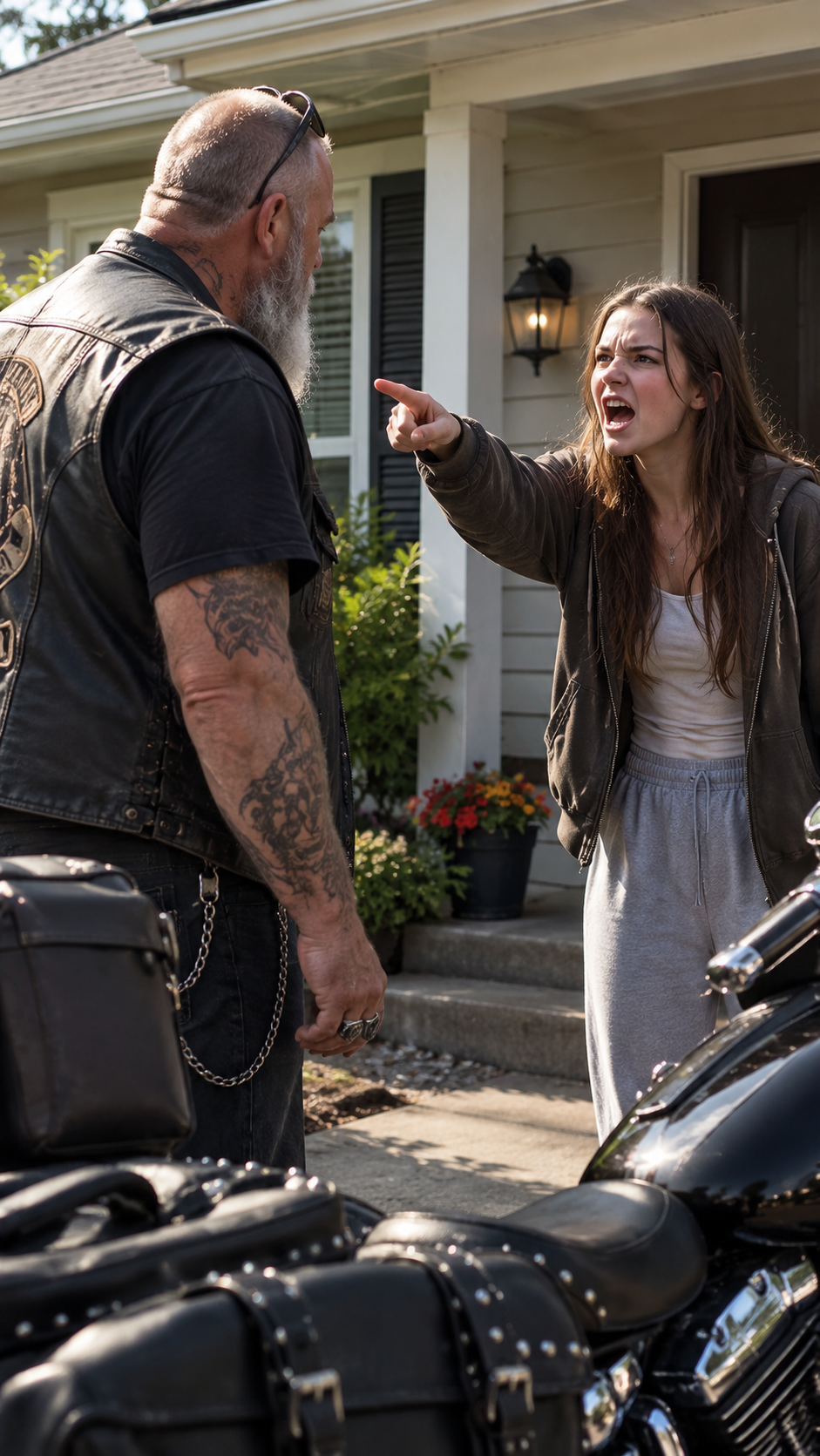
The last words my daughter ever said to me before she disappeared were, “I hate you and your dumb bike. Don’t call me your daughter again. And never visit me again.”
She was eighteen years old when she said it.
I was standing beside my motorcycle in the driveway, holding a helmet I had driven four hundred miles to give her. She was standing on the front porch with her arms crossed, furious, crying, and shaking so badly that I could see her hands trembling from where I stood. Behind her was a man I had never trusted from the first second I saw him, a man named Travis who had convinced my daughter that everyone who loved her was actually trying to control her.
I wanted to walk up those steps.
I wanted to grab my little girl, put her on the motorcycle, and take her home.
Instead, I stood there listening to her tell me she hated me.
And then she went inside.
The front door closed.
I waited for several minutes, thinking she would open it again.
She didn’t.
That was seven years ago.
Her name is Emma.
She’s twenty-five now.
For seven years, I told everyone who asked that my daughter had chosen her own life and that I respected her decision.
That was the lie.
The truth was that I never stopped looking for her.
My name is Daniel Mercer. I’m fifty-eight years old, I’ve been riding motorcycles since I was nineteen, and most people who meet me for the first time assume I’m the kind of man who doesn’t get emotional.
They’re wrong.
I cried the entire four hundred miles home that night.
I pulled over twice because I couldn’t see through the windshield.
The second time, I parked beside an empty gas station, took off my helmet, and sat on the curb with my hands shaking.
I kept hearing her voice.
“Don’t call me your daughter again.”
A father can survive a lot of things.
But hearing his own child tell him she doesn’t want him anymore is a different kind of pain.
And I knew Travis was behind it.
I just didn’t know how much.
I first met him six months before Emma left.
She had been dating him for less than a year, and everything changed after he came into her life.
Before Travis, Emma was stubborn, loud, funny, and independent. She played music too loudly in her bedroom, stole my motorcycle keys when she was sixteen even though she wasn’t allowed to ride, and used to sit in my garage while I worked on engines.
She called my motorcycle “the old beast.”
Whenever I came home from a ride, she’d run outside and ask, “Did you bring me anything?”
Sometimes it was a patch.
Sometimes it was a cheap roadside souvenir.
Once it was a ridiculous little stuffed bear wearing a cowboy hat.
She kept every single thing.
Then Travis appeared.
At first, I tried to like him.
I really did.
He was twenty-four, confident, charming, and knew exactly how to talk to people. He shook my hand the first time we met and called me “sir” every other sentence.
But there was something in his eyes I couldn’t explain.
He watched Emma constantly.
Not in the way a boyfriend looks at his girlfriend.
He watched her like he was checking whether she was doing what he expected.
If she laughed with someone else, he noticed.
If she talked to me for too long, he noticed.
If she went somewhere without him, he wanted to know where she had been.
I mentioned it to Emma.
She got angry.
“You don’t know him.”
“I know what I’m seeing.”
“You’re judging him because he doesn’t ride motorcycles.”
“No. I’m judging him because he doesn’t respect you.”
She slammed her bedroom door.
That was the first crack between us.
Over the next few months, the cracks became wider.
Travis convinced Emma that I was controlling.
Then he convinced her that her mother was controlling.
Then her friends were “fake.”
Then her coworkers were “using her.”
Then one by one, people disappeared from Emma’s life.
I watched it happening and didn’t know how to stop it.
Every time I tried to talk to her, Travis somehow became part of the conversation.
If I said, “I miss you,” Emma heard, “Your father is trying to control you.”
If I said, “I’m worried,” she heard, “Your father doesn’t trust you.”
If I asked where they were going, Travis told her I was spying on them.
And eventually Emma started believing him.
The final argument happened two weeks before she left.
I had found her crying in the kitchen at two in the morning.
She was holding an ice pack against her wrist.
“What happened?”
“Nothing.”
“Emma.”
“I said nothing.”
I looked at the bruising around her wrist.
“Did Travis do that?”
Her expression changed immediately.
She stood up.
“You need to stay out of my relationship.”
“I will when he stops hurting you.”
“He didn’t hurt me.”
“Then tell me how that happened.”
She stared at me for a long time.
Then she whispered, “You don’t understand anything.”
I wanted to argue.
Instead, I said, “You’re right. Maybe I don’t. But I know you’re afraid.”
Her eyes filled with tears.
For one second, I thought she was going to tell me everything.
Then Travis walked into the kitchen.
He looked at me.
Then at Emma.
Then at the ice pack.
And he smiled.
That smile told me more than words ever could.
Two weeks later, Emma left.
I didn’t see her again for seven years.
For the first year, I called her every day.
No answer.
I sent messages.
No response.
I drove to the apartment where I thought she lived.
She wasn’t there.
I contacted old friends.
Nobody knew where she was.
Eventually I received one message from her.
“I’m safe. Stop looking for me.”
It was sent from a number I didn’t recognize.
I knew immediately it wasn’t Emma.
But I had no proof.
So I stopped calling.
At least publicly.
Privately, I kept looking.
I hired a private investigator.
He found several addresses connected to Travis, but nothing that tied Emma to any of them.
Then one night, almost eleven months after she disappeared, the investigator called me.
“I found something.”
I drove to his office.
He placed a photograph on the table.
It showed Travis standing outside a small house in another state.
And beside him was Emma.
She looked thinner.
Much thinner.
But she was alive.
My hands started shaking.
“Where is this?”
He gave me the address.
“Can you get her back?”
He looked at me carefully.
“She’s an adult, Daniel. If she’s choosing to stay with him, there’s very little anyone can legally do.”
“She isn’t choosing this.”
“Then you need proof.”
That sentence changed everything.
I stopped trying to rescue Emma.
I started trying to prove what was happening to her.
For the next several years, I lived two lives.
To my friends, I was still a biker who worked at a motorcycle repair shop, rode with my club, and occasionally disappeared for long trips.
But whenever I could, I traveled to the town where Emma lived.
I rented cheap rooms.
I stayed in motels.
I parked my truck several blocks away.
I learned Travis’s schedule.
I learned where he worked.
I learned where Emma worked.
I learned which grocery store they used.
I learned which pharmacy they visited.
I learned the names of people Travis knew.
And I learned something that broke my heart.
Emma wasn’t living.
She was surviving.
She had stopped working full-time.
She had almost no friends.
She rarely left the house alone.
Her social media accounts had disappeared.
Her bank account was controlled by someone else.
And every photograph I found showed the same thing.
She was getting smaller.
Quieter.
Older.
One photograph was taken outside a grocery store.
Emma was twenty-one.
She looked forty.
I printed that photograph and kept it in my wallet.
I looked at it every time I wanted to give up.
I never approached her.
That was the hardest thing I have ever done.
There were nights when I parked across the street from their house and watched her through the window.
Once, I saw her sitting alone at the kitchen table at two in the morning.
She had her head in her hands.
I almost walked across the street.
I almost knocked.
But I knew if Travis saw me, he would move her again.
So I stayed in the truck.
And I cried.
The turning point came when I met a woman named Carla.
She worked at the diner where Travis ate almost every morning.
She had seen him for years.
One morning, she noticed me sitting alone in a booth.
“You’re not from here.”
“No.”
“You’re watching him.”
I didn’t answer.
She looked at me for a long time.
“That’s Emma’s father, isn’t it?”
My heart stopped.
“How do you know?”
“Because she talks about you.”
I nearly stood up.
“What did she say?”
Carla glanced toward the kitchen.
“She said you ride a motorcycle.”
“That’s it?”
“No.”
She lowered her voice.
“She said you used to call her every Sunday when she was little.”
I swallowed hard.
“She remembers?”
“She remembers everything.”
I couldn’t speak.
Then Carla said something that changed the entire investigation.
“She comes here sometimes when he’s out of town.”
“When?”
“Usually Tuesdays.”
“Why?”
Carla looked toward the door.
“She sits in the back booth for about twenty minutes. Doesn’t eat. Just sits there.”
“Has she ever said anything?”
“Once.”
“What?”
“She asked me if I thought people could disappear without anyone noticing.”
I felt cold.
“Did she say anything else?”
Carla nodded.
“She said, ‘My father would notice.’”
I closed my eyes.
For seven years, I had wondered whether Emma hated me.
Now I knew.
She didn’t.
She was trying to survive.
After that, I started working with Carla.
Not secretly following Emma.
Not confronting Travis.
We were gathering information.
Dates.
Times.
Witnesses.
Photographs.
Financial records.
Anything that could establish a pattern.
Then Carla called me one night.
Her voice was shaking.
“Daniel, something happened.”
“What?”
“Emma came in tonight.”
“Is she okay?”
“She was terrified.”
“Where is she?”
“She left ten minutes ago.”
“Why was she terrified?”
Carla took a breath.
“She asked me for help.”
I gripped the phone.
“What did she say?”
“She said she had been trying to leave.”
My heart started pounding.
“Where is she going?”
“I don’t know.”
Then Carla whispered, “But she left something here.”
“What?”
“A note.”
I drove through the night.
When I arrived, Carla handed me a folded piece of paper.
My hands were shaking so badly I almost dropped it.
Inside were four words.
“Dad, I remember everything.”
Underneath was a second sentence.
“I’m sorry.”
I sat down.
For the first time in seven years, I knew my daughter wanted to come home.
But I also knew something else.
If she was ready to leave Travis, he would know.
And men like Travis didn’t simply let people walk away.
Three days later, Emma disappeared again.
Not from the house.
From the entire town.
Her phone was off.
Her workplace said she hadn’t shown up.
Carla hadn’t heard from her.
I called my investigator.
Nothing.
Then at 1:17 in the morning, my phone rang.
I answered immediately.
Nobody spoke.
I heard breathing.
Then a whisper.
“Dad?”
I couldn’t breathe.
“Emma?”
“Don’t say my name.”
“Where are you?”
“I can’t tell you.”
“Are you hurt?”
Silence.
Then she whispered, “He’s getting worse.”
I stood up.
“What happened?”
“He knows I want to leave.”
My heart dropped.
“Emma, listen to me. Go somewhere public.”
“I can’t.”
“Why?”
“He has my ID. My money. My phone. Everything.”
“Go to a police station.”
“I tried once.”
“When?”
“Last year.”
I froze.
“What happened?”
“He came with me.”
“What do you mean?”
“He told them I was unstable.”
I clenched my fist.
“Emma, listen to me. I have evidence.”
“Dad…”
“I have witnesses. Financial records. Photos. Everything.”
“You’ve been watching?”
“I’ve been trying to prove what he’s doing.”
She started crying.
“Why didn’t you come get me?”
The question nearly broke me.
“Because I was afraid he’d move you somewhere I could never find you.”
“You should have.”
“I know.”
There was silence.
Then she said, “I thought you gave up.”
“Never.”
The line went dead.
I called back.
Nothing.
Then I heard a car door slam outside my motel.
I looked through the curtain.
A black SUV was parked across the street.
I couldn’t see the driver.
Then my phone buzzed.
A message.
“Stop looking for her.”
I stared at the screen.
I knew then that Travis knew about me.
The next morning, I left town.
But I didn’t go home.
I went to the police.
I brought everything.
Photographs.
Witness statements.
Bank records.
Messages.
Dates.
Video.
Carla came forward.
The investigator came forward.
A former coworker came forward.
And then something happened that I never expected.
Another woman contacted us.
Her name was Rachel.
She had dated Travis six years earlier.
She had left him.
Barely.
She told investigators that Travis had a pattern.
Isolation.
Financial control.
Threats.
Intimidation.
Then violence.
She had filed a police report years earlier, but it had gone nowhere because she withdrew it.
She had kept copies.
And one of those copies contained something we needed.
A recording.
Travis threatening her.
His voice was unmistakable.
“You leave me, and nobody will ever find you.”
The prosecutor listened to it twice.
Then she looked at me.
“We may have enough.”
But we still didn’t know where Emma was.
Two days later, Carla called.
“She’s back.”
“Where?”
“The diner.”
I drove there.
I parked across the street.
Emma walked out of the diner twenty minutes later.
She looked exhausted.
She looked terrified.
But she was alone.
I stepped out of the truck.
She saw me.
For a second, neither of us moved.
Then she ran.
I barely caught her before she threw herself into my arms.
She was twenty-five years old.
But in that moment, she was my little girl again.
She buried her face against my chest and sobbed.
“I thought you hated me.”
I held her tighter.
“I never hated you.”
“I said horrible things.”
“You were eighteen.”
“I told you never to come back.”
“I know.”
“Why didn’t you?”
“Because I thought you needed me to stay away.”
She pulled back.
“I needed you to keep trying.”
I closed my eyes.
“I know that now.”
Then she whispered something that made my blood run cold.
“Dad, he’s coming.”
I looked behind her.
A black SUV had just turned onto the street.
Travis.
He saw us.
He slammed on the brakes.
Emma grabbed my arm.
“Don’t let him take me.”
I stepped in front of her.
For seven years, I had imagined confronting that man.
But when the moment finally came, I didn’t feel angry.
I felt calm.
Because for the first time, I knew I wasn’t standing there with nothing.
Police cars turned onto the street.
Two cruisers.
Then another.
Travis jumped out of his SUV.
“What the hell are you doing with my girlfriend?”
Emma stepped behind me.
“She isn’t your girlfriend anymore.”
Travis laughed.
“You’re kidnapping her.”
The lead officer walked forward.
“Mr. Hale, step away from the vehicle.”
“This is my girlfriend.”
“She is an adult,” the officer said. “She is free to leave with anyone she chooses.”
Travis looked at Emma.
“You’re coming home.”
Emma shook her head.
“No.”
His face changed.
“You don’t mean that.”
“I do.”
“You’re confused.”
“No.”
Her voice was trembling, but she kept talking.
“I’ve been confused for seven years.”
Travis took a step toward her.
The officer immediately stepped between them.
“Stay where you are.”
Travis looked at me.
“This is your fault.”
I didn’t answer.
He smiled.
“You ruined her.”
Emma spoke from behind me.
“No.”
Everyone turned.
Emma stepped forward.
“He did.”
She pointed at Travis.
“He ruined me.”
Travis stared at her.
“You’re lying.”
“No.”
“You’re crazy.”
“No.”
She reached into her bag.
Her hands were shaking.
She pulled out a small recorder.
“I recorded everything.”
Travis’s face went white.
The police took it.
Then they took the phone.
Then they took the evidence we had collected.
The prosecutor later told us the recordings showed months of threats, financial coercion, and repeated intimidation.
Travis was arrested that afternoon.
But the story didn’t end there.
Because Emma had spent seven years believing she was broken.
She wasn’t.
She had been manipulated.
She had been isolated.
She had been frightened.
And now she had to learn how to live again.
The first night she stayed at my house, she couldn’t sleep.
I found her sitting on the back porch at 3:30 in the morning.
She was wearing one of my old sweatshirts.
The motorcycle was parked nearby.
She looked at it.
“Do you still have the old beast?”
I smiled.
“Of course.”
She laughed for the first time in years.
Then she started crying.
“Dad?”
“Yeah?”
“Can I sit on it?”
I looked at her.
“You’re not riding it.”
She smiled through her tears.
“I didn’t ask to ride.”
I walked over and helped her sit on the seat.
She ran her hand over the handlebars.
“I used to think this was the most annoying thing in the world.”
“You did.”
“You woke me up every Saturday.”
“You loved it.”
“I hated it.”
“You stole my keys.”
“I was sixteen.”
“You almost crashed it.”
“I didn’t almost crash it.”
“You drove it into a trash can.”
She laughed.
And I realized I hadn’t heard that laugh in seven years.
That night, she slept in her old bedroom.
The next morning, she came downstairs and stood in the kitchen.
“I don’t know what happens now.”
I poured her coffee.
“Neither do I.”
“Are you disappointed in me?”
I looked at my daughter.
“No.”
“Even after everything?”
“Especially after everything.”
She started crying.
I walked around the table and hugged her.
“You came home. That’s enough.”
Months passed.
Emma started therapy.
She got a new job.
She opened her own bank account.
She bought a cheap car.
She learned how to make decisions without asking whether someone would be angry.
The first time she went grocery shopping alone, she called me afterward.
“Dad?”
“Yeah?”
“I bought whatever cereal I wanted.”
I laughed.
“Congratulations.”
“I stood there for twenty minutes because nobody was telling me what I was allowed to buy.”
My heart broke.
But she was healing.
Slowly.
One day, about eight months after she came home, she found the old photograph I had kept in my wallet for years.
The one of her outside the grocery store.
She looked at it.
Then looked at me.
“You kept this?”
“For seven years.”
She sat down.
“I look so tired.”
“You were.”
“I didn’t even recognize myself.”
“I did.”
She looked at me.
“How?”
“Because you were still my daughter.”
She cried.
So did I.
A year after she came home, Emma asked me to take her somewhere.
We rode together.
She was on a second motorcycle now, one she had bought herself after taking lessons.
She wasn’t afraid anymore.
We stopped at a lookout overlooking the valley.
She removed her helmet.
“You know what I realized?”
“What?”
“I spent seven years thinking you were trying to control my life.”
I didn’t say anything.
She looked at me.
“But you weren’t.”
“No.”
“You were trying to keep me alive.”
I looked away.
She continued.
“And when you couldn’t save me by force, you stayed close enough to find a way to save me without making things worse.”
I swallowed hard.
“I wish I’d found you sooner.”
“You found me when I was ready.”
She smiled.
Then she hugged me.
“I love you, Dad.”
I held her tightly.
“I love you too.”
Seven years earlier, she had stood on a porch and told me never to call her my daughter again.
Seven years later, she was sitting beside me on a motorcycle, laughing at the same stupid roadside jokes she used to laugh at when she was sixteen.
People sometimes ask me why I didn’t just force my way into her life when I found her.
They don’t understand.
When someone you love is trapped, you can’t always break down the door.
Sometimes you have to wait.
Sometimes you have to gather proof.
Sometimes you have to stand in the shadows and watch the person you love suffer because one wrong move could make their situation worse.
And sometimes you have to spend seven years wondering whether your child hates you.
I learned something during those seven years that I will never forget.
Love isn’t always loud.
Sometimes love is four hundred miles on a motorcycle.
Sometimes love is sitting in a truck across the street because walking inside would put your daughter in greater danger.
Sometimes love is collecting every photograph, every message, every witness statement, every piece of evidence until somebody finally believes you.
Sometimes love is knowing when to stay away.
And sometimes, after seven years of waiting, love is standing in front of the person who hurt your child and saying nothing at all because the police are already behind you.
But the hardest thing I ever learned was this:
My daughter didn’t need me to rescue her.
She needed me to never stop believing she could rescue herself.
Emma is twenty-five now.
She still has nightmares sometimes.
She still gets nervous when someone raises their voice.
She still has moments when she doubts her own decisions.
But she makes them anyway.
She lives in her own apartment.
She has her own bank account.
She has friends again.
She laughs loudly.
She takes long motorcycle rides on Sunday mornings.
And every few weeks, she comes over to my garage while I’m working on the old beast.
She sits on the stool beside me and asks questions.
Sometimes we don’t talk at all.
We just listen to the engine.
Last month, she handed me a small envelope.
Inside was a photograph.
It was a picture of us standing beside our motorcycles.
On the back, she had written something.
“I told you never to call me your daughter again.”
Underneath that, she had written:
“I was wrong.”
Then another line.
“You were my father even when I forgot how to be your daughter.”
I had to walk away for a minute because I couldn’t let her see me cry.
When I came back, she was smiling.
“Dad?”
“Yeah?”
“Can I have your old biker jacket?”
I looked at her.
“Absolutely not.”
She laughed.
“See? Still controlling.”
I laughed too.
And for the first time in seven years, I didn’t hear anger in her voice.
I heard my little girl.
The girl who used to steal my keys.
The girl who called my motorcycle the old beast.
The girl who once told me I was the worst father in the world.
The girl I never stopped loving.
Seven years ago, I watched my daughter walk through a door with a man who was slowly taking her life apart.
I thought I had lost her.
But I hadn’t.
She was still there.
She was just buried underneath fear, manipulation, shame, and seven years of being told that nobody would ever come for her.
I did.
And I would do it all again.
Because a father doesn’t stop being a father when his child stops calling.
He doesn’t stop loving her when she pushes him away.
And he doesn’t stop looking for her just because the world tells him to let go.
Sometimes the person you love most has to disappear before they can find their way home.
And sometimes, when they finally do, you realize they weren’t the only one who needed saving.
I needed my daughter too.
And after seven years, I finally got her back.