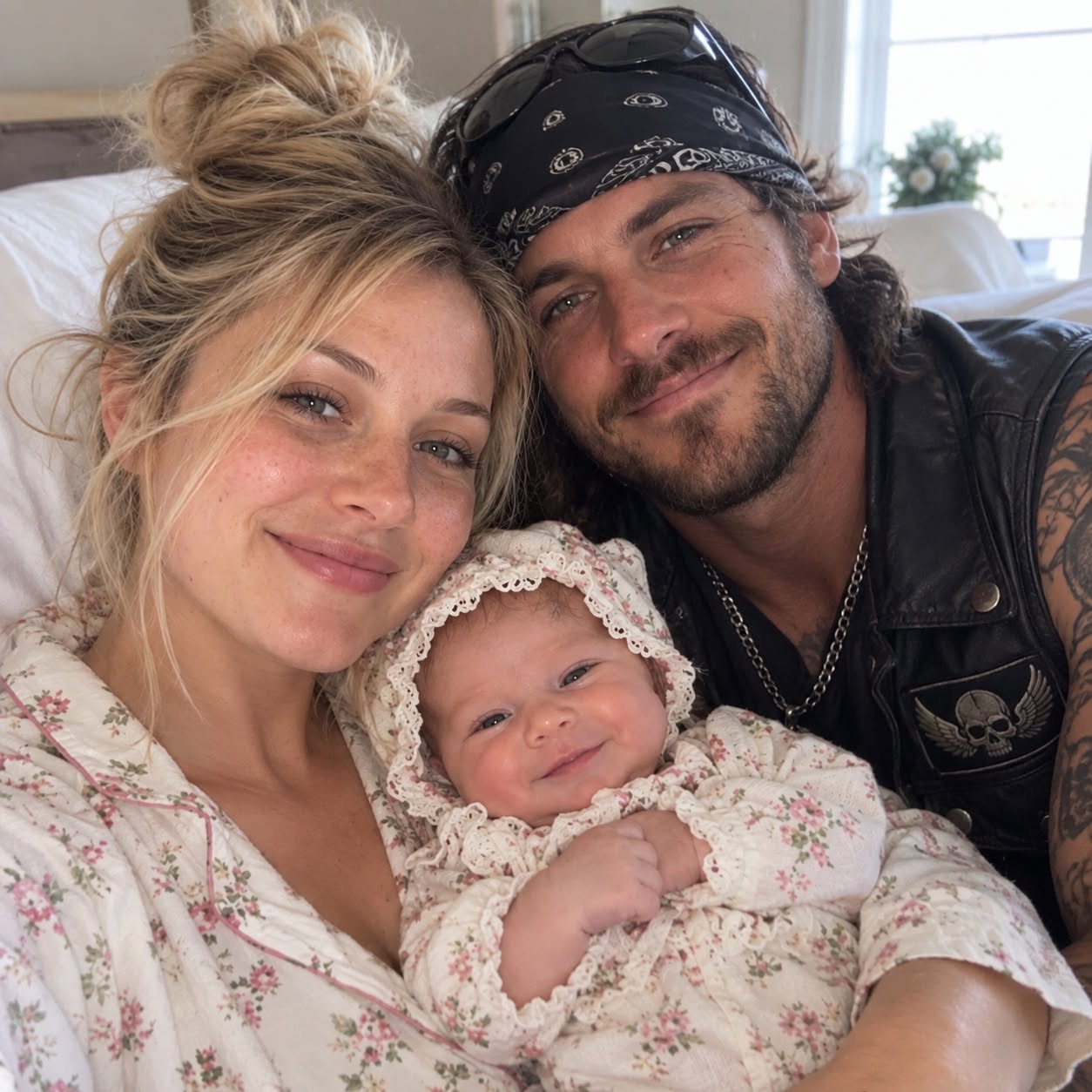
My husband forgot to hang up, thinking the call had ended. When I heard what he truly thought of me, I decided to plan a surprise he would never forget..
Deacon and I had been married two years when I went on leave with our newborn, Ivy. He never helped. He lived at the clubhouse and called it work. One afternoon I called to ask if he would be home for dinner, he left the line open, and I heard him tell another woman he hated me. I hosted both families for our anniversary, played the tape with the roast still on the table, and threw an outlaw out of a house he never owned.
My name is Lena Hart. I used to sign it Lena Rourke. I do not anymore.
Deacon “Deke” Rourke patched into the Iron Petal MC before I ever met him. He had grease in the lines of his hands and a laugh that made a bar feel like a porch. He told me the club was family with bylaws. He told me the custom shop on the county road was legitimate steel and paint. He told me late nights were runs and rebuilds, not other women’s apartments.
I believed him because I wanted a life that was not only spreadsheets.
Before Ivy, I was a senior financial analyst. I knew how to follow a dollar until it confessed. Maternity leave made me look, to him, like a woman who had misplaced that part of herself under burp cloths and a breast pump. He mistook quiet for empty.
He missed bottles. He missed the 2 a.m. stretch when Ivy would not latch and I walked the hallway until the floorboards knew my weight. He came home smelling like smoke, gasoline, and a perfume that did not live in our bathroom.
His mother, Rhea, called it devotion. “He’s providing, Lena. Men like Deke provide with their backs.”
My parents were kinder and more worried. They did not say biker like a slur. They said absent like a diagnosis.
One Thursday I called at four-thirty. Ivy was a warm bundle against my chest. The house was too big for one adult and one infant.
“Will you be home for dinner?”
“Probably not,” he snapped. “Stop checking up on me. I’m working.”
I swallowed it.
“Okay. Love you.”
He did not answer.
I set the phone beside the bottle warmer and saw the timer still running. I reached to end it and heard a woman laugh. Not a television. A mouth close to the mic.
Then Deke.
“She’s driving me insane. Pictures of the baby. When am I coming home. I want her to leave me alone.”
The woman murmured. I could not catch the words. I caught the tone. Soft. Sure. Used to being chosen.
Deke laughed.
“Of course I hate her. I barely touch her. Wait it out. I’ll divorce her and marry you.”
A kiss. Wet. Close.
I ended the call with a thumb that did not feel like mine.
That night he came in with grocery-store flowers and kissed my hairline.
“Missed my girls.”
I smiled the way you smile at a man who has already left.
“We missed you too.”
For six days I said nothing. I watched him take the phone into the shower. I watched him change the passcode. I watched him spray cologne before every “run.” I hired a private investigator with money from an account he never opened because he never asked how my premarital trust was structured. I pulled six months of itemized bills. I photographed the cologne bottle and the timestamps. I had the locks rekeyed on a quiet afternoon while Rhea thought I was at a pediatric visit.
I had planned a small anniversary. Three of us. A chicken. A candle. The kind of evening that pretends a marriage is tired instead of over.
I changed the guest list.
Sunday I cooked a normal American dinner like a person who still believed in table manners: roast chicken, mashed potatoes, green beans, pumpkin pie. I invited both families. Twelve chairs. Ivy asleep in the bassinet in the alcove, monitor on the sideboard.
When the plates were cleared I stood with water, not wine.
“I want to give a toast.”
Deke stiffened in his cut. He had worn it to my table as if leather were a blessing.
“Deke,” I said, “you have spent six months telling everyone how hard you work for this family. You tell your mother you are exhausted. You tell my parents you are a provider.”
He forced a laugh. “Lena. Not in front of everybody.”
“I insist.”
I set a small speaker beside my glass and pressed play.
His voice filled the dining room, clearer than he had ever been with me.
She’s driving me insane. Texting pictures of the baby, asking when I’ll be home. I just want her to leave me alone.
Rhea’s smile died. My father put his napkin down like a tool.
Of course I hate her. I barely touch her anymore. Just wait. I’ll divorce her, and then I’ll marry you.
Then the kiss. Then Tessa’s giggle. Tessa worked the tap at the clubhouse. Twenty-four. A smile that had never had to buy formula.
Deke came up so fast his chair hit the hardwood.
“Lena, shut it off. What the hell is wrong with you?”
My father stood. “Deke. What was that?”
“Setup,” Deke said. His eyes went around the room like exits. “AI. She’s unhinged. Postpartum. She’s been off since the baby.”
I did not raise my voice. I opened the portfolio on the sideboard.
“This is not a generator.” I set the first folder in front of Rhea. “Itemized line for six months. Four thousand late-night texts to Tessa’s personal number. Not the shop dispatch. Not the club roll. Her.”
Second folder to my father. “Investigator log. Afternoons at the motor lodge off 35. Weekends when he told you he was on a charity run for a kid’s hospital. Paid from the joint emergency account I funded after Ivy was born.”
Third folder on his pie plate.
“Petition for divorce. Emergency freeze on marital assets. Filed yesterday at four.”
Rhea looked at a photo of her son’s bike in a lodge lot and Tessa’s arm around his waist. She covered her mouth. For two years she had coached me on being a supportive old lady. Support, in her dialect, had meant silence.
“You cooked a whole dinner for this?” Deke rasped.
“I cooked a dinner so that when I put you out, your people would be here to carry what I will not.”
My father stepped between us. He is not a large man. He did not need to be.
“Get out.”
“Dad—”
“Do not call me that. Five minutes. Clothes. Then the street.”
Deke looked at Rhea.
“Mom. She’s overreacting. I made a mistake. We can fix it.”
Rhea stood slowly. I had never seen her look at him as if the patch were a stain.
“You used your daughter’s birth as cover,” she said. “You disgraced this table. Pack.”
He had no allies left who would lie well enough. He went upstairs. Ten minutes later two duffels bumped the banister. He stopped at the door, waiting for my face to crack.
It did not.
“You’ll regret this,” he said. “No income. Maternity leave. You cannot keep this house without me. The club won’t let a woman embarrass a brother like this.”
“Check the folder,” I said. Ivy was a sleeping weight on my shoulder. “The deed was purchased with my trust. Your name was never on the title. The club does not hold a lien. As of four o’clock the locks are new. Your key is jewelry.”
He had forgotten the woman who used to brief risk committees. He had filed her under wife.
He slammed the door. The cut swung. The night took him.
The club tried, in its way.
Monday a vice president I knew only as Cal called from a number that did not ID. He spoke softly, the tone men use when they want a problem to fold without a meeting.
“This is internal, Lena. Deke’s a brother. You air a recording at a Sunday table, it makes the whole table look sloppy. Come to the shop. We’ll mediate. Tessa’s gone if that’s what you need.”
“Cal,” I said, “if you come to this house without an invitation I will call the sheriff and I will send the same folders to every vendor who still pretends your books are clean. This is not a club vote. This is a marriage I am ending.”
He was quiet long enough to count.
“You’re making this ugly.”
“He made it audible,” I said, and hung up.
I did not go to war with an entire motorcycle club. I went to war with a man and the paper he had been sloppy enough to generate. That distinction mattered. I like my daughter alive. I like my doors locked. I like a sheriff’s non-emergency number in my notes app.
The investigator had not stopped at motels.
Deke ran a custom shop that painted tanks and built bikes for men who paid in stacks. He also ran club errands he called logistics. The shop had a bookkeeper who liked me because I once fixed her payroll withholding in twenty minutes on a paper napkin. She did not betray the club. She betrayed a man who had been coding lodge rooms as “client fabrication” and dinners as “parts.”
Tuesday my attorney walked a dossier to the shop’s outside accountant and, separately, to the county prosecutor’s economic crimes intake, because misuse of a business account is not romantic. I did not send anyone to smash a visor. I sent numbers.
By Wednesday the shop padlocked the office computer Deke used. By Thursday the club had a problem that was no longer only my marriage: a brother who had been skimming the till for a girlfriend while telling the table he was holy about the patch.
I do not know every vote they took. I know Tessa quit the tap before anyone could fire her. I know Deke’s bike spent three nights in Rhea’s carport because the shop suddenly had no bay for him. I know men who had clapped his back at our wedding did not clap when the word snitch drifted near my name, because I had not spoken to cops about the club. I had spoken to an accountant about a husband.
People love a story where the outlaw army rides to the wife’s lawn. That is cinema. What happened was smaller and meaner and more useful. His reputation inside the only job he respected took a crack he could not weld.
The divorce did not take a year. Misconduct, dissipation of assets, a baby, a house already mine. The court gave me sole physical custody. Supervised visits when he could keep a civil tone for ninety minutes. Child support calculated on the income he used to brag about, not the income he was reduced to. He was ordered to put back twenty-five thousand he had lifted from the emergency account.
He moved into Rhea’s spare room. Tessa lasted nineteen days after the money stopped looking like a black card. Rhea called me once, late, voice thin.
“I raised him better.”
“You raised him to be served,” I said, not unkind. “That is not the same as better.”
She did not argue. She asked if she could see Ivy on Sundays at my mother’s, public, no cut, no Tessa. I said yes with conditions in writing. Grandmothers are not the crime.
Six months later the house smelled like lemon oil, jasmine, and baby powder instead of cologne and burnt clutch. Ivy rolled a wooden ball on the rug and laughed at the sound it made against the baseboard. Spring came through the bay window as if it had been waiting for permission.
My mother arrived with muffins and a stuffed fox.
“How are my girls?”
“Fed. Slept. Employed again next month.”
I had accepted a director role in portfolio risk. The firm wanted me back. I wanted a salary that did not depend on a man’s run schedule.
“Has he called?”
“His lawyer asked if I would speak to him directly.”
“And?”
“I don’t speak to strangers.”
We drank coffee in the kitchen where I had once stood with a live call in my hand and a life coming apart on speaker. Ivy gummed apple slices. The cherry tree in the yard had the nerve to bloom.
After they left I stood on the patio with iced tea and a book I did not open. The sky was an idiot blue. For two years I had made myself smaller so a man in a vest could feel large. I had called neglect the life. I had called contempt stress. I had called a kiss on an open line a mistake I should have prevented by being easier.
I had been wrong in a way that still embarrassed me, which I suppose means I am not finished becoming someone I respect.
True strength was not enduring a patch and a perfume. It was building a file while the baby napped. It was cooking chicken for people who needed to hear the truth in a room with pie. It was changing locks before I gave a toast. It was telling a vice president that my daughter’s house was not a chapel for his bylaws.
Deke thought a woman on maternity leave could not audit a snake.
He also thought hanging up was optional.
The call he forgot to end was the last honest thing he gave me. I used it. I kept the house. I kept the baby. I kept the part of myself that knows how money moves when men think you are only listening for a bedtime song.
I still startle when a motorcycle comes down our street. Then I look at the crib monitor, at the new deadbolt, at the folder in the safe, and I go back to whatever I was doing.
He is not a myth. He is a man who said he hated me while I was trying to feed his child, and who learned that a quiet wife can still press play.
That is the whole ride. No sunset. No second chance on the shoulder of the highway. Just a paid-off term of my own life, a girl named Ivy who will never have to hear that tape, and a table that finally belongs to the people who eat at it.