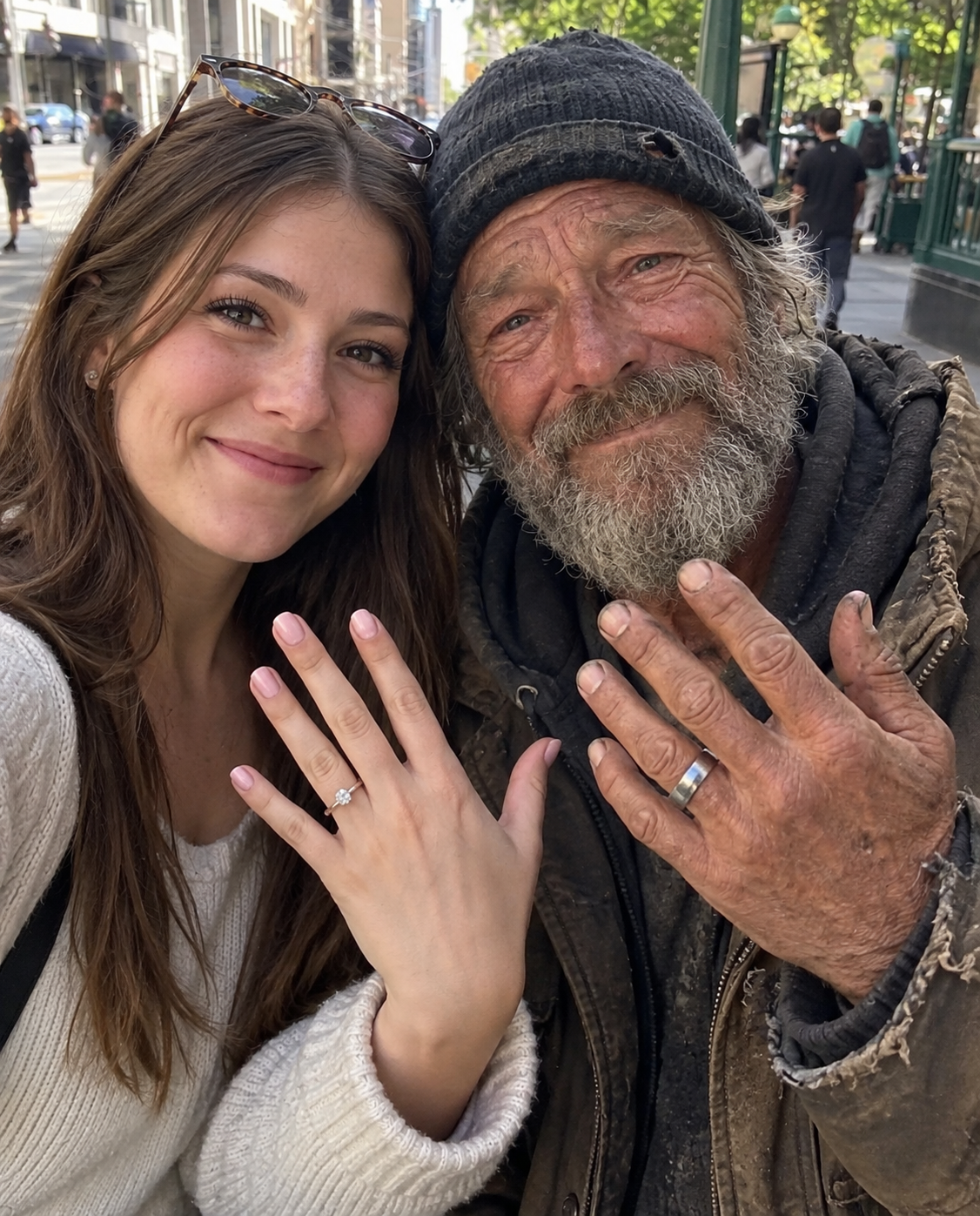
The first time I noticed Larry, it was because he didn’t ask for anything.
Most of the people who lived near the subway entrance had a pitch. A cardboard sign. A paper cup. A story delivered at the same volume as a sales call. Larry sat on a folded blanket with his back against the tiled wall and watched the morning the way other people watch television. Quiet. Still. As if the city were a play he had already seen and no longer needed to interrupt.
I started buying two coffees because the alternative felt worse. One with cream for me. One black for him. I told myself it was habit. Then it became ritual. Then it became the only part of the morning that didn’t feel like I was being swallowed by fluorescent lights and quarterly reports.
We talked about nothing that mattered and everything that did. Weather. The way commuters walked as if late for their own funerals. Pigeons with the confidence of landlords. My shoes, which he claimed were designed by someone who hated feet. I learned that he liked his coffee almost scalding. I learned that he remembered the names of the station attendants. I learned that he never asked where I lived, who I dated, or what I did after six o’clock. That restraint felt like courtesy. Later I would understand it as strategy.
For nearly two years that was our entire world: seven minutes on a strip of cold concrete, two paper cups, and a man who seemed determined to take up as little space as possible.
Then came the Tuesday that smelled like iron and snow.
I turned the corner expecting the usual silhouette. Larry was there. The blanket was there. The coffee would have been there in another thirty seconds. What was new was the rectangle of cardboard across his knees, letters so black they looked wet.
MARRY ME. I ONLY HAVE ONE MONTH LEFT TO LIVE.
I stopped so abruptly a man behind me swore and stepped around my shoulder. Larry did not look up until my shadow crossed the sign.
“Larry,” I said. “What is this?”
He accepted the black coffee with both hands. They shook. Not the theatrical shake of someone performing need. The fine, continuous tremor of a body that had begun to disagree with itself.
“Clinic says a month,” he said. “Maybe less if the weather stays like this.”
“What happened?”
“Liver.” He said the word as if it belonged to someone else. “They used nicer language. It comes to the same thing.”
I crouched. The cardboard was stiff with cold. Up close the letters were not hurried. They had been drawn with a ruler or a very steady hand. That detail lodged somewhere behind my ribs and stayed there.
“Why marriage?” I asked.
He looked at the steam rising from the cup instead of at me.
“I don’t want to die as a file number, Sarah. I don’t want the city deciding what happens to what’s left. I want one name tied to mine. One person who can say I wasn’t just weather.”
He said my name the way people say a password they have been saving.
I was thirty-four, unmarried, and tired of being the person who walked past other people’s emergencies with a plausible excuse. Larry was dying in public. The sign was ridiculous. The request was worse. And still I heard myself say, “I’ll do it.”
He flinched as if I had struck him.
Two days later we stood in a courthouse room the color of old receipts. No rings. No witnesses except a clerk who kept glancing at Larry’s coat as though it might contain a warrant. We signed. We repeated words that sounded larger than the room. Eleven minutes after we entered, I was legally married to a man whose last name I had only just learned how to spell.
I told myself it was paperwork with a pulse. A kindness with a termination date. I told myself a lot of things that week.
The decline was faster than the clinic’s polite estimate. By the end of the first week he was in a state hospice that smelled of bleach and canned peaches. I visited after work. Sometimes he was sharp enough to tease me about the shoes. Sometimes he slept through my entire stay with his fingers hooked around mine as if he were afraid the bed would leave without him.
Small things began to itch.
A nurse once called him “Mr. Hale” and then corrected herself so quickly the correction felt rehearsed. Larry’s intake bracelet listed a date of birth that would have made him fifty-eight. He had always looked older than that, or younger, depending on the light. He asked me, twice, whether anyone from my office had mentioned him. When I said no, he smiled with only half his mouth.
“Good,” he whispered. “Keep it that way.”
I asked what he meant. He pretended to fall asleep.
On the last night the hallway fluorescent lights hummed like insects. Larry’s breathing had gone shallow and uneven. I sat in the vinyl chair and counted the seconds between each rise of his chest. Near midnight his eyes opened. They were clearer than they had been in days.
“Thank you, Sarah.”
“You don’t have to thank me.”
“Yes,” he said. “I do. You’ll understand why.”
He died at 1:17 a.m. The nurse wrote the time in a chart and offered me a plastic bag containing a watch that didn’t work, a folded blanket, and a bus pass with three days left on it. I took the bag because refusing it felt like refusing him.
The funeral was six people and a minister who mispronounced Hale. I stood at the back and told myself the story was finished. A strange kindness. A brief legal fiction. An ending.
Yesterday the letter arrived.
It was thick enough to have a spine. My name on the front in the same careful lettering as the cardboard sign. The postmark was the day before he died. I carried it upstairs like something that might explode if jostled.
I sat at the kitchen table. The apartment was too quiet. I opened the envelope with a kitchen knife because my hands were not trustworthy.
The first page began without greeting.
Sarah,
If you are reading this, the month is over and the performance is finished. I owe you the part I could not say while I still needed you to say yes.
I am not who I told you I was. The liver failure is real. The homelessness was not an accident. The marriage was not a plea for dignity. I chose you two years ago, the first morning you bought the second coffee without being asked. I chose you because you were the only person in that station who looked at me as if I were still a person, and because you work on the seventeenth floor of Meridian Holdings.
I stopped.
Meridian was my building. My employer. The place I had been going every morning after I left Larry with his black coffee.
I read the sentence again. Then I kept going, because stopping would have been a different kind of cowardice.
Fifteen years ago my name was Lawrence Hale. I was chief compliance officer at Meridian. I found the discrepancy in the South Dock ledgers—the same ledgers your department still pretends are clean. Hazardous runoff. Falsified manifests. Three contractors paid to disappear. When I took it upstairs, they offered me a promotion and a silence bonus. When I refused, they offered my family a different kind of silence.
My wife and daughter died in a single-vehicle accident on a dry road with a new brake line. The police report was twelve pages of weather. I was told to be grateful I still had a job. I left the job. I left the name. I lived where they would not think to look for a man who used to sign off on seven-figure risk assessments.
I did not sit outside your station by chance. I sat there because you walk through the same doors the men who killed my family still use. I needed to know if you were one of them or if you were the crack in the wall. For two years I listened to you complain about printers and watch you give your change to people who would never remember your face. I decided you were the crack.
The sign was a door. Marriage was the lock. As my legal spouse you are next of kin. That status does two things they cannot easily undo. First, it transfers to you a safe-deposit box at First Harbor under the name L. Hale, box 4417. The key is taped to the back of this page. Inside are the original ledgers, the brake-line invoice, and a recording I made in 2011. Second, it makes you inconvenient to erase. Widows attract questions. Random homeless men do not.
They have been watching the hospice. A man in a gray coat stood across the street on four of your visits. If he is not already outside your building, he will be. Do not take this letter to the police in your precinct. Meridian owns more badges than you think. Take the box. Make copies. Send one set to the journalist whose card I clipped to page four. Then decide whether you want to keep the name I gave you or burn it.
I am sorry I used your kindness as a tool. I am not sorry I used it. You were the only door that opened.
Larry
The key was there, flat and cold, taped beneath his signature.
I sat until the light in the kitchen changed color. Then I stood and went to the window.
Across the street, under the dead awning of the shuttered florist, a man in a gray coat was reading a newspaper that had not been printed that morning. He turned a page he had already turned. He did not look up. He did not need to. He already knew which apartment was mine.
I locked the deadbolt. I pulled the chain. I put the letter and the key in the empty coffee canister I never used. Then I sat on the floor with my back against the door and listened to the building make the small sounds buildings make when they are trying to convince you that nothing has changed.
Everything had changed.
The man I married to keep him from dying as nobody had spent two years turning me into the only somebody who could finish what he started. The cardboard sign had not been a plea. It had been a summons. And the month he claimed was all he had left had never been about his body.
It had been about how long he thought I would have before the gray coat stopped pretending to read.