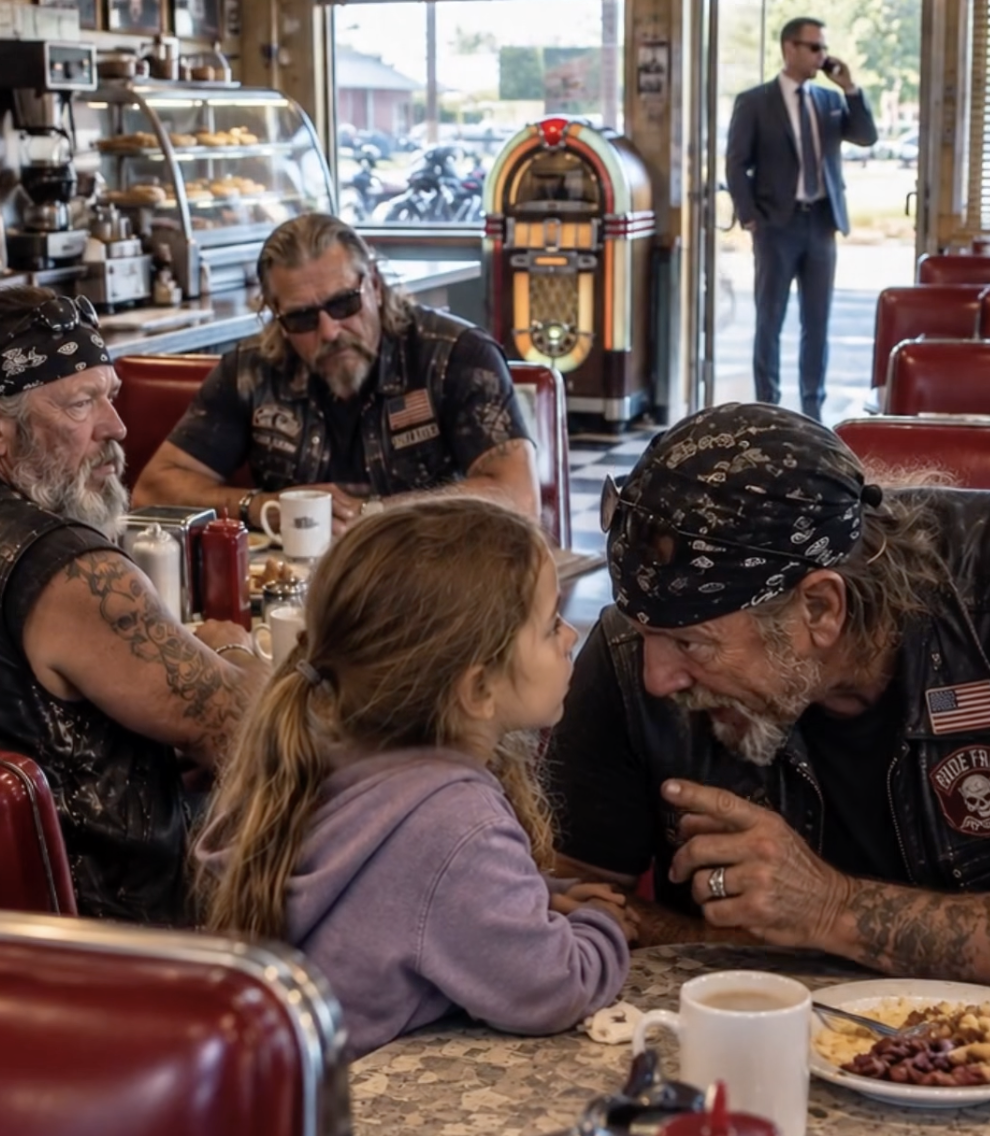
The little girl didn’t walk into the diner like a child looking for breakfast.
She walked in like someone trying to disappear.
It was 10:17 on a cold Tuesday morning when the front door of Daisy’s Diner opened and a seven-year-old girl stepped inside.
Nobody noticed her at first.
That was the strange part.
The diner sat just off Route 81 in western Oklahoma, a weather-beaten place where truckers stopped for coffee, ranchers came in after morning chores, and motorcycle riders knew they could get a hot meal without anyone asking too many questions.
The coffee was strong.
The pie was homemade.
The booths were cracked.
And the old jukebox in the corner had been playing the same three songs for so long that nobody bothered changing it anymore.
Our six motorcycles were parked outside beneath the faded red awning.
We were the Iron Hollow Riders.
Six men.
Six motorcycles.
Six leather vests that made strangers decide who we were before we ever opened our mouths.
We had spent the weekend riding through the Oklahoma backroads after attending the funeral of an old friend.
It wasn’t a cheerful morning.
Most of us were tired.
I was halfway through a plate of eggs when I noticed the little girl standing beside the pie case.
She couldn’t have been more than eight.
Maybe seven.
Thin.
Too thin.
Her sneakers were covered in dried mud.
One shoelace was missing.
Her oversized pink sweatshirt had a tear near the sleeve.
Her hair looked as though someone had cut it themselves with a pair of kitchen scissors.
But none of that was what bothered me.
It was her face.
She wasn’t crying.
She wasn’t asking anyone for help.
She was simply standing there, looking around the room as if she was trying to decide which stranger looked least dangerous.
Then her eyes landed on our table.
Six bikers.
Black leather.
Beards.
Tattoos.
Old scars.
The kind of men parents usually tell their children not to approach.
She stared at us for several seconds.
Then she walked directly toward me.
The entire diner seemed to notice.
She stopped beside my booth.
Her fingers curled around the cracked vinyl seat.
Her voice was so quiet that I almost didn’t hear it.
“Can I sit here for one minute?”
I looked at the empty seat across from me.
“Sure.”
She didn’t move.
I softened my voice.
“You can sit here as long as you need.”
Only then did she climb into the booth.
Carefully.
Slowly.
Like she expected someone to suddenly tell her she wasn’t allowed.
I slid my coffee farther away.
“You hungry?”
She shook her head.
I knew that answer.
Every hungry person says they’re not hungry when they don’t want to be a burden.
I pushed my plate toward her.
She stared at it.
“No, thank you.”
“That’s okay.”
I pulled the plate back.
Then I noticed her hands.
They were trembling.
Not from cold.
From fear.
Across from me, Rhett Mercer stopped eating.
Rhett was the oldest rider in our group, sixty-three years old, with a silver beard, a scar above his eyebrow, and the kind of quiet presence that could make a loud room settle without him saying a word.
He looked toward the front door.
Then toward the girl.
Then back toward me.
Something was wrong.
Very wrong.
I leaned forward.
“What’s your name?”
She swallowed.
“Mara.”
“Mara what?”
She hesitated.
“Mara.”
Just Mara.
Before I could ask anything else, the bell above the front door rang.
A man walked in.
And Mara immediately disappeared beneath the table.
Not metaphorically.
She dropped.
One second she was sitting beside me.
The next she was curled beneath the booth with both hands covering her mouth.
I stood.
The man had stopped just inside the door.
Late thirties.
Gray jacket.
Dark jeans.
Clean boots.
Sweat shining along his forehead despite the cold.
He looked around the diner.
Not like a father searching for his daughter.
Like a hunter searching for something that belonged to him.
Then his eyes landed on our booth.
His shoulders relaxed.
He smiled.
It was the kind of smile that never reached his eyes.
“There you are.”
Nobody answered.
He took a step closer.
“Come on, sweetheart. We need to go.”
Mara’s fingers grabbed my boot beneath the table.
I looked at the man.
Then at the child.
Then back at him.
“She doesn’t seem interested in going anywhere.”
His smile remained.
But only technically.
“She gets nervous around strangers.”
Rhett slowly put down his fork.
The man noticed him.
Then the other four riders.
His eyes moved across our table.
Six men.
Six leather vests.
He suddenly looked less confident.
“She belongs with me,” he said.
I crouched beside the booth.
“Mara?”
She wouldn’t look at me.
I lowered my voice.
“Is this man your father?”
Her head moved slowly from side to side.
“No.”
The word was barely audible.
But everyone heard it.
The diner went silent.
The cook stopped moving.
The waitress froze beside the coffee machine.
Two ranchers at the counter turned completely around.
The man in the gray jacket laughed.
“She’s confused.”
Mara’s grip tightened around my boot.
I looked up.
“She said no.”
The man’s expression changed.
“She doesn’t understand what she’s saying.”
Rhett stood.
He didn’t threaten him.
Didn’t yell.
Didn’t touch him.
He simply stood there.
The man’s eyes traveled upward.
Rhett was a big man.
Six-foot-three.
Broad shoulders.
Gray beard.
Leather vest.
Old military tattoo on one forearm.
Rhett spoke quietly.
“Then maybe you should explain who you are.”
The man looked toward the door.
Then the windows.
Then the hallway.
He was counting exits.
That was when I knew.
This wasn’t a misunderstanding.
I crouched lower.
“Mara.”
Her eyes finally met mine.
“Are you safe with him?”
She shook her head.
I felt something cold move through my chest.
Then she whispered:
“He took me from a motel.”
Everything stopped.
The man’s face changed instantly.
Not anger.
Fear.
Real fear.
He lunged.
He reached toward the booth.
I caught his wrist.
He slammed into the table.
Coffee exploded across the surface.
Plates crashed onto the floor.
Rhett grabbed his shoulder and drove him backward.
“Don’t touch her.”
The man struggled.
“You don’t understand!”
“Then explain.”
“You have to let me go!”
“Why?”
The man looked toward the front window.
That was when I saw the black SUV.
It had just pulled into the parking lot.
No markings.
Dark windows.
Engine running.
Nobody got out.
The man stopped fighting.
His face had gone pale.
Rhett followed my gaze.
“Who’s in the SUV?”
The man said nothing.
I looked at Mara.
She was staring at it.
Her entire body was shaking.
Then she whispered:
“They found me.”
Rhett’s grip tightened.
“Who?”
Mara looked at the SUV.
“The men from the motel.”
A second later, three doors opened.
Three men stepped out.
No shouting.
No rushing.
They simply walked toward the diner.
That was worse.
One of them stopped at the glass.
He looked directly at Mara.
Then slowly pulled out his phone.
He turned the screen toward us.
A photograph filled it.
A little boy.
Blond hair.
Red shirt.
Maybe three years old.
Mara made a sound I never want to hear again.
“My brother.”
She tried to stand.
I caught her gently.
“Where is he?”
The man outside pointed at her.
Then at the phone.
Then made a gesture toward the parking lot.
He wanted a trade.
Mara for her brother.
The man in our booth whispered:
“They’re going to kill me.”
I turned toward him.
“Where is the boy?”
“I don’t know.”
Rhett leaned closer.
“Try again.”
“I swear!”
“Where?”
The man’s eyes filled with panic.
“They move the kids.”
The diner seemed to shrink around us.
Kids.
Plural.
I felt my hands curl into fists.
“How many?”
“I don’t know.”
“Where?”
He looked toward the men outside.
One of them raised his hand and pointed toward the highway.
The man swallowed.
“Pine Hollow.”
Rhett’s face changed.
I knew that name.
Everybody around Route 81 knew it.
An abandoned church retreat twelve miles east of town.
Cabins.
An old chapel.
A basement beneath the mess hall.
Closed for almost fifteen years.
“Pine Hollow?” I asked.
The man nodded.
“There’s a road behind it. Creek road.”
“What happens there?”
His voice dropped.
“They keep them there before they move them.”
Mara started crying.
Silently.
No sobbing.
Just tears.
I looked at her.
Then at the men outside.
Then at Rhett.
We didn’t need to speak.
Rhett reached for his phone.
“Call the sheriff.”
I was already dialing.
The first siren could be heard less than four minutes later.
The men outside heard it too.
They ran.
The SUV roared backward, gravel spraying beneath its tires.
One of our riders, Eli, was already outside.
He moved his motorcycle across the exit.
Another rider pulled alongside him.
The SUV stopped.
For a second, nobody moved.
Then the driver reversed hard.
The riders moved.
Not toward the vehicle.
Away from it.
We weren’t police.
We weren’t looking for a fight.
We just needed to keep them from disappearing before law enforcement arrived.
The SUV clipped the edge of the parking lot, tore through a wooden sign, and disappeared onto Route 81.
Then the sheriff’s cruiser came flying in.
Deputy Nolan Pierce jumped out.
His hand was near his sidearm.
“What happened?”
I pointed toward the road.
“Three men. Black SUV. They have children.”
His expression changed.
“What children?”
I looked toward Mara.
“She says there’s a boy.”
The deputy crouched.
“What’s his name?”
Mara whispered it.
“Jamie.”
“Age?”
“Three.”
“Where?”
“Pine Hollow.”
Pierce’s eyes narrowed.
“You sure?”
Mara nodded.
Then she whispered:
“There are others.”
That was the moment everything changed.
The rescue became bigger than one girl.
Bigger than one boy.
Bigger than one man in a gray jacket.
There were children somewhere outside that diner who didn’t know anyone was coming.
And suddenly twelve miles felt impossibly far away.
PINE HOLLOW
We followed the sheriff’s vehicles toward the old retreat.
Our motorcycles weren’t police vehicles.
We weren’t pretending to be.
But we knew those roads.
We knew the creek.
We knew the back entrance.
And we knew how quickly someone could disappear into the Oklahoma countryside.
Deputy Pierce gave us one instruction before we left.
“Stay outside unless we tell you otherwise.”
Rhett nodded.
But we all knew the truth.
If children were inside that building, nobody was going to stand around waiting.
Pine Hollow appeared through the trees.
Broken sign.
Overgrown driveway.
Abandoned cabins.
A chapel with half its windows missing.
The place looked dead.
Then we heard something.
A child crying.
Very faint.
But unmistakable.
Rhett killed his motorcycle.
We all stopped.
There it was again.
A cry.
From behind the mess hall.
Deputies moved in from the front.
We went around the side.
The back door was chained.
Rhett pulled once.
Nothing.
He looked at me.
I looked at the rusted window beside the door.
We got it open.
Inside was darkness.
Old boxes.
Broken chairs.
Dust.
Then we found the stairs.
They led underground.
Rhett whispered:
“Wait for the deputies.”
Another cry came from below.
This time, louder.
A little voice.
“Help.”
That was enough.
We went down.
The basement smelled like concrete and mildew.
Then my flashlight moved across the room.
And I saw them.
Four children.
Two girls.
Two boys.
Sitting on old blankets.
One little boy was curled against the wall.
Blond hair.
Red shirt.
Jamie.
I knelt.
“Hey, buddy.”
He looked at me.
His eyes were huge.
“Where’s Mara?”
“She sent us.”
His lower lip trembled.
“She’s alive?”
“She is.”
He reached for me.
I picked him up.
He wrapped both arms around my neck.
He was so light.
Too light.
Rhett turned away for a second.
I knew why.
Sometimes even men who have seen terrible things still need a second to breathe.
We brought the children upstairs.
Outside, the sheriff’s team had arrested two men.
A third had tried to escape through the woods.
They found him twenty minutes later.
The old camp was searched.
Evidence was collected.
Phones.
Documents.
Keys.
Fake identification.
Everything the investigators needed to begin pulling apart the operation.
But none of that mattered to me yet.
I was carrying Jamie.
Mara was waiting at the diner.
And I had made a promise.
When we returned, the diner was almost silent.
Mara sat in a booth wrapped in a blanket.
The moment she saw Jamie, she ran.
Jamie ran too.
They collided halfway across the room.
Mara wrapped both arms around him.
He buried his face against her shoulder.
She kept whispering:
“I told you they’d come.”
“I told you.”
“I told you.”
Connie stood behind the counter crying.
One of the deputies wiped his eyes.
Rhett looked down at the floor.
I pretended my eyes weren’t burning.
Mara finally looked at me.
“You came back.”
I crouched.
“We said we would.”
She nodded.
Then she looked at my vest.
“Are you a police officer?”
I smiled.
“No.”
“Then why did you help us?”
I looked at the other riders.
At Rhett.
At Connie.
At the deputies.
At all the people who had refused to look away.
“Because somebody had to.”
Mara thought about that.
Then she hugged me.
Just for a second.
Then she ran back to her brother.
And somehow, that little hug felt heavier than anything I had carried all day.
ONE YEAR LATER
People still talked about what happened at Daisy’s Diner.
The newspapers called it a major trafficking investigation.
The sheriff called it one of the most important rescues of his career.
Some people called the Iron Hollow Riders heroes.
We never liked that.
Heroes sounded too clean.
We were just six men who happened to be eating breakfast when a frightened little girl walked through a door.
The real hero was the girl.
She had every reason to stay silent.
She didn’t.
She walked into a room full of strangers and chose the people who looked the most frightening.
She sat beside us.
She whispered five words.
And those five words brought an entire operation crashing down.
Months later, Daisy’s Diner started something new.
A small sign appeared near the front entrance.
It read:
IF YOU NEED HELP, SIT HERE.
Underneath was a booth.
Always open.
Anyone could sit there.
A child.
A woman.
An elderly person.
Anyone who felt unsafe.
The staff knew what to do.
Call for help.
Stay calm.
Don’t confront.
Don’t make promises you can’t keep.
Just make sure the person isn’t alone.
Other restaurants copied it.
Then gas stations.
Then truck stops.
Then hotels along the highway.
The idea spread farther than anyone expected.
Not because it was complicated.
Because it wasn’t.
Sometimes people don’t need a speech.
They need somewhere safe to sit.
Two years later, I was back at Daisy’s.
Same booth.
Same coffee.
Same cracked vinyl.
I was older.
A little more gray in my beard.
Rhett was sitting across from me.
We were halfway through breakfast when the front door opened.
A young woman walked in.
She looked nervous.
She stood beside the counter.
Her eyes moved around the room.
Then she saw the sign.
IF YOU NEED HELP, SIT HERE.
She walked toward the booth.
I looked at Rhett.
Rhett looked at me.
Neither of us said anything.
The woman sat down.
Connie came over.
“Coffee?”
The woman shook her head.
“Water?”
A tiny nod.
Connie brought it.
Then sat across from her.
“You’re safe here.”
The woman began to cry.
Not loudly.
Just tears.
Rhett looked at me.
I looked at the little sign.
And suddenly I understood something.
That morning had never really been about six bikers.
Or a diner.
Or even a rescue.
It was about what happens when one person decides not to look away.
Because danger doesn’t always announce itself.
Sometimes it walks through the front door quietly.
Sometimes it wears a friendly smile.
Sometimes a frightened child doesn’t scream.
Sometimes all she can manage is five whispered words.
“Can I sit here?”
And the answer should always be yes.
Because you never know what might happen after you make room for someone who is afraid.
You might save a life.
You might find a missing child.
You might expose something terrible.
Or you might simply give a frightened person the first safe minute they’ve had in a very long time.
And sometimes…
one safe minute is enough to change everything.
Enjoyed the story gonna read more