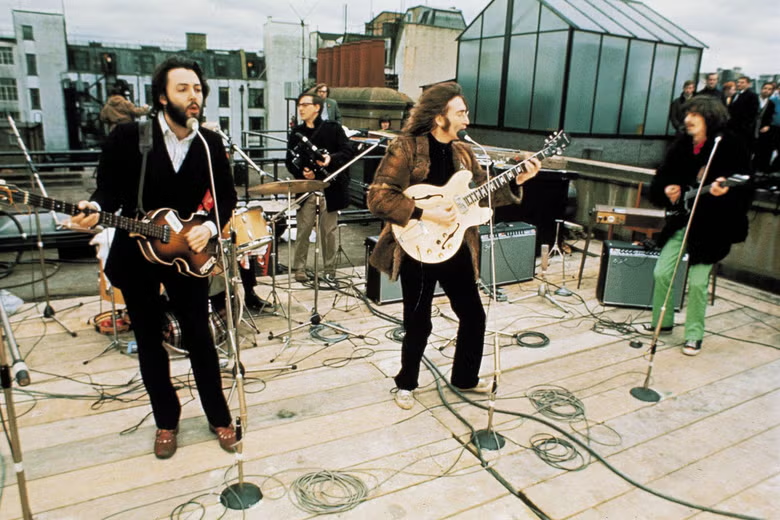
There is a reason the debate never ends. Fifty-plus years after The Beatles broke up, people are still arguing about who the greatest Beatle really was. Paul gets the votes for melody. George gets the votes for spirituality and underappreciated genius. Ringo gets the votes from people who understand drumming better than most. But Lennon — Lennon gets the votes from people who believe that music, at its highest form, is not about technique or beauty or even melody. It is about truth. And no Beatle told the truth the way John Lennon did.
Lennon was uncomfortable in a way the others were not. He was angry when anger was not fashionable. He was vulnerable when vulnerability was considered weakness. He tore down the mythology of The Beatles from the inside while still being one of them, and then he tore it down from the outside once he left. Every album he made as a solo artist was an argument — with the world, with his past, with himself. Here are five songs that make the case better than any argument can.
1. Imagine (1971) The most famous song Lennon ever wrote is also the most misunderstood. People hear it as a gentle utopian lullaby. Lennon intended it as radical. “Imagine no possessions,” sung by a man living in a 72-room mansion, is either hypocrisy or provocation — and Lennon knew exactly which one it was. The song asks you to picture a world without religion, without countries, without private property. In 1971, that was a genuinely dangerous set of ideas wrapped in the most disarming melody imaginable. It reached number one. Lennon later said it was “virtually the Communist Manifesto” dressed up so people would accept it. That is either genius or mischief. Probably both.
2. Working Class Hero (1970) If Imagine is Lennon with a smile, Working Class Hero is Lennon with a knife. Released on the raw, primal Plastic Ono Band album — recorded using Arthur Janov’s primal therapy techniques — this song is a systematic dismantling of the social order. School crushes you. Religion crushes you. The promise of success crushes you. And by the time you realize it, you’ve already become what they needed you to be. Lennon’s delivery is flat, cold, and devastating. No orchestra. No production. Just an acoustic guitar and a voice that sounds like it has stopped caring what you think. John Lennon was a millionaire when he wrote this. He meant every word anyway.
3. God (1970) Perhaps the most audacious song in the Beatles universe. Lennon lists everything he does not believe in — magic, the Bible, Elvis, Bob Dylan, and finally, The Beatles themselves. “I don’t believe in Beatles,” he sings, and in 1970, that line hit like a bomb. He was killing the myth deliberately and publicly. The song ends with him saying the dream is over, that he was the walrus but now he’s just John. It is one of the bravest, most self-aware songs a rock musician has ever recorded. Most artists spend their careers building mythology. Lennon spent his destroying it.
4. In My Life (1965) Written when Lennon was just 24 years old, this is the song that proves he was never just a rock and roller. It is a meditation on memory, love, mortality, and the passage of time — subjects most people don’t fully understand until they are in their fifties. The melody is aching and timeless. The lyric is precise and unfussy. It does not try to be poetic. It simply is. Paul McCartney has disputed the writing credits for this song for decades — which is itself the highest compliment. When two of the greatest songwriters of the century fight over who wrote something, you know it is extraordinary.
5. Jealous Guy (1971) This is the song that reveals the Lennon people rarely discuss — the one capable of genuine remorse and self-examination. Written originally as Child of Nature during the Rishikesh period, it became a confession of insecurity, possessiveness, and the damage those things do to the people you love. For a man known for his sharp edges and brutal honesty about the world, Jealous Guy turned that same brutal honesty inward. It is tender, regretful, and completely undefended. Roxy Music covered it after Lennon was killed and took it to number one in the UK. It was the right song at the right moment. It still is.
I think Imagine is over rated.