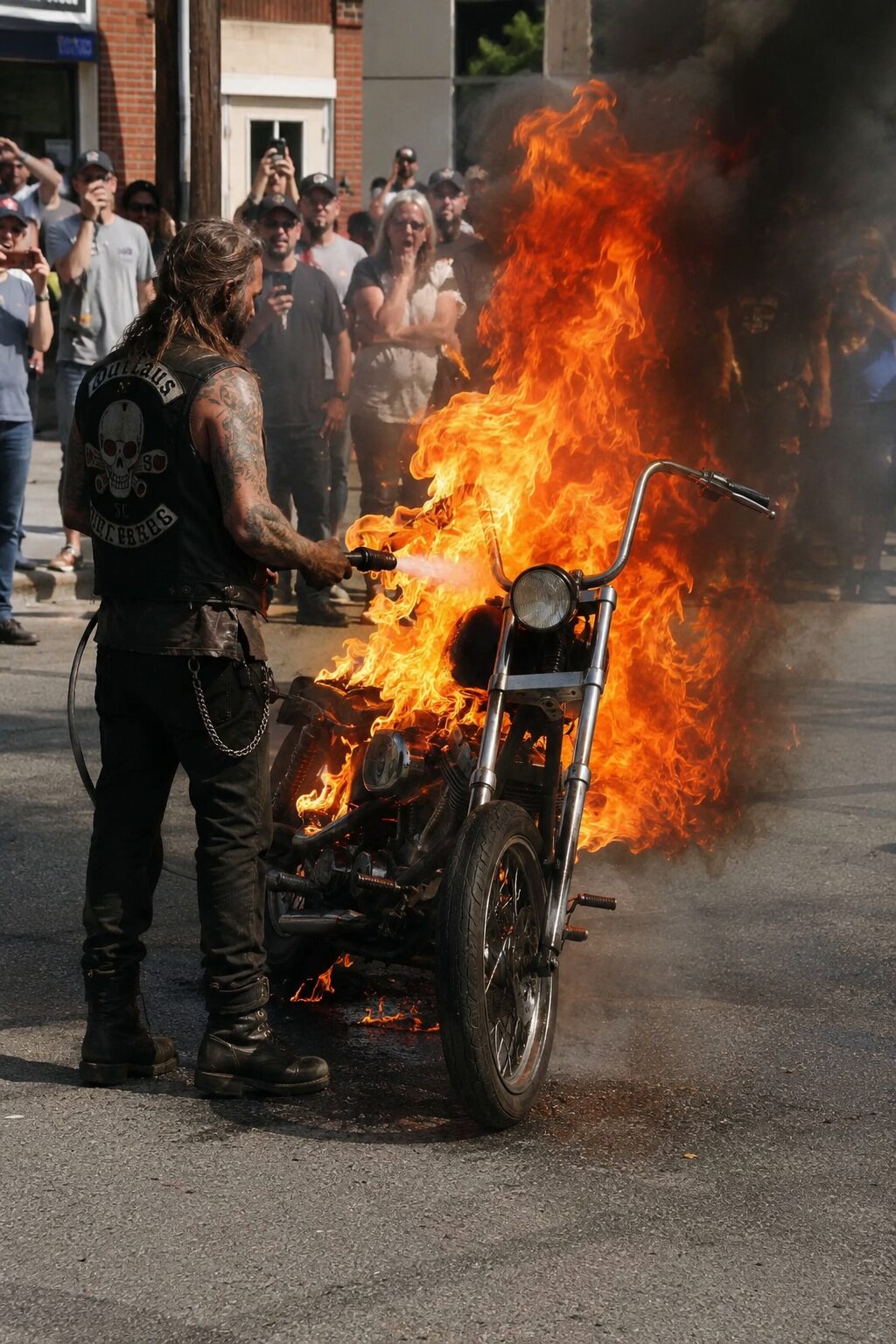
It was a bright, ordinary noon in mid-October. The parking lot outside the big-box store was packed with weekend shoppers pushing carts, kids tugging at sleeves, and engines idling in the search for empty spots. No one expected the scene that unfolded right in the middle of it all.
A man whose face and neck were covered in dense, intricate black tattoos stepped off his motorcycle with calm purpose. He unscrewed the cap on a red gas can he had carried in one hand, and without a word, without a single tremor, he began pouring the fuel over the machine in slow, deliberate arcs.
I stood maybe twenty feet away, a paper cup of coffee going lukewarm in my grip, unable to move forward or back. Something about the way he did it—methodical, almost reverent—made it feel too intentional to be madness and too precise to be an accident.
The motorcycle wasn’t just any ride. It was a deep matte-black custom cruiser, every inch polished with obsessive care. Chrome accents caught the sunlight like dark mirrors. The seat was worn from years of long miles, the tank etched with subtle custom engravings that told stories only the owner could read. It looked like the kind of machine that defined a man without him ever needing to speak.
And yet he didn’t hesitate.
The match flared between his fingers. He dropped it onto the tank.
Flames caught instantly, racing across the fuel in a hungry whoosh that bloomed into orange and yellow petals. Heat rolled outward, forcing the nearest shoppers to stumble back and form a wide, instinctive circle. Phones came out. Someone yelled for help. A woman gasped and covered her child’s eyes. But no one rushed in.
The man simply stood there, boots planted on the asphalt, eyes locked on the growing fire. He wasn’t panicking. He wasn’t raging. He wasn’t even blinking much. He was waiting.
That stillness unsettled me more than the flames themselves. Impulse looks loud and messy. This was quiet. Decided. Finished long before any of us arrived.
Then I noticed it—a strip of red cloth tied tightly around the left handlebar, just beneath the grip. It fluttered lightly in the rising heat, edges lifting as if the fire itself refused to touch it. At first I thought it was just an old rag for wiping down the bike, something practical and forgettable. But as the leather seat cracked and curled, as paint blistered and metal began to warp, that red cloth stayed exactly as it was. Untouched. Unburned. Almost defiant.
A security guard came running, shouting loud enough to cut through the crackle. “Step back! Get away from there!” The tattooed man didn’t turn his head. Didn’t acknowledge the guard at all. Instead, he took one slow step closer to the burning machine.
In a voice low, steady, and terrifyingly certain, he said, “It has to burn.”
No drama. No explanation. Just finality.
That was when I saw it through the shifting flames—something dark and out of place wedged deep inside the motorcycle’s frame. A bundle. Wrapped. Deliberately hidden where no mechanic would ever look. My stomach tightened. Whatever this was, it wasn’t just about destroying a bike.
Someone behind me grabbed my sleeve. “Don’t get any closer,” they whispered, urgent. “You don’t want to see what’s in there.”
The fire roared higher for a moment, then began to settle, collapsing in on itself as fuel ran low. Smoke thickened the air. Sirens wailed in the distance now, growing louder, but the crowd stayed rooted, caught between horror and an aching curiosity none of us could shake.
The man still hadn’t moved. He watched the flames die with the patience of someone who had rehearsed this moment in his mind for years. I leaned sideways, trying to see better through the thinning smoke. The bundle was becoming clearer—charred at the edges but holding its shape, something that had been placed there on purpose.
A guy next to me muttered, “What the hell did he hide inside his own bike?” No one answered. We all already knew the answer in our bones: whatever it was, it mattered enough to burn everything else to reach it.
Police cruisers finally slid into the lot, lights flashing but sirens now quiet. Officers stepped out carefully, hands near their belts, reading the scene the same way we all were—something deliberate, something heavy, something that didn’t fit any standard call sheet.
The tattooed man stepped forward again, each movement slow and measured. He reached into the twisted, glowing frame with bare hands that trembled only slightly, the first crack in the armor he had shown us all afternoon. He lifted the bundle out like it was made of glass instead of whatever remained after the fire.
The crowd drew a collective breath.
He dropped to his knees right there on the hot asphalt, ignoring the officers moving closer, ignoring the murmurs swelling behind him. For the first time, the controlled mask slipped. His shoulders rounded just a fraction. He reached for the knot on the red cloth—the same one that had somehow survived untouched—and began to loosen it with fingers that knew the motion by heart.
The cloth fell away.
Inside was a small, sealed metal container, dented from the heat but still intact, its surface scratched and worn from years of being carried and hidden. The man held it to his chest the way someone holds something that still breathes.
An officer stepped forward, voice firm but no longer sharp. “Sir, put that down and step away.”
The tattooed man didn’t look up. He simply stared at the container, thumb tracing the dents as if memorizing them all over again.
An older man standing near the edge of the crowd—someone I hadn’t noticed until that moment—spoke quietly to me without taking his eyes off the scene. His name was Harlan, I would learn later. He had the tired eyes of someone who had watched this story unfold from the beginning.
“That bike shouldn’t exist anymore,” Harlan said, almost to himself.
I asked him what he meant. He turned just enough for me to see the weight in his face.
“He’s been trying to get rid of it for years,” he said. “But it always comes back.”
I stared, confused. “That’s not possible.”
Harlan nodded slowly. “I know. Because it wasn’t the bike he was afraid of.”
The last layers of wrapping came away in the tattooed man’s hands. Inside the metal container was ash—contained, preserved, intentional. Not random debris. Not accident. Something sacred.
Harlan’s voice dropped even lower. “His daughter. Lost her years ago in a car accident one rainy night on the highway. One of those stories the news forgets by morning. They gave him back what they could find, but somewhere along the chain it got misplaced—lost in storage, mishandled, forgotten by the system. No one ever took responsibility. By the time he tracked it down, it had been treated like nothing more than evidence in a box.”
My throat closed.
Harlan continued, eyes on the kneeling man. “He spent years fighting paperwork, calling departments, chasing leads. Every time he thought he finally had her back, something went wrong—records moved, boxes misplaced again. So he stopped trusting anyone else to keep her safe. He hid the container inside the one place he knew no one would ever look. The only thing that was truly his.”
I looked at the ruined motorcycle, at the empty space inside the frame where the bundle had waited.
“And today?” I asked.
Harlan exhaled. “Today he made sure no one could ever lose her again. The fire was the only way he could be certain.”
The red cloth lay on the ground now, no longer tied, no longer needed as a marker. I don’t know why, but I stepped forward, picked it up, brushed the ash from its surface. It was soft, worn thin from years of being knotted and unknotted, carried and held like a lifeline.
The tattooed man noticed. Our eyes met for the first time.
Up close, the black tattoos didn’t look menacing anymore. They looked like armor earned over time—stories in ink, protection layered on skin.
I held the cloth out to him.
He took it carefully, almost gently.
“Thank you,” he said, voice quiet, steady now in a way it hadn’t been before.
No more explanation was needed. None was offered.
He wrapped the red cloth around the metal container once more—not tight like before, but protective, reverent. Then he stood, still holding it close to his chest, and walked past the officers who no longer tried to stop him. The crowd parted—not out of fear, but out of something closer to respect, something that had replaced every assumption we had made in the last ten minutes.
I watched him go until he disappeared beyond the edge of the lot, a man who had finally finished something that had taken far too long.
Harlan stepped up beside me.
“People always see the fire first,” he said quietly.
I looked at the twisted wreckage, still smoking.
“And what do they miss?”
He glanced at the space where the man had knelt, then back at me.
“They miss what someone had to carry long enough to light it.”
I stayed there long after the fire trucks arrived. Long after the crowd thinned and the smoke drifted away into nothing. The image didn’t leave me—the flames, the stillness, the moment when everything we thought we understood cracked open and revealed something sacred underneath.
Not everything is what it looks like at first. Sometimes the loudest destruction is the only way to protect what matters most.