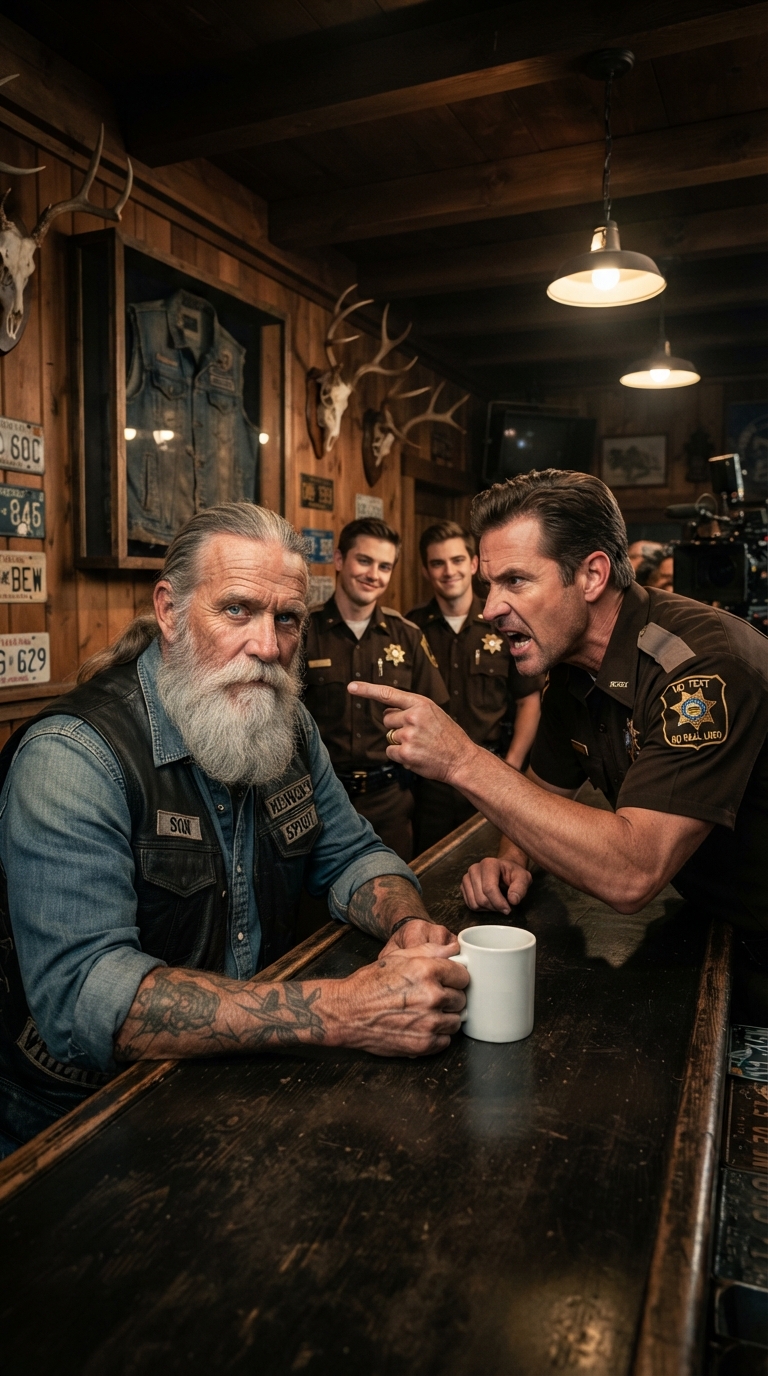
The sound of breaking glass echoed through the little town of Red Hollow, Texas, just after sunset. A heavy wooden chair crashed through the front window of a bar called The Last Mile, scattering glass across the sidewalk. Inside, an old man in a faded black leather vest stood motionless behind the counter, watching three uniformed police officers tear apart the place he’d spent thirty years building.
His name was Frank Mercer. He was sixty-eight years old, gray-haired, broad-shouldered, and walked with a slight limp from an accident he’d never discussed with anyone in town. His bar wasn’t fancy. The floorboards creaked, the stools had cracks in the leather, and the walls were covered with old motorcycle photographs, faded American flags, and framed pictures of men who had once ridden beside him. For Frank, The Last Mile wasn’t just a business. It was the only home he’d had since his wife died twelve years earlier.
“That’s enough, boys,” Frank said quietly.
Officer Travis Cole, a thick-necked man in his early forties, turned from the jukebox he’d just smashed with his boot. His badge gleamed beneath the overhead lights, and a smug smile spread across his face.
“What’s that, old man? You giving me orders now?”
Frank looked at the shattered jukebox. “You’ve made your point. Now get out of my bar.”
Cole laughed. His two fellow officers exchanged glances but said nothing. Everyone in Red Hollow knew Travis Cole had a reputation for making problems disappear, provided someone paid him enough. Local business owners had complained about his so-called inspection fees, mysterious citations, and threats to shut down establishments that refused to cooperate. Most people were too afraid to challenge him. Those who did usually found themselves buried in paperwork, fines, or criminal charges.
Frank had refused to pay him.
Three weeks earlier, Cole had arrived at The Last Mile demanding five thousand dollars for what he called a monthly protection arrangement. Frank had looked him straight in the eye and told him that if he wanted money, he should earn it honestly. Cole had smiled at the time, wished him a pleasant evening, and walked out.
Now Frank was watching him destroy everything.
“Funny thing about old buildings,” Cole said, kicking a fallen stool across the floor. “Sometimes they need to be cleared out before they become a public safety problem.”
“You don’t have a warrant,” Frank replied.
Cole stepped closer. “And you don’t have a license that I’d hesitate to revoke.”
“My license is valid.”
“Not anymore.”
Cole pulled a folded document from his pocket and slapped it onto the counter. It was a temporary closure notice bearing an official seal, but Frank immediately noticed something wrong. The address was incorrect, the inspection date was from the previous month, and the signature looked nothing like the one he’d seen on earlier notices.
“This is forged,” Frank said.
For the first time, Cole’s smile disappeared.
He leaned across the counter until they were only inches apart. “Listen carefully, old man. You have two choices. You can sell this place, take whatever money I decide you’re worth, and leave town. Or you can keep playing the hero and watch me take everything you’ve got.”
Frank studied the officer’s face. He could see the anger beneath the arrogance. Cole wasn’t merely trying to shut down a bar. He was afraid of something, and that fear was making him reckless.
“I’m not selling,” Frank answered.
Cole’s expression hardened.
He grabbed a glass from the counter and hurled it against the wall. Then he swept a row of bottles onto the floor, sending liquor spilling across the boards. One officer began pulling framed photographs from the walls. The other overturned tables while Cole kicked open the small office behind the counter.
Frank didn’t fight back. He didn’t shout. He simply stood there, his hands trembling at his sides, as fifteen years of memories were torn apart in less than ten minutes.
Then Cole spotted an old photograph in a dark wooden frame hanging beside the office door.
It showed six men standing beside their motorcycles outside a roadside diner. They wore black leather vests bearing a simple silver emblem: a winged wheel surrounded by a circle.
Cole tore the photograph from the wall.
“What’s this? Your little motorcycle gang?”
Frank’s eyes moved to the picture.
“Put it down.”
Something in his voice made the two other officers stop moving.
Cole noticed it, too, and grinned. “Oh, now we’ve found something you care about.”
He held the photograph over the counter, then deliberately dropped it into a puddle of spilled whiskey. The glass cracked under his boot as he stepped on it.
Frank closed his eyes.
For a moment, he wasn’t standing in a wrecked bar in Texas. He was twenty-nine again, riding through a storm with five brothers who would have followed him anywhere. He remembered the roar of engines, the smell of wet leather, and the promise they’d made beside a hospital bed fifteen years earlier.
They had promised that if any of them ever needed help, the others would come.
But Frank had broken that promise first.
After his wife, Eleanor, died, he had walked away from the road, sold his motorcycle, and stopped answering their calls. He’d convinced himself that the old life was behind him. He wanted quiet. He wanted ordinary days. He wanted to become a man nobody recognized.
For fifteen years, he had succeeded.
Until now.
Cole leaned over the counter and tapped Frank’s chest with two fingers.
“You’re going to regret crossing me.”
Frank opened his eyes.
“No,” he said softly. “I think you are.”
Cole burst out laughing. “What are you going to do? Call your biker buddies? Tell them the big, bad police officer broke your toys?”
Frank didn’t answer.
Instead, he stepped behind the counter, moved a broken drawer aside, and reached for a small black telephone that had survived the destruction. It was an old-fashioned landline, its cord tangled beneath a stack of receipts.
He stared at it for several seconds.
Then he lifted the receiver.
Cole’s laughter faded.
“Who are you calling?”
Frank pressed a number he hadn’t dialed in fifteen years.
The line rang once.
Twice.
On the third ring, a rough voice answered.
“Who is this?”
Frank swallowed. His throat felt tight, and for the first time that evening, his hands began to shake.
“It’s me.”
Silence.
Then the voice on the other end changed.
“Frank?”
Frank stared at the broken photograph on the floor.
“I know I have no right to ask you for anything,” he said. “But I need you to listen.”
“Where are you?”
“Red Hollow. The Last Mile.”
Another pause.
Then the man asked a question that made Frank’s eyes fill with tears.
“Are you in trouble, brother?”
Frank looked at Cole, who was now watching him with growing unease.
“Yes,” Frank whispered. “I think I am.”
The voice on the other end became cold and steady.
“Don’t leave that building. Don’t touch anything else. And don’t let anyone hurt you.”
Frank took a shaky breath.
“Who is coming?”
The answer came without hesitation.
“Everyone.”
The call ended.
Cole snatched a handful of papers from the counter and threw them to the floor.
“Who was that? Some retired old fool who owes you money?”
Frank carefully placed the receiver back in its cradle.
“You should go home, Officer Cole.”
Cole’s face reddened.
“You think I’m afraid of you?”
“No.”
Frank looked him directly in the eye.
“I think you’re afraid of who you don’t know.”
Cole stepped forward and shoved Frank hard enough to send him crashing against the counter. Pain shot through the old man’s ribs. One of the officers muttered, “Travis, that’s enough,” but Cole ignored him.
He grabbed Frank by the collar.
“You’re under arrest for resisting an official inspection.”
“I haven’t resisted anything.”
“Then you won’t mind coming with us.”
Cole twisted Frank’s arm behind his back. Frank winced, but he made no attempt to fight. The younger officer looked uncomfortable now, glancing between his superior and the ruined bar.
Then, from somewhere outside, came a sound that made all three officers turn toward the windows.
An engine.
Then another.
Then several more.
The rumbling grew louder, rolling down the quiet main street like distant thunder. Through the broken window, Cole watched headlights sweep across the parking lot. One motorcycle turned in from the highway, followed by two more. Then five. Then ten.
Within minutes, the parking lot was filling with motorcycles.
Harley-Davidsons. Indians. Touring bikes covered in road dust. Big V-twins with chrome catching the streetlights. Their riders moved with the calm precision of people who had spent years riding together.
Nobody revved an engine unnecessarily. Nobody shouted threats.
They simply parked.
And waited.
The first man through the door was enormous, with a silver beard reaching halfway down his chest. His black leather vest bore the same winged-wheel emblem as the photograph Cole had destroyed. A long scar ran from his left temple to his jaw.
He looked around the wrecked bar.
Then he saw Frank.
For several seconds, neither man spoke.
Finally, the big biker removed his sunglasses.
“Fifteen years,” he said.
Frank lowered his head.
“I know.”
The biker stepped forward and embraced him so tightly that Frank nearly lost his balance.
“My God, old man,” the biker whispered. “We thought we’d never see you again.”
Frank gripped the back of his vest.
“I’m sorry, Bear.”
Bear closed his eyes for a moment.
“Save it for later. We’ll have time to talk.”
Then he released Frank and turned toward Cole.
His expression changed.
“Who did this?”
Cole straightened his uniform and lifted his chin.
“I’m Officer Travis Cole. This is an active police matter. Everyone needs to leave the premises immediately.”
Bear glanced at the broken furniture, the shattered bottles, and the framed photographs lying beneath muddy boots.
“An active police matter?” he repeated.
“That’s right.”
“Then I’m sure you’ll have no problem explaining why three officers entered a private business without a warrant and destroyed the owner’s property.”
Cole’s jaw tightened.
“You don’t know what happened here.”
“You’re right,” Bear replied. “That’s why we’re going to let the evidence tell us.”
He turned toward the doorway.
A second man stepped inside carrying a small video camera. Behind him came a woman in a dark blazer, followed by two more bikers wearing the same emblem. One carried a folder thick with documents.
Cole’s face lost some of its color.
The woman opened her identification wallet.
“My name is Rachel Dawson. I’m an investigator with the Texas Rangers. Before you say anything else, Officer Cole, I’d advise you to keep your hands where everyone can see them.”
For the first time that evening, nobody in the room moved.
Frank looked at Bear in disbelief.
“What is this?”
Bear glanced at him.
“You remember Daniel Price? The skinny kid who used to ride behind us because he couldn’t afford his own bike?”
Frank nodded slowly.
“Daniel became a lawyer. Rachel here has been helping him investigate misconduct complaints in several counties. We’ve spent the last two years documenting a pattern of false citations, forged inspection notices, and illegal payments connected to certain officers.”
He looked toward Cole.
“Your name kept coming up.”
Rachel gestured to the camera operator.
“We received information that an unlawful search or destruction of property might occur here tonight. The recording started before your officers entered the building. We also have copies of the original inspection records, the closure notice you presented, and statements from other business owners.”
Cole took a step backward.
“This is ridiculous. You can’t just show up and accuse a police officer of a crime.”
“No one is convicting you in this room,” Rachel said evenly. “But your conduct will be investigated, and the evidence will be preserved.”
She turned toward the two other officers.
“Did either of you witness Officer Cole obtain a warrant before entering this establishment?”
Neither answered immediately.
Cole snapped his head toward them.
“Think carefully before you speak.”
The younger officer looked down at the floor.
Then he took a breath.
“No, ma’am. There was no warrant.”
The second officer’s face tightened.
“And the closure notice?” Rachel asked.
The younger man swallowed.
“I saw him prepare it this afternoon. The inspection didn’t happen.”
Cole stared at him as though he had been struck.
“You little traitor.”
“That’s enough,” Rachel said sharply.
She instructed the officers to step apart while another investigator contacted the appropriate authorities. Cole began talking rapidly, claiming that Frank had attacked him, that the bar contained illegal items, and that the bikers had threatened him. But every new accusation only added to the questions he would have to answer.
Bear didn’t threaten him. Frank didn’t raise a hand against him.
They didn’t need to.
For years, Cole had relied on fear to keep people silent. Now there were witnesses, recordings, documents, and people prepared to give statements.
And for the first time, his badge couldn’t make the room obey him.
As the investigators worked, Bear returned to Frank’s side. He knelt beside the damaged photograph and carefully lifted the broken pieces of glass.
“These guys were your family,” he said.
Frank nodded, unable to speak.
Bear studied the photograph. Six young men stood in front of the old diner, grinning at the camera. One had his arm around Frank’s shoulder. Another held a tiny baby wrapped in a blue blanket.
Bear pointed to the child.
“That’s my daughter, Lily. She was six months old when we took this.”
Frank wiped his eyes.
“I remember.”
“You were the one who drove us to the hospital when she was born. You stayed in the waiting room for eleven hours because my wife was scared and I couldn’t stop shaking.”
Frank looked away.
“I should have stayed in touch.”
“Yeah,” Bear said quietly. “You should have.”
There was no anger in his voice now, only the sadness of fifteen lost years.
Frank finally looked at him.
“After Eleanor died, I couldn’t stand seeing any of you. Every time I looked at your faces, I remembered the life I’d lost. You kept calling. I kept ignoring you. Eventually, I thought you were better off without me.”
Bear shook his head.
“That wasn’t your decision to make for us.”
Frank’s shoulders trembled.
“I know that now.”
Bear pulled him into another embrace.
“Then let’s start there.”
Outside, more motorcycles had arrived. Some riders stayed by their bikes, while others helped an investigator photograph the damage. One older woman in a leather jacket gathered the surviving pictures from the floor. Another biker found Frank’s glasses beneath a broken table and carefully placed them on the counter.
Nobody was looking for a fight.
They had come because one of their own had finally asked for help.
And that was enough.
By midnight, the bar had been secured, the evidence documented, and Cole had been taken away for questioning by investigators. The two other officers were separated for formal interviews. Rachel explained to Frank that the investigation would take time, and that no one should assume the final outcome before the evidence had been reviewed.
Frank understood. He had lived long enough to know that a single night couldn’t fix everything.
But it could change the direction of a man’s life.
When the last investigator left, Bear sat on an overturned stool while Frank swept broken glass into a dustpan. The others had begun clearing a path through the wreckage, moving carefully so they wouldn’t disturb anything that still needed documenting.
“Put that broom down,” Bear ordered.
Frank raised an eyebrow.
“I own the place.”
“And I’m older than your common sense. Sit down.”
A few bikers laughed.
For the first time that night, Frank smiled.
He lowered himself onto a surviving chair while Bear placed a cup of coffee in front of him. It was cold, bitter, and probably the worst coffee in Texas, but Frank held it in both hands as though it were something precious.
After a while, he asked the question that had been sitting in his chest since the call.
“How did you know to bring everyone?”
Bear leaned back.
“I didn’t.”
Frank frowned.
“What do you mean?”
“I called Daniel after you called me. He told me the situation might involve an officer abusing his authority, so he contacted Rachel. I called the others because you asked for help. The rest came because they’re still your brothers.”
Frank looked toward the doorway, where the silhouettes of motorcycles stood beneath the streetlights.
“After all these years?”
Bear followed his gaze.
“Brotherhood isn’t a subscription, Frank. You don’t lose it because you disappear for a while. But you do have to decide whether you’re willing to come back.”
Frank stared into his coffee.
“I don’t know if I deserve that.”
Bear’s voice softened.
“Good thing nobody asked you to decide that tonight.”
The next morning, Red Hollow woke to photographs of the ruined bar circulating across local news pages. Within days, several business owners came forward with their own accounts of suspicious fines and alleged demands for money. Investigators reviewed financial records, inspection documents, and earlier complaints. The case against Cole grew more complicated as additional witnesses were interviewed, and the department announced that the allegations would be investigated independently.
The process was neither quick nor simple. Some witnesses were afraid to speak publicly. Some records needed to be verified. And Cole had the right to respond to the allegations and defend himself through the legal process.
But the silence that had protected him for so long was beginning to break.
Frank, meanwhile, faced a different kind of rebuilding.
The Last Mile had no working jukebox, half its furniture was destroyed, and the front window was covered with temporary plywood. The insurance paperwork would take weeks. The repairs would cost more than he could comfortably afford.
On the third morning, Frank unlocked the front door and found twenty-three motorcycles lined up along the curb.
Bear stood near the entrance holding a toolbox.
Daniel Price had arrived with a stack of paperwork and a list of local contractors willing to help. Rachel had arranged for investigators to collect the remaining evidence before repairs began. The other riders brought lumber, paint, replacement stools, and enough cleaning supplies to stock a small hardware store.
Frank stood in the doorway, staring.
“What are you all doing here?”
A younger biker grinned.
“Heard the old man needs a hand.”
Another called from the parking lot, “And somebody told us the coffee here is terrible, so we figured we’d bring our own.”
Laughter rolled through the group.
Frank looked at Bear.
“You didn’t have to do all this.”
Bear picked up his toolbox.
“Neither did you, fifteen years ago, when you drove me six hundred miles to see my dying father. But you did it anyway.”
Frank had no answer.
Bear walked past him into the bar.
“Now stop talking and show us where you keep the spare paint.”
For the next two weeks, The Last Mile became the busiest place in Red Hollow. Riders arrived before sunrise and stayed until dark. Some repaired the window frames, others replaced damaged furniture, and several local residents who had never spoken to Frank before began bringing food for the workers.
The old photographs were restored where possible. The broken jukebox couldn’t be repaired, so the group found a replacement. The winged-wheel picture that Cole had destroyed was carefully reconstructed from an old duplicate Bear had kept in his garage.
On the day the bar reopened, Frank stood behind the counter wearing his original black leather vest. It had been stored in a closet for fifteen years, and the leather was stiff around the shoulders, but it still fit.
The bar filled with riders, neighbors, and people who had followed the case. There was no grand speech, no dramatic announcement, and no celebration of revenge. Just food, music, conversation, and the steady sound of people finding their way back to one another.
Near closing time, Frank stepped outside with Bear.
The Texas sky was turning orange above the highway. Rows of motorcycles reflected the fading sunlight, and the air smelled of warm asphalt and fresh paint.
Frank reached into his pocket and pulled out an old silver key.
“I kept it all these years,” he said.
Bear examined it.
“The key to your old bike?”
Frank nodded.
“I sold the motorcycle after Eleanor died. But I kept the key. I think part of me always knew I’d ride again someday.”
Bear smiled.
“Then maybe it’s time.”
Frank looked down the highway, where the road stretched toward the distant hills.
“I don’t know if I can do fifteen years of riding again.”
Bear laughed.
“Nobody’s asking you to ride fifteen years. We’re asking you to ride fifteen minutes.”
For a long moment, Frank said nothing.
Then he looked at the men and women standing beside their bikes, the people who had crossed miles of highway simply because he’d finally found the courage to make one phone call.
His eyes filled with tears.
“All those years,” he whispered, “I thought I was protecting myself by staying away.”
Bear placed a hand on his shoulder.
“And what did you learn?”
Frank looked at the open road.
“That being alone and being at peace aren’t the same thing.”
Bear nodded.
“Now you’re getting somewhere.”
The next morning, Frank rode again for the first time in fifteen years. His hands were stiff, his knees ached, and the old engine vibrated beneath him like a memory coming back to life. Bear rode beside him, while the others followed in a long line that stretched down the Texas highway.
They weren’t riding to threaten anyone. They weren’t riding to settle a score.
They were riding because one old man had finally stopped running from the people who loved him.
And back in Red Hollow, The Last Mile stood open once more, its windows repaired and its photographs hanging proudly on the walls.
Above the counter, in a freshly restored frame, was the picture of six young bikers standing outside a roadside diner.
Beneath it, Frank had placed a small wooden sign.
“You don’t have to ride alone. You just have to make the call.”