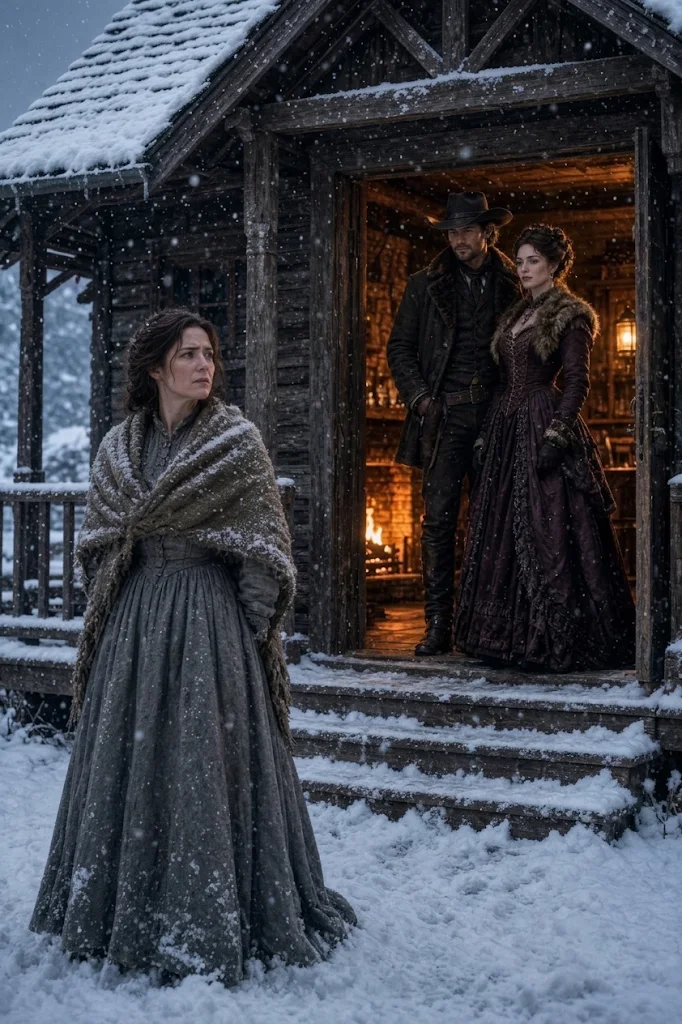
# HE BROUGHT HIS FORMER FIANCÉE TO TAKE MY PLACE—BUT HE FORGOT WHO OWNED THE MONTANA RANCH
*Montana Territory, November 1887*
## Chapter 1: The Woman on His Horse
The sound of my husband’s horse reached me before I saw him.
Three sets of hooves thundered across the frozen ground outside Black Creek Ranch, followed by the familiar creaking of leather saddles and the low whistles of the ranch hands returning from the northern pasture.
I stood beside the iron stove, stirring a pot of beef stew.
For six weeks, I had waited for Caleb Mercer to come home.
Six weeks of managing nearly a thousand head of cattle, paying ranch hands, negotiating with merchants, repairing fences, and making certain the animals had enough hay to survive the approaching winter.
I had done everything a rancher’s wife was expected to do.
And considerably more.
I wiped my hands on my apron and walked toward the window.
Then I saw him.
Caleb was riding his black stallion, wearing his familiar brown coat and black Stetson. His beard had grown longer, and his shoulders looked broader beneath the heavy winter clothing.
But he wasn’t riding alone.
A blonde woman sat behind him, her arms comfortably wrapped around his waist.
I recognized her immediately.
Lillian Whitmore.
His former fiancée.
Seven years earlier, before Caleb married me, Lillian’s wealthy father had considered him an unsuitable husband. Caleb’s family had been drowning in debt, and the Whitmores had refused to allow their daughter to marry a man who owned little more than a failing ranch.
Caleb had once told me that Lillian belonged to his past.
Apparently, his past had just arrived at my front door.
I watched him dismount and help her down.
He held her waist a little longer than necessary.
Then he kissed her gloved hand.
I stepped away from the window.
When the front door opened, Caleb entered first, bringing with him the smell of cold air, horse sweat, and tobacco.
“Evening, sweetheart!”
He removed his Stetson and hung it beside the door.
I looked at him.
Then at the woman standing behind him.
“You’re home.”
“Sure am.” He smiled. “And I’ve brought someone with me.”
Lillian stepped forward.
“Hello, Evelyn. It’s been such a long time.”
Her voice was as sweet as I remembered.
So was the expensive perfume beneath the smell of winter wool.
I noticed the small leather suitcase beside her boots.
“How long are you staying?” I asked.
Caleb answered before she could.
“She’s staying here.”
I waited for him to explain.
He didn’t.
Instead, he walked toward the dining room, poured himself a glass of whiskey, and called over his shoulder.
“Could you bring us supper? We’re hungry.”
I stood in the doorway for several seconds.
Then I returned to the kitchen.
Not because I was afraid of him.
Because I wanted to hear how far he intended to take this.
Dinner was served twenty minutes later.
Caleb sat at the head of the oak table, while Lillian occupied the chair beside him.
My chair.
The one Caleb had made for me during our first winter together, when we were still happy enough to spend evenings talking beside the fireplace.
I sat opposite them.
Lillian examined the room.
“What a charming little house,” she said. “Although I suppose it must be difficult to keep everything organized with so much land to manage.”
I cut a piece of roast beef.
“Someone has to do it.”
She smiled.
“Of course. Though I imagine Caleb will be able to hire proper household help now that the ranch is doing so well.”
Caleb took a drink.
“That’s actually something we need to discuss.”
I put down my fork.
He looked at me with the expression he usually reserved for difficult business negotiations.
“Lillian has fallen on hard times. Her father’s estate is being liquidated, and she has nowhere suitable to go. I’ve offered her the upstairs bedroom.”
I stared at him.
“Our spare bedroom?”
“Yes.”
“That room is full of winter supplies.”
“Then move them.”
I looked at Lillian.
She was smiling into her wineglass.
Caleb continued.
“She’ll also be helping with the household accounts and supervising the staff. You’ve had enough responsibilities on your shoulders, Evelyn. It’s time someone else took over.”
I almost laughed.
For seven years, I had been the person who woke before sunrise to check the cattle, negotiated the price of hay, and rode through freezing rain to bring injured horses back to the barn.
I had even sold my mother’s silver jewelry to cover the ranch payroll when Caleb’s cattle shipment was delayed.
And now my husband was telling me another woman would be taking over the work I had spent seven years doing.
“Did you discuss this with me before inviting her?” I asked.
Caleb frowned.
“I’m discussing it now.”
“No. You’re informing me.”
His jaw tightened.
“Evelyn, don’t make this difficult.”
Lillian gently placed her hand on his arm.
“Please, Caleb. I don’t want to come between you two.”
He immediately covered her hand with his own.
“You’re not coming between anyone.”
I looked down at their hands.
Then I looked at my husband.
Seven years earlier, he had held my hands beside the creek and promised that no woman would ever make me feel unwanted in my own home.
I wondered if he remembered saying that.
Apparently, he did not.
“There is one more thing,” Caleb said.
I waited.
“Lillian will be handling the ranch’s household expenses. I’ll give her access to the accounts tomorrow morning.”
I slowly raised my eyes.
“The ranch accounts?”
“Yes.”
“Caleb, I’ve managed those accounts since we married.”
“And I’ve decided things need to change.”
Lillian smiled sympathetically.
“I know it must be difficult to hand over responsibilities, Evelyn. But a rancher’s wife needs to understand when her husband knows what’s best.”
I looked at her for a long moment.
Then I turned toward Caleb.
“Is that what you think I am? Your rancher’s wife?”
He sighed.
“You’re my wife. But if you can’t accept Lillian living here, perhaps you should consider whether this marriage is still working.”
The words were delivered so casually that I almost missed their cruelty.
He was giving me a choice.
Accept his former fiancée in my home, surrender the household I had maintained for seven years, and quietly become an inconvenience.
Or leave.
I stood and began collecting the empty plates.
“All right,” I said.
Caleb looked relieved.
“Good. I knew you’d eventually understand.”
Lillian smiled.
“Thank you, Evelyn. I promise I’ll make myself useful.”
I stopped beside the dining room doorway.
“Caleb, do you remember the winter your father’s creditors came to take the ranch?”
His expression changed.
“What does that have to do with anything?”
“The mortgage. The north pasture. The cattle you bought the following spring.”
He put down his whiskey.
“Evelyn, we’ve discussed this.”
“Yes. We have.”
I turned to face him.
“Do you remember who paid for all of it?”
Caleb gave a dismissive laugh.
“That was seven years ago. This ranch belongs to the Mercer family.”
I nodded slowly.
Then I asked the question that wiped the smile from his face.
“Caleb, do you remember whose name is on the original deed?”
His whiskey glass slipped from his fingers.
It struck the wooden table and rolled onto its side.
For the first time that evening, my husband looked genuinely afraid of me.
## Chapter 2: The Inheritance He Had Forgotten
Seven years earlier, I had arrived at Black Creek Ranch as a young woman with a small inheritance and no intention of marrying a rancher.
My father, Edward Whitmore, had been a successful landowner and cattle merchant.
He spent most of his life purchasing property across Montana and Wyoming, believing land was the only investment that could outlast a man’s fortune.
When he died, he left me money, several smaller properties, and one particular parcel near the Missouri River.
I had never imagined that inheritance would determine the course of my life.
I met Caleb Mercer during the summer of 1880.
He was handsome, hardworking, and proud.
His father’s ranch had once been prosperous, but years of poor management and unpaid loans had nearly destroyed it.
Caleb was determined to restore the property.
I admired that determination.
He did not pretend to be wealthy. He did not flatter me because of my inheritance.
At least, that was what I believed.
We married the following spring.
Three months later, I discovered how serious the ranch’s financial situation really was.
The bank had issued a foreclosure notice.
The northern pasture was scheduled for auction.
Several creditors were preparing legal claims against the property.
Caleb sat beside the fireplace that evening with his head in his hands.
“My father spent forty years building this place,” he said. “And I’ll be the man who loses it.”
I sat beside him.
“How much do you owe?”
He hesitated.
“More than I can repay.”
I asked him to show me the documents.
By midnight, I understood the problem.
The ranch was days away from being taken from him.
The following morning, I opened the account my father had left me.
There was enough money to settle the most urgent debts, purchase the northern pasture, and negotiate a new arrangement with the bank.
But I made one condition.
The property would be transferred into my name.
Not because I wanted to control Caleb.
Not because I believed he would fail.
But because my father’s money was being used to save the ranch, and I wanted to protect that investment.
Caleb agreed immediately.
He held my hands and kissed them.
“One day, Evelyn, I’ll make you proud of what we’ve built.”
I believed him.
The lawyer prepared the documents.
The bank received its payment.
The creditors withdrew their claims.
The ranch was saved.
Over the following years, Caleb and I rebuilt the business together.
We expanded the cattle operation, repaired the barn, purchased additional equipment, and hired more ranch hands.
The land became profitable again.
But the legal arrangement never changed.
The original deed remained in my name.
Caleb had received a conditional right to manage and operate the ranch while he fulfilled the conditions of our agreement.
He had signed the documents willingly.
Now, seven years later, he was pretending he had never seen them.
I walked into the office and retrieved the leather folder.
Inside were the original deed, the bank agreement, and the signed property contract.
I read every page.
Then I checked the signatures.
Everything was exactly as I remembered.
I was returning the documents to the folder when Samuel knocked.
He was the oldest ranch hand, a man who had worked for Caleb’s father before Caleb was born.
His gray beard had grown almost white, and his left leg had never properly healed after a horse accident.
“Mrs. Mercer?”
I looked up.
“Come in, Samuel.”
He closed the door.
“There’s a gentleman downstairs asking for you.”
“Who is he?”
“He says his name is Mr. Nathaniel Brooks. He’s a solicitor from Helena.”
I frowned.
“What does he want?”
Samuel swallowed.
“He has a court order.”
My fingers tightened around the folder.
“What court order?”
“He says it’s concerning the ranch.”
I stood.
“Where is he?”
“In the sitting room.”
“Does Caleb know?”
Samuel looked uncomfortable.
“He was speaking with Miss Whitmore when the gentleman arrived.”
I closed the folder.
“Then I believe we should find out what he wants before my husband does.”
Samuel nodded.
As I passed him, he spoke quietly.
“Mrs. Mercer?”
I stopped.
“Yes?”
“I’ve worked here a long time. I know what you did for this place.”
I looked at him.
He lowered his voice.
“Don’t let anyone convince you that you owe them your silence.”
I felt a strange warmth in my chest.
“Thank you, Samuel.”
Then I walked downstairs.
## Chapter 3: The Court Order
A tall gentleman in a dark wool coat stood beside the sitting-room fireplace.
He carried a leather briefcase.
Caleb was seated opposite him, while Lillian stood near the window.
When I entered, the gentleman rose.
“Mrs. Mercer?”
“Yes.”
“My name is Nathaniel Brooks. I represent the interests of the Whitmore Estate.”
I stopped.
“The Whitmore Estate?”
Lillian turned sharply.
“Father’s estate?”
Mr. Brooks nodded.
“Yes, Miss Whitmore.”
Caleb stood.
“What is this about?”
The solicitor opened his briefcase.
“Before I explain, I need to confirm that Mrs. Mercer is the registered owner of Black Creek Ranch.”
Caleb answered immediately.
“This is my family’s ranch.”
Mr. Brooks did not look at him.
“I asked Mrs. Mercer.”
I stepped forward.
“Yes. The original deed is in my possession.”
“Excellent.”
He removed several documents.
“Then I believe you should see this.”
I took the papers.
The first was a notice of an attempted mortgage against the ranch.
The second was a copy of a financial agreement.
The third was an application for an injunction preventing the transfer or sale of the property until the ownership dispute could be investigated.
I read the first page twice.
Someone had attempted to borrow money using Black Creek Ranch as security.
The document carried Caleb’s signature.
But it also carried what appeared to be my signature.
I looked closer.
The handwriting was similar.
But it was not mine.
“Who submitted this?”
Mr. Brooks answered carefully.
“An individual claiming to represent the Mercer household.”
I looked at Caleb.
His face had lost its color.
“Did you sign this?”
He shook his head.
“I don’t know what this is.”
“Your signature is here.”
“Someone must have copied it.”
Mr. Brooks looked toward Lillian.
“Miss Whitmore, perhaps you can explain.”
Lillian’s expression changed.
“Explain what?”
“The application was submitted through an intermediary connected to your father’s former business.”
She stared at him.
“That’s impossible.”
Mr. Brooks placed another document on the table.
“Your father’s estate discovered that a substantial loan had been arranged against the supposed value of Black Creek Ranch. The money was intended to finance the purchase of a cattle property in Idaho.”
Caleb looked at her.
“What?”
Lillian shook her head.
“Caleb, I can explain.”
The solicitor continued.
“The loan has not been finalized. However, because the ownership documentation appears to have been falsified, the court has issued an injunction preventing any further action until the matter is resolved.”
I looked down at the documents.
“Who requested the loan?”
Mr. Brooks hesitated.
Then he answered.
“Mr. Arthur Whitmore.”
Lillian’s brother.
The same man who had inherited control of their father’s remaining business interests.
I looked at Lillian.
“Why is your brother trying to mortgage my ranch?”
She began crying.
“Please. I don’t know everything.”
Caleb stepped toward her.
“Lillian, what is he talking about?”
She shook her head.
“My brother is in trouble. He owes money to several investors. He promised that once he secured the loan, he would restore the family business.”
Caleb stared.
“And you thought using my ranch was the way to do it?”
She looked at him.
“I thought we could make it work.”
I almost laughed.
There it was.
The real reason she had returned.
She had not simply come seeking shelter.
She had come looking for access to the property Caleb had spent seven years rebuilding.
And my husband had apparently been willing to help her.
Mr. Brooks closed his briefcase.
“Mrs. Mercer, I recommend that you secure all original documents, restrict access to the financial records, and avoid signing anything until the court has reviewed the matter.”
I nodded.
“Thank you.”
After he left, nobody spoke.
Then Caleb turned toward me.
“Evelyn, I can explain.”
I looked at him.
“Can you?”
He rubbed his forehead.
“I didn’t know about the forged signature.”
“But you knew about the loan?”
He remained silent.
I felt my stomach tighten.
“Caleb?”
He finally looked at me.
“I knew Arthur wanted to discuss a business arrangement.”
“And you intended to use the ranch?”
“I was going to explain everything.”
“When?”
He looked away.
I nodded slowly.
“That is what I thought.”
## Chapter 4: The Marriage That Had Become a Business Arrangement
I did not sleep that night.
Caleb remained downstairs with Lillian for nearly two hours.
I could hear their voices through the bedroom floor.
Sometimes they argued.
Sometimes they whispered.
At one point, Lillian began crying.
Caleb comforted her.
I sat beside the window, looking out toward the frozen pasture.
I remembered the first winter after our wedding.
Caleb and I had shared one small bedroom because the upstairs rooms were not properly insulated.
We had eaten beans and bread for weeks to save money.
I had sewn his torn shirts by candlelight.
When he came home exhausted, I had warmed water for him to wash.
I had never considered those sacrifices extraordinary.
I loved him.
That was enough.
But somewhere along the way, he had begun believing that my contributions belonged to him.
The ranch was his.
The cattle were his.
The profits were his.
Even my inheritance had somehow become part of his family history.
I opened the leather folder again.
My father’s letter was tucked inside.
I had not read it in years.
*My dear Evelyn,*
*Land is more than a piece of ground. It is the security of the people who depend upon it. Never allow anyone to make you feel ashamed for protecting what is yours.*
*Money can be earned again. Trust can sometimes be rebuilt. But never surrender your judgment simply because someone tells you that love requires obedience.*
*I hope you find a man who appreciates your kindness without mistaking it for weakness.*
*Your loving father.*
I read the final sentence several times.
Then I folded the letter and placed it back.
The next morning, Caleb entered the bedroom.
He looked tired.
“Evelyn, we need to talk.”
I was already dressed.
“Then talk.”
He closed the door.
“I never intended to hurt you.”
I looked at him.
“Then why did you bring her here?”
He sighed.
“Lillian needed help.”
“You could have sent her money.”
“I didn’t have enough.”
“Then why offer her control of my household?”
He rubbed his jaw.
“She understands business.”
“So do I.”
“That’s not what I meant.”
“Then what did you mean, Caleb?”
He remained silent.
I stood.
“You brought a woman you once intended to marry into our home. You gave her the spare bedroom. You promised her authority over my responsibilities. You planned to give her access to accounts that I manage. And now I discover that your business arrangement may have involved mortgaging land you do not own.”
His face hardened.
“You are making this sound worse than it is.”
“Am I?”
He stepped closer.
“You’re my wife.”
I looked directly at him.
“That is precisely why this hurts.”
He looked away.
Then he said something I never expected.
“Lillian and I have been discussing our future.”
The room became silent.
I stared at him.
“What future?”
He swallowed.
“I have feelings for her.”
For several seconds, I could not speak.
Then I asked:
“Are you telling me that you have been unfaithful?”
He did not answer.
He did not need to.
I felt something inside me break.
Not loudly.
Not dramatically.
It was simply the final thread connecting my heart to the man standing before me.
“How long?”
“Since the cattle drive.”
I nodded.
“So six weeks.”
“Evelyn—”
“Don’t.”
I raised my hand.
“Do not tell me that you never meant to hurt me. You had six weeks to decide whether you wanted to remain married to me. Instead, you spent those weeks planning how to bring another woman into my home.”
He looked almost angry.
“You have no idea what it is like to live with a woman who spends all her time managing cattle and arguing over money.”
I stared at him.
Then I smiled sadly.
“You’re right, Caleb. I have no idea what it is like to be married to myself.”
He frowned.
“What?”
“I know exactly what it is like to be married to a man who expects me to do everything and thanks me for nothing.”
He opened his mouth.
But I continued.
“I am finished discussing this until Mr. Brooks returns.”
I walked past him.
He called after me.
“Evelyn, where are you going?”
“To check my ranch.”
## Chapter 5: The Men Who Remembered
The ranch hands gathered near the barn that morning.
Samuel stood beside the feed storage building.
Two younger workers were repairing a wagon wheel.
When I approached, their conversation stopped.
“Good morning, gentlemen.”
“Morning, ma’am,” Samuel replied.
I looked around.
“Has anyone noticed strangers near the eastern boundary?”
Samuel frowned.
“Yes.”
“How many?”
“Two men came through yesterday afternoon. Said they were looking at the pasture.”
I felt my stomach tighten.
“Did Caleb meet them?”
Samuel nodded.
“He did.”
“Did they discuss a sale?”
Samuel looked uncomfortable.
“Not in front of me.”
I glanced toward the northern pasture.
“From today onward, no one is permitted to enter the ranch office without my authorization. All financial records are to remain locked. No one is to sign delivery orders, mortgage papers, or property agreements.”
The younger ranch hand looked at Samuel.
Samuel nodded.
“You heard the lady.”
I continued.
“Anyone who asks about the property should be directed to Mr. Brooks.”
One of the workers hesitated.
“Does that include Mr. Mercer?”
I looked at him.
“Especially Mr. Mercer.”
Nobody argued.
As I turned toward the barn, Samuel followed.
“Mrs. Mercer?”
“Yes?”
“There’s something else.”
He lowered his voice.
“Caleb has been meeting a man named Silas Vane.”
I stopped.
“Who is Silas Vane?”
“A land broker from Helena. I’ve seen him twice in town. He has a reputation for buying property when the owners are desperate.”
“How long has Caleb known him?”
“Since the cattle drive began.”
I thought about the attempted mortgage.
“Did you hear what they discussed?”
Samuel nodded.
“One evening, I overheard Silas telling Caleb that Black Creek would be worth considerably more if the northern boundary were extended toward the river.”
I frowned.
“The northern boundary already reaches the river.”
“Exactly.”
I understood.
The land was worth more than Caleb realized.
There had been a railway survey near the valley, and rumors suggested a new freight route might eventually pass close to our property.
Someone wanted the land.
And Caleb had been helping them get it.
“Thank you, Samuel.”
He nodded.
Then he said something that made me stop again.
“Your father would have been proud of you.”
I looked at him.
“You knew my father?”
Samuel smiled faintly.
“Only once. He came here before the wedding. Spoke to Mr. Mercer senior about the property. He told me that his daughter was a better judge of land than most men in Montana.”
I smiled.
“I wish I had heard him say that.”
Samuel nodded.
“I believe he meant every word.”
That afternoon, I rode into town.
I visited the bank first.
The manager, Mr. Harrison, greeted me politely.
“Mrs. Mercer. What a pleasant surprise.”
“I need to review every document connected to Black Creek Ranch.”
His smile faded.
“Is there a problem?”
“Yes.”
He led me into his office.
For nearly an hour, we examined the records.
The bank confirmed that no valid mortgage had been completed.
However, Caleb had submitted a preliminary inquiry regarding a loan secured by the ranch.
He had also requested information about transferring management rights to a business partner.
The bank had not proceeded because the registered owner had not signed.
Me.
I thanked Mr. Harrison.
Before leaving, I asked for copies of every document.
Then I visited the courthouse.
The clerk searched the property register.
My name appeared exactly where I expected.
The deed was intact.
But there was something else.
A recent application had been submitted requesting a review of the property’s ownership.
The applicant was Arthur Whitmore.
I stared at the document.
Lillian’s brother was attempting to claim an interest in my ranch.
And he was using my husband’s business agreement as the foundation.
I left the courthouse with copies of everything.
By the time I returned home, the sun was beginning to disappear behind the mountains.
I had expected to find Caleb in the office.
Instead, I found Lillian sitting in my chair beside the fireplace.
She was reading one of my father’s letters.
I stopped.
“Put that down.”
She looked up.
“Oh, Evelyn. I was only looking.”
“That letter is private.”
She placed it on the table.
“You’re very protective of your things.”
“I have good reason to be.”
She stood.
“You know, Caleb told me that you were always difficult.”
I looked at her.
“Did he?”
“He said you never understood how a man should be treated.”
I almost smiled.
“And what did you tell him?”
She walked closer.
“I told him that a wife should make her husband feel respected.”
I looked at her.
“Then perhaps you should have asked why he came home to a wife who had spent six weeks keeping his ranch alive.”
Her expression hardened.
“You think you’re better than me because you have money.”
“No. I think I’m responsible for the land you’re standing on.”
She looked toward the hallway.
“Caleb will never leave me.”
I studied her face.
“That is between you and Caleb.”
“He loves me.”
“Then you should ask him why he needed my ranch to secure his future with you.”
For the first time, she had no immediate answer.
I picked up my father’s letter.
“Please stay away from my private papers.”
Then I walked upstairs.
## Chapter 6: The Secret Agreement
The following morning, Mr. Brooks returned.
This time, he brought another gentleman.
His name was Judge Henry Caldwell, a retired magistrate appointed to review the property dispute.
We met in the office.
Caleb entered halfway through the discussion.
“What is this?”
Mr. Brooks stood.
“Mr. Mercer, we are reviewing the attempted mortgage.”
Caleb looked at me.
“Why wasn’t I informed?”
I raised an eyebrow.
“Because it concerns my property.”
Judge Caldwell opened a document.
“Mr. Mercer, I need to ask you several questions.”
Caleb crossed his arms.
“Go ahead.”
“Did you authorize a financial arrangement with Mr. Silas Vane?”
Caleb hesitated.
“Yes.”
“Did you authorize Mr. Vane to submit documents concerning the ranch’s ownership?”
“No.”
“Did you intend to transfer management rights to Arthur Whitmore?”
Caleb looked toward Lillian.
She was standing in the doorway.
“That was only a business proposal.”
Judge Caldwell looked at him.
“Did you understand that the property is registered in your wife’s name?”
Caleb’s jaw tightened.
“Yes.”
“Then why did you proceed without her written consent?”
Caleb looked at me.
“I was trying to protect the ranch.”
I laughed softly.
“By risking its foreclosure?”
“I knew what I was doing.”
“Apparently not.”
Judge Caldwell raised his hand.
“Please.”
He removed a second document.
“This is a copy of the original agreement signed seven years ago.”
Caleb looked at it.
I recognized the paper immediately.
The judge began reading.
The agreement stated that I had provided the capital required to settle the ranch’s outstanding debts and acquire the additional pasture.
In exchange, the property would remain under my legal ownership.
Caleb would retain operational authority while he fulfilled the conditions of the agreement.
However, any attempt to sell, mortgage, or transfer the property without my consent would automatically suspend his management authority.
Caleb’s face became pale.
“That cannot be enforced.”
Judge Caldwell looked at him.
“It was properly witnessed and registered.”
“But I built this ranch!”
I looked at him.
“No, Caleb. We built it.”
He turned toward me.
“I worked every day.”
“So did I.”
“You were my wife!”
“And I was the woman whose inheritance saved your family’s property.”
He looked at the judge.
“Surely there must be some way to recognize my contribution.”
“There is,” the judge replied. “You may submit evidence of any financial investment you personally made. However, that does not grant you ownership of the property.”
Caleb sat down.
I could see the anger building behind his eyes.
Then he said something that changed everything.
“Lillian told me the deed could be challenged.”
Everyone turned toward her.
She stepped back.
“Caleb!”
“You told me Arthur had legal papers proving that the original transfer was invalid.”
Lillian shook her head.
“I never said that.”
“You did!”
Judge Caldwell looked at her.
“Miss Whitmore, I would advise you to answer carefully.”
She looked at Caleb.
Then at me.
Finally, she lowered her eyes.
“Arthur said he had found a way to challenge the agreement.”
Mr. Brooks opened his briefcase.
“Did your brother ask you to obtain information about Mrs. Mercer’s inheritance?”
Lillian did not answer.
“Did he ask you to persuade Mr. Mercer to provide access to the ranch accounts?”
She began crying.
Caleb stood.
“Is that why you came here?”
Lillian shook her head.
“I needed help!”
“That isn’t what I asked.”
She looked at him.
Then she whispered:
“Yes.”
Caleb stared at her.
“You used me?”
“I thought we could build something together.”
I looked at her.
“You thought you could build something with my land.”
She said nothing.
Judge Caldwell closed the folder.
“Until this matter is resolved, the management authority granted under the original agreement will remain suspended. Mrs. Mercer will retain control of the property and its financial records.”
He turned toward Caleb.
“You will not attempt to transfer, mortgage, or sell any portion of the ranch.”
Caleb looked as though someone had struck him.
Seven years earlier, he had been the man receiving my money.
Now he was the man being told that he had no right to use the property without my permission.
And he had nobody to blame but himself.
## Chapter 7: The Woman Who Refused to Leave
That evening, Caleb found me in the kitchen.
I was preparing coffee.
He stood near the doorway.
“Evelyn.”
I did not turn.
“What?”
“We need to talk.”
“We have talked.”
“Not properly.”
I poured the coffee.
“Then say what you need to say.”
He approached.
“I made a mistake.”
I turned.
“Which one?”
He looked down.
“All of it.”
I waited.
He took a breath.
“I shouldn’t have brought Lillian here.”
“No.”
“I shouldn’t have agreed to the loan.”
“No.”
“I shouldn’t have allowed Arthur to use the ranch documents.”
“Correct.”
He looked frustrated.
“Can you stop answering like that?”
I stared at him.
“What would you prefer? Applause?”
He lowered his eyes.
“I know I’ve hurt you.”
I placed the coffee pot down.
“Caleb, I want you to understand something.”
He looked up.
“I did not marry you because you owned a ranch. I married you when you were nearly bankrupt. I married you when your father was dead, your creditors were waiting, and your future was uncertain.”
His expression softened.
“I remember.”
“I used my inheritance to save this property because I believed we were building a life together. I worked beside you because I believed we were partners. I stayed through the difficult winters because I loved you.”
He reached for my hand.
I stepped away.
“Don’t.”
“Evelyn, please.”
“No. You don’t get to reach for me whenever you realize you’ve lost something.”
He looked wounded.
“I never stopped loving you.”
I stared at him.
“Then why did you bring Lillian home?”
He lowered his head.
“I thought I could have both.”
The honesty of his answer was more painful than any excuse.
“Both?”
“You and her. The ranch and the life I once imagined.”
I looked at him for a long moment.
“Then you never understood what marriage meant.”
He sat down.
“I was foolish.”
“You were selfish.”
“I know.”
“No, Caleb. You know that you might lose the ranch. You know that your business arrangement has failed. You know that Lillian’s brother has betrayed you. But I don’t think you understand what you did to me.”
He looked up.
I continued.
“You made me feel like a guest in the home I saved. You invited another woman to take over my responsibilities. You told me I could leave if I didn’t like it. And when I reminded you that the ranch belonged to me, you looked at me as though I had committed some terrible offense.”
Caleb said nothing.
“Do you know what hurt the most?”
He shook his head.
“You laughed.”
His eyes filled with regret.
“When I reminded you that my inheritance saved your family’s land, you laughed as though my sacrifice meant nothing.”
He covered his face.
I turned away.
“That is something I cannot forget.”
## Chapter 8: The Night the Truth Came Out
Three days passed.
Lillian remained in the upstairs bedroom.
She rarely spoke to me.
Caleb spent most of his time in the barn, avoiding the house.
Then, on the fourth evening, a stranger arrived.
He was a tall man with a narrow face, a black coat, and a silver watch chain.
Samuel brought him into the office.
“Mrs. Mercer, this gentleman says he has important information.”
The stranger removed his hat.
“Silas Vane.”
I recognized the name.
“Mr. Vane.”
He looked toward the hallway.
“Is Mr. Mercer here?”
“Not at present.”
“Good. Perhaps we can speak privately.”
I remained standing.
“Say what you came to say.”
He placed a small envelope on the desk.
“I was involved in the proposed mortgage.”
I looked at him.
“That much I know.”
He nodded.
“But there is something you should understand. Arthur Whitmore was not the only person involved.”
My stomach tightened.
“Who else?”
“Caleb.”
I stared at him.
“Explain.”
Silas removed several papers.
“Mr. Mercer approached me six weeks ago. He wanted to know whether the ranch could be used as security for a substantial loan.”
“Why?”
“He said he intended to purchase another property and establish a new cattle operation.”
I frowned.
“With Lillian?”
Silas shrugged.
“He mentioned that he was planning a new life.”
I felt cold.
“Did he say anything about me?”
“Only that the property would eventually be under his control.”
I took the documents.
One was a letter written in Caleb’s handwriting.
It was addressed to Arthur Whitmore.
I read it.
*Once the property transfer is complete, Evelyn will have no authority over the business. She can remain in the house if she accepts the new arrangement, or she can return to her father’s relatives. Lillian and I will take over the northern operation.*
My hands trembled.
There was another letter.
This one was dated before Caleb returned from the cattle drive.
*The plan is simple. Once Evelyn signs the household transfer papers, Lillian will have access to the accounts. We can then establish the loan and move the operation before winter ends.*
I read the sentence again.
He had not simply brought Lillian home because he wanted to rekindle an old romance.
He had planned to remove me from control of the property.
The dinner announcement had been part of a larger scheme.
I looked at Silas.
“Why are you giving me these?”
He hesitated.
“Because I don’t want to be involved in a fraud investigation.”
“Did you know the signature was forged?”
“I suspected it.”
“Did Caleb?”
Silas looked down.
“I believe he knew that Arthur intended to obtain your signature without your knowledge.”
I placed the letters on the desk.
“Thank you.”
Silas stood.
“One more thing. Arthur is coming to the ranch tomorrow.”
“Why?”
“He intends to demand the original property papers.”
I looked at him.
“He can demand whatever he likes.”
Silas nodded.
Then he left.
I remained in the office, staring at the letters.
For seven years, I had believed my husband and I were building a future together.
Now I understood that he had been planning a future in which I no longer existed.
I heard footsteps behind me.
Caleb stood in the doorway.
“What was Silas doing here?”
I turned.
“Giving me the truth.”
He saw the letters.
His face changed.
“Evelyn, don’t read those.”
I looked at him.
“Too late.”
He stepped forward.
“Those letters don’t explain everything.”
“Then explain them.”
He opened his mouth.
Nothing came out.
I picked up the first letter.
“You intended to remove me from the ranch.”
“No.”
“You planned to take control of the accounts.”
“I was going to reorganize the business.”
“You planned to move the cattle operation and leave me with nothing.”
“That was never going to happen.”
I looked at him.
“Your own handwriting says otherwise.”
He ran a hand through his hair.
“Arthur told me it would be temporary.”
“Temporary?”
“Once the loan was secured, I intended to repay it.”
“With what?”
He said nothing.
I placed the letters down.
“You weren’t trying to save the ranch, Caleb. You were trying to take it from me.”
He lowered his head.
“I was trying to start over.”
“Then you should have had the courage to end our marriage before using my property to finance your new life.”
His eyes filled.
“I know.”
“No. You know now because you have been caught.”
I turned toward the window.
“Tomorrow, Arthur Whitmore will not be allowed past the front gate.”
Caleb looked at me.
“He’s going to be angry.”
I turned back.
“So am I.”
## Chapter 9: Arthur Whitmore Comes to Black Creek
The next morning, Arthur Whitmore arrived with two men.
His carriage stopped outside the main gate shortly after ten.
He wore a dark blue coat, polished boots, and a tall silk hat.
He looked like a man who had never been told no.
Samuel came to the house.
“Mrs. Mercer, Mr. Whitmore is here.”
“Let him wait.”
“He says he has legal authority to inspect the property.”
“Then he can show it to Mr. Brooks.”
Arthur was not accustomed to waiting.
Within minutes, he was inside the sitting room.
“Evelyn Mercer!”
He removed his gloves.
“I demand an explanation.”
I remained seated.
“Good morning, Mr. Whitmore.”
“Do not play games with me. My sister tells me you are refusing to cooperate.”
“Your sister is welcome to speak for herself.”
He glanced toward Lillian, who stood near the stairs.
Then he looked back at me.
“Black Creek Ranch was supposed to be part of a larger business arrangement.”
“Not with my permission.”
“You are being unreasonable.”
I smiled.
“That is an interesting thing to hear from a man who attempted to mortgage land he does not own.”
His face darkened.
“You have no idea how much money is involved.”
“I know exactly how much money is involved. I have read the documents.”
Arthur stepped closer.
“You are a woman. You have no understanding of the demands of running a cattle operation this size.”
I looked at him.
“I have run this cattle operation for seven years.”
“Under your husband’s authority.”
“Under my own legal authority.”
He laughed.
“Your husband is the Mercer heir.”
“And I am the registered owner.”
He turned toward Caleb.
“Are you going to allow her to speak to me like this?”
Caleb stood beside the fireplace.
For a moment, I thought he might defend his old friend.
Then he looked at me.
“Arthur, I think you should leave.”
Arthur stared at him.
“What?”
“You heard me.”
“You invited me into this arrangement!”
Caleb lowered his head.
“I know.”
Arthur’s face turned red.
“You promised me the land!”
“I shouldn’t have.”
Arthur slammed his hand against the table.
“You foolish man!”
I stood.
“That is enough.”
He turned toward me.
“You’re making a terrible mistake, Mrs. Mercer.”
“No. The mistake was believing that anyone who wanted my property could simply take it.”
Arthur reached into his coat and removed a folded document.
“Then perhaps you should read this.”
He threw it onto the table.
It was a copy of a supposed agreement between Caleb and me.
According to the document, I had allegedly agreed to transfer the ranch to Caleb after seven years of marriage.
I stared at it.
The signature looked almost identical to mine.
But I had never signed it.
Mr. Brooks, who had arrived moments earlier, stepped forward.
“That document is not valid.”
Arthur turned.
“And who are you?”
“Nathaniel Brooks. Solicitor representing Mrs. Mercer.”
Arthur looked annoyed.
“Stay out of family business.”
Mr. Brooks examined the paper.
“This signature is disputed. We have already submitted the original deed and the authenticated agreement to the court. This document will be included in the investigation.”
Arthur took a step toward him.
“You have no proof.”
Mr. Brooks calmly opened his briefcase.
“Actually, we do.”
He removed the letters Silas had provided.
Arthur’s expression changed.
“Where did you get those?”
“From a witness who has agreed to testify.”
Arthur looked toward Caleb.
“You gave them these?”
Caleb shook his head.
“I didn’t.”
Arthur turned to Lillian.
“You told me you could manage this!”
She began crying.
“I thought you knew what you were doing.”
Arthur pointed at her.
“Be quiet!”
I stepped between them.
“You will not shout at anyone in my home.”
He glared at me.
“You think you’ve won?”
I held his gaze.
“I think the law will decide.”
Arthur snatched his hat from the table.
“This isn’t finished.”
He turned toward the door.
Before leaving, he looked back at Caleb.
“You’ve ruined everything.”
Caleb did not respond.
The door closed.
And for the first time in weeks, the house became quiet.
## Chapter 10: The Man I Had Married
That evening, Caleb came to the office.
I was reviewing the cattle accounts.
He stood near the door for several moments before speaking.
“I told Arthur to leave.”
I did not look up.
“I saw.”
“I should have done it sooner.”
“Yes.”
He walked closer.
“I know you don’t trust me.”
I turned a page.
“That is correct.”
“I want to fix this.”
I placed the ledger down.
“Why?”
He frowned.
“Because I love you.”
I looked at him.
“Do you love me, Caleb, or do you love the life I made possible?”
He looked hurt.
“I love you.”
“Then why were you willing to throw me out of my own home?”
He lowered his eyes.
“I thought you would never forgive me for wanting something different.”
“So you decided to deceive me instead?”
He nodded.
“I was a coward.”
I leaned back.
“Yes, you were.”
He sat in the chair opposite me.
“I met Lillian again in Helena. She told me she had lost everything. I felt sorry for her.”
“Feeling sorry for someone does not require betraying your wife.”
“I know.”
“Then you started imagining what life would have been like if you had married her.”
He looked toward the window.
“Sometimes.”
The honesty hurt.
But at least he was no longer pretending.
“Did you ever consider asking me for a divorce?”
He looked at me.
“No.”
“Why?”
“Because I didn’t want to lose you.”
I stared at him.
“You wanted to keep me as your wife while planning a future with another woman.”
He covered his face.
“I know how terrible that sounds.”
“It sounds exactly like what you did.”
For a long time, neither of us spoke.
Then Caleb said:
“I remember the day you paid the bank.”
I looked up.
He continued.
“You were wearing that blue dress. You came home with the documents, and I thought my father would have been proud.”
I said nothing.
“You told me we could rebuild everything. You said we would do it together.”
“I remember.”
“I was grateful.”
“Then.”
He looked at me.
“I was.”
“Then why did you begin treating me as though I had done nothing?”
He had no answer.
I stood and closed the ledger.
“Caleb, I don’t want to punish you. I don’t want to destroy your reputation. I don’t even want to see you suffer.”
He looked hopeful.
“But I will not remain married to a man who believes my kindness makes me easy to control.”
His expression fell.
“What are you saying?”
“I am asking Mr. Brooks to prepare the papers for a separation.”
He stood.
“Evelyn, please.”
“I have made my decision.”
“Seven years!”
“Yes. Seven years.”
“We can repair this.”
“Perhaps. But I cannot repair it alone.”
He looked at me for a long time.
Then he quietly left the room.
## Chapter 11: Lillian’s Confession
Two days later, Lillian asked to speak with me.
I found her sitting on the upstairs landing, holding a small photograph.
It was a picture of her father.
She looked exhausted.
“May I sit with you?” she asked.
I nodded.
She placed the photograph on her lap.
“I owe you an apology.”
I waited.
“I came here knowing Caleb was married.”
“Yes.”
“I knew you had built a life together.”
“Yes.”
“I told myself that he still loved me. I convinced myself that because we had once been engaged, I had some right to return.”
I looked at her.
“And did you?”
She shook her head.
“No.”
She began crying.
“I was desperate. My father died, my brother lost most of the business, and I had nowhere to go. Arthur told me that Caleb could provide the money and property we needed.”
I looked at her.
“Did you know about the forged documents?”
“Not at first.”
“At what point did you know?”
She hesitated.
“When I arrived.”
I stared at her.
“Then why didn’t you leave?”
“Because I thought Caleb would choose me.”
The honesty of that answer surprised me.
She continued.
“I believed that if I stayed long enough, he would remember what we had before you.”
I looked toward the window.
“People are not possessions, Lillian.”
“I know that now.”
She wiped her cheeks.
“I also know you never deserved any of this.”
I remained silent.
She stood.
“I’m leaving tomorrow.”
“Where will you go?”
“My aunt lives in Virginia. She has agreed to let me stay with her.”
I nodded.
“That sounds sensible.”
She picked up the photograph.
“One more thing.”
I looked at her.
“Caleb told me something on the journey home. He said that you had become more interested in the ranch than in him.”
I felt a bitter smile touch my lips.
“He told you that?”
“Yes. He said you cared more about the land than your marriage.”
I looked directly at her.
“Did you ask him who paid for the land?”
She lowered her eyes.
“No.”
“Did you ask him who kept the ranch operating while he was away?”
“No.”
“Did you ask him why he needed another woman to manage a household that already had a capable owner?”
She shook her head.
I stood.
“Then perhaps next time you should ask more questions before believing a married man’s promises.”
She nodded.
“I am sorry, Evelyn.”
I believed that she was.
But an apology could not restore what had been taken.
“Goodbye, Lillian.”
“Goodbye.”
She walked upstairs.
The following morning, her suitcase was carried to the carriage.
She left without speaking to Caleb.
He watched from the porch.
I stood several feet away.
When the carriage disappeared beyond the trees, he turned toward me.
“She’s gone.”
“Yes.”
He looked at me.
“And now?”
I looked toward the ranch.
“Now we deal with what remains.”
## Chapter 12: The Blizzard
The first major winter storm arrived before the week was over.
The morning began with a gray sky and a sharp northern wind.
By noon, snow was falling so heavily that the distant mountains had disappeared.
I was in the barn checking the feed stores when Samuel approached.
“Mrs. Mercer, the weather is turning dangerous.”
“I can see that.”
“The northern cattle are still near the river.”
I looked toward the pasture.
“How many?”
“Almost two hundred.”
I frowned.
“They need to be moved before nightfall.”
Samuel nodded.
“We’ll send the boys.”
I turned toward the younger workers.
“Take the eastern trail. Stay together. If the snow becomes too heavy, return immediately.”
They mounted their horses.
Caleb appeared near the barn entrance.
“I’ll go with them.”
I looked at him.
“You don’t need to.”
“They’re my responsibility.”
I held his gaze.
“They are the responsibility of everyone who works here.”
He nodded.
Then he mounted his horse.
The men rode out.
For several hours, I remained in the barn, organizing feed and checking the animals.
By late afternoon, the wind had become fierce.
Snow struck the windows like handfuls of stones.
The ranch hands returned one by one.
But Caleb did not.
Neither did Samuel’s youngest nephew, Thomas.
I stood near the barn doors, staring into the white landscape.
“How long have they been gone?” I asked.
“Nearly four hours,” Samuel replied.
I felt a knot tighten in my chest.
“They should have been back.”
Samuel looked toward the storm.
“We’ll have to send someone.”
“No.”
I turned.
“The weather is too dangerous.”
“Then what do we do?”
I looked at the stable.
“Prepare the spare horses. We’ll use the southern trail and search as far as the creek. If we find them, we bring them home. If not, we return before dark.”
Caleb’s horse appeared through the snow shortly afterward.
But Caleb was not riding it.
A ranch hand was leading the animal.
My heart dropped.
“Where is my husband?”
The worker jumped down.
“He’s near the old bridge. His horse slipped. Thomas stayed with him.”
I grabbed my coat.
“How far?”
“Not far, but the bridge is covered in snow.”
Samuel shook his head.
“Ma’am, nobody should go out in this.”
I looked at him.
“Then we will not go alone.”
I ordered two men to prepare the wagon.
We loaded blankets, lanterns, rope, and a box of medical supplies.
The wind howled as we set out.
The southern trail was barely visible.
Snow covered the fence posts, and the horses struggled through the drifts.
After nearly forty minutes, we found them.
Caleb was sitting beneath the shelter of an old pine tree.
His leg was injured.
Thomas stood beside him, holding the reins of a frightened horse.
When Caleb saw me, he looked surprised.
“Evelyn?”
I climbed down.
“Can you stand?”
He shook his head.
“My ankle.”
I examined it quickly.
It was swollen but not obviously broken.
“We need to get you home.”
Thomas looked frightened.
“I thought we were going to die out here.”
I placed a blanket around his shoulders.
“You’re going home now.”
We lifted Caleb into the wagon.
The return journey was difficult.
At one point, the horses nearly lost their footing.
Samuel guided them while I held the lantern.
When we finally reached Black Creek, the storm had become a wall of white.
The barn doors were secured.
The animals were sheltered.
The workers had gathered inside the main house.
Caleb was carried upstairs and placed in bed.
I remained downstairs, making certain everyone had enough food and warm clothing.
It was nearly midnight when the worst of the storm passed.
I sat beside the kitchen stove, exhausted.
Caleb appeared in the doorway, leaning heavily on a wooden crutch.
“You should be resting,” I said.
“So should you.”
I looked at him.
“How is your ankle?”
“Better.”
He lowered himself into a chair.
For a while, he watched the fire.
Then he spoke.
“You came after me.”
I looked at him.
“Of course I did.”
“After everything I’ve done?”
I stirred the coffee.
“You were injured in a blizzard. I wasn’t going to leave you there.”
He looked down.
“I don’t deserve that.”
I said nothing.
He stared into the fire.
“I used to think being a strong man meant making every decision myself.”
I turned toward him.
“That is not strength.”
“I know.”
“Strength is accepting help when you need it. It is admitting when you are wrong. It is treating the people beside you with respect.”
He nodded slowly.
“I wish I’d understood that before.”
“So do I.”
## Chapter 13: The Last Battle for the Ranch
The blizzard delayed the legal proceedings for several days.
When the roads finally reopened, Mr. Brooks arrived with news.
Arthur Whitmore had been arrested in Helena.
Investigators had discovered that he had used forged property documents in several attempted business transactions.
Silas Vane had agreed to testify.
The court had also confirmed that the original deed to Black Creek Ranch was valid.
Arthur’s claim was dismissed.
The attempted mortgage was canceled.
The ranch was legally protected.
I stood in the office as Mr. Brooks delivered the news.
“Congratulations, Mrs. Mercer. The property remains entirely yours.”
I released a breath I had been holding for weeks.
“Thank you, Mr. Brooks.”
Caleb sat beside the window.
He looked at the floor.
Mr. Brooks closed his briefcase.
“There’s another matter. Mr. Mercer has submitted a statement acknowledging that he had no authority to transfer the property.”
I nodded.
“Good.”
The solicitor looked between us.
“Do you wish to proceed with the separation agreement?”
I glanced at Caleb.
He did not look up.
“Yes,” I said.
Mr. Brooks nodded.
“I’ll prepare the documents.”
When he left, Caleb remained seated.
I walked to the window.
Snow covered the northern pasture, and smoke rose from the barn chimney.
Everything looked peaceful.
But the marriage that had once made this house a home was gone.
Caleb finally spoke.
“I won’t fight you.”
I turned.
“Thank you.”
“I’ll sign the agreement.”
I nodded.
He looked toward the ranch.
“May I ask one thing?”
“What?”
“Would you allow me to continue working here until spring? I can help repair the fences and care for the cattle. I’ll accept whatever wages you believe are fair.”
I considered his request.
“You can remain as a ranch manager until the spring roundup, provided you follow the same rules as every other employee.”
He nodded.
“That’s fair.”
“You will have no authority over the property documents or financial accounts.”
“I understand.”
“And you will treat the workers with respect.”
He looked at me.
“I will.”
I extended my hand.
He looked at it for several seconds before shaking it.
It was the first time in seven years that we had shaken hands like business partners.
And somehow, it felt more honest than many of the kisses we had shared during our marriage.
## Chapter 14: A New Beginning
Winter slowly loosened its grip on Montana.
The snow melted from the lower fields, and the first signs of spring appeared along the creek.
The ranch survived.
The cattle remained healthy.
The fences were repaired.
The northern pasture was ready for the spring roundup.
And I was still there.
Not because I had nowhere else to go.
Because I wanted to be.
Caleb kept his promise.
He worked hard, followed my instructions, and treated the ranch hands fairly.
He never again referred to Black Creek as his property.
At the end of March, he came to the office with a small package.
“I thought you might want this.”
I opened it.
Inside was a silver locket.
I recognized it immediately.
It had belonged to my mother.
I had sold it during our first winter of financial trouble to help pay the ranch payroll.
I looked up.
“Where did you find this?”
“One of the merchants in Helena had purchased it years ago. I bought it back.”
I held the locket carefully.
“Why?”
He looked uncomfortable.
“Because you shouldn’t have had to sell it.”
I closed my fingers around it.
For a moment, I could not speak.
“Thank you.”
He nodded.
“I don’t expect it to change anything.”
“It doesn’t.”
“I know.”
He stood.
Then he reached into his coat and removed a folded document.
“The separation agreement.”
I took it.
Everything was written clearly.
The marriage would be legally dissolved according to the applicable territorial proceedings.
I would retain the ranch and its property.
Caleb would receive compensation for his documented labor and personal contributions, but he would have no claim to the land itself.
There was also a provision preventing either party from making further claims against the other’s inheritance.
I read every page.
Then I signed.
Caleb signed afterward.
We were no longer husband and wife.
For the first time in seven years, I could imagine a future without waiting for someone else to decide what I deserved.
Caleb placed his pen down.
“I hope you find happiness, Evelyn.”
I looked at him.
“I hope you do too.”
He nodded.
Then he walked out of the office.
I watched him cross the yard toward the barn.
I did not cry.
Not because the marriage had meant nothing.
Because it had meant something.
And I had finally learned that something meaningful could still come to an end.
## Chapter 15: The Woman Who Owned Her Future
By early summer, Black Creek Ranch was thriving.
We had nearly twelve hundred cattle.
The northern pasture was producing excellent grass, and the ranch had secured a profitable contract with a Helena meat supplier.
I hired a new bookkeeper named Margaret Ellis, a widow from Bozeman who had spent years managing accounts for a trading company.
She was intelligent, organized, and not easily intimidated.
The ranch hands respected her.
So did I.
Samuel continued overseeing the cattle operations.
Thomas, who had once been terrified during the blizzard, became one of our strongest young riders.
As for Caleb, he left Montana in June.
He accepted a position managing another cattle operation several hundred miles south.
Before he departed, he came to the house one last time.
He stood on the porch holding his hat.
“Everything looks good,” he said.
“It does.”
“You’ve done well.”
“We have.”
He smiled faintly.
“I suppose I should say goodbye.”
I nodded.
“Goodbye, Caleb.”
He looked at me.
“I did love you, Evelyn.”
I believed that he had.
Perhaps he had loved me in the only way he understood how.
But love without respect had never been enough.
“I loved you too,” I replied.
He put on his hat.
Then he walked down the steps and mounted his horse.
I watched him ride through the front gate.
The wind moved gently across the grass.
For the first time, the sight of a man riding away from the ranch did not make me feel abandoned.
It made me feel free.
That evening, I sat on the porch with a cup of coffee.
Samuel came out of the barn carrying a small wooden box.
“Mrs. Mercer?”
“What is it?”
“Something I thought you should have.”
He opened the box.
Inside was a brass nameplate that had once hung above the ranch office.
It read:
**BLACK CREEK RANCH — EDWARD WHITMORE ESTATE**
I ran my fingers over the letters.
“Where did you find this?”
“It was in the old storage room. Mr. Mercer senior had it made years ago, before the debts.”
I smiled.
“Thank you, Samuel.”
He nodded.
“Thought it belonged back where everyone could see it.”
I looked toward the office.
“You’re right.”
The next morning, the nameplate was mounted above the entrance.
And beneath it, I placed a smaller sign.
**EVELYN MERCER — OWNER AND MANAGER**
Some people in town whispered that I had been foolish to allow Caleb to remain at the ranch after everything he had done.
Others said I should have fought harder to punish him.
But I had no interest in living the rest of my life as a woman defined by betrayal.
I had work to do.
Cattle to care for.
People to employ.
Land to protect.
And a future to build.
## Epilogue: The Deed
Five years later, Black Creek Ranch was one of the most successful cattle operations in the territory.
The northern railway had finally been extended close to the valley.
The value of the land had increased dramatically.
Several businessmen offered to purchase the property.
I refused every offer.
Not because I was unwilling to sell land.
Because I had no intention of surrendering the place my father had left me simply because someone else wanted it.
The ranch had become more than an inheritance.
It was a home for the people who worked there.
It was a business built through patience and determination.
And it was proof that a woman did not need a husband to manage land, negotiate contracts, or make difficult decisions.
One autumn afternoon, a young woman arrived at the front gate.
She was traveling alone, wearing a worn coat and carrying a small suitcase.
Samuel brought her to the porch.
“Mrs. Mercer, this young lady is looking for work.”
I stood.
“What is your name?”
“Clara Bennett.”
“Where are you from?”
“Virginia.”
“Do you have family nearby?”
She shook her head.
“My husband passed away last winter. I came west looking for work, but the last ranch I visited told me they didn’t employ women.”
I studied her face.
She looked frightened, but there was determination behind her eyes.
“Can you read and write?”
“Yes, ma’am.”
“Can you keep accounts?”
“I worked in my father’s store.”
I smiled.
“Then perhaps I have a position for you.”
Her eyes widened.
“Truly?”
“We need someone to help Margaret with the office records. You’ll have a room, meals, and fair wages.”
She began crying.
“Thank you.”
I placed a hand on her shoulder.
“Don’t thank me yet. The work is demanding.”
She smiled through her tears.
“I can work hard.”
“I believe you.”
I led her inside.
As we passed the office, she stopped beneath the brass nameplate.
She read the words slowly.
**EVELYN MERCER — OWNER AND MANAGER**
Then she looked at me.
“Did you inherit this place?”
I smiled.
“Part of it.”
“And the rest?”
“I saved it.”
She looked at the nameplate again.
“Alone?”
I thought about my father, the ranch hands, the years of hard work, the people who had stood beside me, and the lessons I had learned.
“Not entirely,” I answered. “But I was the one who refused to let it be taken.”
Clara nodded.
I opened the office door.
On the desk lay the original deed.
Its paper had yellowed with age, but the writing remained clear.
At the bottom was my name.
**Evelyn Whitmore Mercer.**
The same name Caleb had once laughed at.
The same name he had forgotten.
And the same name that had protected everything he had tried to take.
I looked at the deed and smiled.
My husband had once believed that a woman without a husband had no place in the unforgiving Montana Territory.
He had been wrong.
I had found my place.
I had built my future.
And I had never needed his permission to do either.
**THE END**