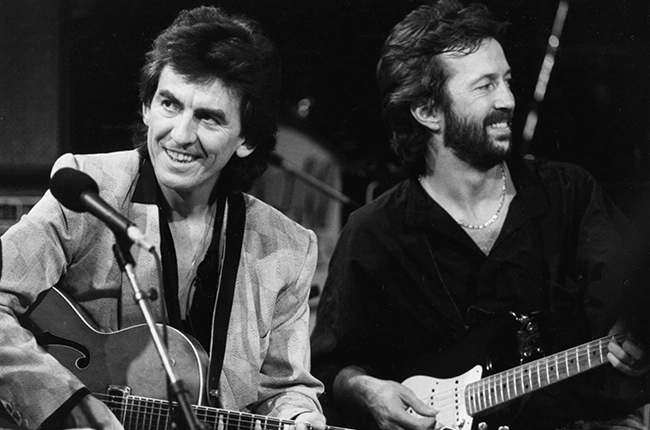
On November 29, 2002 — exactly one year after George Harrison’s death — the Royal Albert Hall in London became the site of one of the most heartfelt tributes in rock history. The Concert for George brought together an extraordinary lineup of musicians who had shared decades of friendship and collaboration with the quiet Beatle, and at the center of it all stood Eric Clapton, who had organized the event and led the house band through the night.
Clapton’s relationship with Harrison stretched back to the mid-1960s, through the highs of songwriting collaborations like “While My Guitar Gently Weeps” and the lows of a complicated personal history involving Harrison’s first wife, Pattie Boyd. By 2002, though, decades of friendship had smoothed over whatever tension once existed, and Clapton’s presence on that stage carried the weight of genuine loss.
The concert featured Harrison’s Traveling Wilburys bandmates Tom Petty and Jeff Lynne, along with Ringo Starr, Paul McCartney, Ravi Shankar’s daughter Anoushka Shankar performing Indian classical pieces Harrison loved, and Harrison’s own son, Dhani, who bore an uncanny resemblance to his father both in looks and in guitar phrasing. Clapton guided the band through a set that spanned Harrison’s Beatles-era songwriting and his solo career, including a devastating rendition of “While My Guitar Gently Weeps,” a song Clapton had famously played on for the White Album in 1968.
What made the night so powerful wasn’t just the star power — it was the sense that everyone on stage genuinely loved the man they were honoring. Harrison had spent his post-Beatles life quietly avoiding the spotlight, focusing on gardening, Formula One racing, and Hindu spirituality rather than chasing fame. The concert reflected that same humility: proceeds went to Harrison’s Material World Charitable Foundation, and the performers treated the night less like a marketing event and more like a private memorial that happened to include an audience.
Clapton has rarely spoken about that night without acknowledging how difficult it was to hold the show together emotionally while also serving as its musical director. Losing Harrison meant losing one of the last links to his own formative years as a musician, a friendship forged before either of them had any idea how far their music would travel.
More than two decades later, footage and recordings from the Concert for George remain a touchstone for fans trying to understand who George Harrison really was beneath the “quiet Beatle” label — a devoted friend, a serious musician, and a man capable of inspiring some of the biggest names in rock to set aside their egos for one unforgettable night.