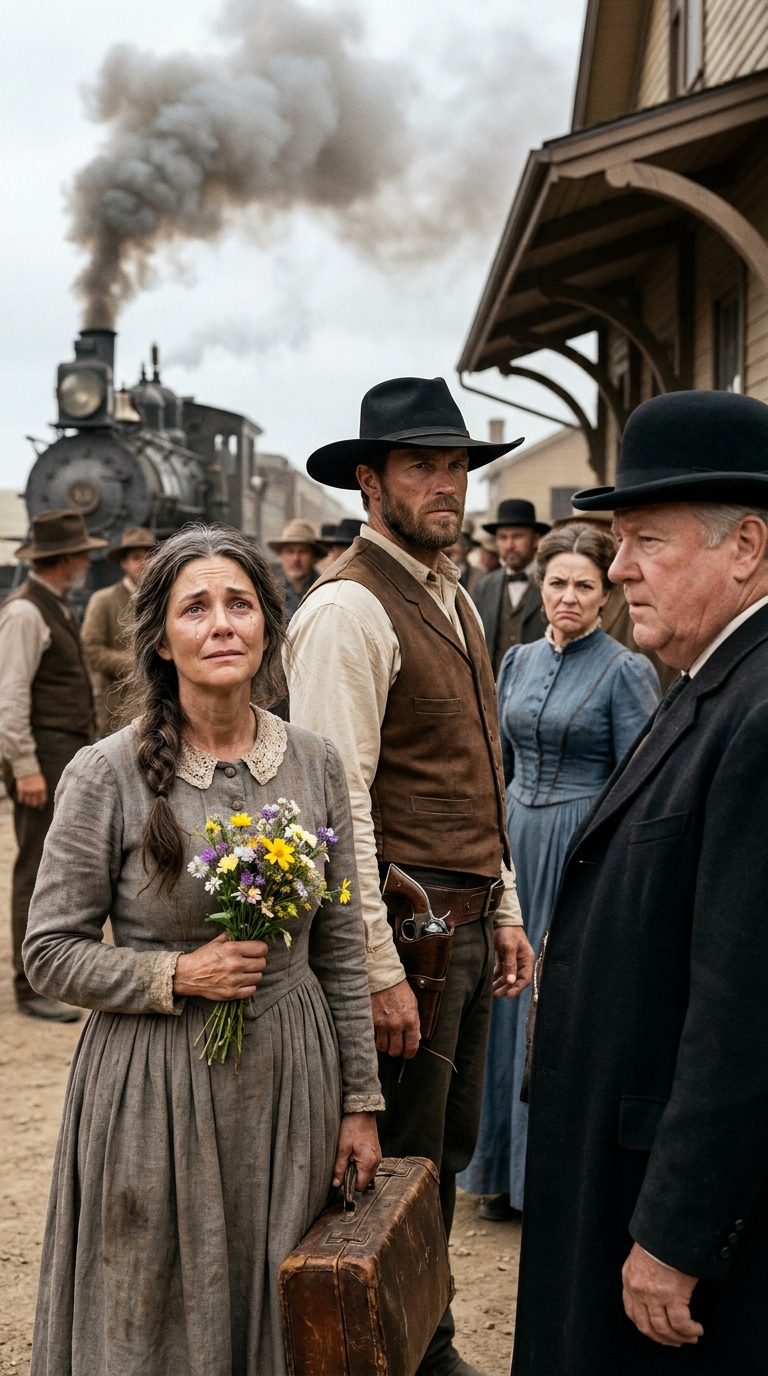
“YOU ORDERED A BRIDE THROUGH THE MAIL, AND THEY SENT YOU AN OLD WOMAN?”
A Montana Western Romance — 1883
Part One: The Bride Nobody Expected
Mercy Creek had been laughing for nearly ten minutes when Wyatt Callahan finally crossed the train platform.
He had heard every joke.
He had seen Deputy Briggs slap his knee, watched the cowboys exchange amused looks, and noticed the women whispering behind their gloved hands. He had even heard someone suggest that the railroad company should refund his money.
But Wyatt wasn’t looking at any of them.
He was looking at the woman standing beside the station bench, holding a battered suitcase as though it contained everything she had left in the world.
Eliza Whitmore was thirty-eight years old.
Her dark brown hair, once thick and entirely black, was now threaded with silver. Her face showed the years she had spent working, worrying, and caring for people who rarely thought to ask whether she was tired. Her gray dress had been carefully mended, and her boots were dusty from nearly two thousand miles of travel.
She was not the young bride the town had imagined.
She was not the pretty twenty-year-old with rosy cheeks and fashionable ribbons that Deputy Briggs had described at the saloon.
She was simply Eliza.
And for the first time in years, she was standing somewhere because she had chosen to be there.
Wyatt stopped in front of her.
He removed his hat.
“Mrs. Whitmore?”
“Miss Whitmore,” she corrected softly. “I haven’t been married.”
“Then Miss Whitmore it is.”
He held out the small bouquet of wildflowers.
“I picked these on the ridge this morning. I wasn’t sure what kind you liked.”
Eliza looked at the flowers.
They were ordinary mountain flowers, some yellow, some white, tied together with a piece of brown string. They were not expensive. They were not arranged by a florist. But someone had gone out into the cold morning to find them for her.
“Thank you,” she whispered.
Wyatt smiled.
“Welcome to Montana.”
Behind them, Deputy Briggs cleared his throat.
“Well, Callahan, are you going to introduce us to your new grandmother?”
The crowd laughed again.
Wyatt slowly turned.
The smile disappeared from his face.
“Her name is Eliza Whitmore.”
Briggs grinned.
“I heard you the first time.”
“Then use it.”
The deputy raised his eyebrows.
“Don’t get sensitive, Wyatt. We’re only having a little fun. You ordered a bride through the mail, and they sent you an old woman. That’s a mighty expensive mistake.”
Wyatt took one step toward him.
“She’s thirty-eight.”
“Old enough to be my mother.”
“Then perhaps your mother taught you better manners.”
The laughter stopped.
Briggs’s grin faded.
Wyatt turned back to Eliza and offered his arm.
“Shall we?”
She hesitated.
The entire station was watching.
“Mr. Callahan…”
“Wyatt.”
“Are you certain?”
“About what?”
“That you still want me to come?”
He looked at her for a long moment.
Then he answered quietly enough that only she could hear.
“I wouldn’t have come to the station with flowers if I didn’t.”
Eliza lowered her eyes.
For sixteen years, she had been a schoolteacher. She had taught children to read, helped young mothers write letters, and stayed after lessons to explain difficult sums to boys who would later forget to thank her.
She had spent her twenties caring for her sick mother and her early thirties helping her younger siblings find their way in the world.
She had never expected applause.
But she had hoped that one day, someone might look at her and see a woman rather than a collection of years.
Wyatt was the first man in a very long time who had done so.
She placed her hand on his arm.
Together, they walked through the station doors.
Behind them, the town remained silent.
But silence, Eliza would soon discover, was not the same as acceptance.
Chapter 1: The Journey to Callahan Ranch
The ride from Mercy Creek to the ranch took almost an hour.
Wyatt drove a sturdy chestnut horse, while Eliza sat beside him on the wooden wagon seat. Her suitcase rested between their feet, and the bouquet lay carefully in her lap.
For the first few minutes, neither spoke.
The town gradually disappeared behind them. Wooden buildings gave way to open grassland, scattered pine trees, and distant hills whose peaks were still covered in snow.
Eliza watched the scenery pass.
She had never seen such a vast landscape.
Back in Missouri, the roads had been narrow, the fields divided by fences, and the houses close enough together that a person could hear a neighbor calling from the next yard.
Here, the land seemed endless.
“Have you ever been this far west?” Wyatt asked.
“No. I’ve never been farther than St. Louis before.”
“Then I imagine this looks different.”
“It looks like a painting.”
Wyatt glanced at her.
“That’s a good way to describe it.”
She smiled faintly.
He returned his attention to the road.
A little later, he pointed toward a line of trees.
“There’s the creek. That’s how Mercy Creek got its name.”
Eliza looked in that direction.
A narrow stream crossed the meadow, its water shining beneath the afternoon sun.
“Your ranch is beyond it?”
“About two miles.”
“Is it a large property?”
“Large enough to keep a man busy.”
“How many cattle?”
“Nearly a hundred and fifty. More if the spring calves survive.”
Eliza nodded.
She had read about ranching in newspapers, but she knew very little about the actual work.
“Do you have help?”
“Two men during the busy season. Sometimes three. At present, it’s mostly me.”
“That must be difficult.”
“It can be.”
She looked at him.
“Why did you decide to find a wife?”
Wyatt’s hands tightened slightly around the reins.
“That’s a fair question.”
“I’m not trying to pry.”
“I know.”
He was quiet for a moment.
“My father died when I was twenty-seven. My mother passed away a few years later. I stayed on the property, and the years went by.”
“Did you never marry?”
“No.”
“Did you never wish to?”
Wyatt gave a small, thoughtful smile.
“I suppose I did. But wishing and doing are different things.”
Eliza understood that more than he knew.
For years, she had wished for a home of her own. She had imagined a husband who might sit beside her after supper, someone who would ask about her day, someone who would notice if she were missing.
But wishing had never been enough to change her circumstances.
“What about you?” Wyatt asked.
“I was engaged once.”
He turned his head slightly.
“How long ago?”
“Twenty years ago.”
“That’s a long time.”
“His name was Thomas. We were both young. He wanted to move to Kansas and start a business. I was supposed to go with him.”
“What happened?”
“My mother became ill. I couldn’t leave her.”
“Did he wait?”
“For a while.”
Eliza watched the road.
“Then he wrote that he could not put his life on hold forever. I told him he should go.”
“Did you want him to stay?”
She considered the question.
“Yes.”
Wyatt waited.
“But I couldn’t ask him to give up his future because my mother needed me.”
He nodded.
“And after that?”
“After that, I became a teacher. My younger brother and sister needed help. There was always something that had to be done.”
She gave a small smile.
“Eventually, there were no more emergencies. My brother married, my sister moved to Chicago, and my mother was gone. I looked around and realized that everyone had built a life except me.”
Wyatt said nothing for a while.
Then he asked, “Do you regret it?”
Eliza looked down at the bouquet.
“Some days.”
“That’s honest.”
“I loved my mother. I loved my brother and sister. I don’t regret caring for them. But sometimes I wonder what my life might have been if I had been allowed to choose something for myself.”
Wyatt slowed the horse as they approached the creek.
“Perhaps you still can.”
Eliza looked at him.
He did not say it like a promise that everything would be easy. He said it as though he genuinely believed she had a future worth choosing.
She turned toward the landscape again.
And for the first time since stepping off the train, she began to feel that perhaps she had not made a mistake.
The ranch appeared beyond a small rise.
It was a modest property, but it was beautiful. A white farmhouse stood near a line of cottonwood trees. Behind it were a barn, a stable, a fenced pasture, and a windmill turning slowly in the breeze.
A dog barked from the porch.
Wyatt smiled.
“That’s Ranger. He thinks he owns the place.”
The dog ran toward the wagon, tail moving wildly.
Eliza laughed.
It was a small sound, but Wyatt noticed.
He had not heard a woman laugh in his home for a very long time.
When the wagon stopped, Wyatt climbed down and helped her.
“Welcome to Callahan Ranch.”
Eliza looked at the farmhouse.
It was not grand.
The paint was peeling near the porch. One shutter hung slightly crooked, and the garden was mostly bare.
But smoke rose from the chimney.
There was a rocking chair beside the front door.
And the house looked warm.
“Thank you,” she said.
Wyatt took her suitcase.
“Come inside. I’ll show you around.”
Chapter 2: A House With an Empty Room
The farmhouse had three rooms downstairs and two bedrooms upstairs.
The main room contained a large fireplace, a wooden table, four chairs, and a bookcase filled with old newspapers and farming ledgers.
The kitchen was small but clean.
A copper kettle sat on the stove, and several pots hung from hooks above the counter.
Wyatt carried Eliza’s suitcase upstairs.
“This room belonged to my mother,” he explained, opening a door at the end of the hallway.
Eliza stepped inside.
The room was simple. A narrow bed stood against one wall, with a quilt folded neatly at the foot. There was a dressing table, a small wardrobe, and a window overlooking the pasture.
“Would you prefer this room?”
Eliza looked around.
“It is lovely.”
“My mother kept it this way. I haven’t changed much.”
“Thank you.”
Wyatt placed the suitcase near the wardrobe.
“There’s another bedroom across the hall. That’s mine. I’ll stay there.”
Eliza turned toward him.
“You’re giving me your mother’s room?”
“It seems right.”
“But this is your house.”
“And you’re my guest.”
She looked at him.
“Your bride, according to the letters.”
Wyatt nodded.
“Yes. But I think we should get to know each other before we start pretending we’re something we’re not.”
The words surprised her.
She had expected a formal marriage arrangement, perhaps even a husband who believed that paying for her journey gave him the right to demand obedience.
Instead, Wyatt seemed more concerned with making sure she was comfortable.
“Do you want me to call you Mrs. Callahan?” he asked.
Eliza shook her head.
“Not yet.”
“Then Eliza it is.”
He started toward the door.
“There’s a washbasin on the table. I’ll bring hot water. Supper will be ready in an hour.”
She watched him leave.
Then she sat on the edge of the bed.
For a long moment, she simply looked around the room.
A woman had slept there once.
A woman had placed her hairbrush on that dressing table and opened the curtains every morning. She had probably watched the same pasture through the same window.
Eliza felt a strange sadness.
She wondered what Wyatt’s mother had been like.
Perhaps she had been the sort of woman who remembered birthdays and made preserves in summer. Perhaps she had sat in the rocking chair downstairs and waited for her son to return from the fields.
Eliza opened the wardrobe.
It was empty except for a folded shawl.
She touched the fabric.
Then she closed the door.
When Wyatt returned with hot water, she was standing beside the window.
“Everything all right?”
“Yes. Thank you.”
He set the basin down.
“If you need anything, just ask.”
“I will.”
He hesitated.
“There’s something else.”
Eliza turned.
“The people in town can be unkind. They like to talk. Don’t let them convince you that their opinions matter more than your own.”
She gave a faint smile.
“Are they always like that?”
“Not all of them. But some.”
“Deputy Briggs?”
Wyatt’s expression hardened.
“Especially Briggs.”
“Why does he dislike you?”
“He doesn’t dislike me. He likes making people uncomfortable. There’s a difference.”
“Have you known him long?”
“Since we were boys.”
“Then perhaps he knows how to push your buttons.”
Wyatt gave a short laugh.
“That he does.”
Eliza smiled.
He looked at her for a moment.
Then he said, “I’ll leave you to rest.”
“Wyatt?”
He stopped.
“Thank you for coming to the station.”
He nodded.
“You’re welcome.”
“And for the flowers.”
He looked toward the small bouquet she had placed on the dressing table.
“They looked better in the field.”
“I think they’re beautiful.”
For the first time, Wyatt appeared genuinely embarrassed.
He touched the brim of his hat.
“Well, I’ll see you downstairs.”
When he left, Eliza opened the window a little.
The air smelled of grass, wood smoke, and distant rain.
She placed the wildflowers in a glass jar.
They were not perfect.
Some petals were bent, and one stem was broken.
But she liked them.
They were the first flowers anyone had ever brought her simply because she was coming.
Chapter 3: The First Supper
Wyatt had prepared beef stew, potatoes, and fresh bread.
Eliza entered the kitchen wearing a clean blouse and the same gray dress.
He stood beside the stove.
“I hope you like stew.”
“I do.”
“Good. It’s the one thing I can cook without ruining.”
She smiled.
“Then we’re already ahead of yesterday’s possibilities.”
Wyatt looked puzzled.
“Yesterday?”
“On the train, I was wondering whether I would be able to cook for you.”
He laughed.
“Then we can learn together.”
They sat across from each other at the table.
At first, their conversation was careful.
Wyatt asked about her teaching career. Eliza described the little schoolhouse where she had worked, the children who had attended, and the trouble she had once had with a boy who insisted that the alphabet contained twenty-seven letters.
Wyatt listened with genuine interest.
“Twenty-seven?”
“He counted the letter W twice.”
“Perhaps he was trying to be clever.”
“He was trying to avoid his spelling lesson.”
Wyatt smiled.
Eliza asked about the ranch.
He explained how he bought his first cattle, how a winter storm had destroyed part of the north fence, and how he had spent three days repairing it.
“You must be very proud of this place.”
“I am.”
“Did you build the house?”
“My father built most of it. I repaired it after he died.”
“Then it has been in your family for a long time.”
“Almost forty years.”
Eliza looked around the room.
“That explains why it feels lived in.”
Wyatt followed her gaze.
“It has been quiet for a while.”
She lowered her eyes.
“I hope I don’t disturb too much.”
He looked at her.
“Eliza, I didn’t send for a wife so I could keep living exactly as I did before.”
She was silent.
“I know the town made a spectacle of your arrival,” he continued. “I am sorry you had to hear those things.”
“It wasn’t your fault.”
“It happened because of me.”
“People will laugh about something whether they have a reason or not.”
“That doesn’t make it right.”
Eliza folded her napkin.
“May I ask you something?”
“Anything.”
“Did you expect someone younger?”
Wyatt leaned back.
“No.”
“Not even a little?”
He considered the question.
“I expected someone willing to share a life with me. I didn’t ask the agency to find a young woman. I asked them to find someone who understood that marriage is work, patience, and companionship.”
“How did you know I understood that?”
“I read your letter.”
Eliza looked surprised.
“My letter?”
“The one you sent with your application. You wrote that you had spent sixteen years teaching children, that you had cared for your mother, and that you wanted a peaceful home where two people could treat each other with respect.”
She remembered writing it.
She had been embarrassed by how much she had revealed.
“I thought it sounded foolish.”
“I thought it sounded honest.”
Wyatt put down his spoon.
“I don’t need a woman who can pretend to be twenty. I need someone who knows who she is.”
Eliza felt her eyes sting.
She looked down at her plate.
“Thank you.”
They finished supper in a comfortable silence.
Afterward, Wyatt carried the dishes to the kitchen.
Eliza rose to help.
“You don’t have to.”
“I know.”
“You’re tired.”
“So are you.”
He looked at her.
Then he handed her a towel.
“All right. You dry. I’ll wash.”
They stood side by side at the sink.
Their shoulders did not touch.
But neither seemed eager to move away.
Chapter 4: The Town That Had Already Judged Her
The following morning, Eliza woke to the sound of a rooster.
She dressed, pinned her hair, and went downstairs.
Wyatt had already left for the barn.
A note lay on the kitchen table.
Gone to check the north pasture. Coffee is in the pot. There’s bread in the cupboard. I’ll be back before noon.
She smiled at the note.
It was the first time a man had ever left her a message about breakfast.
After eating, she decided to unpack properly.
She placed her dresses in the wardrobe, folded her undergarments into the drawer, and arranged her books on the dressing table.
Among them was a small leather-bound notebook containing the names of former pupils.
She opened it.
On the first page, she had written:
Children I have taught and the things I hope they remember.
Her throat tightened.
She had not expected to miss the schoolhouse so quickly.
At noon, Wyatt returned.
“I need to go into town tomorrow,” he said. “We have to collect flour and lamp oil.”
“May I come?”
“Of course.”
“I’d like to see the town.”
He studied her expression.
“Are you sure?”
“Yes.”
“Then we’ll go together.”
The next morning, they drove into Mercy Creek.
The town was small, with a general store, a blacksmith, a church, a schoolhouse, a saloon, and a hotel.
As they passed the main street, people looked up.
Some nodded.
Others whispered.
Eliza kept her back straight.
She had decided that she would not hide simply because strangers had chosen to be cruel.
At the general store, Mr. Harris greeted Wyatt.
“Morning, Callahan.”
“Morning.”
Mr. Harris looked at Eliza.
“And this must be your new bride.”
“Eliza Whitmore.”
“Welcome to Mercy Creek, ma’am.”
“Thank you.”
Mr. Harris was a broad man with a white mustache and a friendly expression.
“Your husband tells me you came all the way from Missouri.”
“Yes.”
“That’s quite a journey.”
“It was.”
“Well, we’re glad you made it.”
Eliza smiled.
Wyatt began listing the supplies he needed.
While Mr. Harris collected them, a woman approached.
She was elegantly dressed in a blue traveling gown and wore a large hat decorated with feathers.
Her name was Margaret Bell.
She was the wife of the town’s most successful banker.
“Wyatt,” she said.
He turned.
“Mrs. Bell.”
Margaret’s gaze moved toward Eliza.
“So this is the famous bride.”
Eliza offered her hand.
“Eliza Whitmore.”
Margaret glanced at the hand but did not take it.
“Margaret Bell.”
The pause was uncomfortable.
“I hope the journey wasn’t too difficult,” Margaret said.
“It was long, but I arrived safely.”
“How fortunate.”
Margaret looked at Wyatt.
“I must say, you surprised us all.”
Wyatt’s expression remained calm.
“Did I?”
“Well, everyone expected someone quite different.”
“Everyone seems to have an opinion.”
Margaret gave a thin smile.
“People are only curious.”
Eliza lowered her hand.
Margaret turned back toward her.
“Tell me, dear, how old are you?”
Wyatt’s jaw tightened.
Eliza answered before he could.
“Thirty-eight.”
Margaret raised her eyebrows.
“My goodness.”
Eliza looked directly at her.
“Is there a problem?”
“Not at all. I simply hadn’t expected…”
“Someone my age?”
Margaret’s smile became strained.
“Well, yes.”
Eliza nodded.
“I imagine that must have been disappointing.”
Margaret blinked.
Wyatt looked at Eliza with quiet surprise.
Eliza continued.
“But I should tell you that I am not disappointed. I have spent enough years worrying about what other people expected of me. I don’t intend to spend the rest of my life doing that.”
Mr. Harris suddenly became very interested in arranging a row of canned goods.
Margaret’s cheeks turned pink.
“Of course.”
She turned and walked away.
Wyatt waited until she was outside.
Then he looked at Eliza.
“That was well said.”
“I hope I wasn’t rude.”
“You weren’t.”
“I don’t want trouble.”
“Neither do I. But you have a right to defend yourself.”
Eliza smiled.
For the first time, she began to understand that being Wyatt Callahan’s wife might mean having someone stand beside her.
Not in front of her.
Beside her.
Chapter 5: A Place at the Schoolhouse
Three days later, Eliza discovered that Mercy Creek had a small schoolhouse.
It stood at the edge of town, near a grove of cottonwood trees. The building was weathered, and one of its windows had been boarded up.
She stopped her wagon outside.
“Is that the school?”
Wyatt looked over.
“Yes.”
“Does it still operate?”
“Most days.”
“Most days?”
He shrugged.
“The teacher left last month. Her husband found work in Helena.”
Eliza looked at the building.
“Who teaches the children now?”
“Nobody regularly. Some parents take turns. Reverend Miller helps when he can.”
“How many children?”
“Perhaps twenty.”
Eliza looked at him.
“Wyatt, would you mind if I went inside?”
“Not at all.”
They entered.
The room smelled of chalk, old wood, and dust.
There were several small desks, a blackboard, and a shelf of books.
Eliza walked slowly between the desks.
She touched the top of one.
Then she turned toward Wyatt.
“May I ask something?”
“Go ahead.”
“Would the town object if I offered to teach here?”
Wyatt looked at her.
“You want to teach again?”
“I think so.”
“You haven’t been here a week.”
“I know.”
“You’re allowed to rest.”
Eliza smiled.
“I have rested enough.”
He considered her words.
“Then I’ll speak with the school committee.”
“Thank you.”
He studied her face.
“Are you sure this is what you want?”
“Yes.”
“Then we’ll see what can be arranged.”
The school committee met two evenings later.
There were four members: Reverend Miller, Mr. Harris, a farmer named Thomas Reed, and Deputy Briggs.
Eliza attended with Wyatt.
Reverend Miller welcomed them.
“Miss Whitmore, I understand you have experience teaching.”
“Sixteen years.”
“That’s impressive.”
Deputy Briggs leaned back in his chair.
“Sixteen years teaching in Missouri doesn’t mean she can handle Montana children.”
Eliza looked at him.
“Children are children, Deputy.”
He smirked.
“These ones are different.”
“How?”
“They’re stubborn.”
Eliza smiled.
“So was the boy who once tried to convince me that the alphabet had twenty-seven letters.”
Mr. Harris laughed.
Even Reverend Miller smiled.
Briggs looked annoyed.
Thomas Reed asked, “What subjects can you teach?”
“Reading, writing, arithmetic, geography, and basic history.”
“Can you teach older pupils?”
“Yes.”
“Would you be willing to help children who have fallen behind?”
“Of course.”
Reverend Miller nodded.
“I think we should give her the opportunity.”
Briggs folded his arms.
“I still think it’s a mistake.”
Eliza looked at him.
“Deputy, you have not seen me teach a single lesson.”
“And I know what I see.”
She paused.
Then she said quietly, “No. You know what you assume.”
The room went still.
Wyatt sat beside her, his expression unreadable.
Finally, Mr. Harris spoke.
“I vote we give Miss Whitmore a trial month.”
Thomas Reed agreed.
Reverend Miller raised his hand.
“Agreed.”
Briggs looked around.
He was outnumbered.
“Fine. One month.”
Eliza thanked them.
As she and Wyatt walked out, she felt a strange happiness.
She had come west to become someone’s wife.
But perhaps she could also become herself again.
Chapter 6: The Children Who Needed Her
Eliza’s first day at the schoolhouse began with rain.
Three children arrived late, two forgot their books, and one boy refused to sit down.
His name was Samuel Reed.
He was eleven years old, with unruly blond hair and a stubborn expression.
“My father says I don’t need to learn all this,” he announced.
Eliza placed her book on the desk.
“Your father must be a very wise man.”
Samuel looked surprised.
“He is.”
“Then he probably knows that a person who can read has more choices than a person who cannot.”
Samuel frowned.
“I can read.”
“Then you won’t mind reading this page.”
She handed him a book.
He took it reluctantly.
He stumbled over the first sentence.
Then the second.
By the third, his ears had turned red.
Eliza waited patiently.
“Take your time.”
He tried again.
This time, he managed the sentence.
“Very good,” she said.
Samuel looked at her suspiciously.
“You’re not going to make fun of me?”
“Why would I?”
“Because I read slow.”
“Everyone learns at a different pace.”
He stared at her.
Then he sat down.
By the end of the week, Samuel was arriving early.
Other children began bringing their younger siblings.
Eliza taught them reading, writing, arithmetic, and geography. She also encouraged them to ask questions.
Sometimes she read aloud from adventure books.
Sometimes she made the children draw maps of the world.
And sometimes, when a child seemed troubled, she allowed them to talk.
One afternoon, a little girl named Annie came to her desk.
“Miss Whitmore?”
“Yes, Annie?”
“Can I ask something?”
“Of course.”
“Are you really old?”
Eliza smiled.
“That depends on whom you ask.”
Annie considered this.
“Mrs. Bell says you’re too old to be a bride.”
Eliza felt a small ache in her chest.
She knelt beside the girl.
“People sometimes say things they don’t understand.”
“But are you too old?”
Eliza looked at her carefully.
“No, sweetheart. I’m not too old to be loved.”
Annie smiled.
“That’s good.”
“Why?”
“Because Mr. Callahan looks happy when you come to the school.”
Eliza laughed softly.
“Does he?”
Annie nodded.
“He waits outside sometimes.”
Eliza glanced toward the window.
Wyatt was indeed standing near the fence, holding a sack of flour.
He had come to town to deliver supplies and had stopped to see whether she needed a ride.
Eliza felt her cheeks warm.
“Well, I suppose I should thank him.”
Annie giggled.
The children returned to their lessons.
That evening, Eliza told Wyatt what Annie had said.
He looked surprised.
“She noticed that?”
“Apparently.”
Wyatt smiled.
“Children notice more than adults think.”
Eliza looked at him.
“Why do you wait outside?”
He shrugged.
“I like knowing you’re all right.”
She smiled.
“That’s a very good reason.”
He took her hand as they walked toward the wagon.
It was the first time he had held it in public.
And this time, Eliza did not worry about who might be watching.
Chapter 7: The Photograph in the Drawer
One Sunday afternoon, Eliza was cleaning the upstairs bedroom when she found a small wooden box inside the bottom drawer of the dressing table.
She hesitated before opening it.
Inside were several photographs, a faded ribbon, and a folded letter.
The first photograph showed a young woman standing beside Wyatt.
She was perhaps twenty-five, with light hair and a serious expression.
Eliza studied the picture.
She wondered whether this was the woman Wyatt had loved.
She placed it carefully on the table.
Then she opened the letter.
It was dated twelve years earlier.
Dear Wyatt,
I have thought about our conversation many times. You are a good man, and I know you mean well, but I cannot spend my life waiting for you to decide whether you want a family.
I hope you find the courage to choose happiness one day.
Margaret.
Eliza stopped.
Margaret Bell.
She read the letter again.
The woman in the photograph was the same Margaret who had refused to shake her hand at the general store.
A strange feeling settled in her stomach.
She returned the letter to the box.
When Wyatt came upstairs later, he found her sitting beside the dressing table.
“Everything all right?”
Eliza looked at him.
“I found something.”
She showed him the photograph.
Wyatt’s expression changed.
“Where did you find that?”
“In the drawer.”
He took the box.
For a moment, he seemed to be deciding whether to explain.
“Margaret and I were close once.”
“How close?”
“We were engaged.”
Eliza looked at him.
“She was your fiancée?”
“Yes.”
“Why didn’t you tell me?”
Wyatt sat on the edge of the bed.
“Because it ended a long time ago.”
“Does she still care for you?”
“I don’t know.”
“She certainly seems interested in your marriage.”
Wyatt sighed.
“Margaret has always believed she knows what’s best for everyone.”
Eliza looked down.
“Did you love her?”
He was quiet.
“I thought I did.”
“And now?”
“Now I understand that I was in love with the idea of a life I thought I was supposed to have.”
Eliza looked at him.
“What does that mean?”
“Margaret wanted a wealthy husband, a large house, and a place in town society. I wanted a wife who would be happy living on a ranch. We were both trying to fit into something that didn’t suit us.”
He returned the photograph to the box.
“She left. I let her.”
“Do you regret it?”
“Not anymore.”
Eliza nodded slowly.
Then she asked the question that had been bothering her.
“Did you send for me because you wanted someone to take her place?”
Wyatt looked directly at her.
“No.”
“Are you certain?”
“Eliza, I didn’t ask the agency for a woman who looked like Margaret. I didn’t ask for a younger woman. I asked for someone who wanted a quiet life and understood that companionship matters.”
He paused.
“I read your letter, and I liked the woman who wrote it.”
Eliza’s eyes softened.
“I was afraid you would compare us.”
“I won’t.”
She looked toward the photograph.
“She is beautiful.”
Wyatt followed her gaze.
“That may be true.”
He turned back to Eliza.
“But beauty was never what made me want to spend my life with someone.”
She did not answer.
He reached for her hand.
“And I hope you never feel you have to compete with a memory.”
Eliza squeezed his fingers.
“I don’t want to.”
“Good.”
He leaned forward and kissed her forehead.
For the first time, she felt that the past was not something standing between them.
It was simply something they had both survived.
Chapter 8: The Man Who Wanted to Humiliate Her
The trouble began at the Mercy Creek Harvest Social.
Every September, the town held a celebration in the church hall. There was music, food, dancing, and a small auction to raise money for the school.
Eliza had been asked to help organize the children’s reading exhibition.
She spent two weeks preparing it.
The children wrote short stories, drew pictures, and copied poems. Samuel Reed even wrote a story about a cowboy who rescued a lost dog.
Eliza was proud of them.
On the evening of the social, she wore her best dress.
It was still the gray one she had arrived in, but she had cleaned it carefully and added a small lace collar she had sewn herself.
Her hair was pinned neatly at the back.
Wyatt waited by the wagon.
When she stepped outside, he looked at her.
“You look lovely.”
Eliza smiled.
“It’s the same dress.”
“I know.”
“Then how can I look different?”
“Because you look happy.”
She lowered her eyes.
He offered his arm.
“Shall we?”
The church hall was crowded.
People greeted Wyatt, and several women complimented Eliza’s work with the children.
For the first hour, the evening went well.
Then Deputy Briggs arrived.
He was already drinking.
He approached the table where Eliza had arranged the children’s stories.
“Well, Miss Whitmore. I see you’ve made yourself useful.”
Eliza turned.
“Good evening, Deputy.”
He picked up one of the papers.
“What’s this?”
“Samuel Reed’s story.”
Briggs read the first few lines.
“Terrible handwriting.”
“He’s improving.”
“Maybe you should teach him to hold a pencil before you teach him to write stories.”
Eliza kept her voice calm.
“He is eleven. He has made remarkable progress.”
Briggs laughed.
“Remarkable? Is that what we’re calling it?”
Wyatt approached.
“Leave her alone, Briggs.”
The deputy turned.
“Don’t start, Callahan. We’re having a conversation.”
“No. You’re trying to embarrass my wife.”
Briggs looked at Eliza.
“Your wife? You mean the woman the railroad delivered?”
A few people nearby became quiet.
Wyatt’s face hardened.
Briggs continued.
“Tell me something, Mrs. Callahan. Did you ever imagine you’d be marrying a rancher at your age? Or was this your last chance?”
Eliza felt the familiar heat of humiliation rise in her face.
For a moment, she was back on the train platform.
She could hear the laughter.
She could see the people staring.
But this time, she did not lower her eyes.
“Deputy Briggs,” she said clearly, “I have spent sixteen years teaching children to read. I have cared for a dying mother. I have helped two younger siblings build their lives. I have traveled nearly two thousand miles to begin a new one of my own.”
She stepped closer.
“I know exactly how old I am. I know what I have lost. I also know what I have earned.”
Briggs opened his mouth.
Eliza continued.
“You may believe a woman’s worth disappears when her hair turns gray. But that says more about your understanding of women than it does about mine.”
The room was silent.
She placed Samuel’s story back on the table.
“And if you wish to criticize a child’s handwriting, I suggest you first learn to write something worth reading yourself.”
Someone near the doorway laughed.
Then another person did.
Briggs turned red.
Wyatt looked at Eliza with unmistakable pride.
The deputy threw the paper down and walked away.
Eliza’s hands trembled.
Wyatt took them gently.
“Are you all right?”
She nodded.
“I think so.”
“You were magnificent.”
She gave a small, breathless laugh.
“I was terrified.”
“That doesn’t make it any less magnificent.”
He kissed her hand.
And for the first time, the people of Mercy Creek saw Eliza Whitmore not as the older bride who had arrived unexpectedly, but as a woman who would not allow them to decide her value.
Chapter 9: A Dance She Had Waited Twenty Years For
After the incident with Briggs, Reverend Miller approached Eliza.
“Miss Whitmore, would you do us the honor of opening the dance?”
Eliza looked surprised.
“I don’t know if I should.”
“Why not?”
She glanced at Wyatt.
He smiled.
“I would be honored.”
The musicians began a slow waltz.
Wyatt offered his hand.
Eliza placed hers in it.
They stepped onto the floor.
At first, she felt awkward.
She had not danced in years. Her last dance had been at a church gathering when she was eighteen.
Wyatt guided her carefully.
“Just follow me.”
“I’m afraid I’ll step on your boots.”
“I’ve survived cattle stampedes. I can survive that.”
She laughed.
They moved slowly beneath the lanterns.
Around them, couples danced, and children ran between the tables.
Eliza looked up at Wyatt.
“Thank you.”
“For what?”
“For not being ashamed of me.”
He stopped slightly.
“Why would I be ashamed of you?”
“Because people keep reminding me that I’m not what they expected.”
Wyatt’s expression softened.
“Eliza, I have spent most of my life watching people chase things they think will make them happy. Money. Beauty. Status. Approval.”
He looked into her eyes.
“I don’t want any of those things as much as I want to come home and find you there.”
Her eyes filled.
“Wyatt…”
“I’m not saying this because we’re married on paper. I’m saying it because I mean it.”
She rested her head against his shoulder.
The music continued.
And in that small church hall, under the warm light of lanterns, Eliza finally experienced something she had thought was lost to her forever.
She felt cherished.
Chapter 10: The Letter From Her Sister
A week later, a letter arrived from Missouri.
Eliza recognized her sister’s handwriting.
She sat at the kitchen table and opened it.
Dear Eliza,
I hope you are well. I have been thinking about you since your last letter. I cannot tell you how surprised I was to hear that you had married a rancher in Montana.
I must confess that I was worried. You have always been too willing to sacrifice your happiness for others.
I remember how you cared for Mother. I remember how you paid for my lessons and helped Thomas find work. You gave us everything you had.
I wish I had told you more often how much it meant.
I hope this new life gives you something in return.
Please tell me about your husband. Is he kind? Are you happy?
With love,
Clara.
Eliza read the letter twice.
Then she began to cry.
Wyatt entered the kitchen and found her wiping her eyes.
“Bad news?”
She shook her head.
“My sister.”
He sat beside her.
“What did she say?”
Eliza handed him the letter.
He read it quietly.
When he finished, he placed it on the table.
“She loves you.”
“I know.”
“Then write back.”
Eliza nodded.
She dipped her pen into the ink.
For several minutes, she stared at the blank page.
Then she began.
Dear Clara,
I am well. Better than I expected.
The mountains are beautiful, and the ranch is peaceful. Wyatt is a good man. He is not a man of many words, but he listens carefully, and he has never made me feel small.
I am teaching again. The children are wonderful, and I have begun to feel useful in a way I had forgotten.
You asked whether I am happy.
I think I am learning what happiness feels like.
For many years, I believed that my life had already happened. I thought the best years were behind me, and that I should simply be grateful for whatever remained.
But I was wrong.
There is still laughter ahead. There are still new places to see and new people to love.
And there is still time.
I wish you could see the flowers outside my window. Wyatt brought me some on the day I arrived. I have kept them pressed inside a book.
They remind me that sometimes the most beautiful things arrive when we have stopped expecting them.
With love,
Eliza.
She folded the letter.
Wyatt stood behind her and rested his hands gently on her shoulders.
“That was beautiful.”
Eliza smiled.
“I hope she understands.”
“I think she will.”
He leaned down and kissed her hair.
Chapter 11: The Storm That Changed Everything
Autumn passed.
The ranch grew quieter as the weather turned colder.
Wyatt spent long days preparing for winter. He repaired the stable roof, stacked firewood, and checked the cattle.
Eliza continued teaching.
The children had grown fond of her, and the schoolhouse was now one of the busiest places in town.
But one afternoon, a storm arrived earlier than expected.
Dark clouds rolled over the mountains.
The wind grew violent.
Wyatt was away with the cattle when the first heavy snow began.
Eliza was at the schoolhouse with five children whose parents had not yet arrived.
She sent the younger ones home with their older siblings, but Samuel Reed remained.
“My father is out checking the south pasture,” he said. “He told me to wait here.”
Eliza looked outside.
The snow was already covering the road.
“Then we’ll wait together.”
She closed the shutters and added wood to the stove.
An hour passed.
Then another.
The wind shook the building.
Samuel sat near the fire, trying to hide his fear.
“Miss Whitmore?”
“Yes?”
“Do you think my father is all right?”
Eliza sat beside him.
“I’m sure he’s doing everything he can to get home.”
“What if he can’t?”
“Then we’ll keep the fire burning until he can.”
Samuel looked at her.
“Like a lighthouse?”
She smiled.
“Exactly like a lighthouse.”
The storm continued.
Near dusk, someone knocked on the door.
Eliza opened it cautiously.
Wyatt stood outside, covered in snow.
“Eliza!”
She hurried toward him.
“You’re freezing!”
“I’m all right. Is Samuel here?”
The boy rushed forward.
“Mr. Callahan!”
Wyatt placed a hand on his shoulder.
“Your father is safe. He’s at the Reed farm. The road near the creek is blocked, so I’ll take you there once the wind settles.”
Samuel sighed with relief.
Eliza looked at Wyatt.
“How did you find us?”
“I saw the light in the schoolhouse.”
She stared at him.
He smiled faintly.
“Some things are worth following.”
Eliza felt tears gather in her eyes.
They waited until the storm weakened.
Then Wyatt took Samuel home.
When they returned to the ranch, it was late.
Eliza helped Wyatt remove his wet coat.
His hands were cold.
She brought him hot tea and placed a blanket over his shoulders.
“You shouldn’t have gone out in that weather.”
“I couldn’t leave you waiting.”
“I was safe.”
“I know.”
He looked at her.
“But I wanted to be here.”
She sat beside him.
For a long moment, they listened to the fire.
Then Wyatt said something she had never expected to hear.
“I was afraid today.”
Eliza turned.
“Of the storm?”
“Of not getting back to you.”
She placed her hand over his.
“You’re home now.”
He looked at her.
“Yes.”
And for the first time, Wyatt understood that he had something to lose.
It was no longer simply a ranch.
It was no longer a quiet house.
It was Eliza.
And he loved her.
Chapter 12: The Truth About the Mail-Order Agency
Winter settled over Montana.
One morning, a letter arrived from the marriage agency in St. Louis.
It was addressed to Wyatt.
He opened it at the kitchen table.
The letter contained a formal request for confirmation that the marriage arrangement had been completed.
It also included a short note from the agency’s manager.
Dear Mr. Callahan,
We hope the arrival of Miss Whitmore has met your expectations. We understand there was some confusion among the townspeople regarding her age. We trust the matter has been resolved.
Wyatt read the note twice.
Then he folded it.
Eliza entered with a basket of laundry.
“Something wrong?”
“No.”
She noticed the letter.
“Is that from the agency?”
“Yes.”
“What do they want?”
“Confirmation that you arrived safely.”
Eliza set the basket down.
“Then you should tell them.”
Wyatt looked at her.
“I have something else to ask.”
“What?”
“Would you like to have a proper wedding?”
She blinked.
“A wedding?”
“Yes.”
“But we’re already married.”
“On paper. We signed the agreement before you left Missouri. We haven’t had a ceremony.”
Eliza looked at him.
“Why now?”
“Because I want to stand beside you in front of the people who laughed at you and tell them that I chose you.”
Her eyes filled.
“You don’t have to prove anything to them.”
“I know.”
“Then why?”
Wyatt took her hand.
“Because I want to remember the day I married you as something more than a piece of paper and a train ticket.”
Eliza smiled.
“Would you really want to do that?”
“I would.”
She looked toward the window.
Snow covered the pasture.
The world outside was white and still.
“Then yes.”
Wyatt smiled.
“Yes?”
“Yes, Wyatt.”
He stood and pulled her gently into his arms.
They remained there for a long time.
The agency letter lay forgotten on the table.
Chapter 13: The Wedding Nobody Expected
Reverend Miller agreed to perform the ceremony in the church.
Eliza wore a new dress.
It was not expensive, but it was beautiful. Cream-colored fabric, long sleeves, a modest collar, and a small arrangement of wildflowers pinned near her shoulder.
Her hair was arranged in soft waves, with the silver strands left visible.
She refused to dye it.
“I spent years trying to hide the things that made me look tired,” she told Clara in a letter. “I think I have earned the right to wear my age honestly.”
Wyatt wore a dark suit that had belonged to his father.
The church filled quickly.
People who had once laughed at the station platform now came to see the ceremony.
Some were curious.
Some were ashamed.
Some genuinely wanted to celebrate.
Deputy Briggs stood near the back.
Margaret Bell sat beside her husband.
When Eliza entered, the room became quiet.
Wyatt stood at the front.
He looked at her as though the entire world had disappeared.
Eliza walked slowly down the aisle.
When she reached him, he took her hands.
Reverend Miller began.
“Marriage is not the joining of two perfect people. It is the promise that two imperfect people will continue choosing one another.”
Wyatt looked into Eliza’s eyes.
“I promise to respect you, to listen to you, and to stand beside you when the world is unkind. I promise to make this home a place where you never have to question whether you belong.”
Eliza’s lips trembled.
Then she spoke.
“I promise to share your burdens, your joys, and your ordinary days. I promise to tell you the truth, to laugh with you, and to remember that love is not something we earn by becoming younger, prettier, or more useful. It is something we give freely.”
Reverend Miller smiled.
“Then, by the authority entrusted to me, I pronounce you husband and wife.”
Wyatt kissed her.
The church erupted in applause.
Eliza laughed through her tears.
And somewhere near the back, Deputy Briggs lowered his head.
He did not clap.
But he did not laugh either.
Chapter 14: The Apology
After the ceremony, people gathered outside the church.
Wyatt was speaking with Mr. Harris when Deputy Briggs approached Eliza.
She saw him coming.
Her expression became cautious.
“Mrs. Callahan.”
“Deputy.”
He removed his hat.
“I wanted to say something.”
Eliza waited.
Briggs looked uncomfortable.
“I was wrong about you.”
She said nothing.
“I thought I was being funny at the station. I didn’t consider what it might feel like to stand there while everyone laughed.”
Eliza looked at him.
“Why did you do it?”
He rubbed his jaw.
“Because I thought Wyatt was making a fool of himself. I figured I’d have some fun with it.”
“And me?”
He lowered his eyes.
“I didn’t think about you at all.”
Eliza nodded slowly.
“That was the problem.”
Briggs looked up.
“I know.”
For a moment, neither spoke.
Then he said, “I’m sorry.”
Eliza considered his apology.
She did not want to carry anger forever.
But she also did not want to pretend that the cruelty had not mattered.
“Thank you for saying that,” she replied.
Briggs nodded.
“Congratulations on your marriage.”
“Thank you.”
He started to leave.
Then Eliza added, “Deputy?”
He turned.
“Yes?”
“Next time you see someone arrive in town carrying everything they own, perhaps you could ask whether they need help before deciding what they’re worth.”
Briggs looked at her.
Then he nodded.
“I’ll remember that.”
Eliza watched him walk away.
Wyatt came to stand beside her.
“Did he apologize?”
“Yes.”
“Do you forgive him?”
“I think I can.”
Wyatt took her hand.
“That’s more kindness than he deserves.”
“Perhaps. But I don’t want to become bitter because someone else was unkind.”
He kissed her forehead.
“That’s one of the things I love about you.”
She looked up.
“You love me?”
Wyatt froze.
He had not intended to say it that way.
Then he smiled.
“Yes. I do.”
Eliza’s eyes filled.
“I love you too.”
He pulled her close.
And for once, no one in Mercy Creek laughed.
Chapter 15: The Woman in the Gray Dress
The first anniversary of Eliza’s arrival came the following spring.
The snow had begun to melt, and wildflowers were appearing along the road.
Wyatt woke early and went outside.
When Eliza came downstairs, she found a small bouquet on the kitchen table.
Yellow and white mountain flowers.
Tied with brown string.
Beside them was a folded note.
One year ago, I brought these to the station because I hoped the woman arriving on that train might be the person I could share my life with.
I was right.
Happy anniversary, my love.
Eliza held the note against her chest.
Wyatt entered from the porch.
“Good morning.”
She smiled.
“You remembered.”
“I remember everything about that day.”
“Even Deputy Briggs?”
“Unfortunately.”
She laughed.
Then she walked toward him.
“Do you know what I remember most?”
“What?”
“The moment you took off your hat.”
He looked surprised.
“Why?”
“Because everyone else was looking at my gray hair and old dress. You were the only person who looked at my face.”
Wyatt gently touched her cheek.
“I saw a woman who had traveled a very long way to find a home.”
Eliza smiled.
“And I found one.”
They stood together beside the window.
Outside, the pasture was turning green.
The ranch was no longer silent. There were chickens near the barn, children sometimes visited from the schoolhouse, and Eliza’s flowers had begun growing beside the porch.
The house had changed.
But the greatest change was inside it.
Wyatt no longer ate dinner alone.
Eliza no longer woke wondering whether the day would bring another duty she had to carry by herself.
They had built something together.
Not a perfect life.
There were still difficult winters, broken fences, and days when the cattle refused to cooperate. Sometimes Wyatt was stubborn. Sometimes Eliza worried too much.
But they had learned to speak, to listen, and to forgive.
And every evening, when the sun disappeared behind the mountains, Wyatt lit the lantern beside the front door.
One night, Eliza asked him why he still did it.
He looked at the flame.
“Because someone might need to find their way home.”
She leaned against him.
“And if nobody does?”
He kissed the top of her head.
“Then it will still be burning for us.”
Chapter 16: A Different Kind of Beauty
Years passed.
Eliza continued teaching until the schoolhouse became too crowded for one teacher.
She helped establish a small library and persuaded the town to purchase more books for the children.
Samuel Reed grew into a thoughtful young man. He became a clerk in Helena and wrote to Eliza every Christmas.
Annie married a farmer and named her first daughter after her.
The children remembered her as the teacher who never laughed when they made mistakes.
Wyatt’s ranch prospered.
He hired two permanent ranch hands and expanded the pasture. He built a new barn and repaired the farmhouse roof.
But he never changed the room that had belonged to his mother.
Eliza kept it clean and placed fresh flowers near the window.
On the wall, she hung a photograph of herself and Wyatt taken after their wedding.
She wore her cream dress.
He wore his father’s dark suit.
Neither looked particularly young.
But both looked happy.
One autumn afternoon, Margaret Bell visited the ranch.
She arrived alone.
Eliza welcomed her inside.
“Would you like some tea?”
Margaret removed her gloves.
“Yes, thank you.”
They sat in the main room.
For several minutes, they spoke about the weather and the harvest.
Then Margaret looked toward the photograph.
“You seem very happy.”
Eliza followed her gaze.
“I am.”
Margaret looked down at her cup.
“I owe you an apology.”
Eliza waited.
“I was unkind when you arrived. I judged you before I knew anything about you.”
“Yes, you did.”
Margaret nodded.
“I thought Wyatt had made a foolish decision.”
“Why?”
She gave a sad smile.
“Because I once believed he would marry me.”
Eliza remained quiet.
Margaret continued.
“When he sent for a bride, I was surprised. I had spent years believing that he would eventually come back to me. Seeing you arrive made me feel as though I had been replaced.”
Eliza studied her.
“You were not replaced, Margaret. Your relationship with Wyatt ended long before I came.”
Margaret nodded.
“I know that now.”
She looked toward the photograph again.
“I thought a woman became less valuable as she grew older. I was frightened of becoming invisible myself, I suppose. It was easier to laugh at someone else than admit I was afraid.”
Eliza considered her words.
Then she said, “Getting older does not make us invisible. Sometimes it simply makes us easier to overlook if we allow other people to decide where we belong.”
Margaret looked at her.
“You’re a wiser woman than I gave you credit for.”
Eliza smiled gently.
“I’ve had time to learn.”
Margaret laughed softly.
Then she stood.
“Thank you for the tea.”
“You’re welcome.”
At the door, Margaret paused.
“Eliza?”
“Yes?”
“Wyatt looks happy.”
Eliza glanced toward the barn, where her husband was working.
“He is.”
Margaret nodded.
“I’m glad.”
After she left, Eliza stood on the porch for a while.
She did not feel triumphant.
She did not feel that she had won anything.
She simply felt at peace.
Chapter 17: The Letter That Arrived Too Late
One winter morning, a letter arrived from St. Louis.
It was from Thomas, the man Eliza had once been engaged to.
She recognized his handwriting immediately.
Her fingers trembled slightly as she opened it.
Dear Eliza,
I hope this letter finds you well. I heard from an old acquaintance that you married a rancher in Montana.
I have thought about you many times over the years. I sometimes wonder what might have happened if I had been more patient.
I was young when we parted. I believed that love meant never having to wait, and I did not understand what you were carrying.
I am married now, and I have two children. My life has been good, but I wanted you to know that I have never forgotten your kindness.
I hope you have found happiness.
Thomas.
Eliza read the letter quietly.
Then she folded it.
Wyatt entered.
“Who was that from?”
“Someone I knew long ago.”
He looked at her.
“An old friend?”
“An old possibility.”
She handed him the letter.
Wyatt read it.
When he finished, he returned it.
“Does it trouble you?”
Eliza thought for a moment.
“No.”
“Are you certain?”
“Yes.”
She looked at the window.
“For years, I wondered what might have happened if I had gone with him. I wondered whether I had sacrificed too much.”
Wyatt waited.
“But I don’t wonder anymore.”
She turned toward him.
“Because I know what happened. I came here.”
He smiled.
“And you’re happy?”
She reached for his hand.
“Very.”
Wyatt kissed her forehead.
They placed the letter in the drawer with other old memories.
Not because it no longer mattered.
But because it belonged to a different chapter.
Chapter 18: The Promise Beside the Creek
In the spring of 1890, Wyatt and Eliza celebrated seven years since their first meeting.
They returned to the creek where Wyatt had first told her that perhaps she could still choose her own future.
The water moved quietly over the stones.
Wildflowers grew along the bank.
Eliza sat on a flat rock while Wyatt stood beside her.
“Do you remember this place?” he asked.
“Of course.”
“This was where I told you that perhaps you still had time.”
She smiled.
“You were right.”
Wyatt sat beside her.
“I was afraid you would think I was making promises I couldn’t keep.”
“Did you?”
“Yes.”
She looked at him.
“Why?”
“Because I didn’t know whether I could make you happy.”
Eliza took his hand.
“You never had to make me happy every day. You only had to give me a reason to keep choosing you.”
He smiled.
“And have I?”
“Every day.”
They sat together, watching the water.
After a while, Wyatt spoke.
“Do you ever think about the woman who stepped off that train?”
Eliza laughed softly.
“The woman in the gray dress?”
“Yes.”
“I remember her very well.”
“What would you tell her?”
Eliza looked toward the mountains.
“I would tell her not to listen to the people laughing. I would tell her that she is not too old, too plain, or too late.”
She paused.
“I would tell her that the best part of her life might still be waiting.”
Wyatt kissed her hand.
“And what would she say?”
Eliza smiled.
“She would probably ask whether the man waiting at the station was kind.”
Wyatt laughed.
“What would you tell her?”
“That he is stubborn, quiet, and terrible at making coffee.”
He shook his head.
“That’s unfair.”
“And that he is the best man she could have hoped to find.”
Wyatt pulled her close.
They remained beside the creek until the sun began to set.
Then they returned to the ranch.
The lantern was already burning.
Chapter 19: What the Town Remembered
Years later, when people in Mercy Creek told the story of Wyatt Callahan’s marriage, they rarely began with the wedding.
They began with the train station.
They remembered the winter afternoon in 1883 when a woman in a gray dress stepped onto the platform.
They remembered the laughter.
They remembered Deputy Briggs’s cruel joke.
And they remembered Wyatt walking through the crowd with a bouquet of wildflowers.
But the story changed as the years passed.
The younger people no longer laughed at the idea of a thirty-eight-year-old bride.
They asked why anyone had thought her age was something to mock.
The schoolchildren heard the story from their parents and grandparents.
Some of them visited the ranch and saw Eliza’s flowers beside the porch.
They saw the books on the shelves and the old photographs on the wall.
They learned that the woman everyone had called too old had taught half the town’s children to read.
They learned that she had helped build the library, organized the school, and raised money for families who had lost their homes in the winter storms.
They learned that she had been brave long before she arrived in Montana.
And they learned that Wyatt Callahan had been right.
He had not ordered a young woman to decorate his home.
He had invited a person to share his life.
One afternoon, a young woman named Ruth came to Eliza’s door.
She was twenty-six and had recently lost her fiancé.
She had heard that Eliza was willing to talk with women who were uncertain about their futures.
Eliza invited her inside.
Ruth sat near the window.
“I don’t know what to do,” she admitted. “Everyone says I should find someone else quickly. They say I won’t have many chances.”
Eliza poured tea.
“How old are you?”
“Twenty-six.”
Eliza smiled.
“And already people are telling you your chances are disappearing?”
Ruth looked embarrassed.
“Yes.”
Eliza placed the cup before her.
“Then perhaps you should stop listening to people who measure a woman’s life by how quickly she marries.”
Ruth looked at her.
“How did you know?”
Eliza glanced toward the photograph of herself and Wyatt.
“Because I was thirty-eight when I arrived in this town, and half the people here thought my life was already over.”
Ruth followed her gaze.
“But it wasn’t.”
“No.”
Eliza smiled.
“It was just beginning.”
Chapter 20: The Last Bouquet
In the spring of 1901, Eliza turned fifty-six.
Wyatt was sixty.
They had spent eighteen years together.
The ranch had grown, the town had changed, and many of the people who had laughed at the station platform were no longer alive.
But Wyatt still brought Eliza wildflowers every year on the anniversary of her arrival.
That morning, he went to the ridge before sunrise.
He returned carrying a small bouquet.
Eliza was sitting on the porch, reading a book.
She looked up.
“You’re early.”
“I had something to do.”
He handed her the flowers.
She smiled.
“After all these years?”
“Especially after all these years.”
She took them.
The stems were tied with brown string, just as they had been on that first day.
Eliza touched one of the white petals.
“Do you remember what you said at the station?”
Wyatt sat beside her.
“I said welcome to Montana.”
“Before that.”
He thought for a moment.
“I told Deputy Briggs that he should use your name.”
Eliza laughed.
“Yes. But I mean when I asked whether you were certain you still wanted me to come.”
Wyatt looked at her.
“I told you I wouldn’t have come with flowers if I didn’t.”
She nodded.
“I was so frightened.”
“I know.”
“I thought I was too old to begin again.”
Wyatt took her hand.
“You weren’t.”
“No.”
She leaned against his shoulder.
“Do you ever wish the agency had sent someone younger?”
Wyatt looked at her with a gentle smile.
“Not for a single day.”
“Why?”
“Because I didn’t fall in love with a number. I fell in love with the woman who arrived carrying a battered suitcase, a gray dress, and enough courage to cross the country alone.”
Eliza’s eyes filled.
“And I fell in love with the man who walked through a crowd of laughing people just to make sure I didn’t have to stand alone.”
Wyatt kissed her forehead.
They sat together as the morning sun rose over the pasture.
The flowers rested in Eliza’s lap.
The wind moved softly through the cottonwood trees.
And the old ranch stood exactly where it had always stood, surrounded by mountains and open land.
Epilogue: She Was Never Too Old
The train station in Mercy Creek was rebuilt in 1905.
The old wooden platform was replaced, the roof was repaired, and a new waiting room was added.
But the people who remembered 1883 never forgot the afternoon when Eliza Whitmore arrived.
Some remembered the laughter.
Others remembered the flowers.
A few remembered the way Wyatt Callahan removed his hat and offered his hand.
But Eliza remembered something different.
She remembered the moment she had considered turning around.
She remembered looking at the train and wondering whether she should return to the life she knew.
She remembered how close she had come to believing the people who called her old.
And she remembered the quiet voice of a rancher who had looked into her eyes and asked her to come home.
Years later, a little girl visiting the ranch asked Eliza a question.
“Grandma Eliza, were you really too old to be a bride?”
Eliza laughed.
“Who told you that?”
“My grandmother said people laughed when you arrived.”
Eliza looked toward Wyatt, who was repairing a chair near the window.
“People laughed because they thought they knew what love was supposed to look like.”
The little girl frowned.
“What is love supposed to look like?”
Eliza thought for a moment.
“Sometimes it looks like a young couple holding hands. Sometimes it looks like two old people sitting beside a fire. Sometimes it looks like a man carrying flowers across a crowded train station because he doesn’t want a frightened woman to feel alone.”
The girl smiled.
“Did you love him?”
Eliza looked at Wyatt.
He looked up from the chair.
Their eyes met.
“Yes,” she answered. “I did.”
Wyatt stood, walked across the room, and offered her his hand.
“Would you like to dance, Mrs. Callahan?”
Eliza laughed.
“At our age?”
“Especially at our age.”
He led her into the middle of the room.
There was no orchestra, no church hall, and no crowd watching.
Just the two of them.
They moved slowly, laughing when Wyatt stepped on her foot.
Outside, the Montana wind brushed against the windows.
Inside, the lantern burned.
And the woman whom an entire town had once called too old to be loved danced in the arms of the man who had never once believed it.
Because Eliza Whitmore had never been too old for love.
She had simply needed someone who was wise enough to see her.
THE END.