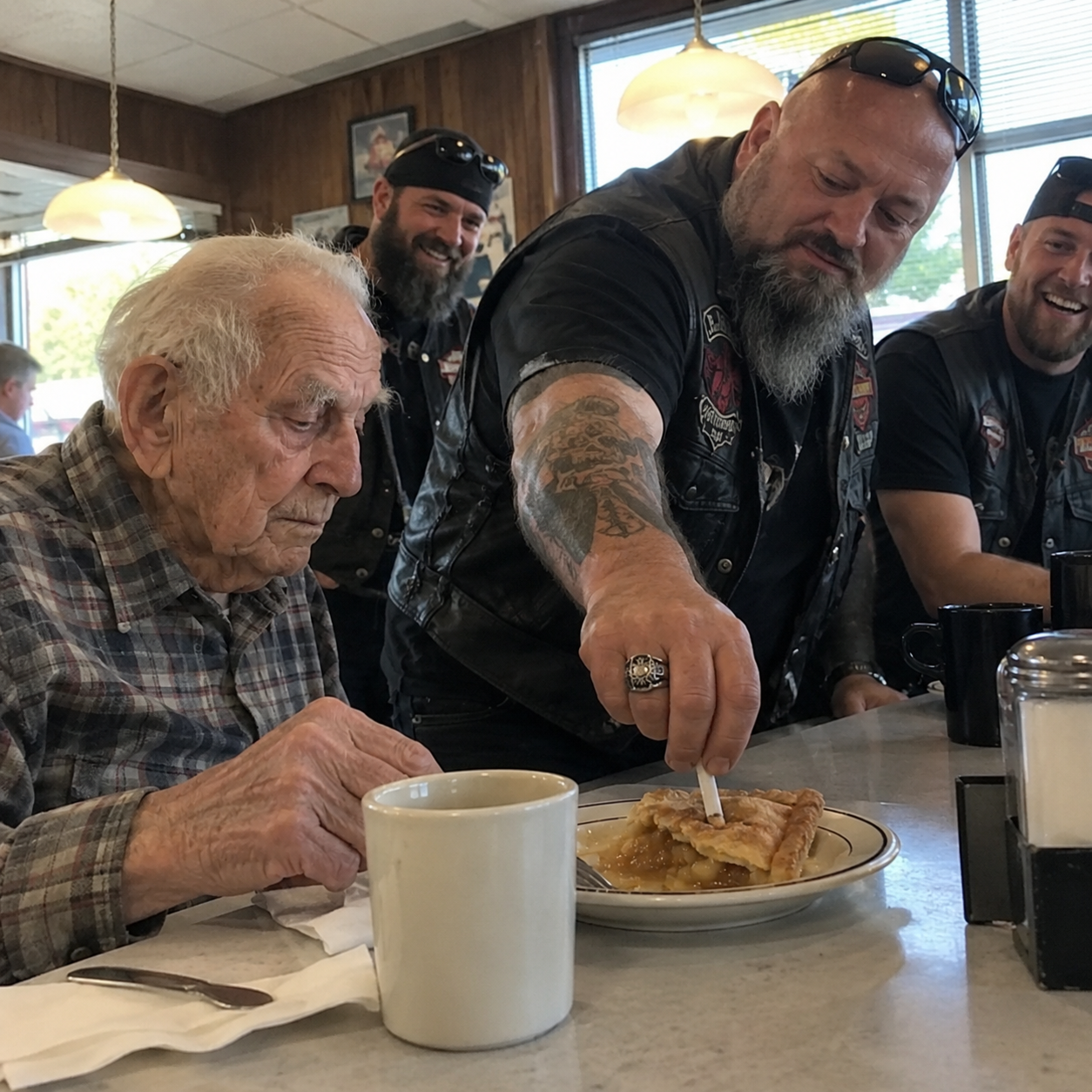
At 91 years old, Paul Whitaker had learned something that most people never figured out, even after a lifetime of making mistakes: the loudest man in the room was rarely the most dangerous, and the person who stayed calm when everyone else lost control was usually the one worth watching.
On a cold Thursday morning, Paul sat alone in a corner booth at Miller’s Diner, enjoying the two things he had ordered almost every Thursday for the past eleven years: a slice of warm apple pie and a cup of black coffee.
His old brown jacket hung beside him. His reading glasses rested on the table, and a folded newspaper lay beneath his left hand. Outside, autumn leaves scraped across the parking lot, pushed along by a sharp wind that made the diner windows tremble.
Paul had driven forty minutes to get there.
Not because Miller’s served the best pie in the state, although he would have argued that point with anyone willing to listen, but because the diner reminded him of a time when life had been simpler. His wife, Eleanor, had loved the place. They had spent countless mornings sitting in the same booth, arguing about crossword puzzles and making plans they never imagined would one day become memories.
Eleanor had been gone for six years.
Paul still came every Thursday.
He had just cut another piece of pie when the front door opened so violently that the little bell above it struck the glass twice.
Three men walked in wearing black leather vests, heavy boots, and expressions that suggested the world owed them something. They were members of a local motorcycle club called the Iron Vultures, a group known around town for their roaring engines, loud arguments, and habit of treating public places as if they belonged to them.
The largest of the three was named Rick. He stood nearly six feet four inches tall, with a thick neck, a shaved head, and a beard that reached the top of his chest. A faded scar crossed his left eyebrow.
Behind him came Dwayne, a muscular man with tattoos climbing both arms, and Cody, the youngest of the three, whose grin rarely disappeared even when nobody had said anything funny.
They smelled of cigarette smoke and cold air.
“Morning, sweetheart,” Rick called to the waitress.
The waitress, a woman in her early fifties named Linda, continued pouring coffee for a truck driver.
“Menus are on the counter,” she replied.
Rick looked at his friends.
“Friendly place.”
“Maybe they don’t recognize royalty,” Cody said.
The three laughed and moved toward a booth near the windows. They threw their jackets across the seats and spoke loudly enough for everyone in the diner to hear.
Paul glanced at them once, then returned to his newspaper.
He had seen men like them before.
Some were angry because life had treated them unfairly. Others were frightened of looking weak. A few had discovered that making other people uncomfortable was the easiest way to feel powerful.
Paul had spent most of his working life around men who behaved that way. He had learned not to mistake noise for strength.
Unfortunately, the three bikers had noticed him.
Perhaps it was the old man’s thin frame. Perhaps it was the hearing aid behind his right ear, or the way he carefully folded his newspaper before setting it aside.
Whatever the reason, Rick watched Paul for almost a minute before nudging Dwayne.
“Look at that guy.”
Dwayne followed his gaze.
“What about him?”
“He looks like he was old when they invented electricity.”
Cody laughed.
“Bet he needs both hands to lift that coffee cup.”
Rick leaned back, studying the old man.
“Let’s see if he has a sense of humor.”
Dwayne shook his head, but the smile on his face showed he was not particularly concerned about what came next.
Rick stood and walked toward Paul’s booth.
“Hey, Grandpa.”
Paul continued cutting his pie.
Rick tapped the table with one thick finger.
“Talking to you, old man.”
Paul raised his eyes.
“Then you should try saying something worth listening to.”
For the first time that morning, the diner went quiet.
Rick blinked.
He had expected a frightened smile, a nervous apology, perhaps a request to be left alone.
He had not expected the old man to answer him as if they were two ordinary people having an ordinary conversation.
Rick pulled out the opposite seat and sat down without asking.
“What’s your name?”
“Paul.”
“Paul what?”
“Paul Whitaker.”
“Well, Paul Whitaker, you look like you’ve been around since the dinosaurs.”
Paul placed his fork beside his plate.
“And you look like you’ve spent most of your life trying to impress people who don’t care.”
A truck driver near the counter coughed into his coffee to hide a laugh.
Rick’s face tightened.
He leaned closer.
“Careful, old man. You don’t know who you’re talking to.”
Paul looked at him calmly.
“Neither do you.”
Rick stared at him for another second, then rose abruptly.
“Enjoy your breakfast.”
He returned to the booth, where his friends were waiting.
Dwayne was grinning.
“What happened? Did he tell you a bedtime story?”
Rick picked up his cigarette packet.
“No. But we’re going to give him something to remember.”
Linda saw the three men whispering. She had worked at Miller’s for fourteen years, and she knew trouble when she saw it gathering around a table.
She walked toward them.
“Whatever you’re planning, don’t.”
Rick looked up innocently.
“Planning what?”
“I don’t care what you call it. Leave the old gentleman alone.”
Cody spread his hands.
“We’re just being friendly.”
Linda looked directly at him.
“Then try being friendly somewhere else.”
Rick smiled, but there was no warmth in it.
“Relax, Linda. We’re not going to hurt anybody.”
He said it loudly enough for the whole diner to hear.
And that was precisely what made Linda nervous.
Men who intended to behave themselves rarely needed to announce it.
Paul, meanwhile, had returned to his pie.
He had heard the exchange. He knew what was coming. But instead of becoming upset, he looked through the window at the three motorcycles parked outside.
One was a black touring bike with chrome exhaust pipes. Another was a red cruiser with custom handlebars. The third was a blue motorcycle with a large windshield and a luggage rack strapped to the back.
Paul studied them for several seconds.
Then he looked at his watch.
It was 10:17 a.m.
He took another sip of coffee.
At 10:19, Rick stood up again.
This time, he carried his cigarette between two fingers.
He walked directly to Paul’s table, stopped beside the pie, and looked down at it.
“That looks good.”
Paul did not respond.
Rick pressed the burning cigarette into the center of the pie.
The crust crumbled beneath the pressure. A thin trail of smoke rose from the filling.
Linda gasped from behind the counter.
“Hey!”
Rick twisted the cigarette once, grinding the ash into the dessert, then lifted it away.
“There. Now it’s got some flavor.”
He turned and walked back to his friends.
Cody burst into laughter.
Dwayne slapped the table.
Rick bowed theatrically, accepting their applause.
Paul looked at the ruined pie.
He did not shout. He did not stand. He did not even look toward the bikers.
Instead, he picked up his napkin and wiped a small smear of filling from the side of his plate.
Linda hurried over.
“Mr. Whitaker, I’m so sorry. I’ll get you another slice.”
Paul shook his head.
“That’s kind of you, Linda, but I don’t think I’ll be needing it.”
“At least let me replace your coffee.”
“No, thank you.”
He reached for his cup.
Before he could lift it, Dwayne appeared beside the booth.
“Coffee break, Grandpa?”
Paul looked up.
Dwayne leaned over the table and spat directly into the cup.
“Now it’s extra strong.”
Cody nearly fell out of his seat laughing.
Rick raised both hands as if he were watching a comedy show.
Linda rushed forward.
“That’s enough! Get away from him!”
Dwayne ignored her.
He picked up Paul’s plate, tilted it toward the edge of the table, and let the remaining pie slide onto the floor.
The dish struck the tile and shattered.
The sound echoed through the diner.
For a moment, nobody moved.
Paul stared at the broken plate.
Then he looked at Dwayne.
“Are you finished?”
Dwayne smirked.
“What are you going to do about it?”
Paul slowly removed his glasses and folded them.
“At my age, young man, I’ve learned not to waste energy on questions that answer themselves.”
Dwayne’s smile faded slightly.
Paul placed his glasses in his jacket pocket, reached for his newspaper, and carefully folded it under his arm.
Then he stood.
His knees were stiff. His back was slightly bent. He needed a moment to steady himself beside the booth, but he did not ask anyone for help.
Linda stepped toward him.
“Paul, please sit down. I’ll call the police.”
Paul shook his head.
“No need to trouble yourself.”
“Those men have destroyed your breakfast!”
“Then I suppose I’ll have to find another breakfast.”
He reached into his wallet, removed a twenty-dollar bill, and placed it on the table.
Linda stared at him.
“You don’t owe them anything.”
“I’m paying for my coffee and the trouble I’ve caused you.”
“The trouble they caused me,” she corrected.
Paul smiled faintly.
“Then perhaps you should keep the change.”
He walked toward the entrance.
Behind him, Rick called out, “Hey, Grandpa! You forgot to thank us for the entertainment!”
Paul stopped at the door.
He turned his head just enough for the three men to see his face.
“Enjoy the rest of your morning,” he said.
Then he walked outside.
The bell above the door rang softly behind him.
For several seconds, the bikers sat in silence.
Then Cody burst into laughter again.
“Did you see him? He just walked out like some kind of old movie character.”
Rick leaned back.
“That’s because he knows he can’t do anything.”
Dwayne picked up his coffee.
“The old geezer probably thinks we’re going to chase him down the street.”
Linda stood beside their booth with her arms crossed.
“You three should be ashamed of yourselves.”
Rick looked at her.
“What’s the matter? You upset because we ruined his little breakfast?”
“You humiliated an old man who was minding his own business.”
Rick shrugged.
“Then he should have stayed home.”
Linda’s expression hardened.
She had spent years watching people walk through her doors carrying all kinds of burdens. She had seen lonely widowers eating breakfast alone, exhausted parents trying to feed their children, and elderly customers counting coins to make sure they could afford a cup of soup.
She knew what it meant to have very little and still try to preserve your dignity.
Watching three grown men destroy an old man’s breakfast for amusement made her feel sick.
But she did not argue.
She simply looked at Rick, then at the clock above the counter.
10:24 a.m.
Outside, Paul had reached the far end of the parking lot.
He stopped beside an old gray pickup truck parked near the delivery entrance. Its paint was faded, its rear bumper had a dent, and the driver’s door had a small scratch near the handle.
He unlocked it, climbed inside, and placed his newspaper on the passenger seat.
Then he sat without starting the engine.
Through the windshield, he could see the three motorcycles.
Paul studied them.
He looked at the truck’s dashboard clock.
10:25.
He reached into the glove compartment and took out a small notebook with a cracked leather cover.
He opened it to a page marked with a yellow tab.
A few handwritten lines were visible.
Paul read them once, then closed the notebook.
He had not wanted to spend his morning dealing with foolishness. He had come for pie, coffee, and a quiet hour before driving home to feed his old dog.
But the three men had made a decision.
And Paul had learned long ago that decisions came with consequences, whether the people making them understood that or not.
He started the truck.
The engine rumbled to life.
Then he pulled out of the parking lot and disappeared down the road.
Inside the diner, the Iron Vultures were still laughing.
They had no idea that the old man they had just humiliated had spent thirty-eight years operating heavy vehicles, supervising road crews, and handling machinery that weighed more than their motorcycles combined.
They also had no idea that Paul had noticed something about their parking arrangement that would soon become very important.
But the biggest surprise was yet to come.
Because when Linda finally walked over to take their order, she looked at the empty parking spaces outside, smiled, and asked a question that made all three bikers stop laughing.
“Did any of you check whether your motorcycles were parked in the loading zone?”
Rick frowned.
“What?”
Linda pointed toward the window.
“That sign out there. The one that says the delivery entrance must remain clear.”
Dwayne glanced outside.
Their motorcycles were parked beside the loading entrance, close to the curb.
“So?”
Linda picked up her order pad.
“So I hope you have good insurance.”
Cody laughed nervously.
“What are you talking about?”
Linda looked at them for a moment.
Then she said, “You might want to look outside.”
All three men turned toward the window.
Their smiles vanished.
The gray pickup was no longer in the parking lot.
And neither were their motorcycles.
For a moment, none of them understood what they were seeing.
The spaces beside the loading entrance were empty.
Rick stood so quickly that his booth seat scraped across the floor.
“Where the hell are our bikes?”
Dwayne rushed toward the door.
Cody followed, nearly tripping over a chair.
They burst outside and stared at the empty spaces.
Rick looked left, then right.
“Who took them?”
Linda appeared in the doorway behind them.
“Maybe the old man you were laughing at.”
Rick spun around.
“What did you say?”
Linda folded her arms.
“I said maybe the old man you treated like garbage knows something you don’t.”
Dwayne pulled out his phone.
“I’m calling the police.”
“Go ahead,” Linda replied. “You might want to tell them where you parked.”
Rick ignored her and began pacing across the lot.
Then he saw something near the curb.
A long, dark skid mark ran across the pavement beside the loading entrance. A few feet away, a small piece of red plastic lay near the storm drain.
Rick picked it up.
It was part of a motorcycle reflector.
His face changed.
“He didn’t,” he muttered.
Cody looked at him.
“Didn’t what?”
Rick stared at the road.
“He couldn’t have.”
But the empty parking spaces were telling a different story.
They ran back inside, demanding that Linda explain what had happened.
She calmly pointed toward a small security camera mounted above the entrance.
“You might want to ask the owner to review that footage.”
Rick looked up at the camera.
For the first time that morning, he seemed genuinely uncertain.
Dwayne was already on the phone with the police, shouting that three motorcycles had been stolen from the diner parking lot.
Cody kept looking through the window, expecting the bikes to reappear as if the entire thing were some elaborate joke.
Then Linda spoke again.
“There’s one thing you should know about Paul Whitaker.”
Rick turned toward her.
“What?”
Linda placed her order pad on the counter.
“He spent most of his working life driving trucks and operating heavy equipment. He knows more about vehicles than the three of you combined.”
Rick stared at her.
“You’re telling me that old man stole our motorcycles?”
Linda shook her head.
“No. I’m telling you that you should find out what happened before you start accusing people.”
She turned away and began wiping the counter.
The three bikers stood motionless.
Outside, the wind pushed autumn leaves through the empty spaces where their motorcycles had been.
And somewhere down the road, Paul Whitaker was driving home, unaware that the worst part of his morning had not yet reached its conclusion.
Because the Iron Vultures were about to discover that the old man they had mocked was not the only person in town who knew how to make a bad decision expensive.
## The Man Who Knew Every Road
By noon, the police had arrived at Miller’s Diner.
Two officers interviewed Linda, checked the security camera, and took statements from the bikers. Rick insisted that Paul had somehow arranged for their motorcycles to disappear.
But the footage showed something different.
At approximately 10:26 a.m., a delivery truck had entered the lot. The driver had stopped near the loading entrance, spoken briefly with someone outside the camera’s field of view, and then left.
A few minutes later, the motorcycles were gone.
The camera did not show who had moved them or where they had gone.
The officers told the bikers they would investigate.
Rick was furious.
“That’s it? You’re just going to leave us here?”
One officer looked at him.
“We’re taking a report. If you have information about where your motorcycles went, tell us.”
Rick jabbed a finger toward the diner.
“That old man did it.”
“Then we’ll need evidence connecting him to the incident.”
Rick had no evidence.
He had no witness who could explain exactly what happened outside.
And the more he thought about the morning, the more he remembered the calm expression on Paul’s face when he left.
It unsettled him.
By early afternoon, the three bikers had contacted several people they knew, hoping someone had seen the motorcycles. One friend reported spotting a gray pickup near an industrial yard on the edge of town.
Rick immediately drove there with Dwayne and Cody in a borrowed car.
The yard belonged to a towing company that handled heavy vehicles and commercial equipment. Several trucks were parked behind a chain-link fence, and a large sign warned visitors to check in at the office.
The three men marched inside.
A woman behind the counter looked up.
“Can I help you?”
“We’re looking for three motorcycles,” Rick said. “One black, one red, one blue. We think somebody brought them here.”
The woman checked a clipboard.
“Do you have the registration numbers?”
Rick gave them to her.
She examined the list, then made a telephone call.
After a few minutes, a man in a gray work shirt came out of the garage.
He was in his sixties, with broad shoulders, silver hair, and hands stained by years of working on engines.
“You’re looking for the motorcycles that were parked in a restricted loading area?”
Rick narrowed his eyes.
“Who told you that?”
“The police.”
Dwayne stepped forward.
“Where are they?”
The man gestured toward the office.
“They’re safe. But there’s a problem.”
Rick’s jaw tightened.
“What problem?”
“The loading entrance at the diner is used by delivery vehicles. The business owner reported that the motorcycles were blocking access. A towing contractor was called to clear the area.”
Rick stared at him.
“A towing contractor?”
“That’s right.”
“Who called them?”
The man consulted his paperwork.
“The diner manager.”
Rick looked at Dwayne.
Dwayne looked at Cody.
For several seconds, none of them spoke.
Then Rick demanded, “Where’s the old man?”
The towing manager shrugged.
“I don’t know. But if you want your motorcycles, you’ll need to settle the fees and provide proof of ownership.”
Rick’s face turned red.
“Fees? You want us to pay fees for our own bikes?”
“You can dispute the charge through the appropriate process. But the motorcycles were removed from a restricted area, and the towing company followed its procedure.”
Rick leaned across the counter.
“You have no idea who you’re dealing with.”
The manager looked at him calmly.
“Actually, I know exactly who I’m dealing with. Three men who parked their motorcycles where they weren’t supposed to and are now angry that somebody enforced the rules.”
Cody looked down.
Dwayne muttered something under his breath.
Rick stepped back, furious but suddenly aware that making another scene would not get him any closer to his motorcycles.
They paid the required fees after confirming the charges and completing the paperwork. By the time the three men had retrieved their bikes, the afternoon was nearly over.
They had spent hours chasing a story that turned out to be far less dramatic than the one they had invented in their heads.
Paul had not destroyed their motorcycles.
He had not stolen them.
He had simply left the diner, and the staff had arranged for the improperly parked bikes to be removed.
The real humiliation was that the bikers had been so eager to believe the old man was helpless that they had failed to notice the consequences of their own behavior.
Rick did not find that explanation satisfying.
He wanted someone to blame.
And in his mind, Paul was still the person who had made him look foolish.
“Find out where he lives,” Rick told Dwayne.
Dwayne hesitated.
“Why?”
Rick looked at him.
“Because I’m going to have a conversation with him.”
Cody shifted uncomfortably.
“Maybe we should leave it alone.”
Rick turned on him.
“Since when do you get scared of an old man?”
Cody said nothing.
Rick started his motorcycle and rode away.
The others followed.
But as they passed the diner, Rick glanced through the window and saw Linda standing beside Paul’s usual booth. She was replacing the damaged table setting and speaking with another customer.
For some reason, that image angered him more than the towing bill.
Paul had left without arguing, without threatening anyone, and without giving Rick the reaction he wanted.
Rick had spent the entire day trying to regain control of a situation he had created himself.
And he still couldn’t accept that the old man had refused to play his game.
## An Unexpected Visit
Paul lived in a small house on a quiet street lined with maple trees.
The place had white siding, a narrow front porch, and a mailbox that leaned slightly to one side. A bird feeder hung from a branch in the front yard, and an old green garden hose lay coiled beside the garage.
It was not the kind of house that suggested a man had spent decades operating heavy machinery.
But the garage told a different story.
Inside stood a collection of old tools, carefully arranged shelves, and a framed photograph of a much younger Paul standing beside a large construction truck. Another photograph showed him wearing a work uniform beside a group of men at a highway construction site.
Paul had spent years building roads, repairing bridges, and helping maintain the routes that connected small towns to the rest of the state.
He had retired at seventy-two.
He was now ninety-one, and his greatest ambition was to finish the crossword puzzle before his afternoon nap.
That evening, he was sitting in his kitchen when the doorbell rang.
He looked at the clock.
5:43 p.m.
Nobody had told him they were coming.
He rose slowly, crossed the hall, and opened the door.
Rick stood on the porch.
Dwayne and Cody were behind him.
Paul regarded the three men without surprise.
“Good evening.”
Rick stepped forward.
“You know who we are?”
Paul nodded.
“The gentlemen who ruined my breakfast.”
Dwayne shifted his weight.
Rick’s face tightened.
“Don’t get smart with me.”
“I’m not. I’m simply answering your question.”
Rick looked past Paul into the house.
“We need to talk.”
“Then talk.”
Rick seemed thrown off by the answer.
He had expected Paul to invite them inside, perhaps because he was frightened or because he wanted to avoid an argument in front of the neighbors.
Instead, the old man stood calmly in the doorway.
Rick lowered his voice.
“You think you’re clever, don’t you?”
Paul considered him.
“No. I think I’m old enough to recognize when a conversation is going nowhere.”
Cody looked at the ground.
Dwayne cleared his throat.
Rick stepped closer.
“Those motorcycles cost us a lot of money.”
“Then you should take better care of them.”
“You had something to do with getting them towed.”
Paul looked directly at him.
“I left the diner before your motorcycles were removed. If you believe someone acted improperly, speak to the towing company or the police.”
Rick’s face darkened.
“You know what I mean.”
“Then say what you mean.”
For several seconds, Rick appeared unable to decide what to do.
He had come to intimidate an old man, but the old man’s refusal to become frightened left him with nothing to work with.
Finally, he said, “You embarrassed us.”
Paul looked genuinely puzzled.
“I did?”
“You walked out like you were better than us.”
Paul was silent for a moment.
Then he replied, “I walked out because I wanted to go home.”
Cody looked up.
Something about the simplicity of the answer made him uncomfortable.
Paul continued.
“You destroyed my food. You spat in my coffee. You broke my plate. I chose not to spend the rest of my morning arguing with you. If that embarrassed you, I suggest you think about why.”
Rick’s hands tightened into fists.
“You don’t get to lecture me.”
“You’re correct. I don’t. But you came to my house, so I assume you wanted to hear something.”
Rick looked toward the street.
A neighbor was walking a dog on the opposite sidewalk. Another neighbor had stepped onto her porch after noticing the three motorcycles parked outside Paul’s home.
The situation was becoming visible to people who knew Paul.
Rick did not like that.
He stepped backward.
“This isn’t over.”
Paul nodded.
“Most things aren’t.”
Rick turned and walked down the steps.
Dwayne followed.
Cody remained behind for a moment.
He looked at Paul, then at the open doorway.
“Sir?”
Paul waited.
Cody swallowed.
“I’m sorry about your breakfast.”
Rick shouted from the sidewalk.
“Cody! Let’s go!”
Cody flinched.
Paul gave him a small nod.
“That’s a start.”
Cody hurried after the others.
Paul closed the door, locked it, and returned to his kitchen.
He did not feel victorious.
He felt tired.
He had no interest in humiliating the bikers, and he had no desire to turn an unpleasant breakfast into a feud. He wanted them to understand that other people deserved respect, regardless of their age, size, or appearance.
But he had a feeling that Rick would not let the matter end so easily.
And Paul had lived long enough to know that when a proud man felt foolish, he sometimes made an even bigger mistake trying to prove he wasn’t.
## The Challenge
Three days later, Paul received a letter.
It was delivered in a plain white envelope with no return address. Inside was a handwritten note.
The message was brief.
“Mr. Whitaker,
You made us look like fools in front of the whole town. If you have something to say, meet us at the old fairground on Saturday at noon. Come alone.
—Rick”
Paul read the letter twice.
Then he placed it on the kitchen table and called his neighbor, Frank Miller.
Frank was eighty-four, a retired mechanic who had known Paul for more than thirty years. He arrived twenty minutes later carrying a bag of oranges and wearing a flannel shirt.
After reading the note, Frank frowned.
“You’re not going.”
Paul peeled an orange.
“I haven’t decided.”
“What is there to decide? Three idiots want to intimidate you. Let the police handle it.”
Paul separated the orange into sections.
“They haven’t threatened to hurt me in writing.”
“They told you to come alone.”
“That isn’t a crime by itself.”
Frank shook his head.
“Paul, you spent your whole life telling other people not to be stubborn. You should try taking your own advice.”
Paul smiled.
“That sounds like something Eleanor used to say.”
“Then perhaps you should listen to her.”
Paul placed the orange peel on a napkin.
He did not intend to meet the bikers simply because they had challenged him. But he also knew that ignoring them might not end the matter. They had already come to his home, and Rick appeared determined to turn a foolish incident into something larger.
Paul called the local police station and explained what had happened. An officer took the information and advised him not to meet the men alone. If they returned or made explicit threats, he should call immediately.
Paul thanked him.
Then he called Linda at Miller’s Diner.
She listened carefully and told him that Rick had returned to the diner twice, asking questions about him. She had refused to provide his address.
“I’m sorry, Paul,” she said. “I should have done more when they were bothering you.”
“You did what you could, Linda.”
“I could have called the police sooner.”
“Perhaps. But you cannot go back and change what happened. You can only decide what you do next.”
There was a pause.
Then Linda laughed softly.
“You sound like my grandmother.”
“She must have been a wise woman.”
“She was.”
After the call, Paul sat at his kitchen table for a long time.
He thought about the note, the diner, and the three men who had treated cruelty as a form of entertainment.
He also thought about something his father had once told him.
A man could spend his life trying to win arguments, his father had said, but the real test was whether he knew when an argument was worth having.
Paul had no intention of fighting the bikers. At ninety-one, he knew exactly what his body could and could not do. He was not going to pretend he could overpower three younger men.
But he was not going to allow them to decide what he should fear, either.
On Saturday morning, Paul put on his brown jacket, checked that his phone was charged, and drove to the old fairground.
He did not go alone.
Frank followed in his own car, and an officer had agreed to remain nearby in case the meeting turned threatening. Paul had also told his granddaughter, Emily, where he was going and when he expected to return.
At noon, the fairground was almost empty.
The old ticket booths were boarded up, and weeds grew through cracks in the asphalt. A rusted Ferris wheel stood beyond the fence, its empty passenger cars moving slightly in the wind.
Rick’s motorcycle was parked beside the entrance.
Dwayne and Cody stood near a concrete bench.
Rick walked toward Paul.
“You came.”
Paul looked at the three men.
“You asked me to.”
Rick smiled.
“I thought you’d be too scared.”
“I considered staying home. I decided I would rather hear what you had to say.”
Rick glanced at Frank’s car.
“Who’s that?”
“My friend.”
“I told you to come alone.”
Paul nodded.
“And I decided not to.”
Rick’s smile vanished.
For several seconds, he looked as though he might lose his temper.
Then he laughed bitterly.
“You’re something else, old man.”
Paul remained quiet.
Rick stepped closer.
“You made us look stupid. People are talking about us.”
Paul raised his eyebrows.
“Have you considered that people might be talking about you because of what you did?”
Rick stared at him.
“You don’t understand. Respect matters in our world.”
“Then you should understand why you need to show it.”
Dwayne looked away.
Cody folded his arms.
Rick shook his head.
“You think you’re better than us because you’re old.”
“No,” Paul replied. “I think we’re all responsible for how we treat people.”
Rick took a step closer.
“And what if I don’t care what you think?”
Paul met his gaze.
“Then nothing I say will change your mind.”
That answer seemed to irritate Rick more than an insult would have.
He had prepared for a confrontation. He had expected Paul to become frightened or angry. He had expected to leave feeling that he had restored his reputation.
Instead, he was standing in an abandoned fairground arguing with a man who seemed to have no interest in proving anything.
Rick glanced toward the road.
A police cruiser was parked several hundred feet away.
He looked back at Paul.
“You called the police?”
“I told them where I was going.”
“You don’t trust us?”
Paul considered the question.
“You came to my house after I left your diner. You sent me a note telling me to meet you alone. What would you have me believe?”
Rick had no answer.
Dwayne finally spoke.
“Rick, let’s go.”
Rick turned on him.
“Stay out of it.”
Dwayne looked at Paul.
“He’s right, you know. We went too far.”
Rick stared at his friend as if he had betrayed him.
Cody rubbed the back of his neck.
“We shouldn’t have messed with him at the diner.”
For the first time, Rick seemed to understand that he was losing control of the situation.
Not because Paul had threatened him, but because the people standing beside him were beginning to recognize the truth.
He had brought them there to make an old man feel small.
Instead, they were being forced to look at their own behavior.
Rick stepped backward.
“This is ridiculous.”
Paul nodded.
“I agree.”
Rick turned toward his motorcycle.
Dwayne and Cody followed him.
Before climbing onto his bike, Rick looked back.
“You think this makes you the winner?”
Paul shook his head.
“No. I think it means we can all go home.”
Rick started the engine and rode away.
Dwayne followed.
Cody hesitated, then gave Paul a small nod before starting his own bike.
Frank stepped out of his car.
“Well,” he said, “that was a waste of a perfectly good Saturday.”
Paul smiled.
“Not entirely.”
Frank looked at him.
“What did we accomplish?”
Paul glanced toward the road where the motorcycles had disappeared.
“We gave them a chance to make a different choice.”
Frank shook his head.
“You really believe people can change?”
Paul looked at the old fairground, the rusted rides, and the weeds growing through the pavement.
“Not everyone changes,” he said. “But you never know who might, until you give them the opportunity.”
He walked back to his truck.
As he opened the door, he noticed something beneath the windshield wiper.
A small envelope had been tucked under the blade.
Paul removed it and opened it.
Inside was a photograph of the three bikers standing beside their motorcycles. On the back, someone had written a single sentence.
“We owe you an apology.”
Paul looked at the handwriting.
It was Cody’s.
He placed the photograph in his jacket pocket and climbed into the truck.
For the first time since the incident at Miller’s Diner, he allowed himself to believe that the story might end without another confrontation.
But he still had one question.
Would the bikers apologize because they had finally understood what they had done?
Or because they had discovered that an old man was not as easy to intimidate as they had imagined?
The answer would come the following Thursday.
## The Empty Booth
At 9:45 a.m. the following Thursday, Linda was preparing the morning coffee when she noticed three motorcycles pulling into the diner parking lot.
Her stomach tightened.
She recognized the bikes immediately.
The Iron Vultures had returned.
Rick parked near the entrance. Dwayne and Cody followed, leaving their motorcycles in the designated spaces this time.
The three men sat at a booth near the window.
They did not shout. They did not throw their jackets across the seats. They did not make jokes about the other customers.
Linda approached cautiously.
“What can I get you?”
Rick looked up.
“Three coffees, please.”
“Anything to eat?”
He glanced at the menu.
“Three slices of apple pie.”
Linda studied him.
“Are you sure?”
Rick nodded.
“Yes.”
She brought the coffee first.
For several minutes, the men sat quietly.
Then Cody looked toward the corner booth where Paul usually sat.
“Do you think he’ll come today?”
Linda followed his gaze.
“I don’t know.”
Rick stared into his coffee.
“I want to apologize.”
Dwayne nodded.
“Then you should.”
Rick looked at him.
“You make it sound easy.”
“It isn’t easy. But neither was what we did.”
Cody leaned forward.
“We acted like bullies. There’s no point pretending otherwise.”
Rick looked toward the window.
He had spent years believing that respect came from being feared. He had learned to interpret silence as weakness and kindness as an invitation to push harder.
The incident with Paul had exposed how fragile that belief really was.
The old man had not fought him. He had not threatened him. He had not even tried to humiliate him.
He had simply refused to be controlled by him.
And that had been enough to make Rick feel powerless.
The diner door opened.
Paul walked inside, carrying his folded newspaper.
He paused when he saw the three bikers.
Linda watched him carefully.
Rick stood.
For a moment, nobody spoke.
Then Rick walked toward Paul’s booth, stopping several feet away.
“Mr. Whitaker?”
Paul looked at him.
“Good morning.”
Rick swallowed.
“I wanted to apologize.”
Paul waited.
Rick glanced back at his friends, then continued.
“What we did last week was wrong. We treated you like you weren’t a person. We thought it was funny to humiliate you, and it wasn’t.”
Dwayne stepped forward.
“I’m sorry, too.”
Cody nodded.
“Me as well.”
Paul looked at all three men.
He did not smile immediately. He did not rush to reassure them that everything was fine.
Instead, he asked a question.
“Why?”
Rick looked confused.
“Why what?”
“Why did you do it?”
Rick stared at the floor.
For several seconds, he seemed unable to answer.
Finally, he said, “Because we thought nobody would stand up to us.”
Paul nodded slowly.
“That is a dangerous thing to believe.”
Rick looked up.
“Yes, sir.”
Paul studied him for a moment.
“An apology doesn’t erase what happened. But it can be the beginning of something better, if you mean it.”
Rick nodded.
“I do.”
Paul pointed toward the booth.
“Then sit down.”
The three bikers looked at one another.
Rick hesitated.
“You’re sure?”
Paul pulled out his chair.
“I didn’t come here to spend my morning holding a grudge.”
They sat.
Linda brought Paul his usual coffee and a fresh slice of apple pie. She placed it in front of him, then looked at the three men.
“Are we going to have a peaceful breakfast today?”
Cody smiled nervously.
“That’s the plan.”
Linda raised an eyebrow.
“Good. Because I have a lot of dishes, and I’m not interested in sweeping up another one.”
For the first time, the bikers laughed without anyone being the target.
The conversation began awkwardly. Rick asked Paul how old he was when he started driving trucks. Paul told him about hauling construction materials across the state and navigating narrow mountain roads before modern navigation systems existed.
Dwayne asked whether Paul had ever been frightened on the job.
“Of course,” Paul replied. “Anyone who tells you he’s never been afraid is either lying or hasn’t been paying attention.”
Cody asked how Paul had learned to remain calm when people were rude.
Paul took a sip of coffee.
“I didn’t always remain calm. I made plenty of mistakes when I was younger. But I learned that anger can make you feel powerful while quietly taking away your judgment.”
Rick listened carefully.
“What do you do when someone disrespects you?”
Paul considered the question.
“First, I decide whether the situation needs a response. Sometimes the best answer is to walk away. Sometimes you need to set a boundary. And sometimes you need to ask for help. But you should never let someone else’s bad behavior turn you into a person you don’t want to be.”
Rick lowered his eyes.
“I wish somebody had told me that years ago.”
Paul smiled faintly.
“Perhaps somebody did. You might not have been ready to listen.”
The conversation continued for nearly an hour.
When the bill arrived, Rick reached for it.
Paul stopped him.
“This one’s mine.”
Rick looked surprised.
“After what we did to you?”
Paul nodded.
“After what you did, you owe me something more valuable than breakfast.”
“What?”
Paul folded his newspaper.
“Next time you see someone being treated badly, don’t join in. If you can safely help, help. If you can’t, get someone who can. And remember how it felt to sit here knowing you’d done something you couldn’t take back.”
Rick sat quietly.
Then he nodded.
“I can do that.”
Paul placed the money on the table.
“Good. Then we’re finished.”
He stood, thanked Linda, and walked toward the door.
Before leaving, he turned toward the bikers.
“By the way, gentlemen?”
All three looked up.
Paul smiled.
“If you’re going to park those motorcycles outside, use the marked spaces. The delivery drivers have a difficult enough job without having to navigate around them.”
Cody burst out laughing.
Dwayne covered his mouth.
Even Rick smiled.
“Yes, sir,” he said.
Paul walked out into the autumn sunshine.
Linda watched him cross the parking lot and climb into his old pickup.
Then she returned to the counter.
Rick looked through the window.
“He’s a remarkable man.”
Linda nodded.
“He is.”
Cody took a bite of his pie.
“You think he’ll come back next week?”
Linda began pouring coffee for another customer.
“Paul has been coming here every Thursday for eleven years.”
She looked at the empty corner booth.
“And I don’t think three foolish men are going to change that.”
The Iron Vultures stayed another half hour.
They paid their bill, thanked Linda, and left without disturbing anyone.
Outside, Rick paused beside his motorcycle and looked toward Paul’s truck, which was already disappearing down the road.
He thought about the old man’s words.
He had come to believe that being strong meant never admitting you were wrong.
Now he wondered how much of his life he had wasted trying to prove something that had never needed proving.
Dwayne climbed onto his bike.
“You coming?”
Rick nodded.
He put on his helmet, started the engine, and followed his friends out of the parking lot.
They were still the Iron Vultures. They still rode motorcycles, wore leather vests, and enjoyed the freedom of the open road.
But something had changed.
They had learned that respect could not be demanded through fear. It had to be earned through the way a person treated others, especially those who could offer nothing in return.
And Paul Whitaker had taught them that lesson without raising his voice.
He had not defeated them with violence or some elaborate revenge.
He had done something far more difficult.
He had refused to let their cruelty decide who he would become.
That Thursday, Paul returned home, fed his dog, and sat on the porch with a cup of tea.
The afternoon sun warmed his face. A neighbor waved from across the street, and Paul waved back.
He thought about Eleanor, about the diner, and about the three men who had finally apologized.
He hoped they meant it.
But whether they did or not, he had learned something once again.
A person’s age did not determine the strength of their character. A person’s size did not determine the weight of their words. And a person’s reputation did not tell the whole story of who they were.
At ninety-one, Paul had no interest in proving he was tougher than three bikers.
He had better things to do.
He had a dog to feed, a crossword puzzle to finish, and another Thursday morning to look forward to.
And if anyone ever asked him what he had learned from the incident, he would offer the same advice he had followed all his life:
Never mistake kindness for weakness, never mistake silence for fear, and never assume that someone who has lived a long life has nothing left to teach you.
Because the person you underestimate today may be the person who teaches you the lesson you remember for the rest of your life.