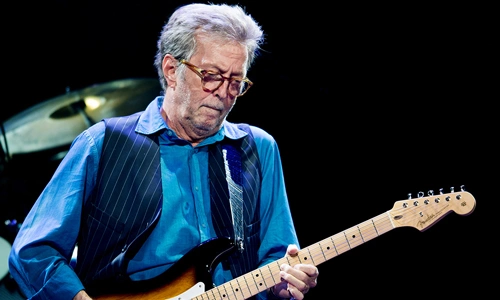
Eric Clapton has a complicated relationship with admiration. He is, by any measure, one of the most gifted guitarists in rock history — a man who was literally called “God” in London graffiti in the mid-1960s, who played in the Yardbirds, Cream, Blind Faith, Derek and the Dominos, and a solo career that produced “Layla,” “Wonderful Tonight,” and “Tears in Heaven.” He has sat across from most of the musical giants of the last six decades. He has a trained ear and an experienced set of musical reference points that most critics would sacrifice considerably to possess.
So when Clapton expresses genuine bewilderment at another singer’s voice — not admiration framed in familiar terms, but actual bewilderment, the feeling that something is happening he cannot fully account for — you pay attention.
The singer is Ray Charles, and Clapton’s comments about him over the decades reveal something important about the difference between technical understanding and felt experience. Clapton can explain, technically, what most great singers are doing. He can identify the mechanics, the phrasing choices, the breath control. With Ray Charles, he has said, the explanation never quite covered the effect. Something was left over that the technical vocabulary could not reach.
Ray Charles was blind from the age of seven. He learned piano by ear, developed a musical language that drew simultaneously from gospel, blues, jazz, and country — a synthesis that was considered scandalous by gospel purists who felt he was corrupting sacred music with secular feeling — and produced a voice that carried an emotional authority that even technically superior singers could not replicate. He did not have the purest instrument in popular music. What he had was the ability to make you believe, completely, that he was telling you the exact truth about exactly what he felt at the exact moment of singing.
“Georgia on My Mind” is the purest example. The song had been recorded before. It was a standard. And then Charles recorded it in 1960 and made everything before it sound like a rehearsal. The restraint in the opening vocal. The way the note bends at the end of “Georgia.” The sense that an entire human life is compressed into a three-minute pop song. Clapton has said that when he hears it he feels the same combination of deep satisfaction and mild inadequacy that the very best music always produces — the feeling of being shown what the form is truly capable of.
Charles had a creative fearlessness that Clapton has specifically admired: the willingness to move across genre boundaries at a time when those boundaries were enforced not just commercially but racially. Modern Sounds in Country and Western Music (1962) was Ray Charles recording country songs — a Black musician in Jim Crow America recording the music most associated with white Southern identity — and making it completely natural, completely his, completely Ray Charles. The audacity of it was matched only by the quality of the result.
Clapton has said that there are voices that teach you guitar and voices that teach you something larger. Ray Charles was the second kind.
I have had Ray in my car as I drove him from the Vancouver Airport to downtown Vancouver , as a performing guest of the Variety Club Telethon , circa 1978.