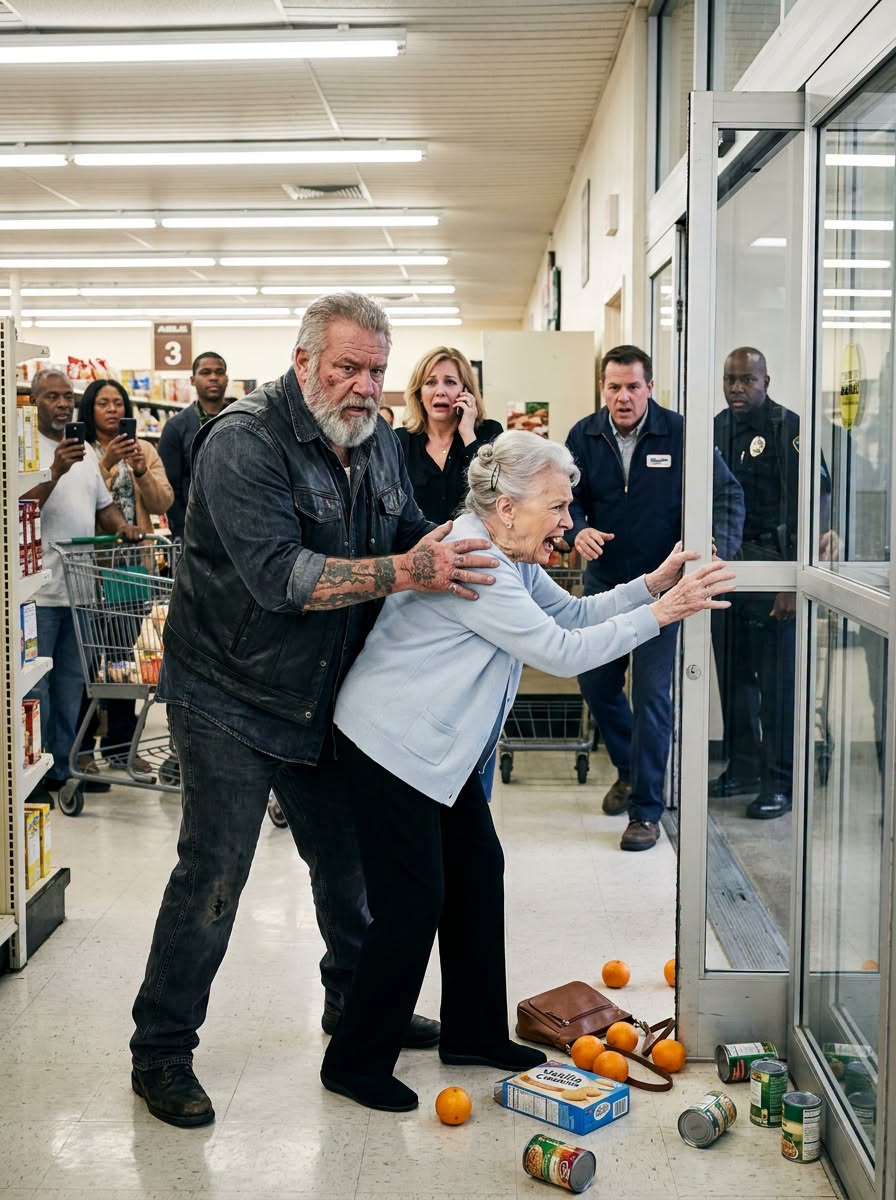
The silence that settled over aisle three felt heavier than the shouting had.
No one moved.
The police officers slowly lowered their hands from their belts.
The customers who had been recording with their phones quietly slipped them back into their pockets.
Every person standing there realized they had been watching compassion and mistaking it for violence.
David looked at Frank with tears gathering in his eyes.
“I’m sorry,” he whispered.
Frank simply nodded.
“You don’t owe me an apology,” he replied. “Just stay with your mom.”
The paramedics arrived a few minutes later.
After checking Eleanor’s pulse, blood pressure, and oxygen levels, they confirmed what Frank had already suspected.
“It wasn’t just confusion,” one paramedic explained quietly. “The electrical smell probably triggered an old traumatic memory.”
David closed his eyes.
“I should have been here.”
One of the officers placed a hand on his shoulder.
“Your mother isn’t alone because you don’t care,” he said gently. “She’s sick. There’s a difference.”
David nodded, though the guilt remained.
Later that evening, after Eleanor had calmed enough to answer simple questions, Dr. Melissa Grant from the memory clinic arrived.
She had treated Eleanor for almost four years.
When she heard Frank humming the old melody outside Eleanor’s hospital room, she stopped walking.
“Where did you learn that?” she asked.
Frank stared at the floor.
“My wife.”
The doctor sat beside him.
“Tell me.”
Frank took a long breath.
“My wife, Susan, was diagnosed with dementia when she was fifty-eight.”
He rubbed the scars across his knuckles.
“The first year she forgot birthdays.”
“The second year she forgot where we lived.”
“The third year…”
His voice caught.
“…she forgot me.”
No one interrupted.
“There were days she’d think I was a stranger breaking into our house.”
He smiled sadly.
“So I learned not to argue.”
Dr. Grant nodded.
“Never tell someone with dementia they’re wrong.”
“I learned that the hard way.”
“If she believed she was twenty years old…”
“I met twenty-year-old Susan.”
“If she thought she needed to pick up our children from school…”
“I helped her find her purse.”
“If she thought the house was on fire…”
“I helped her get somewhere safe.”
He looked toward Eleanor’s room.
“You don’t pull someone out of their reality.”
“You walk into it with them.”
Dr. Grant smiled softly.
“That’s exactly what our nurses teach.”
Frank shrugged.
“I didn’t learn it from books.”
“I learned it from loving someone.”
The next morning David visited the grocery store.
He carried a box of donuts.
Another box of coffee.
And an apology for every employee who had witnessed what happened.
“I judged him,” David admitted.
“I saw tattoos.”
“I saw leather.”
“I forgot to actually see the man.”
Nora, the store manager, nodded.
“So did I.”
The broken automatic doors were replaced within forty-eight hours.
The company that owned Larkspur Market quietly admitted maintenance should have been completed days earlier.
But the real changes were happening somewhere else.
The employees requested dementia-awareness training.
Every cashier attended.
Every stock clerk.
Every manager.
Frank refused to teach the class.
“I’m no expert.”
Dr. Grant smiled.
“No.”
“You’re something better.”
“You’ve lived it.”
Two weeks later Frank reluctantly agreed.
Thirty-eight employees filled the break room.
Instead of beginning with medical terms, Frank placed two photographs on the table.
The first showed Susan at twenty-five.
Long brown hair.
Bright smile.
Holding a fishing pole.
The second showed her twenty-nine years later.
Gray hair.
Eyes searching for memories that no longer came.
“I loved both women exactly the same.”
The room stayed silent.
“The disease changes memory.”
“It doesn’t erase dignity.”
He taught them simple things.
Approach from the front.
Speak calmly.
Never argue with someone’s reality.
Offer reassurance before correction.
Use familiar songs.
Familiar smells.
Familiar objects.
And most importantly…
“Don’t ask them to remember you.”
“Help them feel safe.”
The training spread.
Another grocery store asked him to speak.
Then a pharmacy.
Then the local library.
Soon police officers attended.
Firefighters.
School nurses.
Home health aides.
Frank never accepted payment.
“If Susan can still help people,” he said, “then she’s still here.”
Months later, David invited Frank to Eleanor’s seventy-ninth birthday.
Frank almost declined.
He wasn’t comfortable with parties.
David insisted.
“You belong there.”
When Frank arrived carrying his usual bouquet of yellow flowers, Eleanor looked up from her chair.
For a moment everyone wondered if she would recognize him.
She smiled.
“The gentleman with the steady hands.”
Frank laughed.
“I’ll take that.”
She reached for his hand.
“I remember your kindness.”
It wasn’t perfect memory.
But it was enough.
After cake, David brought out an old photo album.
Inside was a faded black-and-white photograph of a young firefighter wearing a soot-covered helmet.
“My father,” David said.
“The fire she keeps running from happened sixty years ago.”
Frank studied the picture.
“What happened?”
David swallowed hard.
“When Mom was eighteen, their apartment building caught fire.”
“My grandparents escaped.”
“But my little brother…”
He couldn’t finish.
“The smoke took him before the firefighters reached his room.”
Eleanor had carried that grief her entire life.
Sometimes the smell of burned toast…
Sometimes fireworks…
Sometimes faulty wiring…
Would send her back to that hallway.
Back to that terrible night.
Still trying to save a little boy who had been gone for decades.
Frank quietly reached inside his leather vest.
From an inside pocket, he removed a worn photograph protected by clear plastic.
It showed a smiling woman sitting on the back of his motorcycle.
Susan.
Young.
Laughing.
Hair blowing across her face.
“I carry this every day.”
David looked at it.
“You never leave home without her?”
Frank smiled.
“No.”
“I spent six years helping her remember me.”
“Now it’s my turn to remember for both of us.”
The following spring, Larkspur Market unveiled a small bronze plaque near aisle three.
It didn’t mention the panic.
It didn’t mention police.
It didn’t mention misunderstandings.
It simply read:
“Compassion sometimes looks unfamiliar. Pause before you judge.”
Underneath were smaller words:
Dedicated to every caregiver whose quiet strength is often mistaken for weakness.
Frank tried to avoid seeing it.
But every Thursday, he still came in for black coffee, apples, and yellow flowers.
Only now, employees greeted him by name.
Customers smiled.
Police officers waved.
And if Eleanor happened to be shopping that day, she’d often look at the tall biker with the gray beard and say the same words every time.
“You have kind hands.”
Frank would smile gently.
“They belonged to my wife first.”
Then he’d walk toward the checkout carrying yellow flowers—not because anyone expected him to, but because love, even after loss, had become the habit he refused to forget.
Some people believed strength was measured by fists, muscles, or the roar of a motorcycle.
But everyone who witnessed what happened in aisle three learned a different truth.
Sometimes the strongest person in the room is simply the one who knows how to hold someone together until they find their way home.