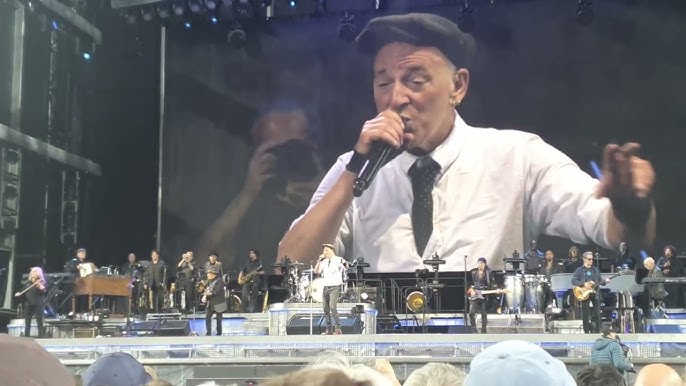
There is a paradox at the center of Bruce Springsteen’s career that has been noted by critics and by Springsteen himself and that has never been fully resolved because it is not the kind of paradox that resolves — it simply persists, productively and mysteriously, as one of the most interesting facts about how music works. The paradox is this: Springsteen is the most specifically local major artist in American rock history, a man who writes about specific streets in specific towns in a specific state with a specificity that functions almost as documentary journalism. And he is simultaneously the artist whose music has been received as personally relevant by more people in more countries in more vastly different circumstances than almost any of his contemporaries.
The streets of Freehold, New Jersey. The bars of Asbury Park. The factories of the Jersey Shore. Route 9. The Turnpike. These are not metaphors or approximations. They are actual places, named and located and described with the precision of someone who grew up on them and has never fully left them regardless of how far the touring schedule has taken him. And people in Norway and Japan and Brazil and Australia and South Africa have heard the songs about those streets and recognized in them something about their own streets that the specificity somehow enables rather than prevents.
1. Thunder Road (1975)
The opening track of Born to Run and the song that introduces Mary and the screen door and the porch and the radio and the possibility of escape — a possibility the song neither confirms nor denies but holds open across eight minutes of music that builds from a single harmonica and piano to something that sounds like the entire American dream straining against its own limitations. Springsteen has said he wrote Thunder Road as an invitation — as a song addressed to a specific girl in a specific town that became, in performance, an invitation addressed to everyone in every audience. The girl on the porch is the most universal specific character in American rock.
2. The River (1980)
A song about a young couple in a small New Jersey town — a pregnancy, a hasty marriage, a factory job, the slow disappearance of the dreams they had at eighteen. Springsteen has said it is about his sister and her husband, which makes it as local and as specific as a photograph. It has been received by people in working-class communities across the world as the most accurate description of their own experience they have encountered in music. The specificity is the universality. The factory in New Jersey is the factory everywhere.
3. Atlantic City (1982)
From Nebraska — the solo acoustic album recorded on a four-track cassette in Springsteen’s bedroom in Colts Neck, New Jersey that is the quietest and most devastating record he ever made. The song is about a man in Atlantic City considering an offer from people he knows are dangerous because there are no other offers available. It is a specific New Jersey story about a specific kind of American desperation. Tom Waits has called it one of the greatest American songs ever written. People in former industrial towns across Europe have said it describes their town in the 1980s exactly.
4. Born to Run (1975)
The title track — the song that made Springsteen famous, that Jon Landau heard and said he had seen the future of rock and roll, that spent weeks on the radio in 1975 and that has not significantly diminished in cultural presence since. The chrome-wheeled, fuel-injected, stepping-out-over-the-line imagery is specific to a New Jersey teenager’s relationship with cars and escape in the mid-1970s. It is also the most complete expression of the universal human desire to get out — to go somewhere that is not here — that rock and roll has produced. The specificity of the chrome wheel is what makes the desire real rather than abstract.
5. The Promised Land (1978)
From Darkness on the Edge of Town — the album Springsteen made after the legal dispute with his former manager had kept him from recording for three years and that contains his angriest and most committed work. The Promised Land is a song about refusing to give up on the idea that something better exists even when the evidence suggests otherwise — about choosing to believe in what you cannot yet see because the alternative is to stop choosing anything. The promised land of the title is New Jersey, in the specific sense that the song was written there by a man who had grown up there, and it is everywhere else simultaneously, in the sense that the desire it describes belongs to everyone who has ever been somewhere they need to leave.
Springsteen has said, in interviews given over fifty years, that the goal of every song he has written is to make the specific general — to find in one person’s experience the thing that belongs to everyone. He has said he learned this from Woody Guthrie and from Hank Williams and from the gospel tradition and from John Steinbeck. He has spent fifty years proving that he learned it correctly.