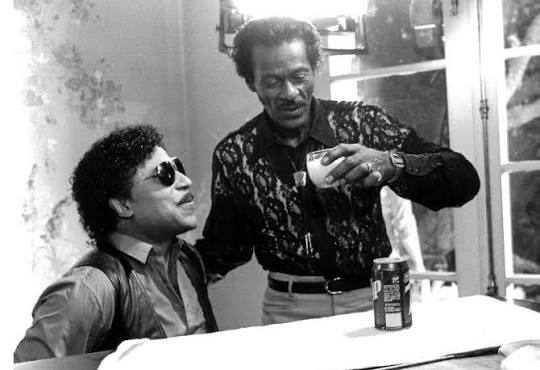
In the mid-1950s, American popular music had two figures who were, simultaneously and independently, inventing something that did not yet have a name but that would shortly be called rock and roll. Chuck Berry was doing it from St. Louis with a guitar and a lyrical precision that documented teenage American life with the specificity of a journalist and the rhythm of someone who had absorbed the full tradition of the blues and redirected it toward something new. Little Richard was doing it from Macon, Georgia with a piano and a voice of such uncontained physical energy that the people who heard him for the first time in 1955 and 1956 frequently described the experience in terms usually reserved for natural disasters.
They knew each other. They performed on the same bills during the touring circuit of the mid-1950s — the package tours that moved through Black venues and then, as the music’s commercial reach expanded, through venues that were not segregated by law if not always by practice. The relationship between them was not warm in the straightforward sense of the word. It was the relationship of two people who are competing for the same crown without any established protocol for how the competition should be conducted, in a cultural environment that was simultaneously celebrating them and exploiting them with a thoroughness that the white musicians who would subsequently profit from their innovations did not experience.
Berry’s relationship with Little Richard is documented in fragments — in interviews each gave separately across decades, in the accounts of musicians who performed with both, in the specific ways they spoke about each other in contexts where the other was not present. What emerges is a picture of mutual awareness so precise and so sustained that it constitutes a form of relationship even in the absence of warmth. They knew exactly what the other was doing. They tracked it. They adjusted to it. They competed without ever fully acknowledging the competition publicly.
Little Richard’s position on his own primacy has been consistent and loudly maintained across seven decades of interviews. He has said he invented rock and roll. He has said this in terms that left no room for amendment or qualification. He has said it about Chuck Berry, about Elvis, about the Beatles, about anyone whose claim to innovation might be placed alongside his own. The consistency of the claim — the absolute refusal to modulate it for diplomatic purposes — is itself a form of historical testimony, because people who are fabricating claims usually show some awareness of their implausibility.
Berry’s position has been characteristically more precise and less loud — he has made the argument through interviews and through his memoir in ways that are documented and specific rather than declarative. He has noted, with the precision of a man who kept careful track of dates, that Maybellene was released in 1955 before Little Richard’s first major hit, that the guitar-based sound he developed was distinct from Richard’s piano-based approach, and that the claim to have invented something as broad as rock and roll is in any case historically problematic given how many people contributed to its development.
Elvis was asked, in an interview in the late 1950s, to adjudicate the question. His response has been quoted in multiple biographies and is consistent across the sources — he said he couldn’t choose, that both men had given him things that were essential to what he was doing, and that asking him to rank them was like asking him which of his parents was more important. Then he smiled in the way that Elvis smiled when he had said something he was pleased with. The interviewer moved on.