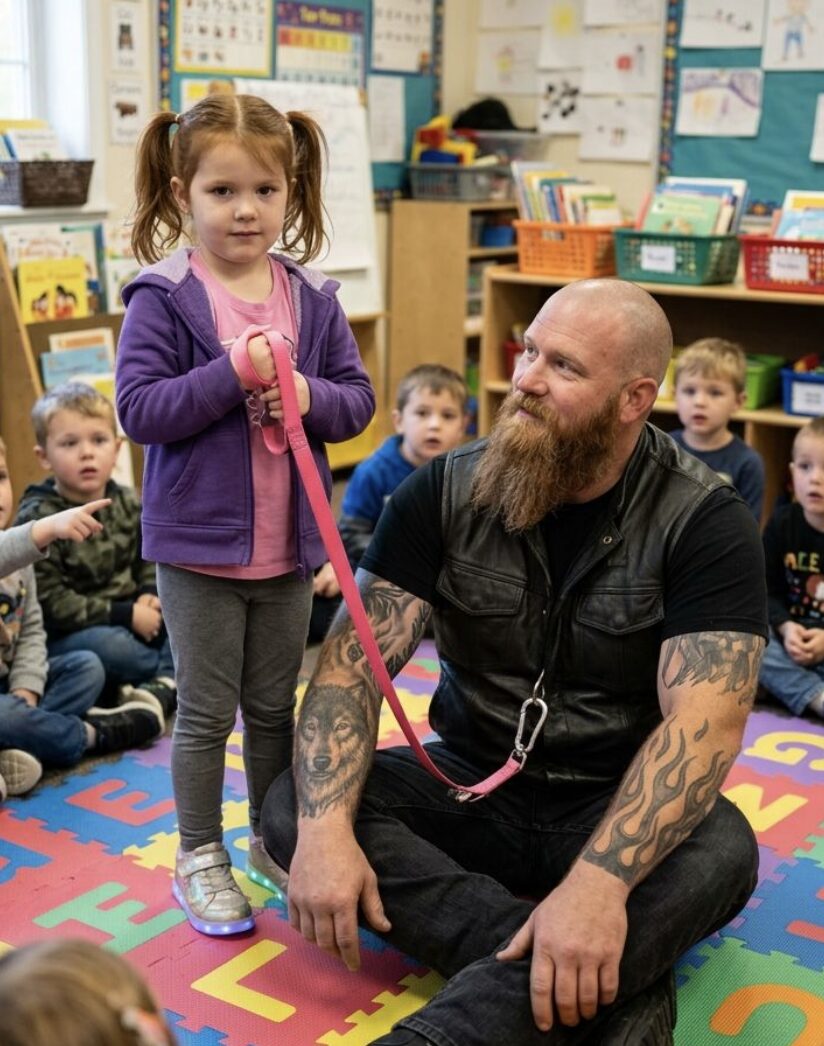
My five-year-old daughter stood at the front of her kindergarten classroom on a crisp Friday morning in October, gripping a cheap pink dog leash in one small hand. On the other end sat her two-hundred-and-forty-pound father—six-foot-one of leather, ink, and quiet strength—cross-legged on the alphabet rug like the world’s most improbable house pet.
Picture him first.
Dax Turner is forty years old. He has worked as a heavy-equipment mechanic at the same yard off I-25 outside Pueblo, Colorado, for sixteen years. His hands are scarred and permanently blackened at the edges of the nails no matter how many times he scrubs them. He’s been a patched member of an independent motorcycle club out of southern Colorado for twelve.
Shaved head, a full reddish-brown beard that reaches the fourth button of his cut, and sleeves of prison-style tattoos from a wilder chapter of his life: flames licking up his right forearm, a lone wolf on the left, LOYALTY stamped across his right knuckles in blocky black ink, and a small tribal piece on the left side of his neck that no collared shirt can fully hide.
To strangers in grocery stores, he is the man they instinctively give a wider berth. To the men who work under him at the yard, he is steady, fair, and brutally competent. To me, he is the husband who still brings me coffee in bed on Sunday mornings and checks the locks three times before we go to sleep.
I am Renee Turner, thirty-four, kindergarten teacher at the same small south-side elementary school for nine years. Dax and I have been married eleven years. Our daughter, Junie, is five—red-brown hair like her father’s, green eyes like mine, two missing front teeth, and the stubborn negotiating skills of a seasoned trial lawyer.
We do not have a pet.
We had Sparkle the goldfish for sixteen weeks, but Sparkle had floated to the top of his bowl the Tuesday before Pet Day. Junie was still in the angry-crying stage of grief and refused to discuss replacements. Ms. Halberg, Junie’s teacher, had kindly suggested stuffed animals or photos for kids without live pets.
Junie considered this for all of thirty seconds at our kitchen table Thursday night.
Dax was eating cold leftover lasagna straight from the pan, scrolling through a parts catalog on his phone. Junie turned to him with the solemn expression she reserves for serious business.
“Daddy,” she said, “can you be my pet tomorrow?”
Dax stopped chewing. He set the phone down slowly.
“Say that again, baby.”
Junie repeated it without hesitation. “At school. You can sit on the rug. I’ll hold the leash and tell everybody about you.”
Ten full seconds of silence followed. Dax looked at me. I looked back. I knew better than to influence this decision. This was between them.
He studied his daughter’s face—the absolute trust shining in her eyes—then gave one slow nod.
“Okay.”
Junie clapped once, very seriously, and went back to her chicken nuggets as if the matter had been settled like any other household negotiation.
—
The next morning, at 7:45, Dax walked into the school carrying the folder I’d left on the counter. He wore his black leather cut over a clean black T-shirt, dark jeans, and his heavy motorcycle boots. Clipped to the carabiner on the front pocket of his vest was a bright pink dog leash. Junie bounced beside him in her purple jacket, the other end of the leash in her hand.
Ms. Halberg—sixty-one years old, thirty-six years teaching kindergarten—met them at the door of Room 4-B. She had seen tarantulas, pythons, emotional support ducks, and one memorable ferret that escaped and caused a thirty-minute lockdown. She had never seen anything like this.
She blinked once, twice, then smiled the kind of smile that only veteran teachers can summon when something extraordinary is about to happen.
“Well, Junie,” she said, voice warm, “let’s get your pet settled.”
—
When Pet Day began, twenty-five five-year-olds gathered on the colorful rug. Hamsters spun in wheels, golden retriever puppies wiggled, a bearded dragon dozed in a heated tank, and one little boy proudly displayed his jar of “the fastest snail in Pueblo.”
Then Ms. Halberg called Junie’s name.
Junie marched to the front, light-up sneakers flashing. Dax followed. The classroom seemed to shrink around his frame. He lowered himself to the rug with surprising grace, knees up, boots tucked under him, sitting directly between the big blue “M” and “N.” The pink leash lay across his lap.
Junie stood tall beside him, holding the leash like a medal.
“This is my pet,” she announced in her clearest voice. “His name is Dax, but I call him Daddy.”
A few giggles rippled through the class. Junie ignored them.
“He is very big,” she continued, patting the top of his shaved head the way she might pet a large, patient dog. Dax closed his eyes and leaned ever so slightly into her touch. “But you don’t have to be scared. He eats lasagna and drinks coffee from a black cup. His motorcycle is loud and makes the windows shake, but he always drives slow when I ride with him.”
She traced the wolf tattoo on his left forearm with one tiny finger.
“These pictures are from when he was lost,” she said matter-of-factly. “But then he found me and Mommy, and now he’s not lost anymore. He’s my best friend. He fixes big machines and he fixes our house and he fixes me when I’m sad. He is the best pet in the whole world.”
She looked at Ms. Halberg and gave a satisfied nod.
Dax, who had not moved or spoken the entire time, looked up at his daughter with eyes so soft they didn’t belong on a man who once looked the way he does. He gave her the smallest, most private wink.
The room was silent for half a heartbeat. Then Ms. Halberg—tough, no-nonsense Ms. Halberg—wiped a tear from the corner of her eye and started clapping. The children exploded into applause. Dax simply unclipped the pink leash from his vest, handed it back to Junie with grave courtesy, and stood up, towering once more. He ruffled her hair gently and walked out of the classroom without a word.
—
My sister-in-law posted the twenty-two-second video Ms. Halberg had quietly recorded. She thought her family and a few friends would see it.
By Tuesday it had been shared more than a hundred thousand times. By the end of the month, eleven million views. Comments poured in from every corner of the world.
But the one I printed and tucked in my desk drawer came from Leo’s mother, whose son had been sitting two feet from Dax that morning:
“My son Leo came home and told me he met a giant man who was as strong as a superhero but as gentle as a bedtime story. A lot of adults look at a man like Dax and see a past they want to run from. But that little girl looked at him and saw a future she could trust completely. We should all be so lucky to be loved by a monster who chooses, every single day, to be a protector.”
—
Dax never read the comments. He doesn’t have social media and doesn’t want it. He still leaves the house at six-thirty every morning, comes home covered in grease and metal dust, and kisses me like it’s the first time. But if you walk into our garage now, past the Snap-On toolbox and the rows of heavy wrenches, you’ll see it hanging on a single silver nail right beside his leather riding jacket: the small pink dog leash.
Some nights, when Junie is supposed to be asleep, I catch her standing on her tiptoes in the garage doorway just staring at it, like it’s the most precious thing we own.
And maybe it is.
Because that leash isn’t just a prop from one Friday morning. It’s proof that the scariest-looking man in the room can still sit on a kindergarten rug between the letters M and N and let the whole world see what real strength looks like: the willingness to be small for the people who make you feel ten feet tall.