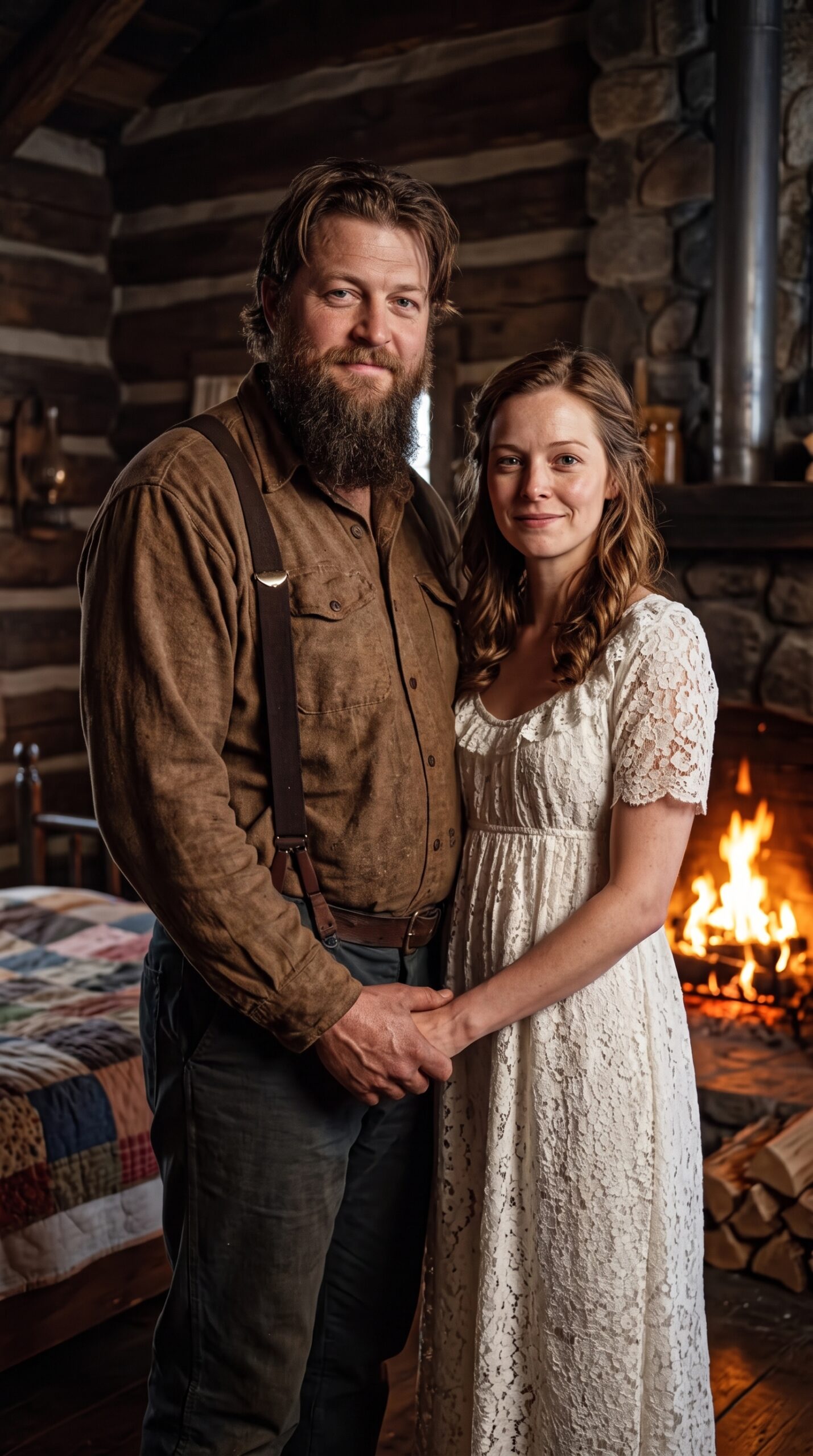
# THE MOUNTAIN MAN NEVER TOUCHED A WOMAN — BUT THE LETTER IN HIS CABIN REVEALED WHY HE REALLY MARRIED HER
**Colorado Territory, 1884**
The first thing Eleanor Whitmore noticed about Caleb Mercer was that he never once looked at her like a hungry man looking at a woman.
He looked at her as though she were something fragile he had been trusted to carry through a storm.
That frightened her more than the rumors about his strength, his temper, or the blood supposedly staining the floorboards of his mountain cabin. Eleanor had learned to distrust kindness because, in her experience, kindness often came with a price that was revealed only after a woman had nowhere left to go.
Three days earlier, she had been standing in the office of her Baltimore landlord, clutching a worn carpetbag while rain dripped from the brim of her hat.
Her husband, Thomas Whitmore, had been dead for eleven months. Fever had taken him in the spring, leaving behind a widow, unpaid bills, and a rented room that Eleanor could no longer afford. Thomas had not been a wealthy man, but she had believed that marriage would at least give her a little security. Instead, she had spent the last year sewing shirts until her fingers cramped, mending dresses for women who paid her late, and eating bread soaked in tea when she could not afford supper.
The landlord had waited until she was alone before making his offer.
“You are a pretty woman, Mrs. Whitmore,” he had said, leaning against the door of his office. “There are gentlemen who would be willing to help you.”
Eleanor had known what he meant before he finished speaking.
“I am not looking for that kind of help.”
“Then you should have thought of that before you fell behind on your rent.”
“I can pay you next week.”
“You have said that three weeks running.”
He had stepped closer, and Eleanor had backed toward the door.
“You can settle your account another way. I have friends who enjoy a woman’s company. You would have a warm bed, good meals, and no more worrying about money.”
For a moment, Eleanor had been unable to speak. Then she had lifted her chin.
“I would rather sleep in the street.”
The landlord laughed.
“Three days, Mrs. Whitmore. After that, I change the locks.”
She left his office with seventeen dollars in her purse, a dead husband’s wedding ring on a chain around her neck, and the sickening realization that the world had very little patience for a woman without a man to protect her.
That evening, while searching through an old newspaper at the boardinghouse where she was staying, she found an advertisement tucked between notices for farmhands and domestic servants.
It was short enough to be overlooked.
**WANTED: A WIFE FOR A MOUNTAIN HOMESTEAD.**
The advertisement explained that the man owned forty acres in Colorado Territory, along with a cabin, livestock, and sufficient supplies for the coming winter. He sought a wife willing to live in a remote location. In exchange, he would pay her travel expenses, settle her outstanding debts up to an agreed amount, and provide food, shelter, and a legal marriage.
One sentence stood out from the rest.
*I promise safety, not love. A woman who comes to my home will be treated with respect and will never be forced to share my bed.*
The advertisement was signed with three initials.
C. M.
Eleanor read it twice.
Then she read it a third time.
It sounded ridiculous. It might have been a trap. A mountain man who advertised for a wife and promised not to touch her was either a fool or a dangerous liar.
But Eleanor had learned that desperate circumstances rarely offered perfect choices. They offered only the possibility of choosing which risk she could live with.
She wrote to the address printed beneath the advertisement.
She expected no answer.
Six days later, a letter arrived.
The handwriting was broad, uneven, and unmistakably masculine.
*Mrs. Whitmore,*
*I received your letter. If you are still interested, I will arrange passage to Colorado and meet you in the town of Silver Creek. You will have an opportunity to see my home before deciding whether you wish to remain. If you change your mind, I will pay for your return journey as far as my means allow.*
*I have no intention of deceiving you about my circumstances. The mountain is lonely, the winters are severe, and I am not a man who knows much about conversation. I need a wife because a homestead is difficult to maintain alone, and because I have grown tired of eating supper without hearing another person’s voice.*
*I will not pretend this arrangement is romantic. If you accept, you will be free to leave when the weather permits.*
*Caleb Mercer.*
Eleanor stared at the last line for a long time.
Free to leave.
She could scarcely remember the last time a man had spoken of her freedom as though it mattered.
She answered that same afternoon.
Within a week, Caleb had sent the money for her ticket and a portion of her debts. She settled what she could, packed her belongings, and left Baltimore before her courage had time to fail her.
The journey west took nine exhausting days.
Eleanor traveled by train until the tracks gave way to rougher roads, then continued by stagecoach over miles of uneven terrain. The farther she went, the more the familiar world disappeared. Crowded streets gave way to open fields. Fields became forests. Forests rose into dark mountains whose peaks were hidden behind clouds.
At night, she slept in boardinghouses and listened to strangers argue through thin walls. During the day, she watched the landscape change through the coach window and wondered whether she had exchanged one kind of danger for another.
When the stage finally reached Silver Creek, a small settlement nestled between the mountains, Eleanor was stiff with exhaustion.
The town had one main street, a general store, a blacksmith, a church, a doctor’s office, and a saloon whose swinging doors never seemed to rest.
She had barely stepped down from the coach when a woman selling apples recognized the name on Eleanor’s luggage.
“You’re the one going up to Mercer’s place?”
Eleanor tightened her grip on the handle.
“Yes.”
The woman’s expression changed.
“Lord help you.”
Another woman, standing near the store, turned at the remark.
“Is she really going to marry that mountain beast?”
“I believe I am,” Eleanor answered.
The women exchanged a glance.
The first one lowered her voice, though not enough to prevent Eleanor from hearing.
“That man is six feet four if he’s an inch. Built like a bear. Doesn’t drink, doesn’t dance, doesn’t attend church, and barely speaks to anyone. They say he once killed a wolf with his bare hands.”
“That is nonsense,” the second woman replied. “A man can’t kill a wolf with his bare hands.”
“Then explain the scar across his shoulder.”
Eleanor pretended not to listen.
The first woman moved closer.
“Did he tell you about his first wife?”
Eleanor’s stomach tightened.
“He told me he had lived alone for some time.”
“That isn’t what I asked.”
Before Eleanor could answer, the sound of heavy boots came from the far end of the street.
The women fell silent.
A man was walking toward them.
He was enormous.
His dark coat stretched across shoulders broad enough to make the doorway of the general store look narrow. A thick beard covered most of his face, and his hair curled beneath the brim of an old hat. His hands were large and rough, marked with the scars of years spent cutting wood, handling livestock, and working with tools.
Yet it was his eyes that caught Eleanor’s attention.
They were gray, almost silver in the afternoon light, and there was something in them that made him look older than his thirty-six years.
He stopped several feet away.
“Mrs. Whitmore?”
His voice was low and rough, as though it had not been used much that day.
“Yes.”
“I’m Caleb Mercer.”
He removed his hat.
For a moment, neither spoke.
Eleanor had imagined a frightening man, perhaps one who would measure her with his eyes and immediately begin explaining what he expected from his new wife.
Instead, Caleb looked uncomfortable.
He shifted his weight and glanced at the carpetbag beside her.
“That all you’ve brought?”
“Everything I own.”
His eyes moved to her worn shoes, then to the thin gloves she had been wearing throughout the journey.
Without another word, he took off his own gloves and held them out.
“These are warmer.”
“Oh, I couldn’t take those.”
“You can. My hands are used to the cold.”
She hesitated.
Then she accepted them.
They were far too large, but they were warm.
Caleb picked up her carpetbag as though it weighed nothing.
“Have you eaten?”
“Not since this morning.”
“Then we’ll get something before we leave.”
He turned toward the general store, but the woman selling apples called after him.
“Caleb! You ought to tell this poor girl what happened to Sarah before you drag her up that mountain.”
He stopped.
Eleanor felt his entire body stiffen.
For one terrible second, she thought he might turn around and strike the woman. His hands closed around the carpetbag handle, and the muscles in his jaw tightened.
But he did not shout.
He simply looked at the woman with an expression so full of pain that Eleanor found herself looking away.
“Sarah’s story isn’t yours to tell, Martha.”
Then he continued toward the store.
Eleanor followed him.
She had not yet reached his cabin, and already she understood that the mountain man was carrying something heavier than the enormous bag in his hand.
Something no one in town had managed to help him put down.
## CHAPTER TWO: THE CABIN WITH TWO CHAIRS
Caleb bought bread, flour, coffee, salt, and a small parcel of dried apples before leading Eleanor toward the horses waiting behind the blacksmith’s shop.
He did not ask whether she was frightened.
Perhaps he assumed she was.
Perhaps he was afraid of what she might say if he asked.
The horse he brought forward was a tall chestnut mare with a white mark between her eyes.
“This is June,” he explained. “She’s gentle, even when the trail gets rough. You’ll ride her.”
“What about you?”
“I’ll walk beside her.”
Eleanor glanced toward the darkening mountains.
“You intend to walk all the way to your home?”
“I’ve done it before.”
“With a horse?”
“Without one.”
He said it so plainly that she could not tell whether he was joking.
They left Silver Creek shortly before sunset.
The trail climbed through thick pine forests, crossed a narrow stream, and wound along the side of a mountain. The air grew colder with every mile. Far below, the town’s lamps became tiny golden specks, and the last sounds of human activity disappeared behind the trees.
For the first hour, Caleb said almost nothing.
He walked beside June with one hand resting on the reins, occasionally glancing at the trail ahead. Eleanor sat stiffly in the saddle, trying not to show how badly her back ached.
Finally, she broke the silence.
“How long have you lived here?”
“Eight years.”
“Alone?”
He took several steps before answering.
“Not all eight.”
Eleanor waited for him to explain, but he did not.
“Did you build the cabin yourself?”
“Most of it.”
“And the barn?”
“Yes.”
“You must be very strong.”
He glanced at her.
“Strong enough to cut wood.”
“People in town say you killed a wolf with your bare hands.”
This time, he stopped walking.
For a moment, Eleanor regretted asking.
Then he looked down at his hands.
“It was a wolf trap. The animal had been caught near the livestock pen. I tried to free it, and it attacked me. I managed to get away before it tore my throat open.”
“So you didn’t kill it with your bare hands?”
“I did.”
Eleanor blinked.
Caleb resumed walking.
“It was a miserable way to spend an afternoon.”
Against her will, a small laugh escaped her.
Caleb looked up so quickly that she thought something had frightened him.
“What?”
“Nothing,” she said.
“You laughed.”
“Am I not permitted to?”
“You are.”
He looked confused by his own answer.
“You’re welcome to laugh whenever you please, Mrs. Whitmore.”
The simplicity of the remark warmed her more than the gloves he had given her.
They continued upward.
When the cabin finally came into view, Eleanor understood why the people in town spoke of Caleb as though he belonged to another world.
The house stood in a clearing surrounded by tall pines, with a sturdy barn behind it and a woodpile stacked neatly beside the back wall. Smoke rose from the chimney, though Caleb had not been home for hours. A narrow stream ran beyond the clearing, and mountains enclosed the property on every side.
It was beautiful.
It was also terribly isolated.
There was no neighboring farmhouse, no road wide enough for a carriage, and no sign that anyone had passed through the clearing recently.
Caleb helped Eleanor down from the horse.
“Careful. The ground freezes here after sundown.”
He carried her bag inside.
The cabin was warm, clean, and surprisingly orderly. A pot of stew simmered over the fire. Fresh bread rested beneath a cloth, and a kettle sat on the stove. Shelves held jars of preserved fruit, dried herbs, flour, and other supplies.
Eleanor had expected a rough room filled with dirty dishes and hunting trophies.
Instead, everything had its place.
Then she noticed the table.
Two bowls.
Two spoons.
Two chairs.
One chair stood near the fire. The other was pulled slightly away from the table, as though someone had risen from it only moments earlier.
A faded blue ribbon was tied around its back.
Eleanor approached it.
“Who does this belong to?”
Behind her, Caleb became completely still.
“No one.”
She turned.
“You keep two places set for nobody?”
“Sometimes I forget to put things away.”
His answer was so obviously untrue that Eleanor did not know what to say.
She looked again at the ribbon.
It had been washed many times. Its edges were frayed, and the blue had faded almost to gray.
“Was she your wife?”
Caleb’s expression hardened, not with anger but with a kind of desperate restraint.
“Not exactly.”
Before Eleanor could ask another question, he lifted the pot from the fire.
“Supper’s ready.”
She understood the dismissal.
For the moment, she allowed him to keep his secret.
They ate quietly, with the fire crackling between them and the wind beginning to howl outside.
The stew was excellent. The bread was fresh. Caleb placed the largest portion of meat in Eleanor’s bowl, then seemed embarrassed when she noticed.
“You cooked all this?”
“Yes.”
“You’re a better cook than I am.”
“I’ve had plenty of practice.”
“Did your mother teach you?”
He lowered his spoon.
“No.”
The silence that followed was different from the earlier ones.
Eleanor began to understand that nearly every ordinary question had the potential to open a door Caleb had spent years trying to keep shut.
After supper, he showed her a small bedroom at the back of the cabin. It contained a narrow bed, a wooden chest, a washbasin, and a window overlooking the forest.
Fresh blankets lay folded at the foot of the bed.
“I thought you might prefer your own room,” he said. “There’s a latch on the inside. It works properly.”
Eleanor stared at him.
“You made a separate bedroom for me?”
“I finished it last month.”
“Why?”
He seemed surprised by the question.
“Because you’re coming to live here.”
She looked around the room again.
The curtains were new. Someone had placed a small vase of dried wildflowers on the windowsill. A clean nightdress, still wrapped in brown paper, rested on the chest.
“You bought these things?”
“I didn’t know what you would need. I asked Mrs. Dawson at the general store to help me choose.”
Eleanor touched the folded fabric.
No one had ever prepared a room for her simply because she was expected to arrive.
“Thank you,” she whispered.
Caleb nodded.
Then he turned toward the doorway.
“I’ll sleep by the stove tonight.”
She followed him into the main room.
“Why?”
“Because we’re married now, and I don’t want you worrying about where I’ll be.”
“But we haven’t even discussed—”
“I know.”
He stopped beside the fire.
“I want you to understand something before this marriage goes any further. You can sleep in that room with the door locked. You can keep your money. You can write to anyone you please. If you decide you don’t want to stay here, I’ll help you leave when the trail is safe.”
Eleanor’s throat tightened.
“And what do you expect from me in return?”
He looked genuinely puzzled.
“Your company, if you’re willing to give it.”
“Nothing else?”
“No.”
“But we’re husband and wife.”
“That doesn’t give me ownership of you.”
The words settled into the room.
Eleanor thought of Thomas, who had once told her that marriage meant a woman could not refuse her husband. She remembered the nights she had turned her face toward the wall, pretending to be asleep because it was easier than explaining why she was afraid.
She had believed that was simply what marriage meant.
Caleb’s voice interrupted her thoughts.
“Mrs. Whitmore?”
She looked up.
“Why did you place the advertisement?” she asked. “If you wanted company, why not hire a housekeeper?”
He looked into the fire.
“Because a housekeeper would leave when the work was finished.”
“And a wife wouldn’t?”
“She might.”
His voice grew quieter.
“But I hoped she might stay because she wanted to.”
Eleanor could find no answer.
That night, she changed into the white cotton nightdress she had carried all the way from Baltimore. She sat on the edge of the bed and listened to Caleb moving about in the main room.
A moment later, she heard him settle beside the stove.
Then came silence.
For the first time in years, Eleanor found herself alone in a room with a man who had promised her nothing except the right to say no.
She should have felt relieved.
Instead, she felt something she had almost forgotten how to recognize.
Curiosity.
She lay down, pulled the blankets to her chin, and listened to the storm gathering around the cabin.
Near two o’clock in the morning, a sound woke her.
A man’s voice.
Low. Broken. Almost inaudible.
“Sarah, don’t go outside.”
Eleanor sat up.
Another whisper followed.
“Please. I’ll get the medicine. Just stay with me.”
Then a sharp breath, as though Caleb had suddenly awakened inside his own nightmare.
“I should have gone.”
Eleanor remained motionless until the sound of his breathing steadied.
Sarah.
The woman whose name could turn Caleb Mercer into a frightened boy.
The woman whose ribbon remained tied to an empty chair.
Eleanor lay awake until dawn, wondering what had happened on that mountain two years earlier.
She had come looking for shelter.
But the man who had offered it was hiding a grief that seemed to have consumed everything except his ability to be kind.
And Eleanor was beginning to suspect that the truth would be far more painful than the rumors in Silver Creek.
## CHAPTER THREE: THE LETTER UNDER THE FLOOR
Morning arrived beneath a pale gray sky.
The storm had not yet reached its full fury, but snow had begun falling in thick, slow flakes. Eleanor dressed, washed her face, and stepped into the main room.
Caleb was already outside chopping wood.
She watched him through the window.
His coat was open despite the cold, and his breath formed clouds in the air. He swung the axe with mechanical precision, splitting logs that would have required two men to lift.
He looked powerful.
He also looked exhausted.
When he came inside, he carried an armful of wood and immediately began preparing breakfast.
“Did you sleep?” he asked.
“A little.”
“Was the room warm enough?”
“Yes.”
“If you need another blanket, there’s one in the chest.”
Eleanor almost smiled.
“Caleb, I slept perfectly well.”
He nodded, as though relieved.
After breakfast, he explained that he needed to inspect the livestock before the next snowfall.
“There’s enough food for several weeks,” he told her. “The water comes from the spring, but don’t go near the stream when the ice gets thick. It can look solid and still break beneath you.”
“I understand.”
“If you hear the wind coming hard from the north, close the shutters.”
“I will.”
“And if you need anything, call me.”
She looked toward the barn.
“How far away will you be?”
“Only a few hundred yards.”
“Then I think I’ll manage.”
For the first time, she saw the hint of a smile beneath his beard.
“You’re probably right.”
He left her with a list of small tasks she could complete inside the cabin.
Eleanor swept the floor, washed the dishes, and began organizing the cupboards. She discovered that Caleb had stored enough supplies for the winter to feed several people, though only one person had lived there for most of the past two years.
There were jars of peaches, apples, beans, and preserved vegetables. Several sacks of flour stood against the wall. In a wooden crate near the pantry, she found children’s toys.
A small carved horse.
A wooden duck.
A little spinning top.
She picked up the horse and turned it in her hands.
It had been carefully made, with smooth edges and a dark mane painted in black.
On its underside, someone had carved a name.
*Samuel.*
Eleanor sat down slowly.
A child had lived here.
She knew it now with a certainty that made the cabin feel suddenly different.
She looked toward the faded ribbon on the chair, then at the toys in the crate.
The cabin had not always been so empty.
Someone had laughed here.
Someone had run across the floorboards with little feet.
Someone had sat in that chair, perhaps holding a child in her arms while Caleb stirred a pot on the stove.
Eleanor carefully returned the wooden horse to the crate.
She told herself she had no right to investigate a secret Caleb was not ready to share.
But while moving a heavy chest away from the wall, she noticed a loose floorboard beneath the bed in the main room.
It was almost invisible beneath the worn rug.
One corner sat slightly higher than the others.
She knelt and ran her fingers along the edge. The board moved when she pressed it.
For a moment, she hesitated.
Then she lifted it.
Beneath the floor was a small wooden box.
The lid was secured with a simple brass clasp, but it was not locked.
Inside lay three things.
A folded letter.
A tiny knitted sock.
And a newspaper clipping, its edges yellowed with age.
Eleanor lifted the clipping first.
The headline was printed in thick black letters.
**WOMAN AND CHILD LOST IN BLIZZARD — HUSBAND SURVIVES.**
Her fingers began to tremble.
The article described a tragedy that had taken place two winters earlier. A woman named Sarah Mercer and her infant son, Samuel, had disappeared during a violent snowstorm in the Colorado mountains.
Searchers had found their bodies three days later in a ravine below a narrow trail.
The article stated that Sarah had left her brother’s cabin during the storm to seek medical assistance for her feverish child.
The brother had begged her to remain indoors.
He had tried to stop her.
She had gone anyway.
Eleanor read the article twice.
Then she unfolded the letter.
The handwriting was delicate, the ink faded in places.
*Caleb,*
*I know you will be angry when you find this letter, because I promised I would not go into town without telling you. But Samuel’s fever has grown worse, and I cannot bear to sit beside him without doing something.*
*I have wrapped him in the warmest blankets and given him the medicine the doctor left last month. It has not helped.*
*I am going to Silver Creek for Dr. Bennett. I know the storm is coming, but I cannot watch my baby suffer.*
*You have done so much for us. You gave us a home when we had nowhere else to go. You repaired the room, built Samuel his little bed, and sat beside him every night when his crying kept me awake.*
*I have never forgotten what you sacrificed to keep us safe.*
*Please do not blame yourself for what happens tonight. You cannot protect everyone from every sorrow, no matter how much you love them.*
*If I do not return, tell Samuel when he is older that his mother loved him more than breathing.*
*And Caleb, please promise me one thing.*
*Do not spend the rest of your life punishing yourself for loving us.*
*Your sister,*
*Sarah.*
Eleanor pressed the letter against her chest.
She read the last paragraph again.
*Do not spend the rest of your life punishing yourself for loving us.*
A terrible understanding began to form.
Sarah had not been Caleb’s wife.
She had been his sister.
The child had been his nephew.
And the man who had built a home in the mountains had watched the two people he loved most disappear into a storm he could not control.
Eleanor sat on the floor, surrounded by the quiet evidence of a life that had once filled the cabin.
She imagined Sarah sitting at the table with the blue ribbon in her hair. She imagined a baby reaching for Caleb’s enormous fingers, laughing when he lifted him into the air. She imagined the little wooden horse being carved beside the fire.
Then she imagined the cabin after the storm.
The empty chair.
The toys no one touched.
The room that had been prepared for a woman and child who never returned.
Outside, the sound of an axe stopped.
Eleanor quickly placed the letter back in the box, but she did not return it beneath the floor.
She heard the cabin door open.
Caleb stepped inside, carrying a bundle of wood.
His eyes immediately fell on the box.
For several seconds, he did not move.
Then he put the wood down.
“You found it.”
Eleanor stood slowly.
“I am sorry. I wasn’t trying to pry.”
He looked at the letter in her hand.
“Did you read it?”
“Yes.”
His face changed.
The color drained from his cheeks, and his mouth tightened as though he were trying to keep words from escaping.
“Then you know.”
“I know Sarah was your sister.”
He closed his eyes.
“And Samuel was your nephew.”
Caleb turned away.
For a moment, Eleanor thought he might order her to leave the room. Instead, he walked toward the chair with the blue ribbon and gripped its back.
“She was twenty-seven,” he said.
His voice sounded distant.
“Samuel was nine months old.”
Eleanor waited.
“Sarah came here because her husband was a cruel man. He drank too much and beat her whenever he was angry. She stayed longer than she should have because she thought a child needed his father.”
Caleb’s fingers tightened around the chair.
“One night, she came to my door with Samuel wrapped in a blanket. Her face was bruised. The boy was crying, and she was shaking so badly she could barely speak.”
He swallowed.
“I wanted to ride straight to her husband’s house and drag him out by the throat. But Sarah begged me not to. She said she only wanted somewhere safe to stay.”
“So you brought her here.”
“I gave her the cabin. I moved into the smaller room and built another bedroom for her and the boy. I thought if I could give them a place where no one could hurt them, everything would be all right.”
He looked at the window.
“For a while, it was.”
A faint smile appeared on his face, but it vanished almost immediately.
“Samuel liked horses. He would crawl after my boots whenever I came in from the barn. Sarah used to laugh because he would fall asleep holding one of my fingers.”
Caleb’s voice cracked.
“I carved him that horse because he was always reaching for the real ones. He was too young to understand why they wouldn’t let him near them.”
Eleanor felt tears gathering in her eyes.
“Then the fever came,” Caleb continued.
“It started in the evening. Sarah said the boy was warm, but he was still playing. By midnight, he was burning up. I rode as far as the trail allowed and brought back what medicine I could find in my supplies. Nothing helped.”
He rubbed a hand across his face.
“The snow started before dawn. I told her we had to wait. The doctor couldn’t reach us in that weather, and no horse could travel safely through the pass. I promised her I’d get him help as soon as the trail opened.”
His voice became harder.
“But she couldn’t wait. She said he was getting worse. I begged her to stay. I told her I would go myself.”
“What did she say?”
Caleb looked at Eleanor.
“She said she was his mother.”
He fell silent.
“She told me that if Samuel died while she sat beside him doing nothing, she would never forgive herself.”
His hands were shaking now.
“I couldn’t stop her. I thought I could reach the trail before she did. I followed her outside, but she was faster than I expected. The snow was already blinding us, and she knew the path better than I thought she did.”
He swallowed hard.
“I lost sight of her near the ridge.”
Eleanor could hardly breathe.
“I searched until the wind drove me back. I searched again the next morning. By the third day, the snow had covered the tracks. When the search party found them, Sarah was holding Samuel beneath her coat.”
Caleb’s face crumpled.
“The boy was tucked against her chest. She had wrapped herself around him to keep the snow off his face.”
He pressed a fist against his mouth.
“They found them together.”
The cabin was silent except for the fire.
Eleanor slowly approached him.
“Caleb…”
“I told her not to go.”
His voice rose, not with anger but with unbearable grief.
“I told her to stay. I told her I would protect them. I had a rifle, horses, supplies, strong hands. I could split a tree in half, lift a fallen beam, fight off a wolf. But I couldn’t save my own sister and a baby.”
He looked down at his hands.
“What good is strength if it cannot save the people who need you?”
Eleanor had no answer that could make the question disappear.
So she did not offer a false one.
She stepped closer and placed the tiny knitted sock on the table.
“Sarah knew you loved them.”
He shook his head.
“She died because I failed her.”
“No,” Eleanor said gently. “She died in a terrible storm while trying to save her child. You did not send her out there. You did not want her to go. You tried to keep her safe.”
“I should have gone with her.”
“Perhaps. But you cannot know what would have happened if you had.”
“I could have carried them both.”
“Perhaps.”
“I could have reached the town.”
“Perhaps.”
“Then why didn’t I?”
The question came out like a cry.
Eleanor looked at the enormous man standing before her.
He was stronger than anyone she had ever met, yet he was asking a question no amount of strength could answer.
Because the past could not be changed.
Because love did not make people invincible.
Because sometimes terrible things happened even when good people did everything they knew how to do.
But Eleanor understood that telling Caleb these things would not make him believe them.
Not yet.
So she did something simpler.
She reached for his hand.
His fingers were rough and scarred. He stared at her small hand resting against his as though he had never seen such a thing before.
“Caleb,” she whispered, “you are allowed to grieve. But you are not required to spend the rest of your life alone to prove that you loved them.”
His eyes filled with tears.
Then the mountain man who had faced wolves and storms without trembling sank to his knees.
He covered his face with both hands and wept.
Eleanor knelt beside him.
She did not tell him to be strong.
She did not ask him to stop crying.
She simply stayed.
For a long time, the only sounds in the cabin were the fire, the wind, and the broken breathing of a man who had been holding his grief inside for two years.
When Caleb finally lowered his hands, Eleanor placed hers gently against his face.
“Look at me.”
He obeyed.
“I need you to understand something,” she said. “I did not come here because I wanted another man to own me. I came because I needed a safe place to live. But I am beginning to see that you needed something too.”
He looked confused.
“What?”
“Someone who would sit at your table and remind you that the world has not ended.”
His lower lip trembled.
“I don’t know how to do that.”
“Neither do I,” she admitted. “But we can learn.”
Outside, the snow thickened.
Inside, Caleb rested his enormous hand over hers.
And for the first time since Sarah’s death, he allowed someone to see his grief without immediately turning away.
## CHAPTER FOUR: THE NIGHT HE TOLD HER THE TRUTH
That evening, Caleb prepared supper, but neither of them ate much.
The letter lay on the table beside the tiny sock.
Eleanor had asked him whether he wanted to put the box away again.
“No,” he had answered.
Then, after a long pause, he added, “I think I’ve kept it hidden long enough.”
He carried the wooden box to a shelf beside the fireplace and placed it where he could see it.
The gesture was small, but Eleanor understood what it meant.
For two years, he had treated his memories as something shameful, something that had to remain buried beneath the floorboards.
Now he was allowing them to exist in the open.
After supper, they sat opposite each other at the table.
The blue ribbon remained tied to the empty chair.
Eleanor looked at it.
“Did Sarah always wear blue?”
“Whenever she could find it.”
“Why?”
“She said blue made her eyes look brighter.”
He smiled faintly.
“She was vain about her eyes.”
“Was she beautiful?”
“Very.”
“Was she kind?”
“Usually.”
Eleanor laughed softly.
Caleb looked at her with surprise, then gave a quiet laugh of his own.
It was the first time she had heard him laugh without sadness.
For several minutes, they spoke about ordinary things. Sarah’s habit of singing while she cooked. Samuel’s fascination with the horses. The way the baby would kick his feet whenever Caleb entered the room.
The stories hurt, but they also brought Sarah and Samuel into the cabin in a way the empty chair never could.
Eventually, the conversation turned to Eleanor’s own past.
She told Caleb about Baltimore, about sewing until her hands bled, about the landlord who had threatened her, and about the marriage that had taught her to fear the very man who was supposed to protect her.
She did not describe every cruelty Thomas had inflicted.
She did not need to.
Caleb listened without interrupting.
When she finished, he sat motionless for a long time.
“Did he hurt you?”
Eleanor looked at her hands.
“Yes.”
“Did anyone know?”
“A few people suspected. No one wanted to become involved.”
Caleb’s jaw tightened.
“I would have—”
He stopped himself.
Eleanor looked up.
“You would have what?”
He shook his head.
“Nothing.”
“Caleb.”
He met her eyes.
“I would have wanted to hurt him.”
The honesty of the admission startled her.
“But you didn’t know him,” she said.
“No.”
“And even if you had, you couldn’t change what happened.”
His expression softened.
“I suppose not.”
Eleanor reached across the table and touched his hand.
“I don’t need you to avenge me. I need to know that if I am afraid, you will listen.”
He turned his hand beneath hers.
“I will.”
“If I disagree with you, you won’t punish me for it.”
“No.”
“If I tell you something hurts—”
“I stop.”
The answer came immediately.
“And if I say no?”
“I stop.”
Eleanor felt tears prick her eyes.
She had expected marriage to demand another sacrifice from her.
Instead, this man seemed to believe that loving someone meant giving them the freedom to refuse you.
She looked at him for a long time.
“Then I think we may be able to make this marriage work.”
Caleb’s eyes widened.
“You do?”
“Yes.”
“But you barely know me.”
“That is true.”
“And I am not an easy man to live with.”
“Neither am I.”
He stared at her.
Then he laughed.
It was a quiet, startled sound, as though he had forgotten that laughter could exist in his own voice.
Eleanor smiled.
For the first time, she saw the man Caleb might have been before grief convinced him that he had no right to happiness.
He was not merely a mountain giant.
He was a man who loved deeply, feared loss, and had mistaken loneliness for punishment.
Later that night, Eleanor stood beside the bedroom door.
Caleb was spreading a blanket near the stove.
“Would you like to sit with me for a while?” she asked.
He looked up.
“Are you sure?”
“Yes.”
He sat in the chair beside the bed, leaving plenty of space between them.
They spoke quietly about the coming winter, about the livestock, and about the possibility of planting a garden when spring arrived.
Eleanor told him she knew how to sew and preserve food. Caleb explained that the land was good for potatoes, beans, and hardy vegetables.
“We could grow enough to sell some in town,” she suggested.
“Perhaps.”
“And I could teach you to make better coffee.”
He raised an eyebrow.
“My coffee is perfectly good.”
“It tastes like something a man would drink to punish himself.”
For a moment, he looked offended.
Then he laughed so hard that he had to put down his cup.
Eleanor laughed with him.
When the laughter faded, they sat quietly.
Caleb looked at her, his expression suddenly serious.
“I want you to know that you never have to do anything to keep your place here.”
“I know.”
“You don’t have to earn your food.”
“I know.”
“You don’t have to pretend to be happy when you aren’t.”
She swallowed.
“I know, Caleb.”
He nodded.
Then, slowly, he reached out his hand.
He did not take hers.
He simply held it open between them, leaving the choice to her.
Eleanor looked at his enormous palm.
Then she placed her hand in it.
His fingers closed gently around hers.
They sat like that until the fire burned low.
No promises were made beyond the ones they had already spoken.
No boundaries were crossed.
But something had changed.
Eleanor no longer saw Caleb as a frightening stranger hiding a terrible secret.
She saw a man who had given her safety when he could have demanded obedience.
And Caleb, for the first time in two years, began to wonder whether the future might hold something other than regret.
## CHAPTER FIVE: THE DOCTOR AT THE DOOR
The following morning, Eleanor woke to the sound of someone pounding on the cabin door.
Three hard knocks.
A pause.
Then three more.
Caleb was already on his feet.
He grabbed his coat and crossed the room, his expression tightening as he listened.
“No one comes up here in weather like this,” he muttered.
He opened the door.
A man stood on the porch, covered in snow.
He was in his late fifties, with a gray mustache, a leather medical bag, and a wool scarf wrapped tightly around his neck. His horse stood behind him, trembling from the cold.
“Good Lord, Mercer,” the man said. “I thought I’d find you buried beneath half the mountain.”
Caleb stared at him.
“Dr. Bennett?”
The doctor pushed past him into the cabin.
“I need somewhere warm before my fingers freeze off.”
Caleb closed the door and immediately helped him remove his coat.
Eleanor brought hot water while the doctor warmed his hands beside the stove.
Only after he had regained some color did he look at her.
“You must be Mrs. Mercer.”
“Eleanor Whitmore,” she corrected gently. “I haven’t changed my name yet.”
The doctor paused.
Then he nodded.
“Of course. Forgive me.”
Caleb stood near the table, watching him.
“Why are you here?”
Dr. Bennett glanced toward the window.
“Because I have been carrying something I should have told you two years ago.”
The cabin went silent.
Eleanor felt Caleb stiffen.
“What do you mean?”
The doctor placed his medical bag on the table.
“I should have come sooner. I tried, in a manner of speaking, but I lacked the courage to face you after what happened.”
Caleb’s face darkened.
“Say what you came to say.”
Dr. Bennett took a long breath.
“Sarah and Samuel did not die in the way the newspaper reported.”
Caleb stared at him.
“What?”
“The article was written from the information available at the time. It was inaccurate.”
Eleanor felt a chill move through her.
Dr. Bennett opened his bag and removed a folded paper.
“I have kept the original medical notes from that winter. There are things you need to know.”
Caleb took one step toward him.
“What things?”
The doctor looked directly at him.
“Your sister was already in serious danger before she left the cabin.”
Caleb’s face went pale.
“She had a fever herself?”
“No. Not a fever.”
The doctor hesitated.
“Sarah came to see me three days before the storm. She was frightened. She told me her husband had been sending letters to her, threatening to take Samuel away from her.”
Caleb gripped the edge of the table.
“Her husband was in Denver. He had no right to—”
“He had connections, Caleb. He knew men who could make trouble for a woman with no money and no influence. Sarah was terrified that he would find her and take the boy.”
Eleanor looked at the newspaper clipping.
“But Sarah was living here safely,” she said. “Why would she leave during a blizzard?”
Dr. Bennett turned to her.
“That is what I have been trying to understand.”
He unfolded the paper.
“On the morning of the storm, I received a message from Sarah. She had sent it through a traveler who was coming to town. She wanted me to meet her at the old crossing below the ridge.”
Caleb’s voice became dangerously quiet.
“You knew she was coming?”
“I knew she intended to seek help. I did not know she would attempt the journey in that weather.”
“Did you go?”
The doctor lowered his eyes.
“No.”
For several seconds, Caleb did not move.
Then he stepped backward as though the floor had shifted beneath him.
“You let her go alone?”
“I was at the other end of the valley, treating a man whose leg had been crushed beneath a wagon. By the time I received the message, the storm was already severe. I believed Sarah would remain at your cabin until the weather cleared.”
“But she didn’t.”
“No.”
Caleb turned away.
The doctor continued, his voice heavy with regret.
“When the search party found Sarah and Samuel, I examined them. Samuel had been suffering from a severe respiratory infection. He was very ill, but I cannot say with certainty that he would have died if she had stayed. Sarah, however, had a serious injury.”
Eleanor’s hand rose to her mouth.
“What injury?”
“A fractured ankle. It was likely caused by a fall on the icy trail.”
Caleb stared at him.
“Why wasn’t that in the newspaper?”
“Because the men who found her believed she had fallen into the ravine. The reporter wrote that she had died from exposure while carrying her child. I had no evidence to challenge that account.”
The doctor paused.
“But there was something else.”
He removed another paper from his bag.
“This was found inside Sarah’s coat. It had been folded into a small pocket. The search party brought it to me because they believed it might contain medical information.”
He placed the paper on the table.
Caleb looked down at it.
His hands began to shake.
It was a letter.
The handwriting was Sarah’s.
But unlike the letter Eleanor had found beneath the floor, this one had never been delivered.
Caleb unfolded it slowly.
*Caleb,*
*If you are reading this, I am sorry.*
*I know you have spent your life trying to protect me. You did it when we were children, when Father was angry, and when my husband became the kind of man I should have left long before I did.*
*You have always believed that if you were strong enough, you could keep the people you love from being hurt.*
*But you cannot live like that forever.*
*I am frightened about Samuel. I am frightened about his fever, and I am frightened about what his father might do if he finds us.*
*I am also frightened that I have made my troubles your burden for too long.*
*You gave us a home. You gave us peace. You gave my son the chance to grow up without hearing a man shout at his mother.*
*Whatever happens, I want you to know that you saved us long before the storm ever came.*
*If I do not return, do not let anyone tell you that you failed me.*
*You were the only person who never asked me to endure cruelty in exchange for a place to sleep.*
*You were the only person who believed I deserved to be safe.*
*Please remember that.*
*Sarah.*
Caleb stopped reading.
His lips moved, but no words came.
Eleanor stood beside him, tears running down her cheeks.
The doctor removed his spectacles and wiped them with a handkerchief.
“I should have brought you that letter when I first received it,” he said. “But I thought it would reopen the wound. I told myself that silence would protect you.”
Caleb looked up.
“Silence doesn’t protect anyone.”
The doctor bowed his head.
“No. I understand that now.”
For a long time, no one spoke.
Then Caleb turned toward the window.
Snow swept across the clearing, covering the trail and the barnyard in a thick white blanket.
“My sister thought she had to save everyone,” he said quietly. “I thought I had to save her.”
He looked down at the letter.
“And we both believed we had to do it alone.”
Eleanor reached for his hand.
He held it.
Dr. Bennett watched them with an expression of sorrow and relief.
“There is one more thing,” he said.
Caleb turned.
“What now?”
The doctor hesitated.
“Sarah’s husband has been asking questions in Silver Creek. He recently learned that you have taken a wife.”
The room seemed to grow colder.
Eleanor felt Caleb’s hand tighten around hers.
“Why would he care?”
“Because he believes the property should have belonged to Sarah’s family. He has been telling people that Samuel was his only heir and that you kept the boy from him.”
Caleb’s eyes hardened.
“He abandoned them.”
“I know.”
“He beat her.”
“I know.”
“And now he wants my land?”
Dr. Bennett nodded.
“He has been speaking to men who have influence in the county. He claims that Sarah was not of sound mind when she left him, and that you encouraged her to abandon her marriage.”
Caleb’s expression became unreadable.
For the first time since Eleanor had met him, the grief in his eyes was replaced by something colder.
Not violence.
Resolve.
“Let him come,” Caleb said.
The doctor shook his head.
“You don’t understand. He has friends in town. Men who can make trouble for you if they believe his story.”
“Then I will tell them the truth.”
“Truth is not always enough to protect a man.”
Caleb looked at Eleanor.
She understood the question in his eyes.
He was thinking about her.
About the life she had just begun to build.
About the danger that might follow her into the cabin.
She squeezed his hand.
“We will face it together.”
He stared at her for a moment.
Then he nodded.
Together.
It was a word neither of them had used lightly.
But now it was the one thing they had that the storm could not take away.
## CHAPTER SIX: THE WOMAN WHO CHOSE TO STAY
Dr. Bennett remained at the cabin until the worst of the storm passed.
During those hours, Eleanor learned more about Sarah than she had expected.
The doctor spoke of her courage, her stubbornness, and her determination to give Samuel a better life. He explained that she had been planning to leave her husband permanently long before she arrived at Caleb’s cabin.
She had saved small amounts of money whenever she could. She had asked questions about work in Silver Creek. She had even considered opening a sewing shop.
“She was not helpless,” the doctor said. “She was frightened, but she was making plans.”
Eleanor thought about the woman who had left Baltimore with seventeen dollars and a carpetbag.
She understood Sarah better than she could have explained.
Sometimes courage was not the absence of fear.
Sometimes courage was leaving a place where everyone told you to remain.
When Dr. Bennett finally prepared to leave, he gave Eleanor a small bottle of medicine and promised to return when the trail was safe.
At the door, he paused beside Caleb.
“I cannot undo what happened.”
“No.”
“But I can testify to what I know. If Sarah’s husband tries to claim your property, I will tell the county judge what happened.”
Caleb studied him.
“Why now?”
The doctor looked toward the table, where Sarah’s letter lay beside the blue ribbon.
“Because I have spent two years convincing myself that silence was kindness. I will not make that mistake again.”
Caleb nodded.
It was not forgiveness, exactly.
But it was the beginning of something better than resentment.
After the doctor departed, the cabin became quiet again.
Eleanor placed Sarah’s letter in the wooden box, along with the tiny sock and the newspaper clipping.
She did not hide the box beneath the floor.
Instead, she placed it on the shelf beside the fireplace.
Caleb watched her.
“Why there?”
“Because Sarah deserves to be remembered.”
He looked at the box for a long time.
Then he nodded.
“Yes. She does.”
That evening, Eleanor prepared supper.
She had found a recipe in one of Caleb’s old books and decided to try making a thick vegetable stew. She added too much salt, forgot to remove a bay leaf, and nearly burned the bread.
When she finally set the meal on the table, Caleb looked into his bowl.
“Is something wrong?” she asked.
“No.”
“You look concerned.”
“I’m trying to decide whether this is supper or a medical experiment.”
Eleanor stared at him.
Then she burst out laughing.
Caleb joined her.
The sound filled the cabin, startling them both.
For a moment, Eleanor thought of the empty chair and the woman who had once sat there. She wondered whether Sarah would have laughed at her cooking too.
Perhaps she would have.
Perhaps she would have pulled up another chair and offered advice.
The thought no longer felt unbearable.
It felt warm.
After supper, Caleb brought another piece of wood to the fire.
Eleanor sat beside him.
“May I ask you something?”
“Anything.”
“Why did you really marry me?”
He looked at her.
“I told you.”
“You said you wanted a voice across the table.”
“I did.”
“But that isn’t the whole truth, is it?”
Caleb stared at the fire.
For a long time, he said nothing.
Then he reached into the pocket of his coat and removed a folded sheet of paper.
It was another copy of the advertisement he had placed in the newspaper.
Eleanor took it.
On the back, in Caleb’s uneven handwriting, were several lines she had never seen.
*I am looking for a woman who has been told that her life is worth less because she has no husband.*
*I am looking for someone who understands what it means to be alone without choosing it.*
*I cannot promise happiness. I have too little of it left to know how to give it.*
*But I can promise that she will have a home where no one will raise a hand against her, where no one will demand payment for kindness, and where she will never have to be afraid of the person sleeping beneath the same roof.*
*If she wants to leave, I will help her.*
*If she wants to stay, I will be grateful.*
*I do not need a servant.*
*I do not need a woman who is afraid to disagree with me.*
*I need someone who can sit across from me at supper and remind me that I am still a man, not a ghost.*
Eleanor read the words twice.
Then she looked up.
“You wrote this?”
“Yes.”
“When?”
“After Sarah died.”
He rubbed his thumb across the edge of his sleeve.
“I didn’t intend to marry at first. I thought I could hire someone to help with the cabin. But every winter became harder. I stopped going into town. I stopped speaking unless I had to. Sometimes I would go days without hearing another human voice.”
He looked toward the empty chair.
“One night, I realized I could no longer remember the sound of Sarah laughing. I knew her face. I knew her voice in my dreams. But when I tried to remember how she sounded when she laughed, I couldn’t.”
His eyes glistened.
“I was afraid that if I stayed alone much longer, I would forget everything about the people I loved.”
Eleanor held the paper carefully.
“So you placed the advertisement.”
“Yes.”
“Not because you wanted someone to cook and clean?”
“I can cook and clean.”
She smiled faintly.
“I noticed.”
He looked down.
“I wanted someone who would have a reason to stay through the winter. Someone who could build a life here if she wanted to. Someone who wouldn’t be frightened if I had a bad night or went quiet for a day.”
“And you thought a wife would be willing to do that?”
“I thought a wife might have a choice.”
He looked at her.
“I never wanted to buy a woman’s affection. I knew I couldn’t offer the sort of life most women wanted. I had no fine clothes, no money to spare, and no desire to move to town. All I could offer was a roof, food, and the promise that I would never treat her as property.”
Eleanor felt tears gather in her eyes.
“Caleb, do you know what I thought when I read your advertisement?”
“What?”
“I thought you were either a fool or a dangerous man.”
He looked offended.
“Which one did you settle on?”
“I hadn’t decided.”
He gave a short laugh.
“Fair enough.”
She folded the paper and placed it beside Sarah’s letter.
“Then I met you, and you gave me your gloves because my hands were cold. You prepared a bedroom because I was coming to live here. You told me I could leave if I wanted to.”
She looked directly into his eyes.
“You offered me a home without asking me to surrender myself in exchange.”
Caleb swallowed.
“I didn’t know that was unusual.”
“It is.”
He lowered his head.
For a moment, neither spoke.
Then Eleanor took his hand.
“I came here because I was afraid of becoming homeless. But I think I am staying because I have found something I didn’t know I was looking for.”
Caleb looked at her.
“What?”
“A place where I can be myself without being afraid.”
His face changed.
“Eleanor…”
She smiled through her tears.
“I am not promising that everything will be easy. I will argue with you. I will burn the bread again. I will probably complain about the snow, and I might become terribly impatient when you refuse to tell me what you’re thinking.”
He laughed softly.
“But I am willing to try,” she continued. “If you are.”
Caleb stared at her as though she had offered him something beyond his understanding.
Then he lifted her hand and pressed it gently between both of his.
“I am,” he whispered.
Outside, the wind began to ease.
Snow still covered the mountains, but the worst of the storm had passed.
For the first time in two years, Caleb did not dread the coming night.
Because the cabin was no longer a place where he waited for morning.
It was a place where someone was waiting for him.
## CHAPTER SEVEN: A PROMISE THE MOUNTAIN COULD NOT BREAK
Spring arrived slowly in the Colorado mountains.
The snow melted first along the southern slopes, then around the barn, and finally along the narrow trail leading to Silver Creek.
Eleanor discovered that mountain life was harder than anything she had imagined.
The water froze on bitter mornings. The wind found every crack in the cabin walls. The chickens were stubborn, the goats were mischievous, and the horses seemed determined to test her patience.
Caleb taught her how to recognize approaching storms by the shape of the clouds. She taught him how to mend a torn shirt without making the sleeve shorter than the other.
He showed her how to plant potatoes in rocky soil.
She showed him how to make coffee that did not taste like punishment.
Their life was not a fairy tale.
There were days when they argued over money, days when Eleanor missed the noise of the city, and days when Caleb withdrew into silence because a sound or a smell had reminded him of Sarah.
But something had changed.
When Caleb became quiet, Eleanor no longer assumed she had done something wrong.
When Eleanor became frightened, Caleb no longer tried to solve every problem by carrying it alone.
They learned to ask questions.
They learned to listen.
And, little by little, they learned that trust was not built by promising that nothing bad would ever happen.
It was built by showing up when life became difficult.
One afternoon, as Eleanor was hanging laundry beside the cabin, she heard the sound of horses approaching.
She turned.
Three men were riding up the trail.
The first wore a dark wool coat and an expensive hat. His face was narrow, his mouth thin, and his eyes moved over the property with the cold calculation of a man inspecting something he intended to purchase.
Caleb stepped out of the barn.
His expression changed immediately.
“Daniel.”
The man dismounted.
“Caleb.”
Eleanor recognized the name from Dr. Bennett’s account.
Daniel Mercer.
Sarah’s husband.
The man who had beaten her.
The man who had left her with nowhere to go.
Daniel removed his gloves and looked toward the cabin.
“So this is where my wife and son spent their final days.”
Caleb walked toward him.
“Your wife is dead.”
“And my son.”
“Yes.”
Daniel’s expression remained strangely calm.
“I have heard that you have taken another woman into your home.”
Eleanor stepped forward.
“I am Eleanor Whitmore.”
Daniel looked her up and down.
“A widow, I presume.”
“Yes.”
“Then perhaps you understand what it means to lose a husband.”
Eleanor held his gaze.
“I understand what it means to survive one.”
For the first time, Daniel’s expression changed.
Caleb moved beside her.
“You have no business here.”
Daniel smiled thinly.
“On the contrary. Sarah was my wife. Samuel was my son. Whatever happened to them, their affairs concern me.”
“You abandoned them.”
“That is a matter of opinion.”
“No,” Caleb said. “It is a matter of fact.”
Daniel’s companions exchanged glances.
The man adjusted his coat.
“I have come to discuss the property. Sarah was my lawful wife when she died. Her son was my heir. If Samuel had survived, he would have inherited whatever property she was entitled to receive.”
“Sarah owned nothing here,” Caleb replied. “The land is mine.”
“Perhaps. But there are questions about whether you encouraged her to leave her marriage. Questions about whether you improperly influenced her decisions.”
Caleb’s face hardened.
“She left because you beat her.”
Daniel stepped closer.
“Be careful.”
The words were quiet, but Eleanor heard the threat beneath them.
She felt Caleb’s arm move slightly in front of her.
Not to claim her.
To protect her.
Yet this time, she did not want him to stand alone.
She stepped beside him.
“Dr. Bennett knows what happened,” she said. “He knows Sarah came to him because she was frightened. He knows you threatened her.”
Daniel’s eyes narrowed.
“The doctor should be careful about what he claims.”
“He has written it down.”
Daniel looked toward Caleb.
“Then I suppose we shall see what the county judge thinks.”
He put his gloves back on.
“This property may be yours today, Mercer. That does not mean it will remain yours.”
He mounted his horse and rode away with the other men.
For several seconds, Caleb remained motionless.
Then he turned toward Eleanor.
“Are you all right?”
She nodded.
“Are you?”
He looked at the trail.
“I don’t know.”
She took his hand.
“Then we will find out.”
That evening, they wrote to Dr. Bennett.
They asked him to send a sworn statement about Sarah’s injuries, her fears, and the circumstances surrounding her death. Caleb gathered the land records, the original purchase papers, and every document that showed the property had been his long before Sarah came to live with him.
Eleanor organized the letters and made copies.
She had spent years watching men assume that women were too frightened or too ignorant to defend themselves.
She was not going to allow Daniel Mercer to turn Sarah’s suffering into a weapon against the brother who had protected her.
The matter took months to resolve.
Daniel attempted to persuade several townspeople that Caleb had hidden information about Sarah’s death. But Dr. Bennett stood by his testimony, and the men who had searched for Sarah confirmed that Caleb had begged her not to leave the cabin.
The judge found no grounds to challenge Caleb’s ownership of the land.
Daniel’s claims were dismissed.
When Caleb received the decision, he read it twice before setting the paper down.
“Is it over?” Eleanor asked.
“The property dispute is.”
She studied his face.
“But?”
He looked toward the shelf where Sarah’s box rested.
“I thought if I could prove I hadn’t caused her death, I would finally feel better.”
“And do you?”
He considered the question.
“Not entirely.”
Eleanor sat beside him.
“Perhaps you were never meant to prove that you weren’t responsible for every terrible thing that happened.”
He looked at her.
“Perhaps.”
She rested her head against his shoulder.
“You loved Sarah. You tried to protect her. And you have spent two years believing that the worst day of your life was proof that you were not strong enough.”
Caleb’s breathing grew uneven.
“But strength isn’t the same as controlling everything,” she continued. “Sometimes strength means admitting that something hurt you. Sometimes it means asking someone to stay.”
He closed his eyes.
Then he leaned his head gently against hers.
For a long time, they remained that way.
The mountain had not changed.
The cabin had not changed.
But Caleb was beginning to understand that he did not have to remain the man who had opened the door to a storm and watched his family disappear.
He could be the man who opened the door to a new morning.
And Eleanor could be the woman who walked through it beside him.
## EPILOGUE: THE CHAIR BESIDE THE FIRE
By the following winter, the cabin no longer felt like a place built around an absence.
Eleanor had planted flowers near the porch. She had sewn new curtains for the windows and hung a small bell beside the door. Caleb had built a larger table, repaired the roof, and added shelves for the books Eleanor had begun ordering from town.
The old chair remained beside the fire.
So did the blue ribbon.
But Eleanor had placed a small vase of dried wildflowers on the table beside it, and every Sunday she and Caleb sat together after supper and spoke about Sarah and Samuel.
They did not pretend the memories no longer hurt.
They simply stopped treating them as something that had to be hidden.
Sometimes Eleanor imagined Sarah laughing at the way Caleb tried to mend clothes. Sometimes she imagined Samuel chasing the horses across the clearing, his little wooden horse clutched in one hand.
And sometimes she imagined that, if Sarah could see the cabin now, she would be relieved.
Not because Caleb had forgotten her.
But because he had finally stopped believing that remembering her required him to remain alone.
One evening, as the first snow of winter began to fall, Eleanor stood beside the window watching the flakes settle on the pine branches.
Caleb came up behind her.
“Cold?”
“A little.”
He reached for the blanket hanging over the chair and placed it around her shoulders.
She turned toward him.
“Caleb?”
“Yes?”
“Do you remember what you said to me on our wedding night?”
He looked thoughtful.
“Several things, I hope.”
“You told me that being married didn’t mean I owed you my body. Not that night. Not ever if I didn’t want to.”
His expression grew serious.
“I meant it.”
“I know.”
She reached for his hand.
“That was the first time I understood that I could be married and still belong to myself.”
Caleb looked down at their joined hands.
“I didn’t know what else marriage could mean.”
“Neither did I.”
She smiled.
“But I think we’re learning.”
He lifted her hand and pressed a kiss to her knuckles.
It was a small gesture, offered without expectation.
Eleanor leaned closer and rested her forehead against his chest.
For a moment, Caleb did not move.
Then his arms came around her, slowly and carefully, giving her every opportunity to step away.
She did not.
She held him tighter.
Outside, the wind moved through the trees, carrying the first whispers of another long mountain winter.
But inside the cabin, the fire burned steadily.
The table was set for two.
The old chair stood beside the hearth, its blue ribbon catching the light.
And Caleb Mercer, the man who had once believed himself cursed, finally understood the truth that Sarah had tried to leave him in her letters.
Love was not a promise that no one would ever be lost.
It was not a guarantee that strength could defeat every storm.
It was the courage to open your heart again, even when you knew how much it could hurt.
Eleanor had come to the mountain because she had nowhere else to go.
She had expected to find a roof, food, and a marriage without love.
Instead, she found a man who respected her freedom, a home where her voice mattered, and a future she could choose for herself.
Caleb had advertised for a wife because he feared the silence would eventually erase the people he had loved.
He had expected companionship.
He had not expected to discover that the woman who came seeking shelter would teach him how to live again.
That night, as snow covered the mountain and the world outside disappeared beneath white silence, Eleanor took his hand and led him toward the fire.
“Come sit with me,” she whispered.
Caleb looked at the two chairs beside the table.
Then he looked at his wife.
For the first time in two years, he did not hear Sarah’s voice as a plea he had failed to answer.
He remembered her laughter.
He remembered Samuel’s tiny hands.
He remembered the promise she had asked him to keep.
*Do not spend the rest of your life punishing yourself for loving us.*
Caleb sat beside Eleanor.
She rested her head against his shoulder, and he placed his hand over hers.
Neither spoke for a long time.
They did not need to.
The cabin was warm.
The fire was bright.
And for the first time since the terrible blizzard of 1882, the silence in Caleb Mercer’s home was no longer the silence of grief.
It was the peaceful quiet of two people who had finally found a place where they could belong.
**He had married her because he was afraid of being alone.**
**He learned to love her because, for the first time in his life, he understood that love was not about keeping someone beside you. It was about making them feel safe enough to stay.**
And Eleanor Whitmore, who had once believed that a woman without a husband had no future, discovered that the greatest gift a marriage could offer was not a roof, a name, or even a promise of forever.
It was the freedom to choose the person beside you every morning.
And to know that, whatever the day might bring, your home was a place where you would never have to be afraid.
**THE END.**