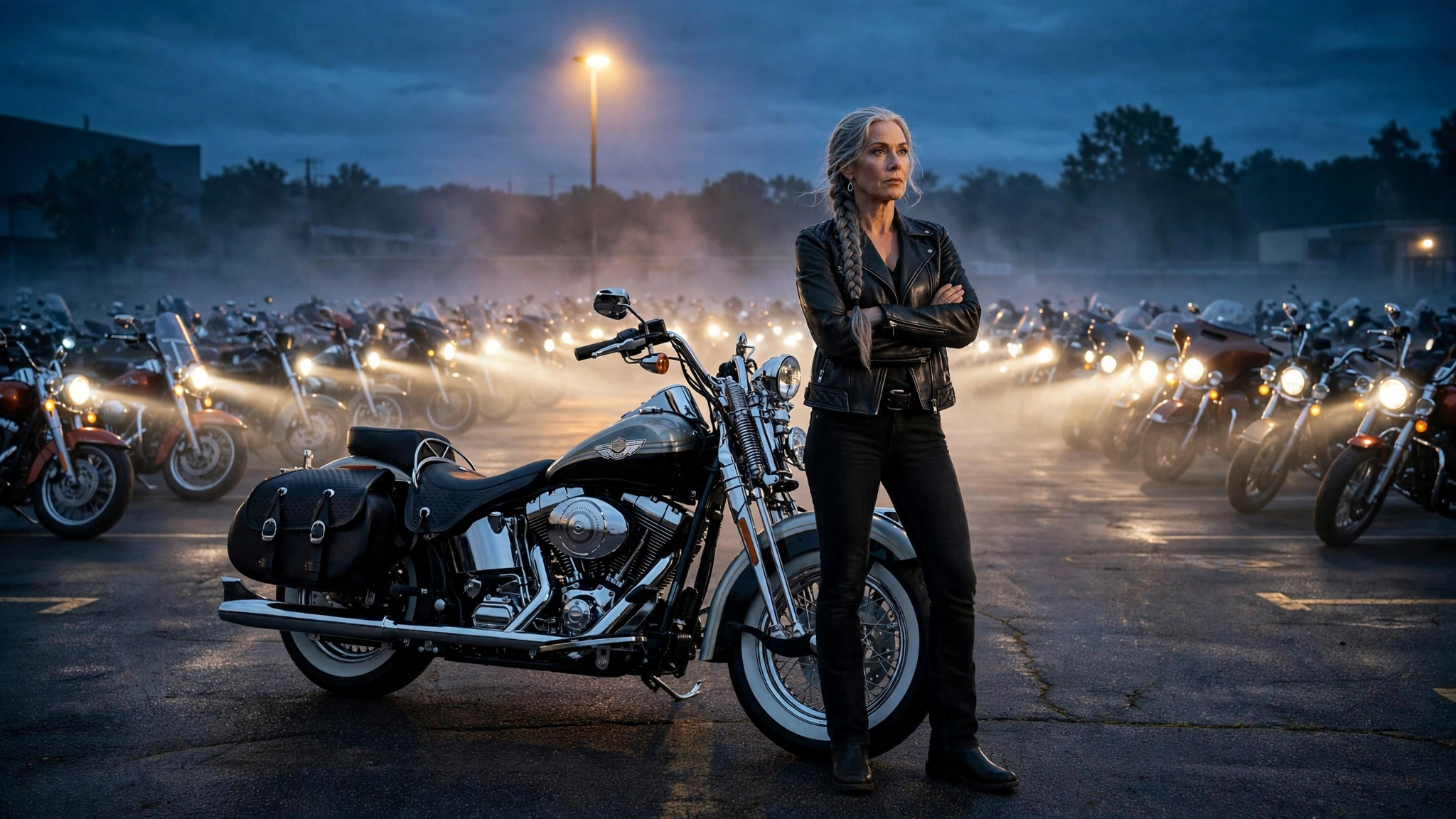
Chapter 1: The Sound of a Heart Breaking
The first thing Blake Mercer noticed about the woman standing beside the black Harley-Davidson was that she wasn’t crying. The second thing he noticed was that she wasn’t screaming. And the third thing, the thing that would haunt him long after that afternoon, was that she seemed to be looking straight through him, as if he were nothing more than a small inconvenience in a day that mattered far more than he could understand.
It was a warm Friday afternoon in the parking lot of the Riverside Plaza, a shopping complex on the outskirts of an American city where money had a way of making people believe that ordinary rules did not apply to them. Cars moved slowly between rows of parked vehicles. A delivery driver carried cardboard boxes toward a restaurant. Two women stood near a coffee shop window, laughing over something on a phone. Everything looked perfectly ordinary until Blake lifted a can of bright red spray paint and aimed it at the fuel tank of Victoria Hayes’s Harley-Davidson.
“Let’s give this old thing a little personality,” he said.
His friend Connor Reed laughed so loudly that a man loading groceries into his trunk looked over his shoulder.
The motorcycle was a black Harley-Davidson Road King, polished carefully enough that the afternoon sunlight reflected off its chrome. It was not a new machine, but it had the kind of presence that made people turn their heads when its engine rumbled through a street. Every scratch and small mark on it had a story. The leather seat had been replaced twice. The grips were worn from years of riding. A small silver cross hung beneath the handlebars, and a narrow strip of faded leather was tied around one mirror.
To Blake, it was just an expensive toy that belonged to somebody he had decided to humiliate.
He shook the can and sprayed a thick red line across the tank.
Victoria stood about fifteen feet away, holding a paper coffee cup in one hand and her motorcycle helmet in the other. She wore a black riding jacket, faded jeans, and boots marked by thousands of miles on the road. Her dark hair was tied back, and her expression did not change.
“Hey,” Connor called to her. “You going to do something about that?”
Victoria looked at the paint spreading across the motorcycle’s glossy finish.
“Stop spraying it,” she said.
Her voice was calm, almost conversational.
Blake turned toward Connor with a grin. “Did you hear that? She said stop.”
Connor pretended to tremble. “Oh, man. I’m terrified.”
Neither of them looked like someone who had ever faced consequences they could not buy their way out of. Blake was twenty-six, the son of Senator Richard Mercer, a man whose face appeared regularly on television and whose campaign advertisements promised law, order, and accountability. Connor was twenty-four, the son of Grant Reed, a wealthy political fundraiser who could arrange a meeting with a governor faster than most people could arrange an appointment with a dentist.
They had grown up attending private schools, holiday dinners with judges, and parties where police chiefs shook their fathers’ hands. They knew how to smile when cameras were present and how to behave when their parents were watching. Away from those cameras, however, they had developed a different understanding of the world.
They believed consequences were for people without connections.
Blake sprayed another stripe, this time across the side cover. Red paint ran down the black metal in thick, ugly streams.
Victoria placed her coffee on the hood of a nearby empty parking-space barrier. She set her helmet beside it.
“That motorcycle doesn’t belong to you,” she said. “You have one chance to put the can down and walk away.”
Blake stared at her for a moment, then burst into laughter.
“One chance?” he repeated. “Who do you think you are?”
Victoria did not answer.
Connor stepped toward the Harley and planted one hand on the handlebar.
“Maybe she thinks she’s in charge because she rides around with those leather guys.” He glanced at the small motorcycle-club emblem stitched onto the back of her jacket. “Where are your friends now?”
Then he shoved the motorcycle.
It happened quickly. The Harley tilted, the front wheel turned sharply, and the heavy machine began to fall. Victoria lunged forward, but the weight was already beyond her reach. The motorcycle struck the pavement with a brutal metallic crash that seemed to silence the entire parking lot.
A mirror shattered. The handlebar scraped the asphalt. The right-side footboard bent beneath the weight, and the beautiful black tank slammed against the ground.
For one second, nobody spoke.
Victoria stood frozen beside it.
She had seen men die on roads. She had watched families receive terrible news in hospital corridors. She had sat across from people who had lost everything and still found the strength to stand up the next morning. She knew the difference between something that could be replaced and something that could not.
The motorcycle could be repaired.
The cruelty was another matter.
That machine had belonged to her older brother, Daniel.
Daniel had taught her to ride when she was nineteen. He had been the first person to tell her that being strong did not mean frightening people, and that being brave did not mean never feeling fear. When their father died, Daniel had become the person who kept their family together. He worked long shifts, repaired broken things around their house, and somehow always found time to make his little sister laugh.
The Harley had been his dream long before it became hers.
Years later, when Daniel was killed in a collision caused by a drunk driver who had connections to a powerful local family, the motorcycle was one of the few things Victoria had left that still carried the sound of his laughter in her memory. She had rebuilt it piece by piece. She had spent weekends cleaning its chrome and nights replacing parts with tools Daniel had left behind.
The little silver cross beneath the handlebars had been his.
Now the motorcycle lay on its side, and red paint was running across the tank like a wound.
Blake looked at Victoria, waiting for the explosion.
“Come on,” he said. “Say something.”
She stared at him.
Then she slowly crouched beside the fallen Harley and reached toward the silver cross. Her fingers touched it gently, almost protectively. She checked the bent handlebar and the broken mirror, but she did not attempt to lift the machine alone.
A woman near the coffee shop whispered, “Oh, my God.”
Someone else raised a phone.
Connor noticed the camera and immediately straightened his shirt. He gave it a charming smile, the kind he had learned to use whenever a situation began attracting attention.
“She should have parked somewhere else,” he announced loudly.
Victoria stood.
For the first time, she looked directly into Blake’s eyes.
“What is your full name?” she asked.
Blake blinked, surprised by the question.
“What?”
“Your full name.”
He laughed. “Blake Mercer. Why? You going to complain to my mommy?”
Victoria nodded once, as if he had just confirmed a delivery address.
“And yours?”
“Connor Reed,” he replied. “You got a problem with that?”
“No,” Victoria said. “Thank you.”
She took out her phone.
Blake shook his head in disbelief. “You’re actually calling the police?”
“No.”
“Your insurance company?”
“No.”
Connor stepped closer. “Then who are you calling?”
Victoria looked down at the damaged Harley, then back at the two men.
“Someone who should be here before you make any more mistakes.”
She pressed a number.
When the person answered, she spoke only seven words.
“Bring the whole club. I need witnesses.”
Then she ended the call.
Blake and Connor looked at each other.
Neither of them understood that the most dangerous part of the afternoon had not begun when Connor pushed the Harley to the ground.
It had begun when Victoria decided to stop giving them the opportunity to walk away.
Chapter 2: The Headlights
The first motorcycle arrived nine minutes later.
Its engine echoed between the buildings before the machine appeared at the far entrance of the parking lot. A broad-shouldered man wearing a weathered leather vest rode a dark touring bike toward Victoria’s parking space. He stopped several yards away, switched off the engine, and looked at the Harley lying on the pavement.
His name was Marcus Cole, president of the Iron Ravens Motorcycle Club.
Marcus had known Victoria for nearly six years. He had met her at a roadside diner after a storm forced dozens of riders to take shelter beneath its leaking roof. While other people complained about the weather, Victoria had helped an elderly couple push their stalled car out of the rain. Later, when Marcus discovered she had repaired her own motorcycle engine in the parking lot, he had asked where she learned to work on machines.
“My brother,” she had answered.
Marcus had never forgotten the sadness in those two words.
He dismounted, removed his gloves, and walked toward her.
“Victoria?”
She pointed at the Harley.
Marcus stopped.
For several seconds, he did not speak. He examined the red paint, the broken mirror, the damaged handlebar, and the deep scrape along the side of the fuel tank.
Then he turned toward Blake and Connor.
“Which one of you did this?”
Blake folded his arms. “Does it matter?”
Marcus looked at him for a long moment.
“It matters to the owner.”
Connor laughed. “Relax, man. It was a joke.”
Marcus glanced back at Victoria. She gave him a small shake of her head, telling him without words that she did not want him to react in anger.
He understood.
“All right,” he said quietly. “Nobody touches anybody. Nobody threatens anybody. We document what happened.”
Blake’s smile returned.
“Oh, this is adorable.”
A second motorcycle arrived, followed by a third. Within minutes, riders were entering the lot from both directions. Some wore club colors; others wore ordinary jackets. A few were older men with gray beards and stiff knees. One rider had a young daughter waiting in a parked car, and another had come directly from his shift at a machine shop.
They were not an army of criminals, despite the image Blake and Connor had already begun constructing in their minds. They were mechanics, veterans, construction workers, business owners, and parents. They were people who had built friendships on long roads and learned to trust one another when a broken-down motorcycle left someone stranded miles from home.
They gathered around Victoria’s Harley, leaving enough room for the growing number of onlookers. Nobody struck Blake. Nobody grabbed Connor. One member began taking photographs of the damage, while another asked the witnesses whether they had recorded the incident.
The parking lot filled with headlights as more riders arrived.
Connor looked around, and for the first time that afternoon, his smile faltered.
Blake recovered quickly.
“Look at this,” he said, lifting his phone. “We have a whole biker gang threatening us.”
“No one has threatened you,” Marcus replied.
“You’re surrounding us.”
“We’re standing in a parking lot.”
“You’re intimidating us.”
Marcus almost laughed, but there was nothing funny about the situation anymore.
“Then you should feel comfortable calling the police,” he said. “We’ll wait right here.”
Blake immediately dialed a number.
“My father is going to love this,” he said loudly.
He walked several paces away, turning his back to the crowd as though the conversation were private. It was not private enough to prevent the people nearest him from hearing.
“Dad, I have a situation,” he said. “A bunch of bikers are surrounding me. Some woman is making a scene over her motorcycle.”
He paused.
“No, I didn’t start anything.”
Another pause.
“Because they look like trouble. Just send someone.”
His voice changed as he listened. The irritation disappeared, replaced by the familiar confidence of someone who had just been promised protection.
“All right. Got it.”
He ended the call and slipped the phone into his pocket.
Connor leaned toward him. “What did he say?”
“Stay here. Don’t let them leave with the story.”
Blake turned toward Marcus.
“You have about five minutes to get your people out of here.”
Marcus stared at him.
“And what happens after five minutes?”
Blake smiled.
“You’ll find out.”
Victoria heard the exchange but said nothing. Instead, she walked to the coffee shop, retrieved her cup, and took a small sip. The coffee had gone cold.
One of the younger Ravens, a former Marine named Ethan Brooks, approached Marcus.
“Want me to call our attorney?”
“Already doing it,” Marcus replied.
Ethan looked at the Harley.
“Those guys need to learn a lesson.”
Marcus lowered his voice.
“Maybe. But not the kind they expect.”
Across the lot, Victoria was checking her phone. A message had appeared from an unfamiliar number.
Leave the parking lot immediately. You have no idea whose sons you’re dealing with.
She read it twice.
Then she took a screenshot.
A second message arrived.
This is your only warning.
Victoria’s expression remained unchanged, but something inside her shifted. The vandalism was one thing. The threat was another. Someone had been watching closely enough to identify the connection between Blake and Connor and had already decided that Victoria was the person who needed to be frightened.
She opened a secure contact list and selected a number she had not used in months.
Before she could call, Marcus approached.
“Victoria, I need to ask you something.”
She slipped the phone into her pocket.
“Go ahead.”
“Do you know these men?”
“No.”
“Do they know you?”
“Not yet.”
Marcus studied her face.
“That sounds like there’s more to this than a damaged motorcycle.”
Victoria looked at the red paint dripping from the fuel tank.
“There is.”
“What are we walking into?”
She met his eyes.
“Something bigger than a parking lot.”
Before Marcus could ask another question, the first police cruiser turned into the entrance.
Its lights flashed blue across the chrome of the motorcycles.
Blake began smiling again.
And Victoria realized that the first test of the afternoon had arrived.
Chapter 3: The Law Has Arrived
Officer Daniel Pike stepped out of the cruiser with one hand resting near his belt. He was a tall man in his early forties, with a carefully trimmed mustache and the stiff posture of someone accustomed to having people obey him before he finished speaking.
His partner, Officer Lewis, remained near the passenger door, surveying the gathering.
Pike looked at the motorcycles, the onlookers, and the fallen Harley. Then he saw Blake.
“Mr. Mercer.”
Blake walked toward him with the relief of a man returning to familiar territory.
“Officer. Thank God you’re here.”
Pike shook his hand.
“What happened?”
“These bikers surrounded us,” Blake said. “They’ve been threatening us since we arrived.”
Marcus stepped forward. “That’s not what happened.”
Pike held up a hand.
“I’ll speak to you in a moment.”
Blake pointed toward the Harley.
“That woman parked her motorcycle in a place where we were trying to get through. She started yelling at us, and then all these guys showed up.”
Victoria looked at him.
“I asked you to stop damaging my property. You sprayed it with paint, and your friend pushed it over.”
Pike turned toward her.
“Do you have proof?”
“Yes.”
“Where is it?”
“Several witnesses recorded the incident. The security cameras may have captured it, too.”
Pike looked toward the shopping complex.
“Did you report this to management?”
“Not yet.”
“Then let’s not jump to conclusions.”
Marcus took a step forward, but Victoria raised her hand slightly. He stopped.
The officer walked toward the motorcycle and examined it with an expression that suggested the damage was less important than the paperwork it would require.
“Looks like a civil matter,” Pike said.
Victoria stared at him.
“Someone deliberately damaged my property.”
“And I’m going to determine what happened. But I won’t have a crowd interfering with my investigation.”
Blake nodded sympathetically.
“Exactly. That’s what I’ve been trying to tell them.”
Pike turned toward Marcus.
“Are you the leader of this group?”
“I’m the president of the Iron Ravens. We came because Victoria asked us to be witnesses.”
“Witnesses to what?”
“The damage to her motorcycle.”
Pike’s jaw tightened.
“Then you can all leave. We’ll contact you if we need statements.”
Marcus did not move.
“Officer, we haven’t done anything wrong.”
“Don’t make me repeat myself.”
For a moment, the entire parking lot seemed to hold its breath.
The Iron Ravens had dealt with police officers who treated them fairly and officers who regarded their leather vests as evidence of guilt. Marcus had learned that anger could turn an ordinary traffic stop into a dangerous encounter. He knew the club members standing behind him were furious, and he knew how easily their frustration could be used against them.
He looked at Victoria.
She gave him the smallest nod.
The bikers began stepping back.
Blake watched them retreat with open satisfaction.
“That’s right,” he called after them. “Go home.”
Connor laughed.
“Tell your friends to bring better lawyers next time.”
Ethan’s hands tightened into fists. Marcus caught his arm before he could take a step.
“Not here,” Marcus whispered.
“But they—”
“Not here.”
Ethan looked at Victoria, expecting her to be just as angry as he was.
Instead, she was watching Officer Pike.
She had recognized something in his behavior. It was not simply favoritism. He was avoiding the obvious evidence, steering the conversation away from the men who had caused the damage, and trying to remove the witnesses before anyone could obtain formal statements.
Those actions alone did not prove corruption.
But they were enough to make her pay attention.
Pike approached Victoria again.
“Ma’am, I need your identification.”
She handed it to him.
He glanced at the card, then looked at her more closely. Something about her name appeared to catch his attention. He checked the card a second time before handing it back.
“Victoria Hayes?”
“Yes.”
He looked as if he wanted to ask another question, but Blake interrupted.
“Officer, I really don’t want to waste your time with this. My father can take care of the situation.”
Pike’s expression changed immediately.
“Your father has nothing to do with my investigation.”
Blake blinked.
For one brief moment, he looked genuinely offended.
Then Pike added, “I’ll handle this personally.”
The confidence returned to Blake’s face.
Victoria noticed.
So did Marcus.
Pike took several photographs of the motorcycle, but he did not ask Blake to surrender the spray-paint can. He did not separate the witnesses for statements. He did not ask Connor why his hands were stained with red paint. Instead, he told Victoria to contact her insurance company and warned the bikers that any further gathering could result in arrests for disorderly conduct.
Then he pulled Blake aside.
They spoke quietly beside the cruiser.
Victoria could not hear every word, but she heard enough.
“Your father called,” Pike said.
Blake lowered his voice. “And?”
“Keep your mouth shut. Don’t post anything. I’ll make sure the report is handled.”
Blake smiled.
“You’re a good man, Officer.”
Pike did not return the smile.
He walked back to the cruiser and drove away with his partner.
No arrest. No meaningful questioning. No formal assurance that the damage would be investigated.
Just a report that had not yet been written and a warning directed at the people who had come to help the victim.
The crowd began dispersing.
A woman who had recorded part of the incident approached Victoria and offered to share the video. Victoria thanked her and saved it. A young man who had witnessed Connor push the Harley over gave her his contact information.
One by one, the witnesses left.
Blake and Connor remained beside the damaged motorcycle, looking triumphant.
“You should have listened,” Blake told Victoria. “This is what happens when people try to make trouble for the wrong family.”
Victoria slipped her phone into her jacket.
“You’re right about one thing,” she said.
Blake smirked.
“Which thing?”
“You have no idea what kind of trouble you’re making.”
She walked toward Marcus.
He waited until they were out of earshot.
“Victoria, I need the truth.”
She looked at the Iron Ravens gathering their helmets.
“The truth is that I need you to do something for me.”
“Anything.”
“Don’t let anyone touch those two men. Don’t threaten them. Don’t follow them. And if anyone asks, you came here because I needed witnesses.”
Marcus frowned.
“Why?”
“Because they want you to become the story.”
She glanced toward Blake, who was already talking animatedly on his phone.
“If one of you loses your temper, they won’t be two men who vandalized a motorcycle anymore. They’ll be two politically connected young men who claim they were attacked by a dangerous motorcycle gang.”
Marcus understood.
“And what will you be?”
Victoria looked at the red paint on her Harley.
“The person who makes sure the truth survives.”
Chapter 4: A Name That Changed Everything
The Iron Ravens moved the damaged Harley into the back of a recovery truck. Marcus refused to let anyone attempt to ride it with a bent handlebar and compromised controls.
Victoria stood beside the truck while Ethan secured the motorcycle with heavy straps.
“Where do you want us to take it?” he asked.
“To my garage.”
“You’re not coming with us?”
“I have something to do first.”
Marcus approached, his face full of concern.
“Are you going to the police station?”
“No.”
“Then where?”
Victoria hesitated.
For six years, she had kept a large part of her life separate from the club. The Iron Ravens knew she had worked in federal law enforcement, but most of them believed she had retired after a difficult assignment overseas. Only Marcus knew that she still received calls from people in Washington and occasionally disappeared for several days without explanation.
He had never asked her to explain.
Now he could see that the time for silence was over.
“Marcus,” she said, “if I tell you something, you have to promise me that it stays between us until I’m ready to make it public.”
He folded his arms.
“You know I won’t betray you.”
“I know.”
“Then tell me.”
Victoria looked around the nearly empty parking lot.
“My name isn’t the only thing those men need to worry about.”
Marcus waited.
“Six months ago, I was assigned to a federal task force investigating political corruption involving public contracts, police misconduct, and the misuse of government funds. The investigation involves people who believe their positions make them untouchable.”
Marcus’s expression grew serious.
“How high does it go?”
“High enough that several people have already tried to interfere with it.”
He looked toward the entrance where the police cruiser had disappeared.
“Is Officer Pike involved?”
“I don’t know yet.”
“Do Blake and Connor know about the investigation?”
“Not officially.”
“But you think they might?”
Victoria looked down at her phone.
“I think their families know more than they’re admitting.”
Marcus was silent for several seconds.
“Why didn’t you tell us?”
“Because knowing something can make you a target. I didn’t want the club dragged into a case that could destroy people’s lives.”
Marcus glanced toward the truck.
“Well, we’re already in it.”
“That’s why I need you to be careful.”
He shook his head.
“You called us because you trusted us. We came because you’re family. You don’t get to decide that we aren’t allowed to stand beside you just because the people we’re facing wear expensive suits instead of leather jackets.”
Victoria felt something tighten in her chest.
For months, she had been working with people who spoke in cautious phrases, signed confidential documents, and measured every sentence against the possibility of a leak. She had grown accustomed to carrying the weight of a case without telling anyone how heavy it had become.
Marcus’s words reminded her that loyalty was not always a liability.
Sometimes it was the only thing keeping a person standing.
She gave him a small, tired smile.
“Thank you.”
He nodded toward her motorcycle.
“Get that thing home. We’ll talk tonight.”
Victoria watched the recovery truck pull away.
Then she crossed the parking lot toward a dark blue sedan parked beneath a tree.
The car had been there since before the vandalism began. Its windows were tinted, and its engine was running. As Victoria approached, the rear door opened.
A woman in a charcoal suit stepped out.
Her name was Evelyn Shaw, deputy director of a federal anti-corruption task force. She had worked with Victoria for four years and had once testified against a senior official who threatened to ruin her career.
Evelyn looked at the damaged motorcycle truck disappearing down the road.
“Was that them?”
“Not directly.”
Evelyn’s eyes narrowed.
“Tell me everything.”
Victoria showed her the video, the threatening messages, and the photographs of the damage. Evelyn watched the recording twice, then asked for the officer’s name.
“Daniel Pike.”
Evelyn typed something into her phone.
“That name appears in one of our preliminary reports.”
Victoria felt a chill move through her.
“What kind of report?”
“Payments connected to a private security contractor. Nothing conclusive yet. But his name came up during an interview with a former city administrator.”
“Who hired the contractor?”
Evelyn looked at her.
“That’s the part I think you’re going to find interesting.”
She handed Victoria a tablet.
A list of companies appeared on the screen. Several were registered to different addresses but shared the same financial officer. Others had received government contracts despite submitting incomplete documentation. One company had been awarded a major public safety contract just weeks after its founder made a substantial donation to a political committee.
At the bottom of the list was a name Victoria knew well.
Mercer Strategic Holdings.
Blake’s father had denied any connection to the company during a televised interview three months earlier.
Victoria stared at the screen.
“He’s involved.”
“We suspect he’s connected,” Evelyn corrected. “We haven’t established his personal role in every transaction, and we aren’t going to pretend suspicion is proof.”
“Of course.”
“There’s more.”
Evelyn swiped to another document.
A photograph appeared.
It showed Grant Reed standing outside a private club with three men. One was a state official. Another was a police administrator. The third was Daniel Pike.
Victoria’s jaw tightened.
“That’s our officer.”
“Yes.”
“Why is he meeting with Reed?”
“We don’t know. The photograph was submitted anonymously. It could be innocent. But in the context of the other evidence, it’s worth examining.”
Victoria looked back at the video of Blake spraying her Harley.
“What are the odds that today was a coincidence?”
Evelyn did not answer immediately.
“At this point, we don’t have enough information to say.”
Victoria understood the caution. An investigation could be destroyed by a single careless accusation. Every fact had to be established. Every witness had to be protected. Every piece of evidence had to be obtained lawfully.
But one thing was already clear.
The men who had vandalized her motorcycle believed they could call their fathers and make a problem disappear.
And the officer who should have investigated the crime appeared to have connections to the same network her team was examining.
Evelyn closed the tablet.
“Victoria, there’s something else you need to know. Someone accessed a restricted file on your assignment this morning.”
Victoria went still.
“Which file?”
“Your personnel file.”
“Who?”
“We’re checking the access logs.”
“Does the file identify me as part of the task force?”
“Not in the public-facing section. But someone with sufficient access could discover your current assignment.”
Victoria looked toward the road.
For the first time since Blake had lifted the spray can, she felt a trace of genuine fear.
Not for herself.
For the witnesses. For Marcus. For the Iron Ravens. For anyone whose name might now appear in a report connected to the attack.
She had thought the young men were merely arrogant.
Now she wondered whether they had been careless enough to expose a much larger problem.
Or whether somebody had deliberately allowed the situation to unfold.
“Get the original security footage,” she said. “Preserve every message. I want the officer’s body-camera records, the dispatch log, and any communications related to the call.”
Evelyn nodded.
“And the boys?”
Victoria looked at the damaged motorcycle.
“Let them think they won.”
Chapter 5: The Men Who Thought They Owned the City
That evening, Blake sat in the glass-walled living room of his father’s mansion, drinking a glass of expensive whiskey he had taken from a cabinet without asking. Connor lounged on a leather sofa, scrolling through videos on his phone.
Their fathers had not arrived yet.
The two young men had already posted a carefully edited account of the incident online. In the video, they were shown standing beside the Harley while a group of bikers gathered in the background. The footage began after the vandalism, leaving out the spray paint, the shove, and Victoria’s repeated requests that they stop.
The caption read: LOCAL BIKER GANG TRIES TO INTIMIDATE TWO INNOCENT MEN AFTER A PARKING DISPUTE.
Within an hour, hundreds of people had commented.
Some called the bikers criminals. Others questioned why so many riders had gathered around one motorcycle. A few asked what had happened before the recording began, but their comments disappeared beneath a flood of accusations.
Blake laughed as the number of views climbed.
“Look at this,” he said. “People are calling for arrests.”
Connor leaned over his shoulder.
“Someone says they should shut down the club.”
“Good.”
“Someone else says the woman should be charged for organizing a gang.”
Blake raised his glass.
“To public opinion.”
They clinked glasses.
The front door opened, and Senator Richard Mercer walked into the room.
He was a handsome man in his early sixties, with silver hair, a polished smile, and the measured voice of someone who had spent decades persuading strangers to trust him. His face appeared on campaign posters beside slogans about protecting families and restoring integrity to public service.
He looked at Blake.
“What happened today?”
Blake’s smile disappeared.
“Dad, before you get angry—”
“I asked you a question.”
Connor sat up.
“It wasn’t that serious. We had a little disagreement with a woman in a parking lot.”
Richard looked at the phone.
“Is that your video?”
“Yes.”
“Did you damage her motorcycle?”
Blake hesitated.
“She was being difficult.”
Richard’s expression hardened.
“Did you damage her motorcycle?”
Blake looked away.
“Yes, but—”
The senator slammed his hand onto the table.
“Are you out of your mind?”
Blake stared at him.
“You said the police would handle it.”
“I said I would handle the situation. I did not tell you to create a public scandal.”
Connor stood.
“Nobody knows who she is.”
Richard turned toward him.
“That is precisely the problem. You don’t know who she is, and neither do I.”
He took out his phone and dialed a number.
When the call connected, he spoke in a low voice.
“I need information on a woman named Victoria Hayes. Motorcycle owner. The incident happened at Riverside Plaza this afternoon.”
He listened.
“No, I don’t want gossip. I want to know who she is, who she works for, and why my son says she called a group of bikers.”
He ended the call.
For several seconds, the room remained silent.
Then Connor’s phone rang.
He looked at the screen.
“My father.”
He answered.
“Hey, Dad.”
Grant Reed’s voice came through so loudly that Blake could hear it from the sofa.
“What did you do?”
Connor sat up straight.
“Nothing major.”
“Nothing major? I have three people calling me about a video that has already reached thousands of viewers. Your name is in it. Blake’s name is in it. And someone has started asking questions about a woman called Victoria Hayes.”
Connor glanced at Blake.
“So?”
“So you are going to delete the video, stop talking to reporters, and stay away from that woman.”
Connor frowned.
“Why? Who is she?”
There was a pause.
“I said stay away from her.”
“Is she important?”
Grant’s voice dropped.
“Do you remember the meeting last month when your father and I discussed the transportation contracts?”
Connor went pale.
“Yes.”
“Then you will understand why I am telling you not to make this worse.”
The call ended.
Blake looked at him.
“What did he say?”
Connor lowered the phone.
“He said we should stay away from her.”
Richard Mercer had heard enough to understand that something more serious was happening.
He walked to the window and looked out over the manicured lawn.
“Delete the video,” he ordered.
Blake frowned.
“But everyone is watching it.”
“Delete it.”
“That makes us look guilty.”
Richard turned around.
“Blake, listen to me very carefully. There are people in this city who can survive scandals, investigations, and even criminal charges because they know how to manage the damage. But there are also people who can destroy years of carefully constructed protection because they know how to prove what happened.”
He paused.
“Until we know which kind of person this woman is, you will do exactly what I tell you.”
Blake swallowed.
For the first time that day, he began to wonder whether the red paint on the Harley had been the smallest part of his mistake.
Chapter 6: The Woman Behind the Leather Jacket
Victoria lived in a modest brick house on a quiet street where the trees grew over the pavement and neighbors still brought one another food during difficult weeks. There were no security gates, no marble statues, and no expensive cars parked in the driveway. The house had a small garage, a vegetable garden, and a wooden bench that Daniel had built years earlier.
The Harley stood inside the garage when she returned.
The red paint looked even worse under the bright overhead lights.
Marcus and Ethan were waiting beside it. Marcus had brought tools, while Ethan had purchased several cleaning products from an automotive supply store. They had hoped to remove the paint without damaging the original finish, but the spray had already dried, and the force of the fall had scratched the tank deeply.
Marcus shook his head.
“Whoever did this knew exactly how to ruin a good day.”
Victoria set her helmet on a shelf.
“They didn’t know anything about the bike.”
“They didn’t need to. They knew how to hurt you.”
She looked at him.
He had said what she had been trying not to think.
Marcus lowered his voice.
“That machine means something to you.”
Victoria walked over to the workbench and picked up an old photograph. It showed a younger Daniel standing beside the same Harley, one hand resting on the handlebars and the other raised toward the camera. He was laughing, his hair blown across his forehead by the wind.
Victoria had been nineteen when the photograph was taken.
Daniel had been thirty-two.
She remembered the afternoon clearly. He had taken her out on a country road, riding slowly while she followed on a borrowed motorcycle. She had been nervous at first, convinced she would make a mistake and fall. Daniel had stopped beside a field and waited until she caught up.
“You don’t have to prove anything to anybody,” he had told her. “Ride because you love the road. Not because you want someone to think you’re brave.”
It had become one of the most important lessons of her life.
Years later, when she entered federal law enforcement, she carried those words into rooms where powerful men tried to intimidate witnesses and convince frightened people that silence was safer than truth.
Daniel never lived to see what his sister became.
He died two years after that photograph was taken, when a drunk driver crossed the center line on a highway outside the city. The driver was the son of a wealthy property developer. Witnesses reported that the young man had been speeding, and the initial investigation indicated that he had been intoxicated.
Then the evidence began to disappear.
A toxicology report was delayed. A witness changed his statement. A traffic camera malfunctioned. The driver was eventually charged with a lesser offense and received a sentence that left Victoria staring at a courtroom wall long after everyone else had gone home.
She had learned then that the law could be powerful, but only when people were willing to let it work.
She had also learned how easily grief could become anger.
For months, she wanted revenge. She imagined confronting the driver, forcing him to look at Daniel’s photograph, and making him understand the emptiness he had left behind.
But she eventually realized that hurting him would not bring Daniel back. It would only allow another person to decide what kind of human being she became.
She joined federal service because she wanted to understand how powerful people escaped accountability. She trained as an investigator, studied financial crimes, and learned to follow evidence through the complicated maze of contracts, political donations, shell companies, and personal favors.
Over the years, she helped build cases against people who had once seemed untouchable.
She had never told the Iron Ravens the full story.
Marcus stood beside her now, studying the photograph.
“Daniel?”
Victoria nodded.
“He taught me how to ride.”
Marcus looked toward the Harley.
“I understand now.”
“No,” she said gently. “You understand part of it.”
She placed the photograph back on the workbench.
“The rest is why I won’t let those two men turn this into a fight.”
Ethan crossed his arms.
“They deserve to be punished.”
“They do.”
“Then why are we waiting?”
“Because if we attack them, they get to decide what happens next. They can accuse us of assault. They can have the police arrest people. They can turn this club into a headline about dangerous bikers. And they can use our anger to hide what they did.”
Marcus nodded slowly.
“So we let the law work.”
Victoria looked at him.
“We make sure the law has no excuse not to work.”
Her phone vibrated.
Evelyn had sent a message.
We have identified the restricted-file access. Call me immediately.
Victoria stepped away from the motorcycle and opened the message.
A second notification appeared beneath it.
The access originated from an office connected to Senator Mercer’s political committee.
She read the sentence twice.
Then she called Evelyn.
“Tell me what you found.”
Evelyn’s voice was tight.
“The access was made using credentials assigned to a contractor who works for a private technology company. That company has several government contracts. We are still verifying who actually used the credentials.”
“Could Blake have accessed the file?”
“Not directly, based on what we know. But someone close to his father may have obtained information from a person who could.”
Victoria looked at Marcus and Ethan.
The two men had stopped talking.
They could see that something had changed.
“Evelyn,” Victoria said, “I want the evidence preserved, and I want an independent review of every record connected to the incident. No informal calls. No favors. No shortcuts.”
“Agreed.”
“And one more thing.”
“What?”
“Check whether Daniel Pike received any communication before he arrived at Riverside Plaza.”
Evelyn was silent for a moment.
“You’re thinking the response was arranged.”
“I’m thinking we should find out whether it was.”
“I’ll check.”
The call ended.
Victoria stood in the garage, surrounded by tools, old photographs, and the smell of motor oil.
Outside, the street was quiet.
Inside, the investigation had just become personal in a way she could no longer ignore.
Chapter 7: The First Threat
At 10:17 that night, a black SUV stopped outside Victoria’s house.
The vehicle remained there for almost three minutes, its engine idling beneath the streetlight. No one got out. No doors opened. No one approached the front door.
Then the SUV drove away.
Victoria watched from behind the curtains.
Marcus stood beside her.
“Friend of yours?”
“No.”
“Want me to follow it?”
“No.”
He turned toward her.
“You’re asking us not to react, but somebody is watching your house.”
“Which is exactly why we don’t follow a suspicious vehicle without knowing what we’re dealing with.”
Marcus frowned.
“You’re telling me that like I’m one of your agents.”
Victoria gave him a tired smile.
“Tonight, I need you to be one of my witnesses.”
He exhaled slowly.
“All right. What do you want me to do?”
“Write down what you saw. The time, the vehicle description, the direction it went. Don’t embellish anything. Don’t guess at the license plate if you didn’t read it clearly.”
Marcus nodded and took out his phone.
Victoria called the appropriate security contact and reported the incident. She did not accuse anyone of sending the SUV. She simply documented what happened and requested that the report be preserved alongside the existing evidence.
Then she checked the house’s exterior cameras.
The vehicle’s license plate was partially visible.
It was enough to provide investigators with a lead, but not enough to establish who had been inside.
At 11:06, her phone rang again.
This time the caller ID displayed a private number.
Victoria answered without speaking.
A man’s voice came through the line.
“You’ve made a mistake.”
She recognized the controlled anger of someone accustomed to giving orders.
“Who is this?”
“You know exactly who this is.”
“No, I don’t.”
“You have a damaged motorcycle. A few photographs. Some witnesses. That’s all. You don’t need to turn this into something bigger.”
Victoria glanced at the clock.
“Are you asking me to withdraw a complaint?”
“I’m asking you to think carefully about your future.”
“Whose future are you concerned about?”
The man breathed out sharply.
“You think you’re the first person to challenge people with influence? You think you’re going to change the world because you have a badge and a few friends?”
Victoria remained silent.
He continued.
“Your friends can get hurt. Your career can disappear. And if you keep pushing, you’ll discover that the people you trust aren’t as loyal as you think.”
Victoria’s fingers tightened around the phone.
For one instant, she thought of Daniel. She thought of the courtroom, the missing report, the driver who had walked away, and the years she had spent trying to make sure another family did not have to experience the same kind of helplessness.
Then she remembered why she had chosen this work.
“Are you finished?” she asked.
The man paused.
“What?”
“Have you finished explaining why I should be afraid?”
“You need to understand the position you’re in.”
“I understand it perfectly.”
She looked at the Harley through the open garage door.
“You should understand yours.”
She ended the call.
Marcus stared at her.
“Who was that?”
“I don’t know.”
“You’re not even going to pretend you do?”
“No.”
“Victoria, this is getting dangerous.”
“Yes.”
She did not try to soften the truth.
Then she opened a secure note and documented the time, duration, and content of the call as accurately as she could remember it. She saved the call details and forwarded the information through the proper reporting channel.
Marcus watched her finish.
“You’re not scared at all, are you?”
Victoria looked up.
“Of course I’m scared.”
He seemed surprised by the answer.
She put the phone down.
“Being brave doesn’t mean you aren’t afraid. It means you decide what deserves more of your attention than your fear.”
Marcus was quiet for a long time.
Then he nodded.
“Daniel taught you that?”
Victoria smiled sadly.
“No. He taught me how to ride.”
She glanced toward the damaged Harley.
“The rest, I had to learn on my own.”
Chapter 8: The Senator’s Private Meeting
The following morning, Senator Richard Mercer entered a private conference room in a downtown office building. The meeting had been scheduled before the incident at Riverside Plaza, but the timing had become urgent.
Grant Reed was already seated at the table.
Two lawyers sat beside him, each with a leather folder and a laptop. A third man stood near the window, speaking quietly into his phone.
Richard closed the door.
“Who is she?”
Grant looked at him.
“Victoria Hayes?”
“Yes.”
“We’re checking.”
“Checking isn’t good enough.”
Grant placed both hands on the table.
“Then perhaps you should tell me why your son was foolish enough to spray-paint her motorcycle in a public parking lot.”
Richard’s face darkened.
“Don’t pretend Connor wasn’t involved.”
“I’m not pretending anything. I’m trying to understand why a stupid prank has become a problem for people who have much more important things to worry about.”
Richard sat down.
“Someone accessed a restricted government file connected to her name.”
Grant’s expression changed.
“How do you know that?”
“Because someone informed me that the file existed.”
“Who?”
Richard did not answer.
Grant leaned back.
“This is exactly what I warned you about. You have people around you who think they can use government access to solve private problems. Eventually, they get careless.”
Richard’s eyes narrowed.
“Are you accusing me of something?”
“I’m asking whether you know who is moving information around.”
The man near the window ended his call and joined them.
His name was Victor Sloane. He had once served as a senior adviser to a governor and had spent the last decade working as a political consultant. His clients included elected officials, corporate executives, and wealthy donors who wanted problems solved before they became public.
Sloane placed a folder on the table.
“I have some preliminary information about Victoria Hayes.”
Richard opened the folder.
The first page contained a photograph of Victoria in a formal government setting. She was wearing a dark suit and standing beside several officials. The photograph had been taken at a public conference, but the caption beneath it identified her as a senior member of a federal anti-corruption task force.
Richard stared at the page.
“Where did you get this?”
“Public records and professional contacts.”
“How senior?”
“Senior enough that you should stop asking your friends in local law enforcement to intervene.”
Grant closed his eyes.
For several seconds, nobody spoke.
Then Richard turned to Sloane.
“Is she investigating me?”
“Her team is examining several contracts connected to your political network. That does not necessarily mean you are the primary subject.”
“That is not an answer.”
“It’s the only honest answer I can give you.”
Richard stood and walked to the window.
For years, he had built his political career around the belief that influence was a form of insurance. He knew donors, judges, police administrators, and business leaders. He understood which favors could be requested over dinner and which required a phone call at a particular hour. He had never considered himself corrupt. In his mind, he was a practical man operating in a complicated world.
The contracts had been legal, he told himself.
The donations had been disclosed.
The people who worked for him had made their own decisions.
And if a few officials had bent the rules to keep a project moving, surely that was not the same as criminal wrongdoing.
But the woman in the photograph had spent years learning how to distinguish an innocent mistake from a pattern of deliberate misconduct.
Richard looked back at the table.
“Can the investigation be stopped?”
Sloane’s expression became cold.
“Not without creating a much bigger problem.”
“Then what do you suggest?”
“Stop creating new evidence.”
Grant nodded.
“Tell our sons to stay away from her. No messages. No calls. No posts. No friends showing up at her house. Nothing.”
Richard picked up his phone.
“I’ll speak to Blake.”
“And the officer?” Grant asked.
Richard looked at him.
“What about him?”
“Make sure nobody contacts him about the case. If he has done something improper, we do not want him making it worse by trying to cover it up.”
Sloane gathered his folder.
“There’s another issue.”
Both men looked at him.
“The woman has a personal connection to an older case involving a politically connected driver. The investigation was closed years ago, but there are indications that some of the evidence was mishandled.”
Richard felt his stomach tighten.
“What case?”
Sloane read the name from the page.
“Daniel Hayes.”
The room became completely silent.
Grant slowly turned toward Richard.
“Tell me your son didn’t know who she was.”
Richard looked at the photograph again.
He did not know whether Blake had recognized Victoria. He did not know whether the vandalism had been a random act of cruelty or a reckless attempt to intimidate someone connected to the investigation.
But he understood something that made the situation far worse.
If Victoria Hayes was examining a network of political corruption, and that same network had helped bury evidence connected to her brother’s death, then the attack on the Harley had placed a spotlight on a history that several people had spent years trying to forget.
And if the investigation reached that history, the consequences would extend far beyond two foolish young men.
Richard closed the folder.
“Find out everything,” he said.
Sloane shook his head.
“That’s exactly the sort of sentence you should stop saying.”
Chapter 9: The Bikers Refuse to Disappear
By Saturday morning, the Iron Ravens had become the center of a local controversy.
The edited video had spread to several community pages. Commentators argued about motorcycle clubs, public safety, and whether a group of riders had the right to gather in a parking lot. A few people recognized Victoria from the original footage, but nobody knew her background.
The club’s workshop received angry phone calls. A business owner who had planned to sponsor an upcoming charity ride asked whether the Ravens were involved in a criminal investigation. One member’s employer called him into the office to discuss the video.
The consequences were already spreading.
Marcus gathered the club members in their workshop, a large industrial building filled with tools, spare tires, metal shelves, and the smell of coffee. The walls were decorated with photographs of charity rides, memorial events, and families standing beside motorcycles.
Nobody was smiling.
Ethan stood near the workbench.
“They’re calling us a gang. They’re saying we threatened those guys.”
A mechanic named Ray slammed a wrench onto the table.
“Then we tell everybody what really happened.”
“With what?” another member asked. “They already cut the video. They can cut anything we post, too.”
Marcus raised his hand.
The room fell quiet.
“We have the original recordings. We have witnesses. We have Victoria. We have the truth.”
Ray shook his head.
“The truth doesn’t pay the bills if our employers believe we’re criminals.”
Marcus understood the frustration. Several members had spent years building respectable lives after difficult experiences. Some had served in the military. Others had worked construction jobs, raised children, or cared for elderly parents. They had joined the club because they valued friendship and the freedom of the open road, not because they wanted to be part of a political fight.
Now they were being dragged into one.
Marcus walked to the wall and took down a framed photograph.
It showed the club’s first charity ride, taken almost twenty years earlier. The riders had collected donations for a family whose home had burned down. The motorcycle club had raised enough money to help the family find temporary housing and replace the children’s school supplies.
“Do you remember this?” he asked.
Several members nodded.
“People told us we were trouble before they knew our names. They told us nobody would trust us. They told us we would never be anything more than a bunch of men on motorcycles.”
He placed the photograph on the table.
“We didn’t answer them by proving we could scare people. We answered them by showing up when somebody needed help.”
He looked around the room.
“We are not going to let two spoiled men decide who we are.”
Ethan lowered his head.
“So what do we do?”
“We preserve the evidence. We cooperate with the investigation. We don’t threaten anyone. We don’t follow anyone. We don’t give them a single excuse to turn this into something it isn’t.”
A quiet voice came from the doorway.
“And we keep the truth alive.”
Everyone turned.
Victoria stood there wearing the same black riding jacket, though she had removed the club emblem from the sleeve and placed it in her pocket. Her eyes were tired, and there were dark circles beneath them.
Marcus walked toward her.
“You should be resting.”
“I’ve had enough rest.”
He studied her face.
“What’s happened?”
Victoria looked at the members.
“I need to apologize.”
Marcus frowned.
“For what?”
“For bringing you into something dangerous without telling you the full story.”
Ray shook his head.
“You didn’t make those idiots spray paint your motorcycle.”
“No,” Victoria said. “But I knew there were powerful people who might react badly when they realized who I was.”
Ethan stepped forward.
“Then tell us what we’re dealing with.”
Victoria took a breath.
“The investigation involves government contracts, political donations, and possible interference in law enforcement. We have not established that every person connected to those matters committed a crime. We are still examining the evidence. But yesterday’s incident has raised questions about whether anyone used improper influence to interfere with a legitimate complaint.”
She paused.
“Some of you may be contacted by investigators. You may receive calls from people who want you to change your statements or forget what you saw. If that happens, don’t argue. Don’t threaten them. Document the contact and report it.”
Ray crossed his arms.
“And if they try to ruin our lives?”
Victoria looked at him.
“Then we make sure the people responsible have to answer for what they did.”
Marcus watched the club members absorbing her words.
He knew some were frightened. Others were angry. A few were already calculating how much easier life would be if they walked away.
He could not blame them.
Then Ethan raised his hand.
“I recorded the whole thing.”
Victoria turned toward him.
“From the beginning?”
“Almost. I was in the lot when Blake started spraying the tank. I thought he was just messing around, but I started recording when he pushed the bike.”
“Did you preserve the original file?”
“Yes. I haven’t edited it or posted it.”
Victoria nodded.
“Good. Don’t send it to random people or upload it publicly just yet. Let the investigators preserve it properly.”
Ethan handed her his phone so she could see the recording.
She watched Connor push the Harley to the ground. She watched Blake laugh. She watched herself crouch beside the motorcycle, touching Daniel’s silver cross.
Then she saw something she had missed.
At the far edge of the frame, a man stood beside a black SUV. He was holding a phone to his ear, watching the incident unfold.
When the Harley fell, he did not appear surprised.
He simply turned away and walked toward the vehicle.
Victoria paused the video.
“Who is that?”
Ethan leaned closer.
“I don’t know. He was there when I arrived.”
Marcus stared at the screen.
“Could be a security guard.”
“Could be,” Victoria replied.
She enlarged the frame.
The man wore a dark suit and had a small silver pin on his lapel.
Victoria recognized the pin.
It was the emblem of a private consulting firm that had provided security and political services to several officials under investigation.
She looked up.
“Marcus, do you remember what I told you about the difference between a coincidence and a pattern?”
He nodded.
“Yes.”
Victoria handed the phone back to Ethan.
“Then we just found another question that needs answering.”
Chapter 10: The Woman Who Would Not Kneel
On Monday morning, Victoria entered a federal building through a side entrance and presented her identification to a security officer. She wore a dark navy suit, carried a leather briefcase, and looked so different from the woman in the parking lot that a stranger might have passed her without recognition.
The Harley was still in her garage, waiting for repairs.
The red paint remained on the tank.
She had deliberately left it there.
It was evidence, but it was also a reminder.
She had spent the weekend watching people react to the incident. Some believed the bikers were dangerous. Others thought Victoria had exaggerated the damage. A few insisted that she should simply have walked away rather than call for help.
What none of them understood was that the point had never been the motorcycle alone.
It was the assumption that someone could destroy another person’s property in public, laugh at the victim, and rely on political connections to make the consequences disappear.
Victoria had seen that assumption destroy lives before.
She was not going to let it happen again.
Evelyn met her outside the conference room.
“We have a problem.”
Victoria placed her briefcase on the table.
“How serious?”
“Someone has filed a complaint alleging that you used your position to intimidate private citizens.”
Victoria stared at her.
“Based on what?”
“The social media video. They claim you summoned a motorcycle gang to threaten Blake Mercer and Connor Reed.”
“Did they include the part where Blake sprays my motorcycle?”
“No.”
“The part where Connor pushes it over?”
“No.”
“The part where the bikers refuse to touch either of them?”
“No.”
Evelyn gave her a grim smile.
“Funny how that works.”
Victoria sat down.
“Who filed the complaint?”
“A lawyer representing a political advocacy group. We are checking whether the organization has any financial ties to the people involved.”
“Good. Keep it separate from the vandalism investigation. I don’t want anyone claiming we’re using one matter to influence the other.”
Evelyn nodded.
“That’s why I wanted to speak with you before the morning briefing.”
She opened a folder.
“We’ve obtained the initial security footage from Riverside Plaza. It confirms that Blake sprayed the motorcycle and that Connor pushed it over. The footage also shows the man in the dark suit standing beside the SUV.”
“Have we identified him?”
“Not conclusively. The security team has provided a clearer image, and our investigators are working through the available records.”
“What about Officer Pike?”
“His body-camera footage has been preserved. We have also requested dispatch records and the original incident report.”
Victoria leaned back.
“And the restricted-file access?”
“We have identified the account used to access your personnel information. We still need to establish who was physically responsible. The account holder says the credentials may have been compromised.”
“Have they provided supporting evidence?”
“Not yet.”
Victoria nodded.
“Then we don’t assume they’re lying, and we don’t assume they’re telling the truth.”
Evelyn closed the folder.
“You know what the worst part is?”
Victoria looked at her.
“The public may never care about the facts. Some people have already decided the bikers are criminals. Others have decided Blake is guilty of everything his father has ever been accused of. The truth is more complicated, and complicated stories don’t always spread as quickly as simple ones.”
Victoria thought of Marcus and the club members.
“Then we’ll have to be patient.”
“You’re willing to let them keep attacking your reputation while we investigate?”
“I’m willing to let the evidence speak for itself.”
Evelyn studied her.
“You sound like your brother.”
Victoria smiled faintly.
“That’s the nicest thing anyone has said to me all week.”
A knock came at the door.
An investigator entered carrying a sealed envelope.
“We have an update from the local department,” he said.
Victoria straightened.
“What kind of update?”
“The officer assigned to the vandalism report has requested that the complaint be reclassified as a noncriminal property dispute.”
Evelyn’s expression hardened.
“On what basis?”
“He cites insufficient evidence of intent.”
Victoria slowly closed her eyes.
The video showed Blake deliberately spraying the motorcycle. It showed Connor deliberately pushing it over. Witnesses had recorded the incident. The damage was visible.
Insufficient evidence of intent was not an explanation.
It was an invitation to ask why someone wanted the case to disappear.
Victoria opened her eyes.
“Has the report been finalized?”
“No. The department says it’s still under review.”
“Good. Preserve the original version and every subsequent amendment. Record who requested the reclassification and when.”
The investigator nodded.
“And the complaint about you?”
“Keep it separate,” Victoria said. “We don’t retaliate. We don’t speculate. We establish the facts.”
When the investigator left, Evelyn leaned forward.
“This is exactly the sort of interference we suspected.”
“Maybe,” Victoria replied. “But we need evidence connecting the decision to an improper request.”
Evelyn shook her head.
“You always make this difficult.”
Victoria gave her a small smile.
“No. I make it defensible.”
For the first time that morning, Evelyn laughed.
Then Victoria’s phone vibrated.
A message had arrived from an unknown number.
It contained a photograph of Daniel’s old motorcycle.
The picture had been taken years earlier, outside a small roadside garage. Daniel stood beside the bike, smiling at the camera.
Beneath it was a single sentence.
Some things should stay buried.
Victoria felt the room grow cold.
She forwarded the message through the appropriate security channel and requested that the photograph be preserved with its original metadata. Then she sat perfectly still, looking at Daniel’s face.
Whoever had sent it knew about her brother.
Whoever had sent it knew the Harley’s history.
And whoever had sent it believed that the threat would make her stop.
Victoria placed the phone on the table.
“Evelyn,” she said quietly, “I think we need to reopen a very old question.”
Evelyn looked at the photograph.
“Daniel’s case?”
Victoria nodded.
For the first time, the damaged Harley was no longer merely evidence of vandalism.
It was the beginning of a road that led backward into a tragedy she had spent years trying to understand.
And somewhere along that road, someone was frightened enough to threaten her with the memory of a dead man.
Chapter 11: The Recording Nobody Was Supposed to Hear
Three days after the incident, Ethan Brooks received a phone call from a man who introduced himself as a representative of a private security company. The caller spoke politely, asked whether Ethan was enjoying his motorcycle, and then mentioned that the video from Riverside Plaza had attracted considerable attention.
Ethan was working beneath a customer’s truck when the call came. He wiped his hands on a rag and stepped away from the machinery.
“Who gave you my number?” he asked.
The man chuckled.
“People know people. That’s how things work.”
Ethan remembered Victoria’s warning.
“If you have something to say about the incident, you can speak to the investigators.”
“I’m not interested in an investigation. I’m interested in helping you avoid trouble.”
“What kind of trouble?”
“The kind that comes when people get involved in matters they don’t understand.”
Ethan stared at the concrete floor.
He had served in the Marines for eight years. He had spent time in places where a friendly voice could conceal a dangerous intention, and he had learned not to confuse politeness with honesty.
“Are you threatening me?”
“Absolutely not. I’m offering advice.”
“Then here’s some advice for you. Don’t call me again.”
He ended the call and immediately documented what had happened. He saved the caller’s number, wrote down the exact wording he remembered, and reported the contact through the channel Victoria had provided.
Twenty minutes later, Marcus received a similar call.
The caller did not mention Ethan. He did not mention the motorcycle. He simply asked whether the Iron Ravens intended to continue associating with Victoria Hayes.
Marcus listened without interrupting.
When the man finished, Marcus said, “We’ve been riding together for twenty years. A phone call isn’t going to change that.”
The caller sighed.
“You’re making this unnecessarily difficult.”
“No,” Marcus replied. “You’re confusing difficulty with consequences.”
He ended the call.
By lunchtime, three other members had reported similar attempts to persuade them to distance themselves from Victoria. None of the callers had made an explicit threat of physical violence, but their language was carefully chosen to create anxiety. They referred to employment, reputations, insurance, and the possibility that the club might attract unwanted attention from law enforcement.
The message was obvious.
Walk away, and the trouble might stop.
Stay, and the trouble might spread.
That evening, Victoria met Marcus and Ethan at the workshop. They sat around a battered table beneath a fluorescent light while rain tapped against the metal roof.
She listened to their accounts without interrupting.
When they finished, she took a notebook from her bag.
“Did any caller claim to represent Senator Mercer or Grant Reed?”
“No,” Ethan replied. “They were careful not to say that.”
“Did they identify their employers?”
“One said he worked for a security consultancy. He wouldn’t give me a company name.”
Victoria wrote that down.
“We cannot assume these calls came from the families. We need to establish who made them and whether there is a connection to the investigation.”
Marcus leaned back in his chair.
“Victoria, I appreciate the distinction, but somebody is trying to scare us.”
“I know.”
“And you keep talking about evidence as though it will protect us from everything.”
She looked at him.
“It won’t.”
The honesty in her answer silenced the room.
Victoria put down her pen.
“I can’t promise that nobody will lose a job, receive an unpleasant phone call, or face pressure because of this. I can’t promise that every official will act properly. What I can promise is that I will not ask you to lie, and I will not use your loyalty to put you in a position where you have to break the law.”
Marcus studied her face.
“And what if we decide to stay involved anyway?”
“Then you stay involved as witnesses. You tell the truth. You preserve what you have. You let investigators do their work.”
Ethan nodded.
“That’s fair.”
Marcus looked around the table.
One by one, the other members nodded too.
Victoria felt a wave of gratitude so powerful that she had to look away for a moment.
She had spent years working with professionals who understood the importance of confidentiality but sometimes forgot the human cost of it. The Iron Ravens did not have the authority to subpoena records or question officials under oath. They could not freeze accounts, examine government contracts, or demand access to confidential communications.
But they could refuse to be frightened into silence.
And sometimes, that was where accountability began.
Before the meeting ended, Ethan opened his phone.
“There’s something else I haven’t shown you.”
He brought up the original recording from Riverside Plaza.
“I was checking the audio because the camera picked up more than I realized. The video shows Blake and Connor, but I heard another voice in the background.”
He played the recording.
At first, there was only the ordinary noise of the parking lot: distant engines, footsteps, a shopping cart rattling over a crack in the pavement.
Then came Blake’s voice.
“Come on. Do it.”
Connor laughed.
“You’re going to get us into trouble.”
“Not if you do it right.”
The sound was faint, partly covered by traffic.
Ethan rewound the clip.
They listened again.
“Not if you do it right.”
Victoria leaned closer.
“That sounds like Blake.”
“It could be,” Ethan said. “But listen to what comes before it.”
He moved the recording backward several seconds.
A third voice emerged, quieter than the others.
“Make sure she sees it.”
Nobody moved.
Victoria felt her heartbeat quicken.
The words were not clear enough to identify the speaker. They did not establish that anyone had planned the vandalism. They might have referred to something else entirely.
But they raised a question none of them had considered before.
Had Blake and Connor simply encountered Victoria and decided to amuse themselves at her expense?
Or had someone wanted Victoria to see the damage?
Marcus stared at the screen.
“That doesn’t sound like a joke.”
“No,” Victoria replied.
She asked Ethan to preserve the original recording and make a separate working copy for review. She did not ask him to edit the audio, enhance it himself, or circulate it online. The investigators would need the original file to verify its integrity and assess whether the voices could be identified.
When Victoria left the workshop, the rain had stopped.
She sat in her car for several minutes before starting the engine.
For days, she had tried to understand why the incident had drawn so much attention. Now she wondered whether the people involved had known more about her than they were willing to admit.
If someone had deliberately arranged the confrontation, the motorcycle might have been only a means to an end.
Perhaps they wanted to provoke her.
Perhaps they wanted to make the Iron Ravens look dangerous.
Or perhaps they wanted to frighten her away from an investigation that had become too close to the truth.
Victoria drove home with the windows closed and the radio switched off.
For the first time, she was no longer certain that she had stumbled into the conspiracy.
She wondered whether the conspiracy had been waiting for her.
Chapter 12: The Night the Bikers Were Surrounded
On Thursday evening, Marcus received an invitation to a meeting at a community hall where the Iron Ravens had planned to host a fundraiser for a local children’s hospital. The event had been arranged months earlier. Families were expected to attend, and several local businesses had donated food, raffle prizes, and equipment.
The invitation came from the property manager, who explained that a complaint had been received concerning the club’s recent activities.
Marcus called the manager.
“What complaint?”
The man hesitated.
“Someone says your members have been intimidating people and interfering with an investigation.”
Marcus looked at the framed photographs on the workshop wall.
“Has anyone provided evidence?”
“I don’t know.”
“Then why are you cancelling our event?”
“I’m not cancelling it. I’m asking you to postpone it until things settle down.”
Marcus understood what that meant.
The fundraiser was not being cancelled because the club had done anything wrong. It was being cancelled because someone had made it easier for the property manager to avoid trouble by pushing the club away.
Marcus thanked him for the call and ended it.
When Victoria arrived that evening, the members were arguing about what to do.
Ray wanted to issue a public statement. Ethan wanted to release the full video. Another member suggested that they hold the fundraiser somewhere else and invite the press.
Marcus listened until everyone had spoken.
Then he turned toward Victoria.
“What do you think?”
She considered the question.
“If you release the video, you might correct some of the misinformation. But you could also expose witnesses to unwanted attention before the investigation has secured their statements. If you make accusations against people you can’t yet identify, you’ll give them an opportunity to challenge your credibility.”
Ray frowned.
“So we do nothing?”
“No,” Victoria said. “You hold the fundraiser somewhere else. You invite the families. You raise the money. You show people what this club actually does.”
Ethan smiled faintly.
“That sounds a lot less exciting than a press conference.”
“Maybe,” Victoria replied. “But it will be much harder for anyone to turn a children’s fundraiser into evidence of criminal behavior.”
The club members agreed to move the event to a community center owned by one of their supporters.
On the night of the fundraiser, the parking lot outside the center was filled with motorcycles and family cars. Children ran between tables, volunteers served food, and a local band played music near the entrance.
Victoria arrived late.
She had spent the afternoon in meetings with investigators and had barely slept the previous night. She stood near the back of the hall, watching Marcus help a little boy climb onto a stationary motorcycle for a photograph.
The boy’s father approached her.
“You’re the woman from the video, aren’t you?”
Victoria stiffened slightly.
“Yes.”
He glanced toward the motorcycles.
“My son saw that clip. He thought all bikers were dangerous.”
Victoria looked at the child.
“What does he think now?”
The father smiled.
“He thinks they help people.”
Victoria felt a lump rise in her throat.
“That’s a much better thing to learn.”
For an hour, she allowed herself to forget the investigation. She helped serve food, spoke to families, and watched the children receive small gifts from club members who had spent their own money to make the evening special.
Then the lights outside the building began flashing.
A line of police vehicles entered the parking lot.
People stopped talking.
Officers stepped out and began moving between the parked motorcycles. Another vehicle arrived behind them, followed by two men in dark suits.
Marcus approached the entrance.
“What’s going on?”
A uniformed officer walked toward him.
“We’ve received a report of a disturbance and possible weapons at this location.”
Marcus stared at him.
“What disturbance?”
“We need everyone to remain inside while we assess the situation.”
The room erupted in anxious whispers.
Several parents gathered their children. Volunteers moved away from the windows. One of the younger bikers reached for his phone, but Marcus signaled for him to remain calm.
Victoria stepped outside.
The officer recognized her from the earlier incident.
“Ma’am, I need you to return indoors.”
“Who reported the disturbance?”
“That information is not available to you.”
“Has anyone identified a victim or described an offense?”
“Ma’am, please don’t interfere.”
Victoria took a step back.
She did not argue. She did not raise her voice. She watched the officers examine the parking lot, then observed the two men in suits speaking to a supervisor near the entrance.
One of the men was Victor Sloane.
The political consultant looked at her and briefly smiled.
It was not a friendly smile.
It was the expression of a man who believed he had arranged the evening exactly as he intended.
Victoria understood the danger immediately.
If the police discovered nothing, the club would still have to explain why officers had surrounded its fundraiser. If someone found a weapon or claimed to have witnessed a threat, the event could become another damaging headline. The presence of children and families would make the consequences even more frightening.
The club had been careful.
They had done everything Victoria had asked.
And someone was still trying to make them look dangerous.
She approached the supervisor.
“Officer, I am requesting that the basis for this response be documented and that any available body-camera footage be preserved.”
The supervisor looked at her identification.
“Are you a lawyer?”
“No.”
“Then you need to let us do our job.”
“I am letting you do your job. I am asking that the reason for your presence be documented.”
He returned her identification.
“We’ll handle it.”
Victoria stepped away.
Inside the hall, Marcus had gathered the members and instructed everyone to remain calm. Nobody had touched an officer. Nobody had tried to leave through a side door. The children were being escorted to a separate room with their parents.
The search continued for nearly forty minutes.
No weapons were found. No evidence of a disturbance was identified. No one was arrested.
Eventually, the supervisor informed Marcus that the club could resume its event.
The police vehicles began leaving.
The children returned to the hall, but the atmosphere had changed. Several families departed early. The band had stopped playing, and the volunteers were packing away food.
Marcus stood near the entrance, watching the last cruiser disappear.
“This wasn’t a mistake,” he said quietly.
Victoria looked at Sloane’s empty parking space.
“We don’t know that yet.”
Marcus turned toward her.
“You’re still giving them the benefit of the doubt?”
“I’m giving the evidence time to speak.”
He shook his head.
“Sometimes I think that’s the hardest thing about you.”
“What is?”
“You refuse to hate anyone until you know exactly what they’ve done.”
Victoria looked at the families leaving the building.
“No,” she said softly. “I refuse to let hatred make my decisions for me.”
Marcus’s expression changed.
He placed a hand on her shoulder.
“Then let’s find out who made that call.”
Victoria nodded.
The fundraiser had been disrupted. The club’s reputation had taken another hit. Families had gone home frightened, and the men who had arrived with the police had disappeared without explanation.
But the evening had also created a new trail of evidence.
Dispatch records would show who requested the response. Body cameras would record what officers were told. The property manager could confirm whether anyone had contacted him beforehand. Witnesses could describe Sloane’s presence.
If the raid had been arranged to intimidate the club, the people responsible had made a serious mistake.
They had created another event that could be documented.
And Victoria intended to find out exactly who had done it.
Chapter 13: A Father’s Confession
Blake Mercer had not slept properly in four nights.
At first, he told himself the situation would disappear. His father would make a few calls, the police would close the report, and the woman would eventually lose interest. He had watched similar incidents vanish from the news before. A public apology, a quiet settlement, or a sudden change in the story usually ended the matter.
But this time, the consequences were multiplying.
His father had stopped answering his casual questions. Grant Reed had warned Connor to remain silent. Victor Sloane had instructed both families not to contact Victoria or anyone connected to the Iron Ravens.
Then Blake received a message from an unfamiliar number.
It contained a photograph of the damaged Harley and a short sentence.
You need to ask your father what happened to Daniel Hayes.
Blake stared at the screen.
He recognized the surname from the folder his father had received. He remembered the photograph of Victoria standing beside government officials. He remembered the strange expression on his father’s face when he learned she was connected to a federal investigation.
He walked into his father’s study.
Richard Mercer was reading a document beside a desk lamp.
“Dad, who is Daniel Hayes?”
The senator did not look up immediately.
“Why are you asking?”
“Someone sent me a message.”
Richard placed the document on the desk.
“What message?”
Blake showed him the phone.
His father’s face changed as he read it.
“Who sent this?”
“I don’t know.”
Richard stood and walked to the door.
“Leave your phone here.”
“What? Why?”
“Because I need to speak to someone.”
Blake refused to hand it over.
“Dad, what’s going on?”
Richard looked at his son for a long moment.
Then he closed the study door.
“Daniel Hayes died in a road collision years ago. The driver was a young man from a wealthy family. There were questions about how the investigation was handled.”
“Was the driver connected to you?”
Richard did not answer.
Blake felt a strange pressure building in his chest.
“Was he?”
“The family was connected to people I knew.”
“Did you help them?”
Richard walked to the window.
“I made a phone call.”
Blake stared at him.
“What kind of phone call?”
“At the time, I was trying to protect a project that was important to the city. The developer involved had donated to several political campaigns. He was facing a scandal, and people were concerned that the publicity would interfere with a major public works agreement.”
Blake could barely breathe.
“What does that have to do with Daniel Hayes?”
“The driver’s father was the developer.”
The room seemed to tilt.
Blake remembered the first time he had heard about the collision. He had been younger, perhaps still in school. He vaguely recalled a dinner conversation in which someone mentioned a tragic accident and a family that had been treated unfairly by the legal system.
He had never asked questions.
He had never cared.
“Did the driver get away with it because of you?”
Richard turned sharply.
“I did not tell anyone to falsify evidence.”
“That’s not what I asked.”
His father looked exhausted.
“I asked a police contact whether the case could be handled quietly. I wanted to prevent a scandal. I told myself I was protecting a larger public interest.”
“And what happened?”
“The case was reduced. I was told the evidence was insufficient for the more serious charges.”
“Did you know the evidence was missing?”
Richard did not answer.
Blake stepped backward.
“You knew?”
“I knew there were irregularities. I did not know who had caused them.”
“But you didn’t ask.”
Richard’s silence was worse than an admission.
Blake looked down at the photograph on his phone.
He thought of Victoria kneeling beside the Harley, touching the silver cross. He had watched her face after Connor pushed the motorcycle over. He had seen something in her expression that he could not understand, and he had chosen to laugh.
Now he understood.
He had taken something that belonged to a grieving woman and destroyed it for entertainment.
He had also discovered that his own family might have played a role in the injustice that shaped her life.
“Dad,” he whispered, “did you know who she was when I called you?”
“No.”
“Did you know when you told Officer Pike to handle it?”
Richard’s face hardened.
“I never instructed Pike to do anything illegal.”
“Did you call him?”
Richard looked away.
Blake felt his stomach turn.
He had grown up believing that his father could solve problems because he was intelligent, experienced, and respected. He had never considered that the same influence could be used to protect wrongdoing.
“Why didn’t you tell me?”
“Because you were not involved in the original case.”
“But I am involved now.”
Richard sat down heavily.
“Yes.”
Blake looked at him.
For the first time in his life, he saw his father not as a powerful man who could fix everything, but as someone trapped by years of decisions he had never been willing to examine honestly.
“What happens now?” Blake asked.
Richard rubbed his forehead.
“That depends on what the investigation finds.”
Blake swallowed.
“And if they prove you helped cover it up?”
His father looked at him.
“Then I will have to answer for it.”
The answer shocked Blake more than any threat could have.
He had expected anger. He had expected another lecture about protecting the family. He had expected his father to explain how to make the problem disappear.
Instead, Richard Mercer looked frightened.
And for the first time, Blake understood that the political power he had used to humiliate other people might not be enough to save the people he loved.
Chapter 14: The Secret in the Evidence Room
Evelyn Shaw called Victoria at 6:40 the following morning.
“We found something.”
Victoria sat up in bed.
“What?”
“A document connected to Daniel’s case. It was archived under a different reference number, and it wasn’t included in the original case summary.”
Victoria felt the room go silent around her.
“What kind of document?”
“A supplemental witness statement. The witness reported seeing the driver leave a private event shortly before the collision. The statement also mentioned that someone had contacted a police supervisor the following morning.”
“Who?”
“The name is partially redacted in the copy we received. We’re obtaining the original record and verifying its history.”
Victoria got out of bed.
“Does the statement identify the driver?”
“Yes. But it does not establish whether the driver was intoxicated, and it doesn’t explain why the original investigators did not pursue the lead. We need the rest of the file.”
“Who had access to it?”
“We’re checking the access logs. There may have been several transfers between departments.”
Victoria closed her eyes.
For years, she had lived with unanswered questions. She had read the official report, attended the hearing, and listened as lawyers explained why the available evidence could not support a more serious charge. She had accepted that the investigation was over, even though the result felt wrong.
Now a document had appeared that might explain why.
She forced herself to breathe slowly.
“Evelyn, I need to be removed from any direct decision-making related to Daniel’s case. I can provide information as a family member, but I don’t want anyone claiming that I influenced the review.”
“Agreed. We’ll establish an independent team.”
“And keep the vandalism investigation separate. The cases may be connected, but we need to prove that rather than assume it.”
“Already underway.”
Victoria dressed and drove to the office.
By midmorning, an independent review team had been assigned to examine the older case. The team would determine how the supplemental statement had been handled, whether evidence had been improperly withheld, and whether any official had attempted to influence the investigation.
Victoria was interviewed as a family member and former investigator. She answered questions about Daniel, the motorcycle, the history of the case, and the messages she had received.
She did not speculate about Richard Mercer.
She did not accuse Officer Pike.
She did not suggest that the vandalism had been planned.
She simply provided what she knew and allowed the investigators to examine the rest.
Then another piece of evidence arrived.
The security footage from Riverside Plaza showed the man in the dark suit entering the shopping complex approximately twenty minutes before Blake and Connor approached Victoria’s Harley. He spent several minutes near the entrance, then moved to a position where he could observe the parking space.
The footage did not show him speaking to either man.
It did not prove that he had arranged the incident.
But it contradicted the idea that he had simply wandered through the parking lot after the motorcycle fell.
Investigators identified the man as a contractor employed by a consulting firm that had worked for both Senator Mercer and Grant Reed.
The firm denied that he had been assigned to monitor Victoria.
When asked why he had been present, the man claimed he was meeting someone at the shopping complex.
He could not provide a name.
Victoria read the preliminary report and stared at the photograph.
The man’s face was familiar now, though she had never met him personally. She had seen him in the background of other photographs connected to political events.
He was not a police officer. He was not a federal investigator. He was a political operative, the kind of person who arranged introductions, carried messages, and ensured that powerful people never appeared too close to an uncomfortable situation.
If he had simply witnessed the vandalism, his presence would mean little.
If he had been sent there to monitor Victoria, the implications were very different.
The investigators were careful not to draw conclusions before interviewing him.
Victoria was careful too.
But the evidence was beginning to suggest that the parking lot incident had attracted attention from people who had no obvious reason to care about a damaged motorcycle.
And the more they investigated, the more the case seemed to lead back to a single question.
What had Victoria discovered that made someone willing to risk so much to frighten her?
Chapter 15: The Call That Silenced the Room
Two days later, Blake and Connor received formal requests to provide statements concerning the vandalism. Their lawyers advised them to cooperate, preserve their communications, and avoid making public comments about the investigation.
For the first time, the young men could not simply call their fathers and demand that the problem disappear.
The evidence was too clear.
The original video showed the spray paint. The security footage showed the motorcycle being pushed over. Witnesses had provided consistent accounts. Photographs documented the damage.
The question was no longer whether the incident had occurred.
The question was whether anyone had attempted to interfere with the response.
At the same time, the independent review of Daniel Hayes’s case continued. Investigators were examining old records, interviewing former officials, and tracing communications between the developer’s representatives and law enforcement.
Richard Mercer received a request to provide information about his contact with the police department years earlier.
He hired additional legal counsel.
Grant Reed instructed his staff to preserve relevant records.
Victor Sloane stopped answering calls from reporters.
And Victoria Hayes remained silent in public.
That silence drove Blake mad.
He expected her to hold a press conference. He expected her to stand in front of cameras and accuse his father of corruption. He expected her to use the story of her brother’s death to turn the public against his family.
Instead, she continued working through the official process.
One afternoon, Blake watched a local news report about the investigation. The reporter stood outside the federal building, explaining that authorities were examining allegations of political interference and reviewing the handling of an older criminal case.
Victoria appeared briefly on camera as she entered the building.
She did not stop for questions.
She did not raise her fist or make a dramatic statement.
She simply walked through the doors.
Blake turned off the television.
Connor sat across from him, looking exhausted.
“Do you think she’s going to destroy us?” Connor asked.
Blake stared at the blank screen.
“I don’t know.”
“My father says we should cooperate and let the lawyers handle it.”
“Your father has been saying that since the beginning.”
Connor rubbed his face.
“What if they find out we knew who she was?”
Blake turned toward him.
“Did you know?”
“No. Did you?”
“No.”
Connor looked down.
“Then why did you spray the bike?”
Blake opened his mouth but could not find an answer that did not sound pathetic.
Because he was bored.
Because he wanted to impress his friend.
Because he had grown accustomed to treating strangers as props in his own entertainment.
Because he had believed that the worst consequence would be an angry phone call and a small payment for the damage.
He had not thought about Daniel.
He had not thought about Victoria’s grief.
He had not thought about the people who would be frightened when the police arrived at a charity event.
He had thought only about the moment.
And now that moment had become the center of a story he could not control.
“I thought nobody could touch us,” he admitted.
Connor stared at him.
“Neither did I.”
For a long time, neither man spoke.
Then Blake stood.
“I need to do something.”
“What?”
He took out his phone and found Victoria’s number in the information provided by his lawyer.
Connor grabbed his arm.
“Don’t call her.”
Blake looked at him.
“Why not?”
“Because our lawyers told us not to contact her directly.”
Blake slowly lowered the phone.
Connor was right.
If he wanted to take responsibility, he would have to do it through the proper process. He could not demand forgiveness, pressure Victoria into a private conversation, or use an apology as a way to protect himself.
He put the phone away.
For the first time, he understood that being sorry did not give him the right to decide when the consequences should end.
And somewhere across the city, Victoria was preparing for a meeting that would change everything.
Chapter 16: The Hidden Political Power
The meeting took place in a secure conference room on the eighth floor of a federal building.
Around the table sat investigators, lawyers, and senior officials from several agencies. The purpose was to review the emerging evidence, identify possible connections between the current allegations and the older case, and determine which matters required further investigation.
Victoria attended as a member of the broader investigative team, but she had formally recused herself from decisions concerning her brother’s case.
Evelyn stood at the front of the room.
“We have three separate matters,” she began. “First, the vandalism of a privately owned motorcycle and the response by local law enforcement. Second, allegations that someone improperly accessed restricted personnel information. Third, the review of a historical criminal investigation involving possible irregularities in the handling of evidence.”
She paused.
“We have reason to examine potential connections among these matters. We do not yet have proof that they were coordinated.”
A senior investigator opened a folder.
“The available records show that Senator Mercer contacted a local police official after his son called him from the parking lot. We are still determining what was discussed and whether the contact influenced the officer’s actions.”
Another investigator spoke.
“We also have evidence that a political consulting contractor was present at the scene before the vandalism occurred. His explanation for being there remains unverified.”
Evelyn nodded.
“Finally, the historical case contains a supplemental witness statement that was not reflected in the original summary. The review team is examining how that document was handled.”
Victoria listened without interrupting.
She knew how easily suspicion could turn into certainty in a room full of people who wanted answers. She had seen investigators become so convinced of a theory that they stopped noticing evidence that contradicted it.
She would not allow her grief to become a substitute for proof.
A senior official turned toward her.
“Ms. Hayes, do you have anything to add?”
Victoria stood.
“I want to make one thing clear. The Iron Ravens are witnesses, not participants in the investigation. They were present because I asked them to help document the vandalism. They have not been authorized to conduct inquiries, approach witnesses, or confront anyone on my behalf.”
The official nodded.
“Understood.”
“I also want the record to reflect that I have not asked anyone to take action against Senator Mercer, Mr. Reed, or their families because of the damage to my motorcycle. My concern is that the evidence be preserved and the appropriate processes followed.”
She paused.
“If the investigation establishes that someone interfered with law enforcement, that conduct should be examined independently of the original vandalism. If the historical review establishes misconduct, that should be addressed on its own evidence. And if the evidence does not support an allegation, it should not be pursued simply because the people involved are unpopular.”
The room remained quiet.
Victoria looked around the table.
“Political influence should not decide who receives justice. But anger should not decide it either.”
The senior official nodded.
“Thank you, Ms. Hayes.”
She sat down.
Evelyn resumed the briefing.
By the end of the meeting, the agencies had agreed on a coordinated plan to preserve relevant records, interview witnesses, and review the police response. Independent personnel would examine the older case to avoid conflicts of interest. The allegations involving restricted information would be assessed separately.
No dramatic arrests occurred.
No one announced that the entire political network had been exposed.
Instead, the process moved forward through the less glamorous work of reviewing documents, verifying statements, and establishing timelines.
Victoria knew that this was how serious cases were built.
It was also why powerful people feared them.
A public accusation could be dismissed as politics. A viral video could be forgotten in a week. But a properly documented record, supported by independent evidence, could survive the disappearance of a headline and the departure of an elected official.
When the meeting ended, Evelyn walked beside Victoria toward the elevator.
“You know,” Evelyn said, “most people would have used this situation to make a public statement about their enemies.”
Victoria pressed the elevator button.
“I’m not interested in having enemies.”
“What are you interested in?”
“Making sure the next person who loses someone doesn’t have to wonder whether the truth was hidden because the wrong family made a phone call.”
Evelyn looked at her for a moment.
Then she nodded.
The elevator doors opened.
Victoria stepped inside.
Her phone vibrated.
It was a message from Marcus.
The boys’ lawyers contacted us. They want to discuss the original video and our statements. We’re leaving everything to the investigators.
Victoria replied with a single sentence.
Thank you for standing by the truth.
She slipped the phone into her pocket.
The most important battle was no longer happening in a parking lot.
It was happening in offices, records rooms, interviews, and court filings, where every claim had to be supported and every decision had to withstand scrutiny.
For the first time since the Harley fell, Victoria felt that the balance was beginning to shift.
Not because she had revealed her political power.
But because she had refused to use that power as a weapon.
And that made her far more dangerous to the people who believed everything could be settled by a phone call.
Chapter 17: The Man Who Knew Too Much
The breakthrough came from an unexpected source.
A retired police detective named Samuel Ortiz contacted the independent review team after seeing a news report about the investigation. He had worked in the department when Daniel Hayes died and had retired several years earlier after a dispute with senior management.
Samuel had never spoken publicly about the case.
He had never contacted Victoria.
But he had kept a personal notebook containing dates, names, and details from several investigations that had troubled him during his final years on the force.
When the investigators met him, he brought the notebook in a sealed envelope.
“I don’t know whether any of this will help,” he said. “But I know what I saw, and I know what I was told not to write down.”
The investigators asked him to explain.
Samuel described the early days of Daniel’s case. He remembered the accident, the witnesses, and the pressure that followed. He recalled a supervisor who repeatedly asked whether the investigation could be completed before a major political fundraiser. He remembered being told that the department needed to avoid unnecessary controversy.
He also remembered Daniel’s sister.
“She came to the station several times,” he said. “She wanted to know why the witness statements didn’t match the final report. She was polite, but she wouldn’t let the questions go.”
One afternoon, Samuel had tried to explain that the investigation was being reviewed by senior officials. Victoria had thanked him and left.
He had watched her walk through the station doors and felt ashamed.
“I knew something wasn’t right,” he told the investigators. “But I had a mortgage, two children, and a supervisor who made it clear that my career would suffer if I kept pushing. I told myself I didn’t have enough evidence to challenge the decisions.”
He opened the notebook.
“There are dates here. I wrote them down because I was afraid I would forget. I didn’t know whether they would ever matter.”
The investigators spent several hours reviewing the material and comparing it with the existing records.
The notebook did not prove that a crime had occurred. It did, however, provide leads that could be checked against official documents and witness statements.
One entry contained the date of a meeting between the police supervisor and a representative of the developer whose son had been involved in the collision.
Another recorded a telephone conversation involving a political aide.
A third referred to a missing supplemental statement.
The information was not a complete answer.
It was a map of questions that had never been properly resolved.
When Victoria learned about Samuel’s interview, she asked to meet him as a family member, subject to the review team’s guidance.
The meeting took place in a quiet office.
Samuel was an older man with gray hair and tired eyes. He stood when she entered.
“Ms. Hayes.”
“Please, call me Victoria.”
He nodded, but he did not sit down immediately.
“I should have done more.”
Victoria looked at him.
“Did you know my brother?”
“Only briefly. I spoke to him the night before the accident. He had called the station to ask about a road closure near the highway.”
The simple detail caught her off guard.
Daniel had been planning to visit her that weekend. He had called her earlier that evening to ask whether she wanted him to bring dinner.
She had told him not to bother.
She had been studying for an examination and had promised to call him the following morning.
She never got that call.
Samuel lowered his eyes.
“I cannot change what happened. And I won’t pretend that my notebook proves everything. But I should have insisted that the questions be answered when I had the chance.”
Victoria sat quietly.
For years, she had imagined that the people who mishandled Daniel’s case had been motivated by cruelty or greed. The truth, if the investigation established it, might be more complicated. Some people might have acted deliberately. Others might have been frightened, ambitious, or unwilling to challenge a superior.
Their motives would not erase the consequences.
But understanding them mattered.
“Why did you keep the notebook?” she asked.
Samuel looked toward the window.
“Because I knew that one day somebody might ask me what I remembered. I didn’t want to discover that I had forgotten the only thing I could still give them.”
Victoria felt tears gathering in her eyes.
“Thank you for coming forward.”
He nodded.
“I hope it helps.”
“It might.”
She did not promise him forgiveness. She did not tell him that everything was all right.
She simply thanked him for finally doing what he believed was right.
When Victoria left the building, she sat in her car and cried.
Not because the investigation had solved Daniel’s death.
It had not.
Not because she had suddenly learned everything that had happened.
She had not.
She cried because, after years of being told that there was nothing more to investigate, someone had finally admitted that there had been questions worth asking.
For the first time, she no longer felt that she was the only person carrying the memory of what had happened.
Chapter 18: The Apology Nobody Expected
Three weeks after the vandalism, Blake Mercer requested permission through his lawyer to submit a written statement concerning the incident.
Victoria did not know what he intended to say, and she did not ask to see it before it was submitted. She had no interest in a private arrangement that might compromise the investigation.
The statement arrived through the appropriate channel.
It was brief.
Blake admitted that he had deliberately sprayed paint on Victoria’s motorcycle. He admitted that Connor had pushed the machine over and that he had encouraged the behavior rather than stopping it. He acknowledged that the video he had posted online omitted the events that led to the confrontation.
He also admitted that he had used his father’s political position as a way to frighten Victoria.
The statement did not excuse his actions.
It did not ask investigators to overlook the evidence.
And it did not promise that he would never make another mistake.
It simply described what he had done.
When Marcus read the relevant portion, he looked up from the document.
“Do you believe him?”
Victoria considered the question.
“I believe he has admitted things the evidence already establishes.”
“That’s not the same as being sorry.”
“No.”
Marcus placed the document on the table.
“Then what happens now?”
“Now the appropriate authorities decide what consequences follow.”
Marcus looked toward the garage, where the Harley was still waiting for repairs.
“And if he walks away with nothing?”
Victoria’s expression became serious.
“Then we’ll have to examine that decision too.”
She did not believe that an apology should automatically erase consequences. A person could be genuinely sorry and still need to accept responsibility. Nor did she believe that punishment alone would transform someone who had never learned to think about the people affected by his actions.
The process needed to establish the facts, address the damage, and ensure that political influence did not determine the outcome.
Days later, Blake’s lawyer arranged a formal apology through the same process.
Victoria agreed to receive it, provided there was no private discussion about the investigation.
Blake arrived at a neutral office accompanied by his attorney. He looked thinner than he had in the parking lot. His expensive clothes were still immaculate, but his confidence had disappeared.
Victoria sat across from him.
For several seconds, neither spoke.
Finally, Blake cleared his throat.
“I know I don’t have the right to ask you to forgive me.”
Victoria waited.
“I wanted to tell you that I’m sorry for what I did to your motorcycle. I thought it was funny. I thought you were just some woman who would get angry, complain, and eventually go home. I didn’t think about what the bike meant to you.”
He looked down at his hands.
“I also used my father’s position to make you think you couldn’t do anything about it. I told myself that was just how the world worked.”
He swallowed.
“I was wrong.”
Victoria watched him carefully.
“Why are you apologizing now?”
Blake’s face reddened.
“Because I finally understand how much trouble I caused.”
“Do you?”
He hesitated.
“I think so.”
“Then tell me what you understand.”
Blake looked up.
“I understand that I damaged something that mattered to you. I understand that I tried to make you feel powerless because I thought I was protected. I understand that I helped spread a false story about the bikers. And I understand that I made the situation worse by involving people who had nothing to do with what I did.”
Victoria remained silent.
Blake took a shaky breath.
“I can’t undo any of that.”
“No,” she said. “You can’t.”
He looked as though he had expected her to soften.
She did not.
“Do you know what hurt the most?” Victoria asked.
Blake shook his head.
“It wasn’t the paint. It wasn’t even watching the bike fall. It was seeing you laugh while you did it. You wanted me to understand that you could hurt something I loved and that there was nothing I could do about it.”
Blake’s eyes filled with tears.
“I didn’t know about your brother.”
“You shouldn’t have needed to know about my brother to understand that what you did was wrong.”
He lowered his head.
Victoria let the words settle between them.
Then she continued.
“You don’t have to know someone’s history before you treat them with dignity. You don’t have to understand their grief before you decide not to cause more of it. And you shouldn’t need a federal investigation to discover that other people are real.”
Blake began crying quietly.
For the first time, Victoria saw him as something other than the arrogant young man who had sprayed paint across Daniel’s motorcycle. She saw someone who had been taught that power meant the ability to avoid consequences, and who was only now beginning to understand the cost of that belief.
She did not excuse him.
But she did not enjoy watching him suffer either.
“Your apology has been received,” she said. “What happens next depends on the process and what you do from this point forward.”
Blake nodded.
“Thank you.”
Victoria stood.
He remained seated for a moment, staring at the table.
Then he left with his attorney.
Marcus had been waiting in the corridor.
“How did it go?”
“He apologized.”
“Do you forgive him?”
Victoria thought about Daniel, the damaged motorcycle, the police response, and the families who had left the fundraiser frightened.
“Forgiveness isn’t a switch I can turn on because someone says the right words.”
Marcus nodded.
“Fair enough.”
Victoria looked through the window toward the street.
“But I hope he means what he said. Not because he deserves to feel better, but because I hope he never treats another person that way again.”
Marcus placed a hand on her shoulder.
“That’s a better answer than most people would give.”
Victoria smiled faintly.
“I’m trying.”
Chapter 19: The Second Phone Call
The following Monday, Victoria received a call from Evelyn.
“The independent review has made a significant finding.”
Victoria sat down at her desk.
“What kind of finding?”
“The historical case contains evidence that should have been examined more carefully. The review has identified inconsistencies between the supplemental witness statement, the final investigative summary, and the documented chain of custody for certain records.”
Victoria closed her eyes.
“Does that establish that someone deliberately buried the evidence?”
“Not yet. It establishes that the discrepancies require further investigation. We have referred the relevant material for independent assessment.”
“And Mercer?”
“Investigators are examining his historical communications with officials involved in the case. We have not reached a conclusion about his criminal liability.”
Victoria appreciated the precision.
She also knew how difficult it would be to hear that the case might finally receive a proper review without knowing whether anyone would ever be held responsible.
“What about the current incident?” she asked.
“The evidence supports the vandalism allegations. The police department has agreed to a separate review of the initial response. The restricted-file access is also being examined.”
“And the man in the suit?”
“We have identified him. His employer says he was attending a private meeting nearby. We are checking that explanation against the records.”
Victoria leaned back.
“Anything else?”
Evelyn paused.
“Yes. Richard Mercer has requested a meeting with the independent review team. He says he wants to provide information about the original case.”
Victoria stared at the wall.
“Why now?”
“His attorney says he believes some of the information he received at the time may have been incomplete.”
“Do we know whether that’s true?”
“No. But he has agreed to an interview.”
Victoria thought about the senator’s public image, his carefully controlled statements, and the frightened expression Blake had described after their conversation.
Perhaps Richard was trying to protect himself.
Perhaps he was beginning to understand the consequences of his decisions.
Perhaps both things were true.
“Let the team handle it,” she said. “I don’t want to be involved in the interview.”
“Understood.”
After the call ended, Victoria sat quietly for several minutes.
Then she took Daniel’s photograph from the drawer and placed it beside her computer.
“I don’t know what they’re going to find,” she whispered. “But they’re finally looking.”
She had imagined this moment for years. She had believed that uncovering the truth would feel like triumph, that answers would bring relief, and that accountability would somehow make the grief easier to carry.
Instead, she felt tired.
She still missed Daniel.
She still remembered the way he laughed, the way he tapped the handlebars before starting the engine, and the way he always slowed down whenever the road became unfamiliar.
No investigation could return him.
No verdict could restore the years they had lost.
But perhaps the truth could prevent someone else from experiencing the same kind of helplessness.
Her phone rang again.
This time, it was Marcus.
“Victoria, you need to come to the garage.”
She straightened.
“What happened?”
“Just get here.”
“Marcus, is something wrong?”
“No. Not exactly.”
His voice sounded strange.
“Please.”
Victoria grabbed her coat and drove to the workshop.
When she arrived, the Iron Ravens were gathered around the Harley. The red paint had been carefully removed from most of the bodywork by a professional restoration specialist. The broken mirror had been replaced, the handlebar repaired, and the damaged footboard restored.
The tank still carried a deep scratch, but the motorcycle was beginning to look like itself again.
On the workbench lay a small wooden box.
Marcus stood beside it.
“We’ve been working on something,” he said.
Victoria looked at the box.
“What’s this?”
“Open it.”
Inside was a restored silver cross, identical to the one Daniel had attached beneath the handlebars. The original cross had survived the fall, but its chain had broken during the impact. Ethan had found a specialist who repaired the damaged clasp without altering the metal.
Beside it was a photograph of Daniel, newly printed and framed.
Victoria covered her mouth.
Marcus spoke quietly.
“We know we can’t replace what was damaged. We know this isn’t going to make the whole thing disappear. But we wanted you to know that the bike isn’t the only thing that matters to us.”
Victoria looked around the garage.
Ray stood near the workbench, pretending to inspect a tool. Ethan was looking at the floor. Several of the older members had removed their glasses to wipe their eyes.
Marcus continued.
“You called us because you needed witnesses. We came because we thought you needed help. But somewhere along the way, you reminded us why we became a club in the first place.”
He gestured toward the motorcycle.
“We ride together. We stand together. And when one of us is hurting, we don’t leave them alone.”
Victoria could not speak.
She reached into the box and lifted the silver cross.
For a moment, she was nineteen again, standing beside Daniel on a country road while he showed her how to adjust a motorcycle mirror.
Then she was back in the garage, surrounded by people who had refused to let someone else’s cruelty define their loyalty.
She hugged Marcus.
He held her tightly, and for the first time since the incident, Victoria allowed herself to cry without trying to hide it.
Nobody told her to be strong.
Nobody told her that the investigation was progressing or that the law might eventually deliver a result.
They simply stood with her.
And that was enough.
Chapter 20: The Twist Nobody Saw Coming
Two months after the parking lot incident, the investigation reached a point that nobody had anticipated.
The independent review team had identified evidence suggesting that several officials had failed to properly document decisions made during Daniel’s case. Investigators were examining whether those failures resulted from negligence, improper influence, or deliberate misconduct.
The review had not yet established that every person named in the records had committed a crime. Some had cooperated with investigators. Others had retained lawyers and declined to comment publicly.
The vandalism case had also progressed. The evidence was preserved, the witnesses had been interviewed, and the local department’s handling of the complaint was under formal review.
Then a new witness came forward.
His name was Thomas Bell, a former administrative assistant who had worked for a private development company years earlier. He had seen the news coverage about the review and recognized several names from his old office.
Thomas contacted the investigators through a lawyer.
He possessed a set of old emails that had been retained in a personal archive. The messages concerned meetings between company executives, political advisers, and law enforcement officials around the time of Daniel’s death.
The emails did not prove a conspiracy by themselves.
But they provided dates, names, and references that investigators could compare against the official records.
One message mentioned a request to review the handling of a traffic collision involving a member of the developer’s family.
Another referred to a supplemental witness statement.
A third contained a phrase that immediately caught the investigators’ attention.
Make sure the family doesn’t turn this into a political problem.
The message had been sent by an executive at the development company to a political consultant.
The consultant was Victor Sloane.
The same man who had appeared in the parking lot before Blake and Connor vandalized Victoria’s Harley.
When the investigators showed Victoria the information, she stared at the screen.
“Are you certain the email is authentic?”
“The digital records support its authenticity,” the investigator replied. “We’re still verifying the surrounding context and the identities of everyone involved.”
Victoria read the message again.
“Does it establish that Sloane arranged the vandalism?”
“No. We have no evidence proving that. His presence at Riverside Plaza and his past communications are separate matters that need to be examined independently.”
Victoria nodded.
She had expected a dramatic answer, a single document that explained everything.
Instead, the investigation had produced another connection and another set of questions.
But the evidence was beginning to reveal a pattern.
Years earlier, someone had tried to prevent Daniel’s death from becoming a political scandal.
Now, years later, the same political consultant had appeared at the scene of an attack on Daniel’s sister.
Whether those events were connected remained unproven.
Yet the timing was troubling enough that investigators expanded their inquiries.
They examined the contractor’s assignment records, communications concerning Victoria’s government role, and the circumstances surrounding the police response at Riverside Plaza.
They also interviewed Blake and Connor again.
Under questioning, Connor acknowledged that he had received a message from an unidentified contact before the incident. The message had suggested that Victoria was “someone who needed to be reminded that the world doesn’t revolve around her.”
Connor had assumed it was a joke.
He had not saved the original message, and his account could not immediately be independently verified. Investigators asked him to provide every remaining communication that might help establish its source.
Blake remembered something else.
The day before the vandalism, he had attended a private gathering where Sloane was present. Sloane had mentioned a woman named Hayes who was “asking old questions that should have been settled years ago.”
Blake had not connected the comment to Victoria at the time.
He had barely listened.
But when he thought back, he remembered Sloane asking whether Blake planned to visit Riverside Plaza the following afternoon.
Blake had answered yes.
He could not remember why Sloane had asked.
He could not prove that the question had anything to do with the vandalism.
But he finally understood that the incident might not have been as random as he had once believed.
When investigators asked Victoria what she thought, she refused to draw a conclusion.
“I think we need to establish who knew what, when they knew it, and whether anyone took action because of that information.”
The investigator nodded.
“That is exactly what we’re trying to establish.”
Victoria left the meeting with a strange feeling.
She had begun this ordeal believing she was dealing with two arrogant young men who thought they could get away with vandalism.
She now faced the possibility that the incident had intersected with a much older political conflict.
But the most important twist had not yet occurred.
It came when Richard Mercer requested another interview.
This time, he arrived without Victor Sloane.
He sat across from the independent review team and admitted that years earlier he had made a phone call concerning Daniel’s case. He acknowledged that he had wanted to prevent the collision from becoming a political scandal and that he had failed to ask enough questions about how the investigation was handled.
He did not admit to ordering evidence to be destroyed.
He did not claim that he had known every detail of what happened.
He said that he had trusted people who told him the matter was being handled appropriately, and that he had chosen not to look too closely when the outcome suited his interests.
Then he provided the name of a former adviser who, he believed, had managed the communications surrounding the case.
That adviser was no longer employed by the senator.
He had become a senior partner at a private political consultancy.
Victor Sloane’s firm.
The information gave investigators another lead to pursue.
But Richard’s most surprising statement came at the end of the interview.
He explained that he had never ordered anyone to vandalize Victoria’s motorcycle. He claimed that he had not known about the incident until Blake called him afterward.
Investigators did not treat the statement as proof of innocence. They documented it, compared it with the available records, and continued examining the evidence.
Yet Richard’s account raised an important distinction.
A man could help create an environment where people believed they were untouchable without personally directing every act committed in his name.
Political influence could work through expectations, favors, fear, and silence.
Sometimes the most damaging instruction was never spoken aloud.
Sometimes everyone involved simply understood what they were expected to protect.
And sometimes a powerful man did not need to tell his son that the rules were different for their family.
His son had learned that lesson long before the parking lot incident.
Chapter 21: The Last Ride
By the time autumn arrived, the Harley-Davidson was ready to return to the road.
The motorcycle had been carefully restored. The tank had been refinished, the footboard replaced, and the chrome polished until it caught the morning sunlight. The silver cross hung beneath the handlebars, its clasp repaired and strengthened.
Victoria stood beside it in her garage.
For weeks, she had delayed taking the motorcycle out. She told herself she was busy, that the weather was uncertain, or that there were still documents to review.
The truth was simpler.
She was afraid.
The bike had once represented freedom. After Daniel died, it became a connection to the person she had lost. Then Blake and Connor had turned it into a symbol of humiliation, and the incident had opened a door to memories she had spent years trying to keep under control.
Now she needed to decide what it would mean to her again.
Marcus arrived just before nine in the morning.
He wore his riding jacket and carried two cups of coffee.
“Ready?”
Victoria looked at the motorcycle.
“I think so.”
He handed her a cup.
“You don’t have to ride today.”
“I know.”
“You don’t have to prove anything to anyone.”
She smiled.
“Daniel used to say that.”
“Sounds like a smart man.”
“He was.”
Victoria finished her coffee and set the cup on the workbench.
Then she pulled on her gloves, lowered her helmet over her head, and swung a leg over the Harley.
She turned the key.
The engine started with a deep, familiar rumble.
For a moment, she closed her eyes.
She remembered Daniel standing beside her on that country road, patiently explaining how to handle a turn. She remembered his laughter when she nearly stalled the engine. She remembered the way he had raised one hand and told her to keep moving.
Victoria opened her eyes.
Marcus climbed onto his own motorcycle.
The Iron Ravens were waiting outside.
Nobody made a speech. Nobody gathered around her demanding that she be brave. They simply started their engines and formed a loose line behind her.
Victoria eased the Harley out of the garage.
The first few streets passed slowly. She felt every vibration through the handlebars, every shift in the engine, every movement of the road beneath the tires.
Then the city opened into a long stretch of highway.
The wind moved across her jacket.
The engine settled into its steady rhythm.
And for the first time in months, Victoria felt something other than grief, anger, or responsibility.
She felt free.
The Iron Ravens rode with her for nearly an hour before stopping at a small roadside diner. They parked beneath a row of trees and gathered around a table near the window.
Ethan raised his coffee.
“To the bike.”
Ray lifted his cup.
“To the truth.”
Marcus looked at Victoria.
“And to the people who stand beside you when the road gets rough.”
Victoria raised her cup.
“To Daniel.”
They drank in silence.
Outside, the Harley stood beneath the trees, black paint shining in the morning sun.
The motorcycle had been damaged, but it had not been destroyed.
The club had been threatened, but it had not been frightened into silence.
The investigation had been challenged, but it had not been abandoned.
And the people who believed political power made them untouchable had discovered that influence could not erase every record, silence every witness, or control every decision.
The road ahead was still uncertain.
The historical review continued. Allegations remained under examination. Some questions had been answered, while others might take months or years to resolve. No one could promise Victoria that every person responsible for wrongdoing would face the consequences they deserved.
But she had stopped waiting for certainty before moving forward.
She had learned that courage was not always a dramatic confrontation. Sometimes it was a witness preserving a video. Sometimes it was a retired detective opening an old notebook. Sometimes it was a biker refusing to throw the first punch when someone was begging him to.
And sometimes it was a woman getting back on a motorcycle that reminded her of everything she had lost.
Victoria looked through the window at the Harley.
Marcus followed her gaze.
“What are you thinking about?”
She smiled faintly.
“That I almost let them take this away from me.”
“Who?”
She looked at him.
“Everyone who wanted me to believe that what happened to Daniel was finished. Everyone who thought I would be too frightened to ask questions. And two idiots who thought they could destroy something I loved and make me feel powerless.”
Marcus shook his head.
“They underestimated you.”
Victoria looked down at her hands.
“No,” she said. “They underestimated what happens when people refuse to look away.”
Epilogue: The Truth Doesn’t Need to Shout
Several months later, the Iron Ravens held another fundraiser at the community center.
This time, the parking lot was filled with families, local business owners, and riders from neighboring towns. Children climbed onto stationary motorcycles for photographs, volunteers served food, and the club raised money for a program that provided transportation assistance to families dealing with medical emergencies.
Victoria arrived on her Harley.
The tank was immaculate.
The silver cross shone beneath the handlebars.
Marcus walked toward her, carrying a folded newspaper.
“Have you seen this?”
Victoria took it.
The headline reported that an independent review had identified serious procedural failures in the handling of Daniel Hayes’s case. Authorities had referred several matters for further examination, and a separate inquiry was continuing into allegations of improper political influence.
The article did not claim that every allegation had been proven. It did not announce that the entire network had been dismantled. It explained that investigators were continuing to examine records, witness statements, and the conduct of officials involved.
Victoria read the article carefully.
Then she folded the newspaper.
“At least they’re asking the questions now.”
Marcus nodded.
“That’s something.”
She looked around the parking lot.
A little girl was sitting on a bench beside her father, drawing a motorcycle on a piece of paper. An elderly man was telling a group of children about a trip he had taken across the country when he was young. Ethan was helping a volunteer carry boxes of supplies into the building.
Nobody was talking about Blake and Connor.
Nobody was arguing about politics.
For a few hours, the story had become what it should have been all along: a group of people choosing to help others without expecting anything in return.
Marcus leaned against the Harley.
“Do you ever think about what would have happened if you’d reacted differently that day?”
Victoria looked at him.
“All the time.”
“What if you’d screamed at them? What if we’d lost our tempers? What if the police had arrested someone?”
She considered the possibilities.
“Then the story might have ended very differently.”
Marcus nodded.
“Do you regret staying calm?”
Victoria looked at the red-free tank and touched the silver cross.
“No.”
She paused.
“But I don’t think staying calm means pretending something doesn’t hurt. I was angry. I was frightened. I wanted those men to understand what they’d done.”
“So what stopped you?”
She looked at the children playing near the entrance.
“Daniel once told me that the road doesn’t care how powerful you think you are. It doesn’t care how much money you have or who your father knows. If you lose control, you still have to deal with the consequences.”
Marcus smiled.
“Sounds like something he’d say.”
“It is.”
A motorcycle engine rumbled in the distance.
Victoria turned toward the entrance as another group of riders arrived.
For a moment, she remembered the first afternoon: the spray paint, the falling Harley, Blake’s laughter, Connor’s smirk, and the feeling of standing alone while people waited to see whether she would break.
She remembered making that quiet phone call.
She had not called the Iron Ravens because she wanted revenge.
She had called because she wanted witnesses.
She wanted people who could say what they had seen. People who would refuse to let the story be rewritten. People who understood that loyalty did not mean taking the law into your own hands.
And when the bikers arrived, they had done exactly what she needed.
They had stood beside her without becoming the villains someone else wanted them to be.
Victoria climbed onto the Harley and started the engine.
The familiar rumble filled the parking lot.
Marcus raised his hand.
“See you on the road.”
Victoria smiled.
“Always.”
She rode out through the entrance, turned onto the highway, and disappeared into the afternoon sunlight.
The motorcycle carried Daniel’s memory with it, but it no longer carried the weight of that parking lot.
The investigation would continue. The truth would take whatever time it required. Some people would face consequences, and others might never be held accountable in the way Victoria believed they should be.
But the most important thing had already changed.
She was no longer waiting for powerful people to give her permission to seek the truth.
She was no longer measuring her strength by how much pain she could endure without crying.
And she was no longer alone.
The two men who had spray-painted her Harley had believed that power meant being able to humiliate someone in public and escape the consequences.
They had believed that their fathers could silence the police, that a phone call could frighten a motorcycle club, and that a woman who refused to shout must be too weak to fight back.
They were wrong.
Victoria had power of her own, but her greatest strength was not her position, her connections, or the people who answered when she called.
It was her refusal to become the kind of person she was fighting against.
Because in the end, the story was never really about the motorcycle.
It was about a woman who had lost someone she loved, a group of bikers who refused to abandon her, and a network of powerful people who discovered that not everyone could be frightened into silence.
And it began with two men, one can of red spray paint, and a single quiet phone call.