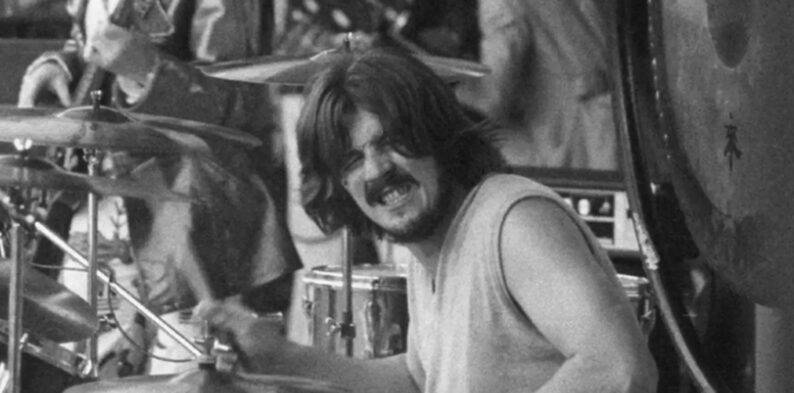
There is a sound that exists in popular music unlike any other sound. It arrives at the beginning of a recording and before the first beat has finished landing, something in the human body responds. Not in the mind — not first, anyway. In the chest. In the stomach. In some pre-verbal place where the body recognizes rhythm before the brain has categorized it. It is a drum sound. One drum sound, replicated in different forms across fifty years of popular music, chased by producers with increasingly sophisticated technology, never fully caught. Never exactly reproduced.
John Bonham created it by not doing what he was supposed to do.
The session was at Headley Grange, a notoriously uncomfortable residential recording location that Led Zeppelin used during the early 1970s partly because its uncomfortable conditions seemed to produce music of unusual rawness. The house was cold. The acoustics were unpredictable. The setup was improvised in ways that a conventional studio would never permit. And Bonham — setting up for what was supposed to be a straightforward recording session — placed his drums in a position and in a room that the engineer noted was technically incorrect.
The stairwell. A two-story entrance hall with specific acoustic properties that nobody had deliberately engineered because nobody had thought to try. Bonham’s drums at the bottom. Microphones at various heights up the stairs. The engineer’s instinct was to fix this — to move everything into a proper configuration with predictable results. Jimmy Page’s instinct was to roll the tape and see what happened.
What happened was “When the Levee Breaks.”
The drum sound on that recording is not a technical achievement in the conventional sense. Nobody designed it. Nobody specified it. It is the sound of a specific room on a specific day with a specific musician playing with a specific ferocity — all of those variables combining into something that has never been exactly reassembled because you cannot exactly reassemble an accident.
Producers have tried. The technology available to them today is incomprehensibly more sophisticated than anything that existed at Headley Grange in 1970. They can sample the original — and they have, hundreds of times, in recordings across every genre. They can analyze the frequency spectrum, replicate the reverb signature, model the acoustic properties of the stairwell. They have done all of these things with considerable skill.
None of them have caught it. Because what they are capturing is the technical artifact of the sound, not the source of it. The source of it was John Bonham, who was one of the three or four greatest drummers who ever lived, playing at the peak of his powers, in a room that nobody planned, on a day when everything wrong turned out to be right.
He died in 1980. He was thirty-two years old. When he died, Led Zeppelin stopped immediately, because they understood — with a clarity that the subsequent fifty years have confirmed — that what they had was not the band minus one member. It was four specific people in specific combination, and without one of them the thing did not exist.
The drum sound exists on the record. That record exists in the world. Nobody will ever make that sound again.
Some accidents are irreplaceable.