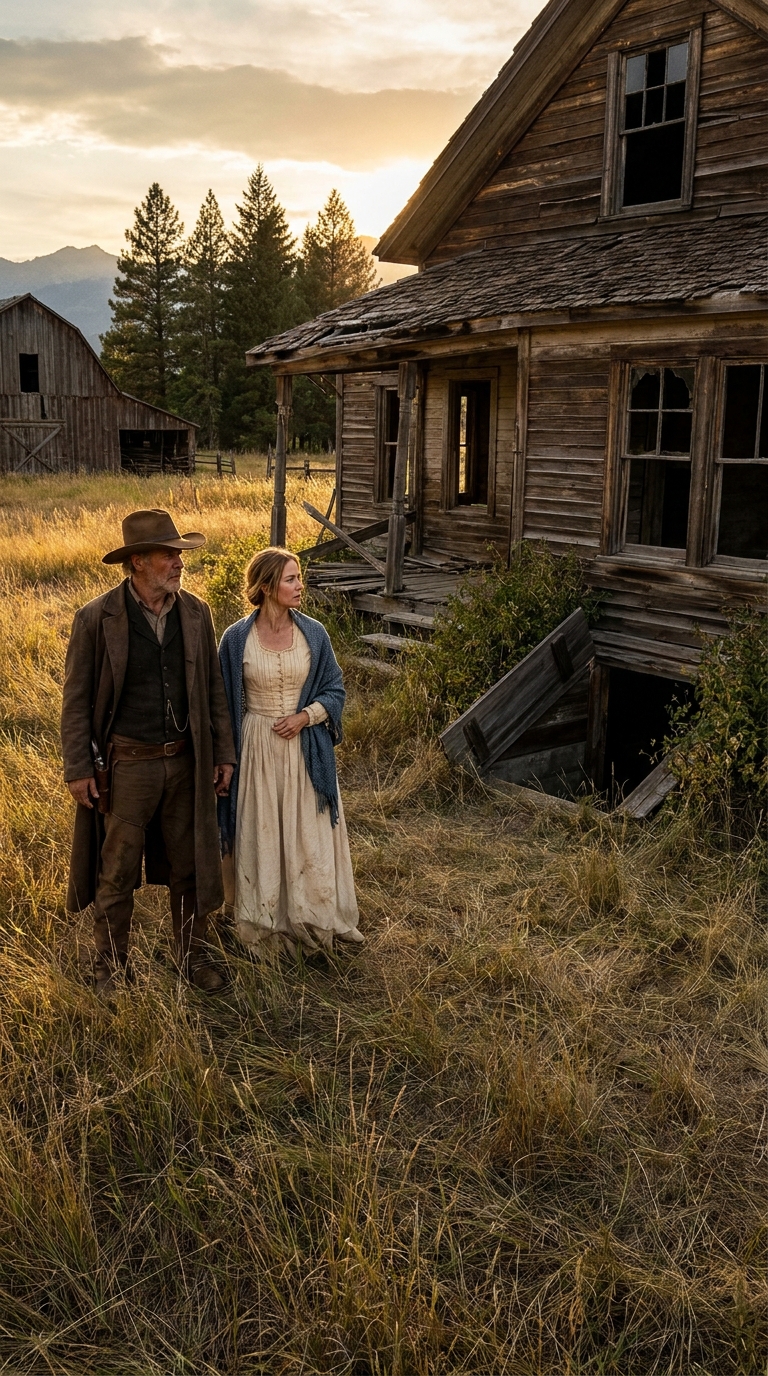
THE COWBOY BOUGHT AN ABANDONED RANCH FOR ONE DOLLAR… THEN A MYSTERIOUS WOMAN REVEALED THE SECRET HIDDEN BENEATH ITS FLOOR
Chapter 1: The Ranch Nobody Wanted
In October of 1887, a lone cowboy rode into the small Montana town of Red Creek with eleven dollars in his pocket, a tired horse beneath him, and nowhere left to call home.
His name was Samuel Walker.
He was thirty-eight years old, tall, broad-shouldered, and weathered by years of working under the open sky. A thin scar crossed his left cheek, and his dark beard had begun turning gray around the chin. His brown coat was faded, his boots were cracked, and his saddle had been repaired so many times that he had stopped counting the patches.
Samuel had spent most of his life moving from one ranch to another. He had driven cattle across dangerous mountain trails, repaired fences during winter storms, and worked for ranch owners who sometimes paid him late or not at all.
He had never been a wealthy man, but he had always managed to survive.
That changed three years earlier when his younger brother, Thomas, died during a cattle drive in Wyoming. Samuel had been leading the herd when a sudden storm scattered the cattle. Thomas rode back to help him and was caught beneath a falling tree.
Samuel had buried his brother far from home.
He had carried the guilt ever since.
After that, he stopped making promises, stopped getting close to people, and stopped believing that settling down was worth the risk.
But now his horse was old, winter was approaching, and he had almost no money left.
He needed a place to stay.
Red Creek was a small frontier town with a blacksmith shop, a general store, a church, a sheriff’s office, and a saloon that remained busy even on quiet afternoons. Samuel tied his horse outside the general store and stepped inside.
An elderly shopkeeper named Walter Briggs looked up from behind the counter.
“Well, I’ll be. Haven’t seen you around here before.”
“Just passing through,” Samuel replied.
“Looking for work?”
“Not exactly. I’m looking for land.”
Walter chuckled.
“Then you must have more money than sense. Land around here doesn’t come cheap.”
Samuel shrugged.
“Doesn’t hurt to ask.”
While Walter prepared his supplies, Samuel noticed a yellowed advertisement pinned to the wall. It showed a rough drawing of an old ranch house and described a property located several miles outside town.
Eighty acres.
A barn.
A well.
A two-story wooden house.
The asking price was one dollar.
Samuel read it again.
“Whoever owns this place must be desperate.”
Walter followed his gaze. His smile disappeared.
“Forget that property.”
“Why?”
“Because nobody stays there.”
Samuel turned toward him.
“What’s wrong with it?”
Walter leaned over the counter.
“The ranch belonged to a man named Thomas Bell. He disappeared nearly six years ago. Before him, two other families tried living there. Both left within a year.”
“Maybe they didn’t know how to run a ranch.”
“Maybe.”
Walter lowered his voice.
“People around here say strange things happen after dark. Lights in the windows. Footsteps in the barn. Someone calling from beneath the house.”
Samuel gave a tired smile.
“Sounds like a story people tell children.”
“Then go ahead and buy it. But don’t say I didn’t warn you.”
Samuel folded the advertisement and placed it in his coat pocket.
He had slept beneath trees during thunderstorms and spent nights in abandoned mining cabins. A few stories about ghosts weren’t going to frighten him.
The following morning, he visited the bank and signed the necessary papers.
For one silver dollar, Samuel Walker became the owner of the abandoned Bell Ranch.
The banker, Charles Whitmore, looked at him as though he had just made the worst decision of his life.
“Mr. Walker, I strongly recommend that you inspect the property before spending any more money on it.”
“I intend to.”
“The house is in poor condition. The well may be unusable, and the barn needs significant repairs.”
“I’ve repaired worse.”
Whitmore slid the papers across the desk.
“Then I wish you luck.”
Samuel placed the silver dollar on the desk.
“That’s all I need.”
He rode out of town before noon.
The ranch was beautiful despite its condition. It sat in a green valley surrounded by pine-covered hills, with a narrow creek running along its western boundary. Beyond the creek, distant mountains rose beneath the clear autumn sky.
The house itself was another matter.
Its porch leaned dangerously to one side. Several roof boards were missing, and weeds covered the path leading to the front door. The barn doors hung crookedly, and an old water tower stood beside a dry-looking well.
Samuel climbed down from his horse.
“Well,” he muttered, “at least the view was worth the dollar.”
He pushed open the front door.
Dust floated through the sunlight. An old wooden table stood in the kitchen, a broken chair lay beside the fireplace, and several empty shelves lined the walls.
He checked the bedrooms, the storage room, and the small hallway.
Nothing appeared valuable.
There were no signs of recent visitors, no fresh footprints, and no food in the cupboards.
Samuel placed his supplies on the kitchen counter.
He planned to spend the next few days repairing the roof, checking the well, and preparing the house for winter.
He had no idea that someone else already considered the ranch home.
And that person was about to change everything.
Chapter 2: The Woman at the Barn
Samuel spent his first afternoon inspecting the property.
The barn needed new hinges, several fence posts had fallen, and the well’s wooden cover was almost completely rotten. Still, the land was better than he had expected.
He found a small patch of healthy grass near the creek and enough firewood to last several weeks.
Just before sunset, he heard a noise behind the barn.
It sounded like a wooden door closing.
Samuel turned.
“Who’s there?”
No answer.
He walked toward the barn with his rifle held low, not raised but ready.
The main doors were partly open.
Inside, an old saddle rested on a wooden bench. Several tools hung from the wall, and a stack of hay sat near the back.
Then he noticed a woman standing beside the far wall.
She was holding a lantern.
She appeared to be in her early thirties, with dark brown hair tied loosely behind her head. Her cream-colored dress was worn at the sleeves, and a faded blue shawl covered her shoulders.
She looked at Samuel without blinking.
“You’re not supposed to be here,” she said.
Samuel lowered his rifle.
“That’s strange. I was about to say the same thing to you.”
“This property is not yours.”
Samuel reached into his coat and removed the folded ownership document.
“According to the bank, it is.”
The woman glanced at the paper.
“Who bought it?”
“Samuel Walker.”
She studied him.
“How much?”
“One dollar.”
For the first time, her expression changed.
She looked almost angry.
“Then they finally found someone foolish enough to take it.”
Samuel placed the document back in his pocket.
“Would you mind telling me who you are?”
The woman hesitated.
“Clara Hayes.”
“Do you live here?”
She looked toward the barn door.
“Sometimes.”
“Sometimes?”
“I have been staying in the old storage room. I thought the property was still empty.”
Samuel slowly lowered his rifle completely.
“How long have you been here?”
“Almost three months.”
“Why didn’t you go to town?”
Clara looked at him with an expression he couldn’t understand.
“Because someone in town is looking for me.”
Samuel waited for an explanation, but she turned away.
He noticed a small bundle of clothing near the wall, a cooking pot, and a blanket spread over a pile of hay.
She wasn’t lying about staying there.
“Do you have family nearby?” he asked.
“No.”
“Friends?”
“Not anymore.”
Samuel looked at her tired face.
He knew what it was like to have nowhere to go.
But he also knew that a stranger could bring trouble.
“Look, Clara. I don’t know your situation, but I just bought this property. I need to repair the house, and I can’t have someone living in the barn without knowing why.”
She lifted her chin.
“Then I suppose I’ll leave.”
She picked up her bundle.
Samuel watched her walk toward the door.
Something about the way she moved bothered him. She wasn’t simply walking away from a place she had been using. She was leaving as if she expected to be chased.
“Wait.”
She stopped.
Samuel sighed.
“You can stay tonight.”
Clara turned.
“Why?”
“Because it’s getting dark, and the nearest town is several miles away.”
“I don’t need your charity.”
“I didn’t offer charity. I offered a dry place to sleep.”
She looked at him for a long moment.
Then she nodded.
“Just tonight.”
Samuel returned to the house and prepared a simple meal. He gave Clara a bowl of beans, some bread, and a cup of coffee.
She ate quietly.
After a while, Samuel asked the question that had been bothering him.
“Who is looking for you?”
Clara placed her spoon down.
“A man named Charles Whitmore.”
Samuel stopped chewing.
The banker’s name was Charles Whitmore.
“Why would the banker be looking for you?”
Clara looked toward the window.
“Because I know what happened to the man who owned this ranch.”
Samuel leaned back.
“Thomas Bell?”
She nodded.
“Yes.”
Samuel waited.
Clara took a slow breath.
“And because Thomas Bell did not disappear.”
Chapter 3: The Truth About Thomas Bell
Samuel placed his cup on the table.
“Then where is he?”
Clara looked at him, and for a moment he thought she might refuse to answer.
“He’s dead.”
Samuel frowned.
“How do you know?”
“Because I buried him.”
The room became silent.
Outside, the wind rattled the loose window frame. Samuel stared at Clara, trying to understand what she had just said.
“Why would you bury a man on this property?”
“Because he was my father.”
Samuel slowly sat forward.
“Thomas Bell was your father?”
Clara nodded.
“He wasn’t always known by that name. When my mother died, he moved us here and started using his middle name. He wanted to leave his old life behind.”
“Why?”
“Because he had discovered something.”
Samuel waited.
Clara looked toward the hallway.
“My father used to work for a land company. He helped survey properties throughout Montana. During one of his assignments, he discovered that several wealthy men were secretly taking land from families who couldn’t afford lawyers. They changed documents, bribed officials, and used false debts to force people off their property.”
Samuel’s expression hardened.
“And Whitmore was involved?”
“He was one of them.”
Clara explained that her father had kept copies of several land agreements. They showed how the company had taken control of valuable land through fraudulent claims. Some of the properties were near Red Creek, while others contained timber, water rights, and deposits of silver.
Thomas Bell had intended to take the documents to the territorial authorities.
But someone discovered his plan.
One evening, three men arrived at the ranch. They demanded that Thomas hand over his papers.
He refused.
A fight broke out, and Thomas was badly injured.
Clara had been away visiting a family in a nearby settlement. When she returned, she found her father dying beside the barn.
“He gave me a key,” she whispered. “He told me the proof was hidden where the old house met the ground. Then he made me promise not to trust anyone who worked for Whitmore.”
Samuel glanced at the floor.
“Under this house?”
Clara nodded.
“I searched for months. I couldn’t find anything. Then Whitmore’s men began looking for me. I had to hide.”
Samuel thought about the banker’s warning.
The property had been sold for one dollar because Whitmore wanted it gone.
But why would a banker give away eighty acres simply to get rid of an old building?
Unless the ranch contained something more valuable than the land itself.
“Why didn’t you go to the sheriff?” Samuel asked.
Clara gave a bitter laugh.
“Because the sheriff takes money from Whitmore.”
Samuel said nothing.
“His name is Harlan. He has been protecting the men who stole those properties. If I went to him, I would never make it out of his office.”
Samuel rubbed his beard.
“How many people know about these papers?”
“My father, me, Whitmore, and the men who killed him. At least, that’s what I believe.”
“Then why did Whitmore sell the ranch?”
“Because he thought the documents were destroyed. He searched the house before the bank took possession. He didn’t find them.”
Samuel looked toward the floorboards.
“And now you think they’re still here.”
“I know they are.”
Clara reached into the pocket of her shawl and removed a small brass key.
“My father gave me this before he died.”
Samuel examined it.
It was old and unusually heavy. A number had been engraved on one side.
“Where does it fit?”
“I don’t know.”
Samuel placed the key on the table.
“Then tomorrow, we search the house.”
Clara stared at him.
“You don’t understand. If Whitmore discovers that I am still here, he’ll send men to kill us both.”
Samuel looked at the rifle beside the fireplace.
“Then I suppose we should be careful.”
Chapter 4: The Secret Beneath the Floor
The following morning, Samuel began examining the house.
Clara showed him the rooms her father had used as an office. Most of the furniture had been removed, but a heavy wooden desk remained near the back wall.
They searched the drawers.
They checked the shelves.
They pulled aside loose boards and examined the fireplace.
Nothing.
By midday, Samuel was covered in dust.
“Your father must have been a very clever man,” he said.
“He was.”
“Or he hid the papers somewhere nobody would ever look.”
Clara studied the room.
“My father always said the safest hiding place was the one people walked over every day.”
Samuel looked down.
The floorboards.
He knelt and examined them carefully. Most were old and uneven, but one section near the fireplace appeared slightly newer.
He tapped it with the handle of his knife.
The sound was different.
“Hollow.”
Clara hurried over.
Samuel removed the knife and worked its blade beneath the edge of the board.
After several minutes, the wood lifted.
Beneath it was a narrow opening.
Inside sat a small iron box.
Clara covered her mouth.
Samuel reached down and lifted it onto the floor.
The box was locked.
Clara took out the brass key.
Her hands trembled as she inserted it.
It turned.
The lid opened with a dry metallic click.
Inside were several folded papers, a leather notebook, and a small photograph.
Clara picked up the photograph first.
It showed her father standing beside a younger woman and a little girl.
Her mother.
Clara’s eyes filled with tears.
“I haven’t seen this in years.”
Samuel gave her a moment before examining the documents.
The first paper was a land agreement.
The second was a handwritten list of payments made to several officials.
The third contained names and signatures.
Samuel recognized one immediately.
Charles Whitmore.
Another name appeared beneath it.
Sheriff Harlan.
There were also references to several families who had lost their farms.
Samuel read the documents slowly.
This was no ordinary land dispute.
The papers suggested that Whitmore and his associates had deliberately taken land from dozens of families. They had used forged signatures, false debts, and threats to force people to surrender their property.
But the most important document was a letter written by Thomas Bell.
It explained that a large section of land outside Red Creek had been transferred illegally to a company controlled by Whitmore. The land included the main creek and a large timber reserve.
If the fraud were exposed, the company could lose everything.
Samuel looked at Clara.
“These papers could destroy him.”
“That’s why my father died.”
Clara held the photograph tightly.
For several minutes, neither spoke.
Then Samuel noticed something else inside the box.
A second key.
This one was larger, made of dark iron, and had a small mark shaped like a star.
He turned it over.
“What’s this for?”
Clara shook her head.
“I’ve never seen that one.”
Samuel looked toward the back of the house.
“Your father may have left another hiding place.”
He returned the documents to the box, but kept the second key in his hand.
Before they could continue searching, three sharp knocks sounded at the front door.
Both froze.
Samuel reached for his rifle.
A man’s voice came from outside.
“Mr. Walker! Open up. We need to talk.”
Samuel recognized the voice.
It belonged to Sheriff Harlan.
Chapter 5: The Sheriff Comes Calling
Samuel moved toward the window and looked through a narrow gap in the curtains.
Three men stood on the porch.
Sheriff Harlan was in the middle. He was a heavyset man in his fifties with a thick mustache and a silver badge pinned to his vest.
The two men beside him carried rifles.
Samuel turned toward Clara.
“Take the box into the bedroom. Hide it beneath the mattress.”
“What about you?”
“I’ll handle this.”
Clara hurried away.
Samuel placed his rifle behind the door and opened it.
“Morning, Sheriff.”
Harlan smiled.
“Beautiful day, isn’t it?”
“Can’t complain.”
“I heard you purchased the old Bell property.”
“That’s right.”
“Cheap deal.”
“One dollar.”
Harlan laughed.
“Must be the bargain of the century.”
Samuel leaned against the doorframe.
“That’s what I thought.”
The sheriff looked over his shoulder.
“Mind if we come inside?”
“Depends. Do you have a warrant?”
The smile disappeared from Harlan’s face.
“Don’t get difficult, son. I’m just checking on the new owner.”
Samuel stepped aside.
“Then take a look.”
Harlan entered the house, followed by the two men.
He examined the kitchen, glanced at the fireplace, and walked toward the hallway.
“Living alone?”
“Yes.”
“Nobody else staying here?”
Samuel shook his head.
“Not that I know of.”
Harlan turned.
“Interesting answer.”
Samuel remained silent.
The sheriff walked into the bedroom.
Samuel’s heart tightened.
The iron box was beneath the mattress.
Harlan looked around, then approached the bed.
“Mind if I check under here?”
Samuel’s voice hardened.
“Yes, I do.”
The sheriff slowly turned.
“You’re making this more complicated than it needs to be.”
“Then tell me why you need to search my bedroom.”
For several seconds, the two men stared at each other.
Finally, Harlan stepped back.
“Fine.”
He returned to the kitchen.
“Listen, Walker. The old owner left some things behind. If you find anything unusual, I suggest you bring it to my office.”
“What kind of things?”
“Documents. Personal belongings. Anything that might help us understand what happened to Thomas Bell.”
Samuel looked directly at him.
“I thought Thomas Bell disappeared.”
The sheriff’s jaw tightened.
“That’s what everyone believes.”
“Do you believe it?”
Harlan stepped closer.
“I believe that asking too many questions can be dangerous.”
Samuel didn’t move.
“Then I suppose it’s a good thing I’m not much of a question asker.”
The sheriff gave him a cold smile.
“Enjoy your ranch.”
He walked outside.
Before mounting his horse, he turned back.
“And Walker?”
“Yes?”
“Keep your doors locked tonight.”
The three men rode away.
Samuel closed the door.
Clara emerged from the bedroom.
“They know.”
Samuel nodded.
“They suspect something.”
She looked frightened.
“We have to leave.”
Samuel shook his head.
“No. If we run, they’ll keep searching for those papers. And they’ll never stop looking for you.”
“What do you suggest?”
Samuel glanced at the documents.
“We take the proof to someone who can actually use it.”
“Who?”
“Someone outside Red Creek.”
Chapter 6: The Woman Who Wouldn’t Run
That evening, Clara sat near the fireplace, reading her father’s letter again.
Samuel was repairing a loose shutter when she spoke.
“My father wanted me to leave this place.”
Samuel turned.
“Why?”
“He said I deserved a life that wasn’t built around fear.”
She folded the letter.
“I spent six years hiding. I changed where I slept, avoided town, and never stayed in one place long enough to feel safe.”
Samuel put down his hammer.
“You shouldn’t have had to live like that.”
Clara looked at him.
“What about you? Why did you come here?”
Samuel stared into the fire.
“I told myself I wanted land.”
“That’s not the whole answer.”
He smiled faintly.
“You ask a lot of questions.”
“Perhaps I learned from my father.”
Samuel pulled a chair closer.
He told her about Thomas, his younger brother. He explained how they had grown up on a small farm, how they had worked together as boys, and how they had eventually left home to find better opportunities.
He described the storm that had taken his brother’s life.
“I was supposed to be watching the herd,” Samuel said. “Thomas rode back to help me. If I had been more careful, he might still be alive.”
Clara listened.
“Was it your fault?”
Samuel stared at the fire.
“I’ve asked myself that question for three years.”
“Then perhaps you should ask a different one.”
He looked at her.
“Which one?”
“What would Thomas have wanted you to do with the rest of your life?”
Samuel didn’t answer.
Clara continued.
“Would he have wanted you to spend every day punishing yourself?”
Samuel lowered his eyes.
It was the first time anyone had spoken to him about his brother without telling him to forget the past.
“Maybe not,” he said.
Clara smiled gently.
“Then perhaps this ranch is a chance to begin again.”
Samuel looked around the old kitchen.
For the first time since arriving, he imagined the house repaired, the barn full of horses, and smoke rising from the chimney during winter.
He imagined staying.
But the sound of distant hoofbeats interrupted his thoughts.
Samuel stood.
He moved toward the window.
A rider was approaching from the eastern trail.
The man stopped near the gate and shouted.
“Walker! You need to get out here!”
Samuel recognized him as Walter Briggs, the shopkeeper.
He opened the door.
Walter rode into the yard, breathing heavily.
“Those men from the bank are coming back,” he said. “They’ve been asking questions about Clara.”
Samuel looked toward the house.
“How do you know?”
“Because I heard them talking at the saloon. Whitmore knows she’s here.”
Walter glanced toward the darkening road.
“And he’s bringing more men this time.”
Chapter 7: The Attack at Midnight
Samuel spent the next hour preparing the house.
He checked the rifle, filled the lanterns, and moved the iron box into a hidden space beneath the kitchen cupboard.
Clara helped him cover the windows.
Walter stayed near the door.
“How many men?” Samuel asked.
“I counted five riding out of town. There may be more waiting along the road.”
Samuel looked toward the hills.
“We can’t fight them all.”
“No,” Walter replied. “But we don’t have to.”
He reached into his coat and removed a folded piece of paper.
“This is a telegram I received from a lawyer in Helena. Thomas Bell sent him a letter before he died. The lawyer has been trying to find Clara for years.”
Samuel opened the paper.
It contained the lawyer’s name and address.
“Why didn’t you tell us earlier?”
Walter looked ashamed.
“Because I was afraid.”
Clara stepped closer.
“You knew my father?”
Walter nodded.
“He helped me once. Years ago, when I was about to lose my store. He found evidence that the same company was trying to take my property. He saved my business.”
Clara’s eyes filled.
“Why didn’t you help me?”
Walter lowered his head.
“I should have. I’m sorry.”
Before Clara could answer, a gunshot echoed from outside.
Samuel grabbed his rifle.
“Get down!”
The lantern near the window shattered.
Another shot struck the wall.
Walter dropped behind the table.
Clara crawled toward the kitchen.
Samuel moved to the side window and looked outside.
Five men were approaching the house.
One carried a lantern. Another held a rifle.
At the front of the group rode Sheriff Harlan.
Behind him was Charles Whitmore.
Samuel recognized the banker immediately.
Whitmore shouted.
“Walker! Come outside!”
Samuel remained behind the wall.
“You’re trespassing!”
Whitmore laughed.
“That property was never supposed to be yours.”
Samuel raised his rifle.
“Then you should have asked for more than one dollar.”
Whitmore’s smile vanished.
“Bring me the documents, and I’ll let you walk away.”
Samuel looked toward Clara.
She shook her head.
He shouted through the window.
“There’s nothing here for you.”
Whitmore raised his hand.
“Then search the house!”
The men began moving forward.
Samuel fired a warning shot into the ground.
The attackers stopped.
“Next one won’t be a warning!”
Harlan shouted.
“Put that rifle down, Walker! You’re interfering with an official investigation!”
Samuel answered.
“Then show me your warrant!”
Harlan cursed.
One of the men moved toward the side of the house.
Samuel saw him through the window and fired. The bullet struck the wooden post beside the man’s shoulder.
The attacker fell backward.
The others scattered.
Clara crawled to the fireplace and pulled a small revolver from a hidden compartment.
Samuel looked at her in surprise.
“You know how to use that?”
“My father taught me.”
She moved toward the kitchen window.
A shadow appeared outside.
The man tried to force the shutter open.
Clara raised the revolver.
“Back away!”
The man froze.
She fired into the wooden frame.
He stumbled away from the window.
Samuel looked at her.
“Good shot.”
Clara’s hands were trembling.
“I hope I never have to do it again.”
The gunfire continued for several minutes.
Then suddenly, another sound came from the eastern trail.
A loud whistle.
Walter lifted his head.
“That’s the town marshal’s signal!”
Samuel looked outside.
Several riders were approaching from the darkness.
At their front was a tall man wearing a black coat and carrying a badge that read U.S. Deputy Marshal.
Behind him rode six armed men.
Whitmore turned toward the new arrivals.
His face went pale.
Chapter 8: The Lawyer’s Letter
The deputy marshal dismounted and walked toward the ranch.
“Everyone put your weapons down!”
Harlan immediately lowered his rifle.
Whitmore remained mounted.
“Who are you?”
“Deputy Marshal James Carter. I have orders to investigate the land fraud allegations involving your company.”
Whitmore tried to smile.
“This is a private property dispute.”
Carter removed a document from his coat.
“Not anymore.”
He looked toward the house.
“Samuel Walker?”
Samuel stepped onto the porch.
“That’s me.”
“I’m looking for Clara Hayes.”
Clara appeared behind him.
“I’m here.”
The marshal studied her face.
“Are you Thomas Bell’s daughter?”
She nodded.
“I am.”
Carter lowered his voice.
“I’ve been trying to find you for almost a year. A lawyer named Edward Mason sent me a letter explaining what your father discovered. He also provided copies of several documents.”
Clara looked at Walter.
He nodded.
Carter continued.
“Are the original records still here?”
Clara hesitated.
Samuel stepped forward.
“We have them.”
Carter looked toward the house.
“Then I need to see them.”
Samuel retrieved the iron box.
He placed it on the porch and opened the lid.
The marshal examined the documents carefully.
As he read, his expression became increasingly serious.
“These are original records.”
Whitmore stepped forward.
“They’re fabricated.”
Carter looked at him.
“Then you’ll have no trouble explaining the payments recorded here.”
Whitmore said nothing.
The marshal removed a second paper from the box.
It was a signed letter from Thomas Bell.
The letter named several officials who had accepted money in exchange for helping the company steal land.
It also contained a detailed description of how Whitmore had arranged the disappearance of property records.
Carter looked at Sheriff Harlan.
“You’re under investigation for corruption and conspiracy.”
Harlan immediately protested.
“You can’t arrest me based on papers from a dead man!”
Carter handed him the document.
“I’m not arresting you based on one letter. I’m arresting you because the territorial office has been investigating your activities for months.”
He turned toward the two men standing behind Whitmore.
“Put your weapons down.”
The men hesitated.
Then they slowly dropped their rifles.
Whitmore tried to ride away.
A deputy moved quickly and grabbed the reins of his horse.
“Not so fast.”
For the first time that night, Charles Whitmore looked frightened.
The man who had controlled Red Creek for years was no longer in control of anything.
Chapter 9: What the Papers Really Revealed
The following morning, the deputy marshal took the documents into town.
Samuel, Clara, and Walter followed.
The news spread quickly.
People gathered outside the courthouse, curious about the arrests.
Several families whose land had been taken arrived to identify the names in the documents.
An elderly farmer named George Miller stepped forward.
“My father lost our property because of Whitmore,” he said. “He told everyone the bank had taken it for unpaid debts.”
A woman named Margaret Ellis began crying when she saw the papers.
Her family had lost a small farm twelve years earlier.
She had spent years believing her father had signed away the property willingly.
The documents showed otherwise.
One by one, people began recognizing the names and events recorded in Thomas Bell’s notebook.
The evidence was stronger than anyone had expected.
But there was still one question Samuel couldn’t answer.
Why had Whitmore sold the ranch for one dollar?
That afternoon, Clara found an additional note hidden inside the leather notebook.
It was written in her father’s handwriting.
She read it quietly.
“Samuel, listen to this.”
The note was addressed to Clara.
It explained that Thomas had discovered something even more important than the fraudulent land records.
The creek running through the ranch was connected to a large underground water source. Several nearby properties depended on it, and the company had been trying to gain control of the water rights.
Thomas had refused to sell.
The ranch had been deliberately neglected so that the property would appear worthless. Whitmore believed that nobody would ever investigate the old land records again.
But the final paragraph contained something Clara hadn’t expected.
Her father had written:
If you ever find someone willing to protect this place without asking what it is worth, trust him. I could not save the ranch from the men who wanted to own everything. Perhaps someone else can give it a future.
Clara slowly lowered the paper.
Samuel looked at her.
“What does it mean?”
She smiled sadly.
“My father wanted this ranch to belong to someone who cared about the land, not just the money.”
Samuel looked toward the window.
Outside, the mountains stood beneath the bright afternoon sky.
For the first time, he understood why the bank had been willing to sell the property for almost nothing.
Whitmore hadn’t wanted to sell a useless ranch.
He had wanted to bury the evidence.
Chapter 10: The Choice to Stay
Over the next several weeks, the investigation grew.
Whitmore and Sheriff Harlan were formally charged. The authorities discovered additional records in the banker’s private office, confirming that several properties had been taken through illegal agreements.
Some of the stolen land was returned to its rightful owners.
The people of Red Creek began speaking openly about what had happened.
Walter helped the deputy marshal locate families who had been forced out of their homes.
And Clara finally had the freedom to walk through town without looking over her shoulder.
But she still hadn’t decided what to do with the ranch.
One afternoon, she found Samuel repairing the front porch.
“You’ve been working since sunrise,” she said.
Samuel drove another nail into the wood.
“Somebody has to fix this place.”
Clara leaned against the railing.
“Are you planning to stay?”
Samuel stopped hammering.
“I suppose that depends.”
“On what?”
“Whether the new owner wants me here.”
Clara smiled.
“You’re the owner.”
“Not exactly.”
She looked confused.
Samuel placed his hammer down.
“Your father left this property for you. The papers make that clear. The bank never had a legitimate claim to it.”
Clara shook her head.
“My father wanted me to be safe. He never expected me to spend my life alone on this ranch.”
“Then what do you want?”
She looked toward the creek.
“I want a home. A real one. Somewhere I don’t have to hide.”
Samuel looked at her.
“So do I.”
For a moment, they stood quietly.
Then Clara said something he hadn’t expected.
“Would you help me rebuild it?”
Samuel smiled.
“I already started.”
They began working together.
Clara repaired the garden, planted vegetables, and cleaned the rooms. Samuel fixed the roof, rebuilt the barn doors, and repaired the fence.
They hired two local men to help with the heavier work.
By winter, the ranch looked different.
The porch stood straight. The roof no longer leaked, and smoke rose from the chimney every evening.
The barn held two horses and a small group of cattle.
The well provided clean water.
And the old house finally felt alive again.
Chapter 11: A Different Kind of Family
Winter arrived early that year.
Snow covered the mountains, and the creek froze along its shallow edges.
Samuel and Clara spent most evenings beside the fireplace. They talked about their childhoods, their families, and the lives they had lost.
Samuel told her about his brother.
Clara told him about her father.
Neither tried to pretend the past had been easy.
One evening, Clara found Samuel sitting alone near the window.
“Thinking about Thomas?” she asked.
He nodded.
“I used to think that moving somewhere new would make the memories disappear.”
“Did it?”
“No.”
Clara sat beside him.
“Perhaps they aren’t supposed to disappear.”
Samuel looked at her.
“What do you mean?”
“You can remember someone without spending the rest of your life blaming yourself for losing them.”
He was quiet for a long time.
Then he reached into his coat and removed a small photograph.
It showed him and Thomas standing beside two horses.
“I carried this for three years,” he said.
Clara examined it.
“He looks happy.”
“He was.”
Samuel smiled faintly.
“He always said I’d never find a woman willing to put up with me.”
Clara laughed.
“Perhaps he was wrong.”
Samuel looked at her.
“Perhaps.”
Outside, the wind moved through the trees.
Inside, the fire burned steadily.
Neither of them rushed to fill the silence.
They had both spent years living with loss. Now, for the first time, they were beginning to understand that the future didn’t have to be another version of the past.
Chapter 12: The Last Secret
Spring came slowly to Montana.
By April, the snow had melted from the valley, and the first green shoots appeared along the creek.
One morning, Samuel discovered a small wooden box beneath a loose board in the barn.
It was old and covered in dust.
He called Clara.
“Have you ever seen this?”
She examined the box.
“No.”
Samuel opened it carefully.
Inside was a folded letter, a silver pocket watch, and a small leather pouch.
The letter was addressed to Thomas Bell.
Samuel recognized the handwriting.
It belonged to Thomas’s old business partner.
Clara read the letter aloud.
It explained that Thomas had once worked with a man named Edward Mason, the lawyer who had helped expose the land fraud. The two men had originally planned to establish a small settlement on the ranch, where families who had lost their land could begin again.
They had intended to use the creek, the surrounding farmland, and the timber to create a self-supporting community.
Thomas had never abandoned that dream.
He had simply been forced to protect it.
The letter ended with one sentence:
The land is worth more than the men who fight over it will ever understand. Its real value is what people can build together.
Clara folded the letter.
For a while, she said nothing.
Then she looked at Samuel.
“My father wanted this place to become more than a ranch.”
Samuel nodded.
“Then perhaps we should finish what he started.”
They decided to use part of the property to build a small home for families who had lost their land. They would provide shelter, food, and work until those families could rebuild their lives.
Walter offered to help.
Several townspeople volunteered.
By the end of summer, the ranch had become something nobody in Red Creek had expected.
It was no longer an abandoned property surrounded by rumors.
It was a place where people could start again.
And Samuel, the cowboy who had bought eighty acres for one dollar, finally had something money could never have purchased for him.
A home.
A purpose.
And someone beside him who understood why both mattered.
Chapter 13: The Promise Beneath the Old Oak
Nearly a year after Samuel first arrived in Red Creek, he and Clara stood beneath an old oak tree near the creek.
The ranch was alive with activity. Children played near the barn, two families had moved into the restored cottages, and Walter was teaching a young boy how to repair a fence.
Samuel watched them for a moment.
“Your father would have liked this,” he said.
Clara smiled.
“I think he would.”
She looked at the ranch house.
“When I first found out Whitmore had sold the property, I thought everything my father had protected was gone.”
Samuel turned toward her.
“But it wasn’t.”
“No. It was waiting.”
Samuel took her hand.
“I came here because I had nowhere else to go.”
“And I stayed because I was afraid to leave.”
He smiled.
“Funny how things turned out.”
Clara looked at him.
“Do you ever regret buying the ranch?”
Samuel glanced toward the old house, the barn, and the people working across the land.
“Not for a single day.”
She leaned her head against his shoulder.
For years, the people of Red Creek had believed the Bell Ranch was cursed. They had told stories about mysterious lights, strange sounds, and a man who vanished without a trace.
But the truth had never been supernatural.
The ranch had been carrying the weight of a secret.
A father had died protecting his daughter.
A daughter had spent years protecting the truth.
And a lonely cowboy had unknowingly purchased the one place where their lives could finally come together.
Samuel had paid one dollar for the ranch.
But what he found beneath its floorboards was worth more than all the money in Red Creek.
It gave justice to the people who had been robbed, peace to a woman who had spent years hiding, and a reason for a lonely man to believe in tomorrow again.
And whenever someone in town asked Samuel whether he regretted buying that old abandoned property, he always gave the same answer.
“I thought I was buying a broken ranch.”
Then he would look toward Clara, standing on the porch with the afternoon sun falling across her hair.
“Turns out, I was buying a second chance.”
THE END.