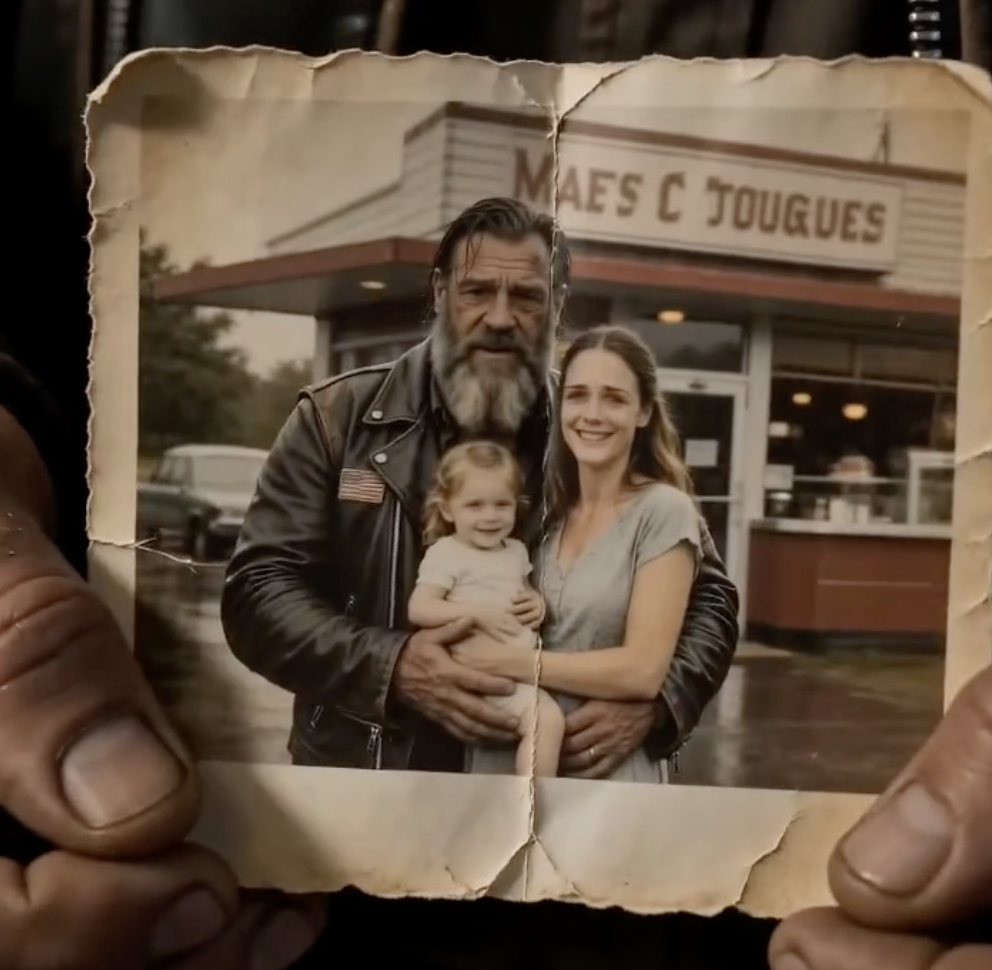
A suspense thriller about a broken promise, a mother’s final secret, and a man who was buried twenty years ago.
The rain had been falling over Millfield, Ohio, since four that afternoon, turning the old Main Street into a ribbon of black pavement and trembling reflections. Inside the Starlight Diner, the smell of burnt coffee, fried onions, and wet wool hung beneath the yellow ceiling lights. A handful of customers sat in the red vinyl booths, minding their own business, while a tired young waitress moved between the tables with a coffee pot in one hand and a stack of plates balanced against her hip.
Then the front door opened.
A massive man in a black leather vest stepped inside, bringing the smell of rain and cold air with him. His gray beard reached nearly to his chest. Water dripped from his helmet, and a faded silver insignia was stitched above the pocket of his vest. He looked like the kind of man people noticed without wanting to. He stood near the entrance, scanning the room as though he had been searching for this place for a very long time.
The waitress looked up.
The coffee pot slipped from her hand.
It struck the tiled floor, shattered, and sent hot coffee spreading beneath the nearest table.
Nobody moved.
The waitress stared at the stranger. Her face drained of color, and her lips parted as if the words were being dragged out of her against her will.
“You!” she whispered.
The biker turned toward her.
She took one unsteady step backward.
“You’re supposed to be dead!”
The diner fell so silent that the rain tapping against the windows suddenly sounded deafening.
The biker slowly removed his helmet.
For several seconds, he said nothing. His pale gray eyes moved across her face, searching for something he could not name. Then his gaze dropped to the little brass name tag pinned to her uniform.
EMILY.
He looked at her again.
“I’m sorry, sweetheart,” he said quietly. “Have we met?”
Emily’s eyes filled with tears.
“You promised my mother you’d come back.”
The man’s expression changed.
And before either of them could say another word, the old scar above his left eyebrow began to tremble as he recognized a face he had spent twenty years trying to forget.
## Chapter One: The Name on the Envelope
Emily had imagined this moment a thousand times.
Sometimes, in her dreams, the man came through the diner door wearing a military uniform. Sometimes he arrived in a battered pickup truck, carrying a box of old photographs and an apology he had practiced for years. Once, when she was twelve, she dreamed he came to her school play and stood in the back of the auditorium, crying silently as she sang.
But in none of those dreams had he looked like this.
The man standing before her was older than the photographs. His face was weathered, his beard silver, and his hands rough from years of work. He carried the quiet exhaustion of someone who had seen too many people leave and had stopped expecting anyone to return.
Emily could not stop looking at the scar above his eyebrow.
She remembered that scar.
Not from her childhood. She had been too young to remember him clearly. She remembered it from a photograph her mother kept hidden in a sewing box beneath her bed. In the picture, the man was laughing, his arm wrapped around a beautiful young woman with dark hair, while a little girl sat on his shoulders.
The little girl had been Emily.
And the man was the person her mother had spent the rest of her life refusing to discuss.
The biker set his helmet on the counter.
“What’s your mother’s name?” he asked.
Emily swallowed.
“You tell me.”
He studied her for a long moment.
“Rebecca.”
The name escaped him like a prayer.
Emily gripped the edge of the counter so tightly that her knuckles turned white.
“Rebecca Hale,” she said. “My mother was Rebecca Hale.”
The man closed his eyes.
For one terrible second, Emily thought he might fall.
When he opened them again, the stranger’s expression had changed. The uncertainty was gone. In its place was something far more frightening: recognition, grief, and a kind of anger that had nowhere to go.
“Emily,” he whispered.
She stepped back.
“How do you know my name?”
He looked at her name tag, then at her face.
“I don’t.”
“Then why did you say it like that?”
He had no answer.
Behind Emily, a spoon slipped from someone’s fingers and clattered against a plate. The sound seemed to bring the diner back to life. A man in a work jacket cleared his throat. An elderly couple exchanged a worried glance. Behind the counter, the coffee machine hissed, and rain continued crawling down the windows in crooked silver lines.
The biker noticed everyone watching.
“I’m sorry,” he told the room. “I didn’t mean to cause a scene.”
He bent down to collect a piece of the broken coffee pot.
“Don’t!” Emily shouted.
He froze.
She stared at him, breathing hard.
For a moment, the two of them looked less like strangers than people standing on opposite sides of a grave.
Then the biker slowly straightened.
“My name is Daniel Mercer,” he said. “And I think you and I need to talk.”
Emily felt the floor tilt beneath her.
Daniel Mercer.
Her mother had spoken those words only twice in Emily’s entire life.
The first time, Emily had been six years old. She had found a faded leather vest in the attic, hidden inside a cardboard box marked WINTER CLOTHES. When she asked her mother whose it was, Rebecca had taken the vest from her hands so quickly that a button tore loose.
“Never touch that again,” she had said.
The second time had been three months before Rebecca died.
Emily had been twenty-two then, sitting beside her mother’s hospital bed while rain tapped against the window. Rebecca had grown frighteningly thin, and her voice had become a fragile whisper. She had been drifting in and out of sleep for hours when, suddenly, she had caught Emily’s wrist.
“There’s a man named Daniel Mercer,” she had whispered.
Emily had leaned closer.
“Who is he?”
Rebecca had stared toward the closed bedroom door.
“If he ever comes looking for you, don’t let him leave until you find out what happened to Thomas.”
“What Thomas?”
But Rebecca’s eyes had closed again.
By morning, she could barely speak.
Three days later, she was gone.
Emily had never found out who Thomas was.
Now Daniel Mercer was standing in the diner, dripping rainwater onto the floor, looking at her as if the dead had opened their eyes.
Emily reached for the envelope beneath the counter.
It was still there, tucked inside the small wooden drawer where she kept spare pens, folded receipts, and the emergency cash her manager insisted every waitress carry. The envelope was thick, yellowed at the edges, and sealed with a strip of old transparent tape.
Her mother had given it to her the day before she died.
Emily had not opened it.
Not because she hadn’t wanted to, but because Rebecca had made her promise something first.
“Wait until the man who was supposed to be dead comes back,” she had said.
At the time, Emily had assumed the morphine was making her mother confused.
Now she wasn’t so sure.
She pulled the envelope from the drawer and placed it on the counter.
Daniel looked down.
The color vanished from his face.
For a long moment, he did not touch it.
“Where did you get that?” he asked.
“My mother.”
“Did she tell you what was inside?”
“No.”
“Did she tell you who to give it to?”
Emily shook her head.
“She said to wait until you came back.”
Daniel’s hand hovered above the envelope.
Then he saw the name written across the front.
His breath caught.
THOMAS MERCER.
He took one step backward.
“No,” he whispered.
Emily watched him carefully.
“You know him?”
Daniel looked at her.
“I buried him.”
The words seemed to empty the diner of air.
Emily stared at the envelope, then at the man who claimed he had buried the person named on it.
“Who is Thomas Mercer?”
Daniel’s jaw tightened.
“My younger brother.”
He reached for the envelope, but stopped just before his fingers touched it.
“He died twenty years ago.”
Emily’s voice was barely audible.
“Then why did my mother leave you a letter addressed to a dead man?”
Daniel looked toward the rain-darkened windows.
“Because,” he said, “your mother knew something I didn’t.”
He finally picked up the envelope.
“And if she was right, Emily, then my brother never died at all.”
## Chapter Two: The Photograph
The diner manager appeared from the kitchen carrying a dish towel.
His name was Frank Donnelly, a broad-shouldered man in his late fifties who had spent twenty-seven years running the Starlight. He had seen fights over unpaid tabs, drunk truckers falling asleep in booths, and a man proposing to his girlfriend while she was trying to eat a plate of pancakes.
But he had never seen Emily look at another human being the way she was looking at Daniel Mercer.
“Everything all right out here?” Frank asked.
Emily did not answer.
Daniel carefully placed the envelope on the counter.
“Could I have a cup of coffee?” he asked.
Frank stared at him.
“Coffee?”
“Black, if you don’t mind.”
Frank looked from Daniel to Emily, then down at the broken pot.
“That’s a new one. Usually people come in here asking for coffee before they break the equipment.”
Daniel glanced at the shattered glass.
“Sorry about that.”
“You didn’t break it.”
“No,” Daniel said. “But I seem to be responsible for what happened.”
Frank studied him for a moment. Then he looked at Emily.
“Take five minutes, sweetheart. I’ll handle the tables.”
Emily hesitated.
“I can’t just leave.”
“You can tonight.”
Frank’s tone was gentle, but there was no room for argument.
Emily untied her apron and hung it behind the counter. Daniel picked up his helmet, then seemed to realize he had no idea where to go. Every chair in the diner suddenly looked too public, every pair of eyes too curious.
Finally, Emily pointed toward the last booth beside the window.
“Sit there.”
Daniel obeyed.
He lowered himself into the red vinyl seat, setting his helmet beside him. The old photograph remained on the counter, lying open beneath the yellow light.
Emily carried it over.
She sat opposite him.
For several seconds, neither spoke.
Up close, Daniel looked even older than she had first realized. There were tiny lines around his eyes, a pale mark along his jaw, and a deep crease between his eyebrows. His hands were enormous, but when he touched the photograph, they moved with surprising care.
“Where did you find this?” Emily asked.
“In a box of my mother’s things. Years ago.”
He turned the photograph toward her.
The picture showed a younger Daniel standing outside the Starlight Diner. His hair was dark, his beard shorter, and his expression so openly joyful that Emily almost failed to recognize him. Rebecca stood beside him, smiling into the sunlight. In her arms was a little girl wearing a yellow dress.
Emily.
She touched the little girl’s face.
“That’s me.”
“I know.”
“How?”
Daniel looked at the photograph for a long time.
“Because I remember taking it.”
Emily waited.
He continued, his voice low and uneven.
“You were three years old. Your mother had brought you to the diner because I was supposed to meet her here before leaving town. You didn’t want to stand still for the picture. You kept trying to climb down from her arms.”
A strange pressure tightened in Emily’s chest.
“What did I call you?”
Daniel’s mouth twitched with a faint, painful smile.
“You called me Danny.”
She looked away.
“Everyone called you Daniel.”
“Not you.”
He rubbed his thumb along the edge of the photograph.
“You used to pull on my beard and tell me it made me look like a bear. You wouldn’t eat your vegetables unless I pretended to be one.”
Emily let out a short, disbelieving breath.
“That doesn’t prove anything.”
“No,” Daniel agreed. “It doesn’t.”
She studied his face.
“Were you my father?”
The question seemed to strike him harder than anything else.
He sat very still.
“Biologically?” he asked. “No.”
Emily’s expression hardened.
“Then why did you let me believe—”
“I didn’t let you believe anything. I didn’t know what Rebecca told you.”
He stopped, searching for the right words.
“I loved your mother. I loved you. Your biological father left before you were born, and I never cared about that. I was there when you took your first steps. I was there when you had pneumonia and your mother stayed awake for three nights. I taught you to ride a little red bicycle in the parking lot behind this diner.”
Emily’s eyes burned.
“I don’t remember any of that.”
“I know.”
“Then how am I supposed to believe you?”
“You shouldn’t have to believe me because I say it. You should look at what happened and decide for yourself.”
He pushed the photograph toward her.
“I came here twenty years ago because Rebecca told me she was afraid someone was following her. I promised I would help her. Then I left for one night, and when I came back, both of you were gone.”
Emily frowned.
“You left us?”
Daniel looked down.
“Yes.”
The answer was so simple that she almost hated him for it.
“Why?”
“Because I was an idiot.”
He gave a small, bitter laugh.
“I thought I could fix everything if I handled it alone. I thought I could keep the people I loved safe by keeping them away from me.”
“That’s what everyone says when they abandon someone.”
“I know.”
He didn’t defend himself.
That unsettled Emily more than an argument would have.
She had spent years imagining a man who was cruel, selfish, or indifferent. Someone who had made a decision and never looked back. But the man sitting across from her looked like someone who had been carrying a mistake for so long that it had become part of his skeleton.
Emily pointed at the photograph.
“You said you came back and we were gone. What happened after that?”
Daniel leaned back, his eyes moving toward the window.
“I searched for you.”
“For how long?”
“Twenty years.”
She shook her head.
“No. You don’t get to say that as if it explains anything. If you searched for twenty years, why didn’t you find us?”
“Because every time I got close, someone made sure I went in the wrong direction.”
“Who?”
Daniel looked at the envelope on the table.
“That’s what I came here to find out.”
He opened the photograph again and examined its back.
The five words written there had been bothering him since the moment he saw them.
Tell her what really happened.
The handwriting was neat and narrow, the letters pressed hard enough to leave faint grooves in the paper. He had seen that handwriting before. He could almost picture the hand that had written it.
But it wasn’t Rebecca’s.
Rebecca’s handwriting had always leaned forward, impatient and messy, with the letter R curling beneath the line. She wrote grocery lists as if she were racing the clock.
This handwriting was different. Deliberate. Controlled.
It belonged to someone who wanted every word to be understood.
Daniel turned the photograph over again.
At the bottom corner, nearly hidden beneath the crease, he noticed a tiny mark.
A number.
417\.
He stared at it.
Emily leaned forward.
“What is that?”
Daniel didn’t answer immediately.
He pulled a folded paper from his wallet and placed it beside the photograph. It was an old receipt from a storage facility, its ink faded to pale blue.
The number printed on it was 417.
Emily looked from the receipt to the photograph.
“Where did you get that?”
“My brother’s things.”
She felt a chill move across her shoulders.
“You said your brother died twenty years ago.”
“He did.”
“Then why do you still have his storage receipt?”
Daniel folded his hands.
“Because I never believed the story they told me about his death.”
Outside, a car passed through the rain, its headlights sliding across the diner windows.
Emily glanced toward the entrance.
“Who told you he died?”
Daniel’s expression darkened.
“The police. The county coroner. A man who claimed he had identified the body.”
“And you believed them?”
“I was twenty-nine years old. My brother was missing, the authorities said they had found him, and the body had been badly damaged in a fire. I was shown a photograph of a burned-out truck and told there was nothing left to identify.”
He swallowed.
“I never saw his face.”
Emily sat back.
“Then how did you bury him?”
“They gave me a sealed coffin.”
The words lingered between them.
Daniel looked at the envelope again.
“I asked to open it. They refused. They said the remains were too badly damaged and that the county had already approved the burial.”
“Who was the man who identified him?”
Daniel’s eyes lifted.
“That’s the part I’ve never been able to forget.”
He leaned closer.
“His name was Arthur Bell.”
Emily felt the name strike some hidden place in her memory.
Arthur Bell.
She had seen it before.
Not in a photograph. Not in a newspaper.
On a letter.
Her mother had kept a stack of old correspondence in the bottom drawer of her bedroom dresser. Emily had gone through it after the funeral, looking for insurance papers and medical records. Most of the letters were ordinary bills, holiday cards, and birthday notes.
One envelope had been different.
It was addressed to Rebecca Hale in handwriting so neat and narrow that it seemed almost printed.
The return address had read:
ARTHUR BELL MILLFIELD, OHIO
Emily had thrown it away with the rest of the paperwork.
At least, she thought she had.
“I know that name,” she whispered.
Daniel stopped moving.
“Where?”
“My mother received a letter from someone called Arthur Bell. Years ago. I saw it after she died.”
His face became completely still.
“What did it say?”
“I don’t know. I never opened it.”
“Do you still have it?”
“I don’t think so.”
“Think carefully.”
Emily closed her eyes, trying to remember.
The drawer. The papers. A brown envelope with a red stamp. The smell of her mother’s perfume lingering in the bedroom.
And something else.
A small white card tucked beneath the envelope.
A telephone number.
She opened her eyes.
“I might have kept the card.”
“Where?”
“At home.”
Daniel looked toward the diner clock.
It was nearly nine.
“Then we should go.”
Emily stared at him.
“You think I’m leaving with you?”
“No.”
“Good.”
He nodded.
“I think you should decide whether you want to hear the truth. If you don’t, I’ll leave you alone.”
Emily looked at the photograph again.
A little girl sat in a man’s arms, smiling as if the world had never hurt anyone.
She wondered what it would feel like to have those memories. To know the smell of his jacket, the sound of his laugh, the way he might have lifted her onto his shoulders.
She wondered what it would feel like to hate him without uncertainty.
Instead, she felt something much worse.
Hope.
And hope, Emily had learned, could be more dangerous than grief.
She picked up the envelope.
“I’m not going with you because I trust you,” she said.
Daniel nodded.
“I understand.”
“I’m going because my mother told me to find out what happened to Thomas.”
She stood.
“And if you lie to me, I’ll never forgive you.”
Daniel rose slowly from the booth.
“That’s fair.”
Emily grabbed her coat from the hook behind the counter. Frank appeared from the kitchen and looked at them both.
“Everything okay?”
“No,” Emily replied.
Frank glanced at Daniel.
“You planning to bring her back?”
Daniel’s expression softened.
“If she’ll let me.”
Frank considered that answer for a moment.
Then he handed Emily a small umbrella.
“Take the big one. The little one always turns inside out.”
Emily accepted it.
As she reached for the door, Daniel stopped beside the photograph.
He folded it carefully and placed it inside his vest.
For a brief moment, his fingers rested against the old silver insignia stitched above his pocket.
Emily noticed the gesture.
“What is that symbol?” she asked.
Daniel looked down.
“An old club.”
“What club?”
“The Iron Ravens.”
She waited for him to say more.
He didn’t.
Instead, he opened the door, and the cold rain swept into the diner.
Neither of them noticed the dark sedan parked across the street.
Inside it, a man in a gray suit watched Emily step beneath the umbrella.
He lifted a mobile phone to his ear.
“They found the envelope,” he said.
A pause.
“No. Mercer hasn’t opened it yet.”
Another pause.
The man’s face remained expressionless.
“Then we still have time.”
He ended the call, started the engine, and followed them into the rain.
## Chapter Three: The House with the Locked Drawer
Emily lived in a small rented house on the eastern edge of Millfield, in a neighborhood where the streetlights flickered during storms and the houses stood close enough for neighbors to hear one another’s televisions through open windows.
Her house had once belonged to her mother.
After Rebecca died, Emily had kept the old curtains, the chipped kitchen table, and the little ceramic bird that sat on the windowsill. She had replaced the leaking roof and painted the front door blue, but the place still smelled faintly of lavender whenever the heating came on.
Daniel parked his motorcycle beside the mailbox.
Emily noticed him looking at the house.
“What?”
“Nothing.”
“You’re doing that thing again.”
“What thing?”
“Looking at everything like you’re trying to remember whether you’ve been here before.”
Daniel studied the porch.
“I have.”
Emily turned toward him.
“What?”
He pointed to the second step.
“There used to be a crack there. Your mother kept telling me she’d fix it, but she never did.”
Emily looked down.
The crack was still there.
A thin line ran through the weathered wood, nearly hidden beneath the paint.
She said nothing.
Daniel stepped away from the motorcycle and followed her up the porch stairs. When Emily unlocked the door, the familiar smell of lavender and old wood drifted into the night.
She switched on the hallway light.
Daniel stopped at the threshold.
For several seconds, he simply stood there.
Emily turned back.
“Are you coming in?”
He nodded, but his eyes remained fixed on a small framed photograph hanging beside the staircase.
It showed Rebecca sitting on the porch with a little girl in her lap. The picture had been taken years after the photograph in the diner. Rebecca looked older, her hair shorter, her smile less carefree.
Daniel stepped closer.
“Your mother cut her hair.”
Emily crossed her arms.
“She did that after I started school.”
“Why?”
“She said long hair got caught in everything.”
Daniel let out a quiet breath that might have been a laugh.
“That sounds like her.”
Emily watched him stare at the picture.
“You remember her very well.”
“I remember everything about her.”
“Then why did she die thinking you abandoned us?”
The question struck him with the force of a physical blow.
Daniel looked away.
“I wish I knew.”
Emily shook her head.
“You keep saying that.”
“Because it’s the truth.”
“Maybe the truth is that you left, and now you want a better story.”
Daniel looked at her.
“You have every reason to believe that.”
“Do I?”
“Yes.”
He took a slow breath.
“But I didn’t stop loving her. And I didn’t stop looking for you.”
Emily wanted to ask another question, but something in his expression made her pause.
She had expected defensiveness. Excuses. Perhaps even anger.
Instead, he seemed willing to accept every accusation she could make, as if he believed he had earned them all.
That frightened her more than she wanted to admit.
She walked toward the kitchen.
“Wait here.”
Daniel remained in the hallway while she opened the drawer beside the refrigerator. She pulled out a stack of old mail, a notebook, and a small cardboard box filled with batteries and loose buttons.
Nothing.
She checked the desk in the living room.
Nothing.
Then she remembered the bedroom.
Her mother’s dresser stood against the far wall, beneath a faded watercolor of a lake. Emily had kept the top drawer closed since the funeral. It contained her mother’s scarves, old jewelry, and a small bottle of perfume she could never bring herself to throw away.
She opened it.
The scent rose immediately, delicate and familiar.
For a moment, she was eight years old again, standing in the doorway while Rebecca got ready for work. Her mother would dab perfume on her wrists, kiss Emily’s forehead, and tell her to behave for the babysitter.
Emily pressed her lips together and searched beneath the scarves.
There was a small wooden box.
Inside it lay two earrings, a broken watch, a folded grocery list, and a white card.
She lifted it.
The telephone number was written in blue ink.
Beneath it were three words.
Ask about Thomas.
Emily felt her heartbeat accelerate.
“Daniel?”
He appeared in the doorway.
She held out the card.
He took it carefully, reading the number twice.
“Do you recognize it?” she asked.
“No.”
“Then what does it mean?”
“I don’t know.”
Emily’s expression hardened.
“Of course you don’t.”
Daniel did not respond. He pulled out his phone and entered the number, then stopped before making the call.
“It’s late,” he said.
“So?”
“If someone has been watching your mother, calling this number could tell them we’re looking.”
Emily stared at him.
“You think someone is watching me?”
“I think someone has spent twenty years making sure certain questions never get answered.”
He looked toward the front window.
“And if that person believes we’re about to answer them, we shouldn’t make it easy.”
Emily felt a chill run down her spine.
“You saw someone outside the diner.”
Daniel looked back at her.
“A dark sedan.”
“I didn’t see it.”
“I did.”
He walked to the window and moved the curtain aside by a fraction.
The street was empty.
No headlights. No moving shadows. Just rainwater gathering along the curb and the occasional flicker of a streetlight.
Emily wrapped her arms around herself.
“This is insane.”
“I agree.”
“You’re telling me that someone might be following me because of a twenty-year-old mystery involving your dead brother?”
“That’s what it looks like.”
She laughed once, without humor.
“Do you hear yourself?”
“Yes.”
“And you’re completely serious?”
“Unfortunately.”
Emily sat on the edge of her mother’s bed.
For the first time since the diner, she felt the full weight of the evening. Her hands were shaking. Her feet hurt from standing all day. She had a half-finished grocery list in her coat pocket and a shift scheduled for six the following morning.
She wanted to return to a world where the worst thing that could happen was a broken coffee pot.
Instead, a dead man had a letter waiting for him.
Daniel crouched several feet away, leaving space between them.
“Emily, I need to ask you something.”
She looked up.
“What?”
“Did your mother ever mention a place called Black Hollow?”
Emily frowned.
“No.”
“An old garage? A train station? Somewhere outside Millfield?”
She shook her head.
Daniel studied her face.
“What about a man with a silver ring? A wide black band with a raven engraved on it?”
“No.”
He looked disappointed, but not surprised.
Emily stared at him.
“Why?”
Daniel hesitated.
“Because that ring belonged to Thomas.”
She stood.
“You said your brother died in a truck fire.”
“Yes.”
“Then why are you asking whether my mother knew where he was?”
“Because Thomas was the last person to see Rebecca before she disappeared.”
Emily went completely still.
“What did you just say?”
Daniel closed his eyes briefly.
“I should have told you earlier.”
“You think?”
He looked at her.
“The night I returned to Millfield, your mother was gone. The police told me she’d taken you and left town. They said she’d made it clear she didn’t want me to follow.”
Emily’s mouth went dry.
“But you said you searched for us.”
“I did.”
“And Thomas?”
Daniel’s expression became distant.
“Thomas vanished three days before I came back.”
Emily slowly lowered herself onto the bed.
“Three days?”
Daniel nodded.
“The police told me he’d stolen money from the garage where he worked and run away. They said he was probably hiding somewhere across the state. I didn’t believe them, but I had no proof.”
“And then they told you he was dead.”
“Yes.”
“Did you think he had something to do with my mother’s disappearance?”
“I thought he might know what happened to her.”
Daniel looked down at his hands.
“By the time I learned he had supposedly died, I had spent months chasing false leads. Someone kept sending me letters claiming Rebecca had been seen in different towns. Every time I traveled to investigate, the person who’d reported seeing her disappeared or denied knowing anything.”
He paused.
“I was running out of money. My motorcycle had broken down twice. I was sleeping in garages and calling hospitals every morning.”
Emily listened without speaking.
“Then I got a letter from the county coroner,” he continued. “They said Thomas had been identified. They gave me a date for the funeral.”
“And you went?”
“I went.”
“Did you ever try to find my mother again after that?”
“Yes.”
“When?”
“Every chance I got.”
Emily stared at him.
“Then how did she die without ever seeing you again?”
Daniel had no answer.
She looked at the photograph in his hand.
For twenty years, she had believed her mother had been left behind by a man who never cared enough to return.
Now she was beginning to wonder whether Rebecca had spent those years waiting for someone who had been deliberately kept away.
It did not excuse him.
But it changed the shape of the question.
Emily rose and returned to the dresser.
At the very bottom of the drawer, beneath a stack of folded sweaters, she found a small metal key taped to a piece of paper.
The paper contained a single sentence in Rebecca’s handwriting.
When you find Daniel, take him to the place where the trains stopped.
Emily read it twice.
“What does that mean?” she asked.
Daniel took the paper from her.
For the first time that evening, genuine fear crossed his face.
“Black Hollow,” he whispered.
“What is that?”
“An abandoned railway station outside town.”
He looked at the key.
“Your mother wanted us to go there.”
Emily felt the room grow colder.
“Why?”
Daniel turned the key over in his palm.
“Because she believed Thomas left something behind.”
He looked at her.
“Something someone has been trying to find for twenty years.”
Outside, a vehicle passed slowly along the street.
Its headlights swept across the bedroom wall.
Daniel moved to the window.
A dark sedan rolled past the house without stopping.
Emily rushed to his side.
“Is that the same car?”
Daniel watched until its taillights disappeared around the corner.
“Yes.”
Neither of them spoke for several seconds.
Then Emily reached for her coat.
“Get your helmet.”
Daniel turned toward her.
“Emily—”
“If my mother left us a key, I’m going to find out what it opens.”
He looked at the young woman standing before him. She was frightened, angry, and clearly determined to walk straight into a mystery that had destroyed much of his life.
For one brief moment, he saw the little girl from the photograph.
Not in her face.
In her stubbornness.
He picked up his helmet.
“Then we go together.”
## Chapter Four: Black Hollow
Black Hollow lay six miles beyond the last row of houses, where the road narrowed between abandoned factories and fields that had long since surrendered to weeds.
The railway station had closed in 1989, after the freight company moved its operations to a larger terminal north of the city. Its brick walls were stained with decades of rain, and the old platform lamps had been removed years earlier. A rusted sign hung above the entrance, swinging whenever the wind rose.
Daniel parked his motorcycle beneath a broken streetlight.
Emily climbed off behind him and immediately pulled her coat tighter.
The rain had weakened to a mist, but the cold was settling into the ground.
“This place is horrible,” she said.
“It used to be busy.”
“When?”
“Before you were born.”
Emily looked at the empty tracks.
“What happened to the trains?”
“They stopped coming.”
She stared at him.
“Very informative.”
Daniel almost smiled.
“Your mother used to say the same thing when I answered questions.”
They approached the station entrance.
A chain hung across the doorway, but the lock had rusted so badly that it no longer closed properly. Daniel lifted it aside and pushed the door open.
The hinges groaned.
Inside, the air smelled of wet brick, dust, and old metal. Moonlight filtered through the broken roof, illuminating a row of wooden benches and a ticket window covered in grime. A timetable still hung on the wall, its printed destinations faded into illegibility.
Emily turned slowly.
“Why would my mother send us here?”
Daniel examined the room.
“I don’t know.”
She looked at him sharply.
“Try something else.”
He sighed.
“Thomas worked on these tracks when we were teenagers. He wanted to become an engineer. He used to spend hours studying the signaling equipment and drawing maps of the rail lines.”
“Was he older than you?”
“Three years younger.”
“What was he like?”
Daniel seemed surprised by the question.
“Funny. Too clever for his own good. He could take apart an engine and put it back together with half the tools missing. He was always trying to prove he could do things better than me.”
“Did he?”
“Frequently.”
A faint smile crossed Daniel’s face, then disappeared.
“He also had a habit of getting involved in things that weren’t his business.”
Emily looked around the abandoned station.
“Such as?”
Daniel didn’t answer.
Instead, he moved toward the old ticket window. Beneath it stood a metal cabinet with several drawers, all of them rusted shut.
He tried the first handle.
Nothing.
The second.
Nothing.
Then he noticed a small keyhole on the bottom drawer.
He held up the key Emily had found.
It fit.
He turned it.
The lock clicked.
Inside the drawer lay a single object wrapped in brown paper.
Daniel carefully lifted it out.
It was a small wooden box, no larger than a paperback book, secured with a brass latch.
Emily watched him open it.
Inside were a folded map, a black-and-white photograph, and a cassette tape with a strip of masking tape attached to its side.
Three words had been written on the tape.
FOR DANIEL.
His hands began to tremble.
Emily reached for the photograph.
It showed three men standing beside a truck outside a warehouse. One was a younger Daniel. Another was Thomas, wearing the black raven ring Emily had heard about. The third man stood between them, his face partially obscured by the brim of a baseball cap.
Daniel stared at the photograph.
“Do you recognize him?” Emily asked.
He leaned closer.
At first, he shook his head.
Then his expression changed.
“No.”
Emily frowned.
“You recognize him?”
Daniel swallowed.
“I know the jacket.”
“The jacket?”
“It’s a county sheriff’s uniform.”
Emily looked at the photograph again.
The third man’s shoulders were broad, and the dark fabric beneath his coat bore the outline of a badge.
Daniel turned the picture over.
On the back, in the same narrow handwriting that had appeared on the photograph at the diner, were the words:
The third man never left town.
Emily felt a cold shiver travel down her arms.
“Who wrote that?”
Daniel shook his head.
“I don’t know.”
He placed the photograph beside the cassette.
“Thomas must have left this here before he disappeared.”
“Then why didn’t the police find it?”
“Because the police weren’t looking in the right places.”
He stopped.
“Or because someone made sure they didn’t.”
Emily stared at the cassette tape.
“Can we play it?”
Daniel examined the old plastic casing.
“If we can find a player.”
“Do you have one?”
“No.”
She gave him a look.
“You’re telling me you rode here on a motorcycle in the rain to open a box containing a cassette tape, and you don’t have anything to play it on?”
Daniel looked at her.
“When you put it like that, it sounds poorly planned.”
Despite herself, Emily laughed.
It was a small sound, unexpected and brief, but it changed something between them.
For the first time that night, Daniel smiled without looking as though it hurt.
Then Emily noticed something beneath the folded map.
A thin strip of paper had been tucked into the crease.
She unfolded it.
The message was written in Rebecca’s handwriting.
Daniel, if you’re reading this, then I failed to keep you away from it. I’m sorry. I wanted to protect Emily, but I should have trusted you.
Emily’s throat tightened.
She continued reading.
Thomas was right about the man in the photograph. He knows what happened that night. He knows why you were given an empty coffin. And he knows why I had to disappear.
Beneath the message was a final line.
Do not trust anyone who tells you the truth too quickly.
Emily lowered the paper.
Daniel stood motionless beside her.
“Your mother knew,” he whispered.
“Knew what?”
“That Thomas might still be alive.”
Emily looked at him.
“Then why didn’t she tell you?”
“Maybe she tried.”
He turned the paper over.
There was more writing on the back, so faint that it had almost disappeared.
Daniel tilted it toward the light.
If anything happens to me, find the blue ledger.
Emily read the words aloud.
“The blue ledger?”
Daniel nodded slowly.
“Thomas used to keep one.”
“What was in it?”
“I don’t know. He wouldn’t show me.”
Emily folded the paper.
“Where is it?”
Daniel looked at the map.
A red circle had been drawn around a location south of the station. Beneath it was a name.
MERCER GARAGE.
Emily stared.
“Your garage?”
“Not anymore.”
“What happened to it?”
Daniel’s face became distant.
“It burned down twenty years ago.”
The same year Thomas supposedly died.
The same year Rebecca disappeared.
The same year Daniel’s life had split into a before and an after.
Emily felt the mystery tightening around them.
“Then why would my mother send us there?”
Daniel folded the map.
“Because she believed something survived the fire.”
He slipped the cassette into his vest pocket.
“We need to find a player.”
Emily glanced toward the doorway.
“Where?”
Daniel looked at her.
“I know a man who collects old music equipment.”
“Can he be trusted?”
Daniel hesitated.
Then he remembered the warning.
Do not trust anyone who tells you the truth too quickly.
“I don’t know,” he admitted.
Outside, a car door slammed.
Emily turned toward the entrance.
A figure stood beyond the broken doorway, silhouetted against the wet platform.
For a moment, neither of them moved.
Then the figure stepped into the station.
He was an elderly man wearing a dark overcoat, with a walking cane in one hand and a flat cap pulled low over his forehead.
He looked at Daniel.
Then at Emily.
“Daniel Mercer,” he said quietly.
Daniel’s face went pale.
“Arthur Bell.”
The old man nodded.
“I was wondering when you’d finally come back.”
Emily felt the room tilt.
The name from her mother’s letter.
The man who had identified Thomas’s supposed body.
The man Daniel had spent twenty years trying to understand.
Arthur Bell stepped closer, his cane tapping against the concrete floor.
He looked at the box in Daniel’s hands.
Then at the cassette protruding from his vest.
“You shouldn’t have opened that.”
Daniel’s voice was low.
“Why?”
Arthur’s eyes moved toward Emily.
“Because now they’ll know you found it.”
Emily stepped forward.
“Who will?”
Arthur Bell looked at her for a long moment.
Then he said something that made Daniel reach for the nearest bench to steady himself.
“The people who buried your brother,” Arthur whispered, “are still alive.”
He paused.
“And one of them is waiting for you at the diner.”
## Chapter Five: The Man in the Gray Suit
Emily wanted to demand answers.
She wanted to know why Arthur Bell had lied about Thomas’s death, why her mother had hidden the truth, and why a man in a gray suit had apparently been following them through the rain.
But before she could speak, Daniel moved between her and the old man.
“Who is waiting at the diner?” he asked.
Arthur looked toward the entrance.
“Someone who has been waiting twenty years for you to make a mistake.”
“Name.”
“Names are dangerous.”
Daniel’s jaw tightened.
“I’m tired of riddles, Arthur.”
“And I’m tired of burying people who trusted the wrong man.”
Arthur’s voice cracked on the last word.
For the first time, Emily noticed that his hands were shaking.
The old man wasn’t merely frightened.
He was ashamed.
Daniel seemed to notice it too.
“Did you identify Thomas’s body?” he asked.
Arthur looked down.
“Yes.”
“Did you see his face?”
“No.”
“Did you see his body?”
Arthur closed his eyes.
“No.”
Daniel took a step toward him.
“Then what exactly did you identify?”
Arthur gripped his cane.
“A medical file. A truck. A set of personal belongings.”
Daniel’s face hardened.
“You told me my brother was dead.”
“I was told he was.”
“By whom?”
Arthur looked at Emily.
Then back at Daniel.
“Sheriff Nathan Cole.”
The name seemed to drain the warmth from the room.
Daniel slowly shook his head.
“Nathan was my friend.”
Arthur’s expression was full of pity.
“That was why you believed him.”
Emily had heard the name Nathan Cole before.
Millfield’s former sheriff.
A man who had retired several years earlier and moved to a lakeside property outside town. He had appeared in old newspaper photographs at charity events and police fundraisers. Rebecca had once mentioned him during a telephone conversation, but the moment Emily asked about him, her mother had changed the subject.
Now the name sat between them like a loaded question.
“Where is he?” Daniel asked.
Arthur looked toward the rain.
“Home, I imagine.”
“Then we’ll go to him.”
“No.”
Daniel stared at him.
Arthur stepped closer.
“If you confront Nathan without knowing what is in that ledger, he will convince you that you’re losing your mind. He will show you documents. He will produce witnesses. He will tell you that your brother was a thief, that Rebecca was unstable, and that you spent twenty years chasing a fantasy.”
Daniel’s face went rigid.
“How do you know?”
“Because he did it to me.”
Arthur’s eyes glistened.
“I signed the statement that put your brother in the ground. I told myself I was protecting my family. I told myself that if I kept quiet, the people who mattered would survive.”
He looked at Emily.
“Your mother spent the rest of her life paying for my cowardice.”
Emily felt anger rise through her fear.
“You knew my mother?”
Arthur nodded.
“I helped her leave Millfield.”
“Then why didn’t you help her tell the truth?”
“Because I was afraid.”
“You let her die believing Daniel abandoned her.”
Arthur flinched.
“I know.”
Emily wanted to strike him with the very words he had used to defend himself.
But there was something terrible about seeing an old man who had already spent twenty years punishing himself.
It did not make him innocent.
It only made the past more complicated.
Daniel looked down at the wooden box.
“What happened that night, Arthur?”
The old man took a slow breath.
“Thomas discovered that someone was using the garage to move stolen documents and money through a private transport company. At first, he thought it was ordinary theft. Then he found names, dates, and payments connected to people in the county government.”
“Who?”
“I never saw the entire ledger.”
“Who?”
Arthur looked at Daniel.
“Nathan Cole. Two businessmen. A judge who is dead now. And a man who was supposed to be buried twenty years ago.”
Daniel’s face changed.
Emily looked between them.
“Who?”
Arthur didn’t answer immediately.
Then he reached into his coat and pulled out a small photograph.
He handed it to Daniel.
The image showed a young man standing beside a black car outside a courthouse. His hair was dark, his face narrow, and his expression calm.
Emily stared.
She knew that face.
She had seen it in a newspaper clipping her mother kept tucked inside a cookbook.
She had seen it on the wall of the diner, in a photograph of the restaurant’s original owners.
And she had seen it on the envelope her mother had left for Daniel.
“That’s Thomas,” she whispered.
Daniel shook his head.
“No.”
Emily looked at him.
“What do you mean?”
“That isn’t Thomas.”
He held the photograph closer to the light.
“It’s his twin.”
Emily’s mouth fell open.
“Thomas had a twin?”
Daniel looked as though the ground had disappeared beneath him.
“No.”
He turned the photograph over.
A name was written across the back.
JONAH MERCER.
Emily looked at Arthur.
“Who is Jonah?”
Arthur’s voice was barely audible.
“The man who was supposed to die with Thomas.”
Daniel stared at the picture.
“I don’t have a twin.”
Arthur’s expression became grave.
“No. You don’t.”
He pointed to the photograph.
“Your father had another son before he married your mother. Jonah was raised by a different family. He and Thomas found each other when they were twenty-one.”
Daniel looked up sharply.
“That’s impossible.”
“I thought so too.”
Arthur took another photograph from his coat.
This one showed Thomas and Jonah standing together outside the garage. They looked almost identical, except for a thin scar that crossed Jonah’s chin.
Emily stared at the images.
The resemblance was undeniable.
Daniel looked as though he might be sick.
“Why didn’t anyone tell me?”
“Because Jonah had a different name when he was born. His mother never registered him under your father’s surname. By the time the two men discovered the connection, they were already involved in the investigation.”
Arthur paused.
“Jonah was the one who found the ledger.”
Emily’s voice trembled.
“Then which one died?”
Arthur looked at her.
“That’s what nobody was supposed to ask.”
A sudden noise came from outside.
The sound of a car engine.
Daniel turned toward the doorway.
Headlights swept across the station wall.
Arthur’s face tightened.
“They’ve found us.”
A black sedan rolled into the parking area and stopped beside the platform.
The driver remained inside.
For several seconds, the three of them watched the vehicle through the broken doorway.
Then the passenger door opened.
A man in a gray suit stepped into the rain.
He was in his early forties, clean-shaven, with dark hair combed neatly away from his forehead. He carried no umbrella. He looked perfectly comfortable standing in the cold, as if the weather had been arranged for his convenience.
He smiled when he saw Daniel.
“Mr. Mercer.”
Daniel stepped forward.
“Who are you?”
The man adjusted his cuffs.
“Someone who would like to save you a great deal of trouble.”
Emily moved closer to Daniel.
The stranger glanced at her.
“And you must be Rebecca’s daughter.”
Emily felt her stomach tighten.
“How do you know my mother?”
“Everyone knew Rebecca.”
He smiled politely.
“She was a very memorable woman.”
Daniel’s voice dropped.
“Name.”
“Elliot Vance.”
Arthur Bell made a strangled sound.
Elliot looked at him.
“Arthur. You look well.”
“You shouldn’t be here,” Arthur said.
“Neither should you.”
Elliot turned back to Daniel.
“I understand you’ve found something that belongs to my employer.”
Daniel said nothing.
“The item is of no value to you. It’s old paperwork, nothing more. But certain people would prefer it returned.”
“What people?”
Elliot smiled.
“People who don’t appreciate having their private affairs disturbed.”
Daniel took the cassette from his vest and held it up.
“You mean this?”
For the first time, Elliot’s expression changed.
It lasted less than a second.
But Daniel saw it.
Emily saw it too.
Fear.
Not anger. Not surprise.
Fear.
Elliot slowly lowered his gaze.
“I wouldn’t play that if I were you.”
“Why?”
“Because some truths are dangerous.”
Emily let out a short, bitter laugh.
“That’s the third time someone has told us not to look for the truth. Is that how people in this town talk?”
Elliot looked at her.
“Your mother had the same habit of asking questions.”
“And what happened to her?”
He paused.
Then his smile returned.
“She died.”
Emily felt something inside her go cold.
Daniel stepped between them.
“You don’t speak about her.”
Elliot raised both hands.
“Of course.”
He looked at the cassette again.
“I’ll make you an offer. Give me the tape, and I’ll tell you what happened to Thomas.”
Daniel stared at him.
“You know where my brother is?”
“I know what happened to him.”
“That isn’t what I asked.”
Elliot’s smile faded.
“Your brother was involved in something he didn’t understand. He made mistakes. So did your mother. So did you.”
He looked at Emily.
“And now you’re about to make one too.”
Emily took a step forward.
“If Thomas is dead, why are you afraid of a cassette?”
For the first time, Elliot had no immediate answer.
The rain tapped against the station roof.
Daniel slowly placed the cassette back inside his vest.
“Tell your employer we’re keeping it.”
Elliot studied him.
“You have no idea what you’re getting into.”
“Maybe.”
Daniel picked up the wooden box.
“But I’m beginning to understand why everyone wants me to stop.”
Elliot’s expression hardened.
“Then understand this. If you continue, the people you love will pay for it.”
Emily held his gaze.
“The people I love have already paid.”
She turned toward the exit.
Daniel followed.
Arthur remained beside the ticket window, trembling.
When Daniel reached the motorcycle, Elliot called after him.
“One more thing, Mercer.”
Daniel stopped.
Elliot’s voice carried across the wet platform.
“If you want to know which brother they buried, ask the man who signed the death certificate.”
Daniel turned.
“Who signed it?”
Elliot smiled without warmth.
“Your father.”
The words struck Daniel with such force that he could not move.
His father had been dead for twelve years.
And according to the records, Thomas had died eight years before that.
Emily stared at Elliot.
“How could his father sign a death certificate for someone who died twenty years ago?”
Elliot looked at her.
“Exactly.”
He opened the car door.
“Good night, Miss Hale.”
Then he drove away.
Daniel remained standing in the rain long after the taillights disappeared.
Emily touched his arm.
“Daniel?”
He did not respond.
She followed his gaze toward the abandoned railway tracks.
For the first time since the diner, she understood that this was not simply a story about a man who had failed to return.
It was a story about a death that might never have happened.
And somewhere in Millfield, someone had spent twenty years making sure nobody discovered the difference.
## Chapter Six: The Voice on the Tape
They found the cassette player in a closed music shop on the north side of town.
The owner, a retired radio technician named Walter Briggs, had known Daniel for years. His shop was a narrow building crowded with old amplifiers, record players, and shelves of vinyl albums. A handwritten sign on the door announced that the shop was closed for the evening, but Daniel knocked until a light appeared in the back room.
Walter opened the door wearing a flannel shirt and reading glasses.
He took one look at Daniel’s face.
“Who died?”
Daniel shook his head.
“I’m hoping nobody.”
Walter’s gaze shifted to Emily.
“That’s a reassuring answer.”
He let them inside.
The shop smelled of dust, old cardboard, and warm electronics. Walter cleared a space on his workbench, plugged in a cassette player, and examined the tape.
“Where did you get this?”
“An old railway station.”
Walter looked up.
“Black Hollow?”
Daniel nodded.
Walter’s expression became thoughtful.
“I haven’t heard that name in years.”
Emily stood beside the workbench, clutching her coat.
“Can you play it?”
“Unless the tape’s been chewed up by time, yes.”
Walter inserted the cassette.
The machine clicked.
A low hiss filled the room.
Then a man’s voice emerged from the speakers.
“Daniel, if you’re listening to this, it means I wasn’t able to tell you the truth myself.”
Daniel stopped breathing.
It was Thomas.
Older than in the photographs, perhaps, but unmistakably his brother. The voice carried the same familiar rhythm, the same slight rasp at the end of certain words.
Daniel gripped the edge of the workbench.
“Thomas,” he whispered.
The recording continued.
“I don’t know who will find this tape. It might be you. It might be Rebecca. It might be somebody who has no business hearing it. If it’s the last one, I hope you’re smart enough to stop listening and walk away.”
A faint laugh came through the speakers.
“Of course, if you’re hearing this, you’re probably too stubborn to do that.”
Daniel closed his eyes.
Emily watched him, feeling as if she were listening to a voice from beyond the grave.
Thomas continued.
“There’s something you need to understand about the night I disappeared. I didn’t leave because I was afraid of getting caught. I left because I discovered that someone had been using our garage for years, and the money wasn’t the worst part.”
There was a pause.
A chair scraped in the background.
“I found a blue ledger. It contained payments, dates, and names. Some belonged to people in town. Some belonged to people who had no reason to be involved in anything that happened here.”
Another pause.
“Then I found my own name.”
Daniel opened his eyes.
Emily turned toward him.
Thomas’s voice became quieter.
“Someone had been using my identity. They’d been opening accounts, signing papers, moving money. If the ledger was discovered, I would be blamed for everything. I tried to take it to Nathan, but he told me I didn’t understand what I was looking at.”
A sharp sound came through the speakers.
Thomas seemed to move away from the microphone.
Then his voice returned.
“I made a mistake trusting him.”
Daniel’s jaw tightened.
The recording crackled.
“Rebecca knows about the ledger. She knows why I had to leave. But she doesn’t know everything, and I can’t tell her until I’m certain who is watching her.”
Emily covered her mouth.
Thomas continued.
“If Daniel comes looking for me, tell him I’m sorry. Tell him I should have listened when he said something was wrong.”
A long silence followed.
Then Thomas spoke again, and his voice sounded different.
Not frightened.
Angry.
“And if Nathan tells you I’m dead, ask him which brother he buried.”
The cassette clicked.
Walter stopped the player.
Nobody spoke.
For several seconds, the only sound in the shop was the faint hum of an old refrigerator.
Then Daniel stepped away from the workbench.
He walked toward the front window and stood with his back to them.
Emily approached him slowly.
“Daniel?”
He shook his head.
“Don’t.”
She stopped.
He pressed both hands against the windowsill.
“I spent twenty years visiting a grave that might not have held my brother.”
His voice cracked.
“Twenty years.”
Emily looked down.
“I’m sorry.”
He turned toward her.
“Do you know what the worst part is?”
She shook her head.
“I wasn’t there when he needed me.”
Daniel stared at the rain-darkened street.
“He called me the night before he disappeared. He said he needed help moving something from the garage. I told him I was busy. I told him I’d come by the next morning.”
He swallowed.
“The next morning, the garage was burning.”
Emily felt a cold pressure in her chest.
“You never told anyone that?”
“I told the police. Nathan said the fire had been an accident. He said Thomas had probably panicked and run away.”
Daniel rubbed his face.
“I believed him because I wanted to believe him.”
He looked at Emily.
“And then I spent the rest of my life blaming myself.”
She stepped closer.
“You didn’t know.”
“I should have.”
“You couldn’t have known.”
Daniel gave a small, bitter laugh.
“Your mother said the same thing.”
Emily stared at him.
“When?”
He hesitated.
“Years ago. I received a letter from her.”
Emily’s heart began to pound.
“What letter?”
Daniel reached into his vest and removed a folded sheet of paper, worn soft at the creases.
He handed it to her.
The handwriting was unmistakable.
Rebecca’s.
Emily unfolded the letter carefully.
Daniel,
I don’t know if this will reach you. I don’t know if you still live where you did when we last spoke. I don’t even know whether you want to hear from me.
I have spent years telling myself that I hate you. Some days, I almost believe it.
But Emily is growing up, and she deserves to know that you loved her. Whatever happened between us, I will not allow her to grow up believing she was unwanted.
Emily’s vision blurred.
She continued reading.
I am afraid of what I know. I am afraid of the people who made Thomas disappear, and I am afraid that if I tell you everything, you will come back and they will hurt you too.
If you ever receive this letter, please understand that I did not leave because I stopped loving you.
I left because someone told me that if I stayed, Emily would be next.
Emily lowered the paper.
Her hands trembled.
“She knew you were looking for us.”
Daniel nodded.
“When did you receive this?”
“Six years ago.”
Emily stared at him.
“Six years ago?”
“I went to the address on the envelope. The house had been sold. The people living there said they had never heard of Rebecca Hale.”
“And you stopped looking?”
“No.”
He looked ashamed.
“I sent letters to every address I could find. I contacted hospitals, county offices, and old friends. I hired someone to search public records.”
“What happened?”
“Nothing. Every lead ended the same way.”
Emily looked back at the letter.
“Why didn’t you show this to the police?”
“Because I didn’t know which police officers I could trust.”
Walter cleared his throat.
Both of them turned.
The old technician had been standing beside the workbench, looking at the cassette player.
“There might be something else,” he said.
Daniel frowned.
“What?”
Walter lifted the cassette and examined its plastic casing.
“Look at this.”
He pointed to the tiny screw near one corner.
The casing had been opened before. Someone had removed the original label and placed another strip of tape over it.
Walter carefully lifted the edge.
Beneath the label was a second inscription, written in tiny block letters.
A date.
And a location.
Emily leaned closer.
“What does it say?”
Walter read it aloud.
“October seventeenth. County records annex. Basement, room four.”
Daniel looked at the date.
“That’s tomorrow.”
Walter nodded.
Emily felt a strange chill.
“Why would Thomas leave a recording that tells us where to go?”
Daniel stared at the cassette.
“Because he wanted someone to find it.”
“Or because someone wanted us to think he did,” Walter said.
They turned toward him.
Walter adjusted his glasses.
“I repaired radios for the county for thirty years. I knew Nathan Cole. I knew Arthur Bell. I knew a lot of men who believed they could keep a secret simply by making sure nobody asked the right question.”
He looked at Daniel.
“If this tape was hidden for twenty years, there may be a reason nobody found it. And if somebody wanted you to find it now, there may be a reason for that too.”
Emily looked at Daniel.
“What do we do?”
Daniel picked up the tape.
“We go to the records annex.”
Walter shook his head.
“Not without finding out who owns the building now.”
Daniel looked at him.
“Can you find out?”
Walter gave him a thin smile.
“I can do better than that.”
He walked to the back room and returned with a battered laptop.
“Before I retired, I helped maintain the county’s old document archive. I know how they catalogued everything.”
He sat down, typed for several minutes, then stopped.
His expression changed.
“What?” Emily asked.
Walter turned the screen toward them.
The building’s ownership record was displayed on the screen.
The county records annex had been transferred to a private company seventeen years earlier.
The company was called Bellweather Holdings.
Daniel stared at the name.
“Who owns it?”
Walter clicked another document.
The registered director was listed beneath the company name.
Elliot Vance.
Emily felt the blood drain from her face.
The man in the gray suit.
The man who had followed them to Black Hollow.
The man who knew they had found the cassette.
Daniel slowly closed his hand around the tape.
“He wasn’t warning us away from the truth.”
Emily looked at him.
“What was he doing?”
Daniel’s expression hardened.
“He was making sure we went exactly where he wanted us to go.”
## Chapter Seven: The Room Beneath the Records Office
The county records annex stood behind the old courthouse, a squat brick building with narrow windows and a faded sign identifying it as a storage facility.
By the time Emily and Daniel arrived the following morning, the rain had stopped. The streets were slick, the sky a flat gray, and the town seemed unusually quiet.
Daniel parked the motorcycle two blocks away.
Emily looked at the building.
“Tell me again why we’re doing this in person instead of calling someone.”
“Because we don’t know who is involved.”
“And walking into a building owned by Elliot Vance is somehow safer?”
“No.”
She stared at him.
He sighed.
“I’m not going to pretend this is a good plan.”
“That’s the first sensible thing you’ve said all morning.”
Daniel gave her a brief smile.
They crossed the street and approached the entrance.
The front door was unlocked.
Inside, the lobby was empty except for a security desk, a broken wall clock, and a stack of cardboard boxes. A narrow corridor led toward a stairwell marked BASEMENT ACCESS.
Emily glanced at the security desk.
“Shouldn’t someone be here?”
Daniel looked at the empty chair.
“Yes.”
They continued toward the stairs.
The basement smelled of damp concrete and old paper. Fluorescent lights flickered overhead, illuminating rows of metal shelves filled with file boxes. At the end of the corridor stood a gray door with a small brass plate.
ROOM 4.
Daniel took the key from Rebecca’s dresser.
It fit.
He turned it slowly.
The lock opened with a quiet click.
Inside was a small office containing a metal desk, two filing cabinets, and a wall covered in old photographs. A single lamp illuminated a blue ledger lying in the center of the desk.
Emily stopped in the doorway.
“That was easy.”
Daniel didn’t move.
“Too easy.”
The room was silent.
No alarm sounded. No footsteps approached. There was no sign that anyone had been inside for years.
Yet the ledger looked new.
Its blue cover was clean, the edges barely worn.
Emily approached the desk.
“Maybe it’s a copy.”
Daniel opened it.
The first page contained a list of dates and names.
The second listed payments.
The third contained a photograph of Thomas Mercer.
Emily leaned over his shoulder.
Beneath the photograph was a handwritten note.
Identity confirmed. Transfer completed.
Daniel turned the page.
Another photograph appeared.
This one showed two men standing outside the Mercer garage.
Thomas.
And Jonah.
The resemblance was unmistakable.
Emily looked at the dates.
“Why are there two names?”
Daniel read the page.
“Because someone was using their identities.”
He turned another page.
There were copies of official documents, financial records, and signatures. Some belonged to Thomas. Others belonged to Jonah. Several carried the signature of Nathan Cole.
Then Daniel reached the final section.
A photocopy of a death certificate.
The name was Thomas Mercer.
The date of death was October 17, twenty years earlier.
The signature at the bottom belonged to their father, William Mercer.
Daniel stared at it.
“That’s impossible.”
Emily looked at the date.
“Your father was alive then?”
“No.”
Daniel’s voice had become very quiet.
“He died in March of that year.”
Emily looked again.
The death certificate had been signed seven months after William Mercer died.
She felt the hairs rise along her arms.
“Someone forged his signature.”
Daniel nodded.
“Someone wanted it to look as though my father had confirmed the identification.”
He turned the page.
Beneath the certificate was a second document.
It was an order authorizing the transfer of unidentified remains to a private funeral home.
The name of the person who approved the transfer was Nathan Cole.
Emily looked at the signature.
“Then Nathan arranged the burial.”
Daniel closed the ledger.
“Or someone used his name too.”
A sound came from the corridor.
Footsteps.
Slow and deliberate.
Emily turned toward the door.
Daniel slipped the ledger beneath his jacket.
A man’s voice echoed from outside.
“Mr. Mercer?”
Daniel went still.
The voice continued.
“I’m afraid you’re in a restricted area.”
Emily looked at him.
“Elliot?”
Daniel shook his head.
The footsteps stopped outside the door.
Then a different voice spoke.
One that sounded older.
Familiar.
And impossible.
“Daniel?”
His blood turned cold.
He knew that voice.
He had heard it in childhood, across the garage, through the walls of their father’s house, and in the last telephone call Thomas had made before disappearing.
Daniel took one step toward the door.
“No.”
The voice came again.
“Danny, it’s me.”
Daniel gripped the edge of the desk.
Emily stared at him.
“What is it?”
He couldn’t answer.
The voice outside the door sounded exactly like his brother.
“Danny,” it said softly. “I need you to listen to me.”
Daniel’s face had gone pale.
“Thomas?”
A long silence followed.
Then the voice answered.
“I’m sorry I took so long.”
The door handle began to turn.
Daniel moved toward it.
Emily caught his arm.
“Wait.”
He looked at her.
“What if it’s him?” she whispered.
Daniel’s eyes filled with tears.
For twenty years, he had imagined what he would say if he ever saw his brother again.
He had imagined anger. Accusations. Questions.
He had imagined falling to his knees.
But now that the voice was on the other side of the door, he could barely breathe.
The handle stopped turning.
Then Thomas spoke one final time.
“Danny, whatever they told you about the funeral, it wasn’t me in that coffin.”
Daniel closed his eyes.
Emily tightened her grip on his arm.
Outside, the footsteps began moving away.
Daniel rushed toward the doorway.
“Thomas!”
But when he opened it, the corridor was empty.
At the far end, the stairwell door swung gently on its hinges.
And on the floor beside the wall lay a single object.
A black metal ring.
A raven engraved across its surface.
Thomas’s ring.
Daniel picked it up with trembling fingers.
Emily looked down at the ring, then at the empty corridor.
“He was here.”
Daniel stared toward the stairwell.
“Yes.”
“Then why didn’t he come inside?”
Daniel closed his hand around the ring.
“Because someone was standing behind him.”
He looked toward the basement entrance.
“And whoever that person was, they wanted us to hear him without seeing him.”
## Chapter Eight: The Funeral Photograph
They left the records annex through a rear exit and walked several blocks before speaking.
Emily kept glancing over her shoulder.
Daniel carried the ledger beneath his jacket, while Thomas’s ring remained clenched in his right hand.
Neither of them had mentioned the voice.
Neither wanted to be the first to admit how much it had affected them.
Finally, Emily stopped beneath the awning of a closed bookstore.
“Daniel.”
He turned.
“Was that really him?”
Daniel looked at the ring.
“I don’t know.”
“You know his voice.”
“I do.”
“Then why don’t you know?”
He stared at her.
“Because I’ve spent twenty years hearing it in my head.”
Emily said nothing.
“Sometimes I hear him laughing. Sometimes I hear him calling from the garage. Sometimes I wake up convinced he’s standing outside my bedroom door, waiting for me to come down and help him fix an engine.”
Daniel’s voice became rough.
“And sometimes I hear the last message he ever left me, telling me he needs help.”
He looked away.
“I can’t tell you whether that voice was real or whether someone has spent twenty years learning how to hurt me.”
Emily felt a wave of sympathy, followed by guilt.
She had spent her life grieving a mother who had been taken from her too soon. She knew what it was like to revisit the same memories until they became indistinguishable from dreams.
But Daniel had been living with a different kind of uncertainty.
He had been mourning someone whose death he had never seen.
“Then we need proof,” she said.
Daniel nodded.
They returned to Walter’s shop.
The old technician was waiting beside the front window, watching the street.
“You found something,” he said.
Daniel placed the ledger on the workbench.
Walter opened it carefully, turning the pages one by one.
When he reached the death certificate, his expression darkened.
“That’s Nathan’s signature.”
Daniel looked at him.
“You’re certain?”
“I repaired his office radio for years. I’ve seen him sign invoices, reports, and enough Christmas cards to recognize his handwriting from across the room.”
Walter pointed to the document.
“Someone might have forged it, but the signature looks genuine.”
Emily frowned.
“But his signature doesn’t prove he signed it after his father died.”
“No,” Walter agreed. “It proves that someone wanted this document to look official.”
He continued examining the ledger.
Then he reached a page containing a list of funeral arrangements.
A date.
A cemetery.
A burial plot.
Daniel leaned closer.
The name of the funeral home was printed across the top.
MILLFIELD MEMORIAL SERVICES.
Emily stared at it.
“That’s still open.”
Walter nodded.
“Same family has run it for three generations.”
Daniel looked at the date.
“That’s where I buried Thomas.”
He swallowed.
“I need to see the records.”
Walter looked at him carefully.
“Do you have the original burial documents?”
“No. Nathan arranged everything.”
“Then we need the funeral home’s copy.”
Emily reached for her coat.
“Let’s go.”
Walter stopped her.
“Not yet.”
She looked back.
He held up a photograph from the ledger.
It showed a funeral procession outside a small chapel. Several men stood beside a closed coffin, their faces turned toward the camera.
Daniel was among them.
He looked younger, thinner, and completely broken.
Beside him stood Nathan Cole.
And behind Nathan was a man whose face had been crossed out with black ink.
Walter placed the photograph under a desk lamp.
“Look at the date.”
Emily leaned closer.
October 17.
The same date written on the cassette.
The same date printed on the death certificate.
But there was something else.
At the edge of the photograph, a clock above the chapel entrance showed the time.
Ten minutes past eleven.
Emily looked at the burial document.
The funeral was recorded as beginning at eleven-thirty.
“Why was the photograph taken before the funeral?” she asked.
Daniel frowned.
“People take photographs before funerals.”
“But look at the coffin.”
She pointed toward the bottom of the picture.
The coffin was resting on a trolley.
Its lid was secured with two metal straps.
And beside it, partly obscured by a man’s coat, was a small rectangular label.
Walter adjusted the lamp.
The label became clearer.
It contained a series of numbers.
Not a name.
A shipping code.
Walter sat back slowly.
“That isn’t how funeral homes label coffins.”
Daniel looked at him.
“What is it?”
“A transport number. Hospitals use them. So do county facilities when unidentified remains are moved between locations.”
Emily felt a chill.
“Then the coffin wasn’t prepared by the funeral home.”
Walter shook his head.
“Not according to this photograph.”
Daniel stared at the image.
For twenty years, he had believed he was looking at the funeral of his brother.
Now he wondered whether he had been standing beside a coffin that had never belonged to Thomas at all.
Walter turned another page in the ledger.
A receipt had been tucked into the binding.
The paper was old, but the ink remained legible.
It listed the transport of unidentified remains from the county medical examiner’s office to Millfield Memorial Services.
The date was October 16.
The day before the funeral.
At the bottom was a handwritten note.
Substitute identification approved.
Daniel read it twice.
Emily looked at him.
“What does that mean?”
He shook his head.
“I don’t know.”
Walter’s expression became grave.
“It means someone authorized the burial of a body under a name that may not have belonged to it.”
Daniel lowered himself into a chair.
His face was gray.
“If it wasn’t Thomas…”
He couldn’t finish.
Emily sat beside him.
For a moment, neither spoke.
Then Walter turned the receipt over.
There was another line on the back.
A name.
Jonah Mercer.
Emily felt the room tilt.
“Jonah was the one in the coffin?”
Walter shook his head.
“Not necessarily.”
Daniel stared at the paper.
“Then who was?”
Walter looked toward the front window.
“I think it’s time you spoke to Nathan Cole.”
Daniel rose immediately.
Emily caught his sleeve.
“Not alone.”
He looked at her.
“Emily, this could be dangerous.”
“So could walking into an old records office. We did that together.”
“That’s different.”
“How?”
Daniel struggled for an answer.
Emily’s expression softened.
“You don’t have to protect me by keeping me ignorant.”
He looked at her for a long time.
Then he nodded.
“All right.”
Walter closed the ledger.
“I’ll make a few calls. If Nathan has kept any records, I may be able to find where.”
Daniel slipped the ring into his pocket.
“And if he hasn’t?”
Walter looked at him.
“Then we’ll ask him why.”
## Chapter Nine: The Man Who Signed the Papers
Nathan Cole lived in a large house overlooking Millfield Lake, where the trees along the shore had begun to turn gold and red with autumn.
The property was surrounded by a low stone wall. A narrow driveway curved through a line of maple trees before reaching the front door.
Daniel parked at the gate.
Emily looked at the house.
“This is where the man who supposedly buried your brother lives?”
“Yes.”
“And you’ve never come here?”
“Not since the funeral.”
She turned toward him.
“Why?”
Daniel stared through the windshield.
“Because he was the one person I trusted.”
He took a breath.
“When Thomas disappeared, Nathan told me he would help find him. He drove me to the garage after the fire. He sat with me at the hospital when my mother collapsed from grief. He helped arrange the funeral.”
Daniel’s jaw tightened.
“When he told me Thomas was dead, I believed him because I couldn’t bear the thought of him lying.”
Emily looked toward the house.
“Maybe that’s exactly why he lied.”
Daniel turned off the engine.
They walked up the driveway together.
Nathan answered the door before they knocked a second time.
He was seventy-two, with silver hair, a neatly trimmed beard, and the straight posture of a man who had spent most of his life in uniform. He wore a dark sweater and held a cup of tea.
When he saw Daniel, he did not appear surprised.
Instead, he sighed.
“I wondered when you’d come.”
Daniel’s face hardened.
“You knew I was looking.”
Nathan stepped aside.
“Come in.”
Emily hesitated.
Daniel glanced at her.
She nodded.
They entered a spacious living room decorated with family photographs and polished wooden furniture. A fire burned in the fireplace, and a small radio played soft classical music.
Nathan gestured toward the chairs.
“Sit down.”
Daniel remained standing.
“Did you sign my brother’s death certificate?”
Nathan looked at him.
“Yes.”
The answer came without hesitation.
Emily felt her stomach tighten.
“Did you see his body?”
Nathan’s gaze shifted to her.
“No.”
“Then how did you know he was dead?”
He placed his teacup on the table.
“The county medical examiner identified the remains using the evidence available at the time. I signed the paperwork because I was the sheriff responsible for the investigation.”
Daniel’s voice was cold.
“You told me you had seen him.”
Nathan looked down.
“I was wrong.”
“Were you?”
The older man did not answer.
Daniel pulled the photograph from his vest and placed it on the table.
“This was taken outside the funeral home.”
Nathan glanced at it.
His expression remained controlled.
“Where did you get that?”
“From the ledger Thomas left behind.”
Nathan looked up sharply.
For the first time, the mask slipped.
Only slightly.
But enough.
“You found the ledger.”
Daniel leaned forward.
“You knew about it.”
Nathan was silent.
Emily stepped closer.
“You knew my mother too.”
He looked at her.
“Rebecca was a good woman.”
“Then why did she spend the rest of her life afraid?”
Nathan’s face tightened.
“Because she knew what Thomas had done.”
Daniel shook his head.
“Thomas didn’t do anything.”
Nathan let out a weary breath.
“You still believe that?”
“I heard his voice.”
Nathan went completely still.
Emily watched him carefully.
“You heard him?” he asked.
Daniel nodded.
“Yesterday.”
Nathan slowly lowered himself into a chair.
For several seconds, he stared at the fire.
Then he spoke.
“That wasn’t Thomas.”
Daniel’s expression hardened.
“How do you know?”
Nathan looked at him.
“Because Thomas is dead.”
“You signed the papers.”
“Yes.”
“You didn’t see the body.”
“No.”
“Then stop telling me he’s dead.”
Nathan’s voice rose.
“Because if he were alive, he would have come back by now!”
The room fell silent.
Nathan seemed to realize what he had said.
He looked away.
Emily stepped forward.
“Why would he come back if someone had spent twenty years making sure he couldn’t?”
Nathan’s face tightened.
She continued.
“You told Daniel his brother was dead. You told my mother she had to disappear. You signed papers that don’t make sense. And now you’re telling us that the voice we heard couldn’t have belonged to Thomas.”
She leaned closer.
“What are you afraid of, Mr. Cole?”
Nathan stared at her.
Then, slowly, he looked toward the hallway.
“Because,” he whispered, “if Thomas is alive, then someone else is dead.”
Daniel felt the blood drain from his face.
“Who?”
Nathan closed his eyes.
“Jonah.”
Emily looked at Daniel.
Nathan continued.
“Twenty years ago, Thomas and Jonah discovered that someone had been using their identities to move money and documents through the county. Thomas wanted to expose everything. Jonah wanted to negotiate.”
Daniel’s hands curled into fists.
“What happened?”
Nathan stared at the fire.
“They met at the garage the night it burned. I arrived after the fire had started. Thomas was gone. Jonah was missing. There was a body inside the building, too badly burned for immediate identification.”
“Whose body?”
“I don’t know.”
Daniel stepped closer.
“But you buried it under Thomas’s name.”
Nathan looked up.
“Yes.”
Emily’s voice trembled.
“Why?”
Nathan seemed to shrink inside his sweater.
“Because someone told me it was the only way to stop the investigation from spreading.”
“Who?” Daniel demanded.
Nathan looked toward the hallway again.
Then he whispered a name.
“William Mercer.”
Daniel recoiled.
“My father was dead.”
Nathan shook his head.
“Your father was supposed to be dead.”
The room seemed to darken.
Emily gripped the back of a chair.
“What does that mean?”
Nathan rose slowly.
“Your father had been declared dead in March. But three months later, I saw him standing in my office. He told me he had been living under another name and that he needed help protecting his family.”
Daniel shook his head.
“No.”
Nathan continued.
“He told me Thomas had become involved with dangerous people. He said Jonah was trying to take over the operation, and that if the truth came out, both brothers would be killed.”
Daniel’s voice broke.
“My father was dead.”
Nathan looked at him.
“I know what the records say.”
He paused.
“But I saw him.”
Emily felt the same cold dread she had felt at Black Hollow.
“Where is he now?”
Nathan’s eyes filled with tears.
“I don’t know.”
Daniel stared at him.
“You’re lying.”
“I wish I were.”
Nathan reached into a drawer and pulled out a small photograph.
It showed a man standing beside a car outside a motel. His hair was gray, his face lined, but there was no mistaking the resemblance.
Daniel took the photograph with shaking hands.
His father.
Alive.
Seven months after the date on his death certificate.
Nathan’s voice dropped.
“The man who was supposed to be buried twenty years ago wasn’t Thomas.”
He looked at Daniel.
“It was your father.”
A long silence followed.
Then Nathan added the words that made Emily’s heart stop.
“And if your father is alive, he knows which brother came back.”
## Chapter Ten: The Letter That Was Never Sent
Daniel did not remember leaving Nathan Cole’s house.
He remembered the photograph in his hands. He remembered the sound of Emily asking whether he was all right. He remembered Nathan standing in the doorway, looking like a man who had finally confessed to something he could no longer carry.
But the drive back to town was a blur.
His father had been dead for twelve years.
Daniel had attended the funeral. He had watched the coffin lowered into the ground. He had stood beside his mother while she cried so hard she could barely breathe.
He remembered the priest’s words.
He remembered the cold rain.
He remembered thinking that death had taken the last person who could explain why his family had fallen apart.
Now he had a photograph showing his father alive seven months after the official date of death.
And a sheriff who admitted to burying an unidentified body under his brother’s name.
Emily sat beside him in silence until they reached Walter’s shop.
Walter took one look at Daniel’s face and ushered them inside.
“What happened?”
Daniel placed the photograph on the workbench.
Walter stared at it.
Then he sat down heavily.
“Good Lord.”
“You knew?” Daniel asked.
Walter shook his head.
“No. But I always thought there was something wrong with William’s death.”
Daniel looked at him.
“Why didn’t you say anything?”
“Because I had suspicions, not evidence.”
Walter rubbed his forehead.
“Your father was a private man. After the garage fire, he disappeared for months. When he returned, he looked twenty years older. Then we heard he had died, and the family held a funeral.”
He looked at Daniel.
“But I never saw him in the coffin.”
Daniel felt the room close around him.
“Did anyone?”
Walter shook his head.
“Not that I know of.”
Emily moved closer to the workbench.
“What happened to the body they buried?”
Walter looked at her.
“I don’t know.”
“Then we need to find out.”
Walter nodded slowly.
He opened the ledger again and searched through the documents until he found a folded sheet tucked into the back cover.
It was a letter.
The paper was yellowed, and the envelope had never been sealed.
The handwriting belonged to William Mercer.
Daniel recognized it immediately.
His father had written the same way on birthday cards, grocery lists, and notes left on the kitchen table.
Walter handed the letter to him.
Daniel unfolded it.
Daniel,
If you ever find this, I need you to understand that I did not leave because I wanted to.
I made choices that I believed would protect my family. Some of those choices were wrong. Others were made by people who knew how to turn fear into a weapon.
Thomas is not the person they say he is. Jonah is not the person they say he is. And neither am I.
Daniel stopped reading.
His hands were trembling.
Emily stood beside him, watching the words.
He continued.
If you are reading this, the person who arranged the funeral has probably already told you that I am dead. Do not believe everything you are told.
There are two sons in this story, and only one of them has been allowed to live under his own name.
Find Rebecca. She knows where the papers are hidden.
And when you find her, tell her I am sorry.
The letter ended there.
No signature.
No date.
Daniel lowered it slowly.
Emily looked at him.
“What papers?”
He shook his head.
“I don’t know.”
Walter turned the page over.
At the bottom, almost invisible beneath the fold, was another line.
The truth is in the photograph.
Emily stared at the old photograph from the diner.
The one showing Daniel, Rebecca, and the little girl in the yellow dress.
She took it from the workbench and examined it closely.
At first, she saw nothing unusual.
Then she noticed the background.
Behind Rebecca, partly hidden by a parked car, stood a man wearing a dark coat.
His face was turned away from the camera.
Emily brought the photograph closer to the lamp.
“There’s someone behind us.”
Daniel leaned over her shoulder.
He stared at the figure.
Then he looked at the photograph from the courthouse.
The man standing behind Thomas and Jonah wore the same coat.
The same narrow shoulders.
The same distinctive silver ring.
Daniel’s voice was barely audible.
“That’s my father.”
Walter took the photograph.
“Then he was there when the picture was taken.”
Emily looked at the date printed on the back.
The photograph had been taken three months before the fire.
Three months before Thomas disappeared.
Three months before the first official report of William Mercer’s death.
She felt the pieces shifting into place, but the picture was still incomplete.
“Why would your father hide behind us?” she asked.
Daniel shook his head.
“Maybe he didn’t want to be seen.”
“By whom?”
He looked at the photograph again.
“I don’t know.”
Walter turned toward his laptop.
“There’s one more place we should look.”
Daniel glanced at him.
“Where?”
“The old Mercer house.”
Emily frowned.
“Didn’t it burn down?”
“The garage burned. The house was sold afterward, but the original property records may still be in the county archive.”
Walter typed for several minutes.
Then he stopped.
His expression changed.
“What is it?” Emily asked.
Walter turned the screen toward them.
A recent property transfer was listed beneath the old address.
The house had been purchased six months earlier by a company registered under a different name.
The company’s director was listed as Thomas Mercer.
Daniel stared at the screen.
For twenty years, he had believed his brother was dead.
Yet someone using Thomas’s name had purchased their childhood home six months earlier.
Emily slowly looked at him.
“If Thomas is dead, who bought the house?”
Daniel’s voice was low.
“Someone who wants us to believe he isn’t.”
Walter shook his head.
“Or someone who wants us to discover that he is.”
Daniel picked up his helmet.
Emily reached for her coat.
“Where are we going?”
Daniel looked at the address.
“Home.”
He paused.
“To the place where all of this began.”
Outside, the clouds had begun gathering again.
And somewhere on the edge of Millfield, behind the windows of a house that had stood empty for twenty years, a light flickered on.
A man watched the road.
He held a photograph in one hand and a sealed envelope in the other.
The photograph showed three brothers standing outside a garage.
Two of them were alive.
One was supposed to be dead.
The man placed the photograph on the table.
Then he opened the envelope and read the message inside.
Daniel has found the ledger.
He folded the paper carefully.
For a long time, he sat without moving.
Then he picked up the telephone.
“It’s time,” he said.
A pause.
“No more false graves.”
He looked toward the darkened hallway.
“This time, we’re going to tell him which brother came home.”
## Chapter Eleven: The House That Remembered
The old Mercer house stood at the end of a gravel road beneath three enormous oak trees.
Emily had seen photographs of it in her mother’s belongings, but the real building looked nothing like the home in those pictures. The white paint had peeled away in long strips, the porch railing leaned dangerously to one side, and weeds had swallowed most of the garden. One upstairs window was boarded shut. Another stood open by a few inches, its curtain moving gently in the afternoon breeze.
Daniel stopped the motorcycle at the gate.
For a moment, he did not get off.
Emily watched him.
“Is this where you grew up?”
He nodded.
“Until I was twenty-nine.”
She looked at the house.
“What happened to your mother?”
“She died before the fire.”
“And your father?”
Daniel stared at the upstairs window.
“That’s what I’m trying to find out.”
They walked toward the front door.
The lock had been replaced recently.
Daniel touched the brass handle, noticing how clean it was compared with the rest of the door. Someone had been here. Recently.
Emily looked at the windows.
“Maybe we should call the police.”
Daniel turned toward her.
“Which police?”
She had no answer.
He tried the handle.
The door opened.
Inside, the house was surprisingly clean. Dust covered the furniture, but someone had swept the hallway. A pair of fresh footprints crossed the floor toward the kitchen.
Emily followed Daniel inside.
The living room contained an old sofa, a cracked television, and a wooden cabinet filled with books. A family photograph hung above the fireplace.
Daniel stopped in front of it.
The picture showed his father standing between Daniel and Thomas. Both boys were teenagers, their arms slung around their father’s shoulders. Thomas was laughing. Daniel looked as though he had just been told to stand still for a photograph he didn’t want taken.
Emily stepped closer.
“Your father looks kind.”
“He was.”
Daniel paused.
“Most of the time.”
She studied the photograph.
“Which one is Thomas?”
Daniel pointed.
“The one on the right.”
Emily examined the two young men.
They looked similar, but not identical. Thomas had a narrower face and a small scar beneath his chin. Daniel had broader shoulders and the same scar above his eyebrow that Emily had noticed in the diner.
“Did you ever meet Jonah?” she asked.
“No.”
“Do you think he was really your father’s son?”
Daniel looked at the photograph.
“I think someone wants us to believe he was.”
A floorboard creaked upstairs.
They both looked toward the staircase.
Emily whispered, “Someone’s here.”
Daniel raised a hand, asking her to remain behind him.
He climbed the stairs slowly.
The hallway smelled of damp wood and something faintly medicinal. At the end stood a closed bedroom door.
Daniel stopped in front of it.
He remembered that room.
It had belonged to his father. The walls had once been covered in maps and photographs, and a large desk stood beneath the window. William had spent hours in there after dinner, writing letters and sorting paperwork.
Daniel had not entered it since the funeral.
He turned the handle.
The room was empty.
Except for the desk.
And the envelope lying in the middle of it.
Daniel approached cautiously.
His name was written across the front.
DANIEL MERCER.
The handwriting belonged to his father.
Emily stood beside him.
“Open it.”
Daniel lifted the envelope.
Inside was a single sheet of paper and a small brass key.
He unfolded the letter.
Daniel,
If you have found this, then the past has finally caught up with us.
I have spent years trying to protect you from the truth. I told myself that keeping you ignorant was an act of love. I now understand that it was also an act of cowardice.
Your brother did not die in the fire.
Daniel stopped reading.
Emily gripped his arm.
He continued.
But the person who came home afterward was not the brother you remember.
The room seemed to grow silent.
Daniel stared at the page.
There are things I cannot explain in a letter. There are things I cannot explain even to myself.
Take the key to the place where your mother kept her wedding dress. Look beneath the floorboards.
And Daniel, if you hear my voice again, do not assume it belongs to me.
The letter ended with a signature.
William Mercer.
Daniel slowly lowered it.
Emily looked at him.
“Your father knew we would come here.”
Daniel stared at the key.
“Or someone wanted us to think he did.”
He moved toward the hallway.
“Where would your mother have kept her wedding dress?” Emily asked.
Daniel looked down the stairs.
“There’s a storage room beneath the kitchen.”
They returned to the ground floor and found a narrow door behind a pantry cupboard. Daniel pulled it open, revealing a set of wooden steps descending into darkness.
Emily switched on her phone flashlight.
The basement was small and crowded with boxes. Old tools hung from the walls. A broken washing machine stood beside a rusted filing cabinet.
At the far end, beneath a sheet of plastic, was a wooden trunk.
Daniel removed the cover.
Inside lay several old blankets, a pair of leather boots, and a white wedding dress folded carefully around a cardboard box.
Emily stared at the dress.
“Your mother kept it here?”
Daniel nodded.
“She never wore it again after the funeral.”
Emily looked at him.
“Why?”
He didn’t answer.
He lifted the dress and placed it aside.
Beneath it was a loose floorboard.
The brass key fit the small lock attached to the box.
Daniel opened it.
Inside were dozens of photographs, a bundle of letters, and a blue notebook.
The blue ledger.
Emily felt her heart race.
Daniel opened the notebook.
The first page contained a list of names.
The second contained dates.
The third contained a handwritten sentence.
There were three brothers, but only two were supposed to exist.
Emily stared at the words.
“Three brothers?”
Daniel turned another page.
A family tree had been drawn in blue ink.
William Mercer stood at the top.
Beneath him were three names.
DANIEL.
THOMAS.
JONAH.
But the third name had been crossed out.
A fourth name had been written beside it.
ARTHUR.
Emily felt the room tilt.
“Arthur Bell?”
Daniel shook his head slowly.
“No.”
He stared at the handwriting.
“Arthur was my mother’s maiden name.”
Emily looked at him.
“What does that mean?”
Daniel turned the page.
A photograph had been tucked inside.
It showed two newborn babies lying in hospital bassinets. One wore a white bracelet. The other wore a blue one.
Beneath the photograph was a hospital record.
Two births.
Two names.
One date.
Daniel read the document, then went completely still.
Emily watched his face.
“What is it?”
He handed her the paper.
The first child was listed as Thomas Mercer.
The second child was listed as Jonah Mercer.
Both had been born to William Mercer and a woman named Eleanor Arthur.
But beneath the record was a handwritten note.
Only one child was released to the father.
Emily stared at the sentence.
“Why?”
Daniel looked toward the basement stairs.
“I don’t know.”
A sound came from upstairs.
The front door closing.
Footsteps crossed the hallway.
Emily switched off her flashlight.
They stood in darkness, listening.
Someone was inside the house.
A man walked into the kitchen.
He opened a cupboard.
Then another.
Finally, he spoke.
“Daniel?”
The voice was calm.
Familiar.
Impossible.
Daniel’s hand tightened around the notebook.
The man continued.
“I know you’re down there.”
Emily leaned closer to Daniel.
“Who is it?”
He did not answer.
The footsteps approached the basement door.
Then stopped.
A shadow appeared beneath the gap.
The man sighed.
“Danny, please.”
Daniel closed his eyes.
It was the same voice from the records annex.
The same voice from the cassette.
The same voice he had heard in his childhood dreams.
“Thomas?”
Silence.
Then the man replied.
“No.”
The basement door opened.
Light spilled down the stairs.
A gray-bearded man stood at the top, wearing a black leather vest and holding an old photograph.
He looked exactly like Daniel.
Except for the scar above his eyebrow.
His scar was on the other side.
Emily stared at the two men.
Daniel looked at the stranger.
The stranger looked at Daniel.
Then he smiled sadly.
“You were never supposed to find out which one of us was buried.”
He stepped down into the basement.
And when he spoke again, Emily recognized the voice immediately.
It was the voice of the man who had walked into the Starlight Diner and made her drop the coffee pot.
The voice of Daniel Mercer.
The man standing beside her turned slowly.
And for the first time that evening, Emily understood the truth behind the five words written on the photograph.
Tell her what really happened.
Because the man who had promised her mother he would come back was standing right in front of her.
But the man who had spent twenty years searching for him might not have been Daniel Mercer at all.
The stranger placed the photograph on the trunk.
Then he looked at Emily.
“Before you decide which one of us to believe,” he said, “you need to know what your mother did the night the garage burned.”
He paused.
“She didn’t save me.”
His eyes shifted toward the man beside Emily.
“She saved him.”
The lights upstairs went out.
And somewhere in the darkness above them, a third voice whispered:
“That’s enough.”
To be continued.