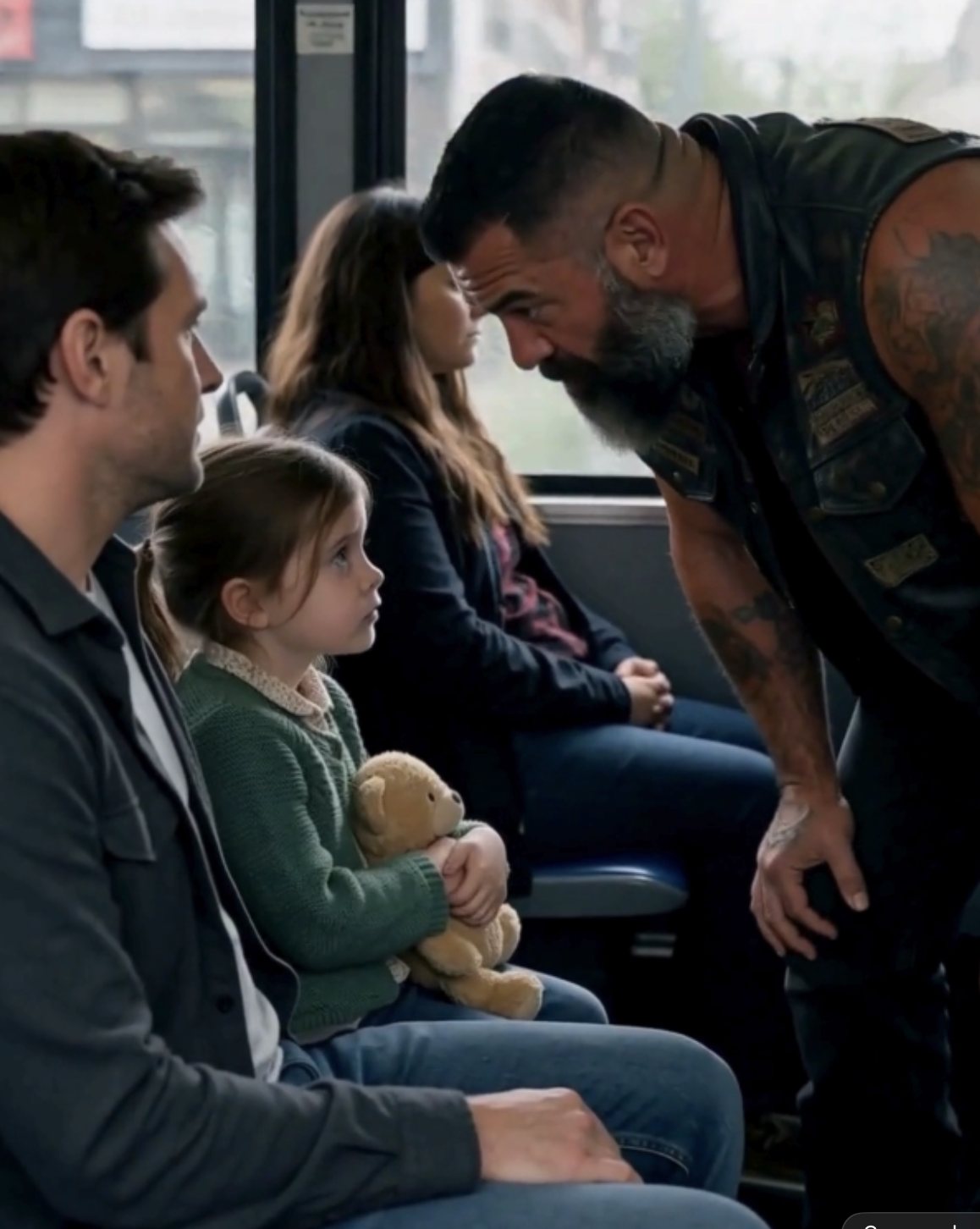
The bus was only three blocks away from the next stop when a bearded outlaw biker climbed aboard, looked straight at the driver, and said five words that made every passenger fall silent.
“Stop this bus. Right now.”
Nobody knew why he had boarded a crowded city bus in the middle of a busy afternoon. Nobody knew why eight motorcycles had appeared outside its windows, riding alongside it through traffic. And nobody understood why the enormous man in the black leather vest was staring at a little girl holding a worn tan teddy bear as though he had just seen a ghost.
The man sitting beside the child smiled politely and rested his hand on her shoulder.
“She’s tired,” he explained. “She doesn’t like crowds.”
The biker didn’t answer. Instead, he slowly crouched in the aisle until he was looking directly into the little girl’s frightened eyes.
“Sweetheart, just nod if you know your name.”
The girl tightened her arms around the teddy bear. Her eyes moved toward the man beside her, then back to the stranger who had stopped an entire bus to reach her.
For several seconds, she said nothing.
Then she lifted her chin and spoke so quietly that the passengers in the nearest seats had to lean forward to hear her.
“My name is Emma, and he’s not my daddy.”
The man’s smile disappeared.
And the bearded biker, whose name was Cole Mercer, realized that the little girl had just put every person on that bus in danger.
Because Cole hadn’t stopped the bus on a guess.
He had been looking for Emma for eleven months.
And the man sitting beside her was supposed to be dead.
## Chapter One: The Man Who Knew Her Name
The first person to react was an elderly man sitting near the rear window. He had been reading a folded newspaper when Cole climbed aboard, and he immediately lowered it into his lap. The second was a young mother who pulled her son closer to her side. The third was the bus driver, who looked into his rearview mirror, saw the eight motorcycles keeping pace with the bus, and decided that whatever was happening behind him was far beyond anything covered in his employee handbook.
Cole remained crouched in the aisle, his broad shoulders nearly level with the little girl’s face. He had removed his sunglasses, revealing tired gray eyes beneath a small scar that ran through his right eyebrow. His beard was threaded with silver, and his black leather vest carried years of wear, road dust, and faded patches. He looked like the sort of man people crossed the street to avoid, but he kept his hands open and his voice gentle.
The man beside Emma, however, had begun to calculate his options.
His name was Daniel Price, at least according to the identification card in his wallet. He wore a charcoal jacket over a pale blue shirt, expensive enough to suggest money but ordinary enough not to attract attention. His hair was neatly combed, his shoes were polished, and a silver watch sat snugly around his wrist. Until Emma spoke, he had looked like a concerned father dealing with a difficult stranger. Now his fingers were pressing so hard into the edge of his seat that his knuckles had turned white.
“She’s confused,” Daniel said with a short laugh. “Kids say things when they’re tired. This is a private family matter, and I suggest you get back to whatever business brought you onto this bus.”
Cole didn’t look at him.
“Emma,” he said gently, “you don’t have to tell me anything you don’t want to. I just need to know whether you want to sit beside this man.”
The little girl looked down at her teddy bear. One of its button eyes was missing, and the fur around its neck had been worn thin from years of being held. She rubbed her thumb across a small stitched patch on its stomach, a nervous movement so familiar that Cole felt something tighten inside his chest.
Then Emma shook her head.
It was barely a movement, but everyone close enough to see it understood.
Daniel stood so suddenly that his knee struck the underside of the seat in front of him. “That’s enough! You’re frightening her. Driver, open the doors at the next stop. I’m getting off with my daughter.”
“Sit down,” Cole replied.
He didn’t shout. He didn’t threaten him. He simply said it with such absolute certainty that Daniel stopped halfway through turning toward the front of the bus.
Cole rose slowly, keeping himself between the man and the child. Around them, passengers shifted uneasily in their seats. A woman near the window began reaching for her phone, but the older biker lifted one hand toward her, not to stop her from calling for help, but to ask her to remain calm.
“Call the police if you want,” Cole said. “Nobody’s stopping you. But nobody touches that little girl until we understand what’s happening.”
Daniel’s face hardened.
“You don’t know who you’re dealing with.”
For the first time, Cole smiled, though there was nothing friendly about it.
“That’s funny,” he said. “I’ve been hearing that sentence from men like you my entire life.”
Outside, the motorcycles continued alongside the bus. Eight riders, dressed in dark leather and denim, moved through traffic with disciplined precision. They weren’t swerving between cars or roaring their engines to frighten pedestrians. They maintained their positions, watching the bus windows and the intersections ahead. The lead rider, a broad-shouldered woman named Mara Vance, glanced through the glass and saw Cole standing over a little girl with a teddy bear.
Mara touched the microphone attached to her helmet.
“Cole, we have a problem?”
Cole looked toward the window.
“Yeah,” he answered through the small communication device clipped beneath his vest. “I found her.”
There was a pause.
Then Mara’s voice came back, quieter than before.
“Is she alive?”
Cole swallowed.
“She’s alive.”
Mara didn’t answer immediately. One by one, the riders behind her eased off their throttles, as though those two words had suddenly made the entire road heavier. They had spent eleven months chasing a trail that ended in false addresses, disconnected telephone numbers, frightened witnesses, and a police report that claimed a little girl had disappeared with her biological father.
Now Emma was sitting three feet away from Cole, alive, frightened, and looking at a stranger as though he might be the only person in the world who could help her.
Cole turned back toward Daniel.
“What’s your real name?”
Daniel stared at him.
“You have no right to ask me that.”
“Then you won’t mind telling me.”
The bus rolled past a row of shops and began slowing toward a red light. Daniel glanced at the front doors, then at the windows, measuring the distance to the street. Cole noticed the calculation and stepped half a pace closer without touching him.
“Don’t,” Cole warned.
Daniel stopped moving.
And Emma, still clutching her teddy bear, whispered the first thing that made Cole truly afraid.
“He has a key.”
Cole looked down at her.
“What kind of key, sweetheart?”
Emma pointed at Daniel’s jacket pocket.
“The little silver one. He says if I run away again, he’ll lock me in the room.”
The bus seemed to grow quieter around them. Even the conversations from the rear seats faded into an uncomfortable silence.
Cole looked at Daniel’s pocket, where the outline of a small metal object was visible beneath the fabric.
For eleven months, Cole had imagined finding Emma in a hundred different circumstances. He had pictured her living with a kind family, hiding with a relative, or being kept somewhere she couldn’t leave. He had prepared himself for tears, anger, questions, and the possibility that she wouldn’t remember him.
He had never prepared himself for a little girl describing a locked room as though it were an ordinary part of her life.
“What’s in the room, Emma?” he asked.
The child lowered her face into the teddy bear’s head.
“A bed,” she whispered. “And a window that doesn’t open.”
Cole felt the old anger rise inside him, the kind that had once ruined years of his life before he learned to keep it under control. He curled his fingers into his palms, then deliberately opened them again. Emma was watching him, and he wasn’t going to give her another frightening man to remember.
“Okay,” he said softly. “You don’t have to tell me any more right now.”
Daniel seized the moment.
“This is ridiculous. She has an active imagination. She’s been watching too much television, and you people are making it worse. I’m calling my attorney.”
He reached for his pocket.
Cole’s voice sharpened.
“Take your hand out slowly.”
Daniel froze.
“Now.”
Daniel withdrew his hand, empty except for a black smartphone. He held it up with a mocking expression.
“Happy?”
Cole didn’t answer. His attention had shifted to the woman sitting across the aisle from Emma, a dark-haired passenger wearing a navy jacket. She had been unusually quiet since he boarded, watching the confrontation without the same fear displayed by everyone else.
Now she was looking toward the driver’s dashboard.
And her hand was moving toward something beneath the edge of her seat.
Cole had spent enough years around people hiding their intentions to recognize when someone was waiting for the right moment to act.
“Ma’am,” he said, without taking his eyes off her, “keep your hands where I can see them.”
The woman looked up.
For a fraction of a second, surprise crossed her face.
Then she slowly raised both hands.
“I think you need to hear me out,” she said.
Cole studied her, then glanced at Emma.
“Something tells me I do.”
## Chapter Two: The Woman Near the Driver
The woman introduced herself as Claire Bennett. She appeared to be in her early forties, with dark hair pulled into a tight bun and a navy uniform jacket bearing a small embroidered insignia. A badge hung near her waist, although Cole couldn’t read its details from where he stood. She had been riding the bus for only three stops, she explained, and had recognized Daniel when he boarded earlier with Emma.
“Recognized him from where?” Cole asked.
Claire hesitated.
“From a missing-child bulletin.”
Daniel laughed sharply.
“Oh, this is getting better. We have a biker, a fake detective, and a child who’s decided to invent a family emergency. Should I expect a television crew next?”
Claire ignored him.
“Mr. Mercer, I know who you are. I’ve seen your name on the case file. I also know the photograph you’ve been carrying for months.”
Cole’s expression changed.
He hadn’t given her his name.
“You’ve been following me?”
“No,” Claire replied. “I’ve been trying to find the child.”
The distinction sounded important, but Cole wasn’t ready to trust her. The photograph inside his vest had been folded so many times that the corners were soft and the surface had developed a thin crease across the middle. It showed a little girl with light brown hair sitting on the front steps of a weathered wooden house, holding a tan teddy bear in her lap. In the picture, she was laughing at something beyond the camera.
Cole had taken that photograph eleven months earlier, on the last afternoon he had seen Emma safe.
At the time, he had thought the picture was an ordinary moment worth keeping. He hadn’t known that he would spend nearly a year studying it, searching every new image of a missing child for the same eyes, the same crooked smile, and the tiny scar on her left wrist from a fall in his workshop.
“You said you saw the case file,” Cole said. “Whose case file?”
Claire glanced toward Daniel.
“Richard Bell.”
The name meant nothing to most of the passengers. To Cole, it meant a man in an expensive suit standing outside a courthouse, smiling while a judge dismissed a complaint that should never have been dismissed. Richard Bell was a property developer with friends in local government, a reputation for charitable donations, and a habit of making inconvenient problems disappear behind legal paperwork.
He was also the last person who had been officially questioned about Emma’s disappearance.
“What does Richard Bell have to do with this man?” Cole asked.
Claire took a slow breath.
“Daniel Price is an alias. His real name is Thomas Reed. He used to work in security for Bell’s company.”
Daniel’s face drained of color.
“You have no idea what you’re talking about.”
Claire reached inside her jacket, moving slowly enough for everyone to see what she was doing. She produced a folded document and held it toward Cole. It wasn’t an official warrant, and she didn’t pretend it was. It was a printed copy of a transport record, with dates, addresses, and a signature at the bottom.
Cole glanced at the paper.
The name Thomas Reed appeared twice.
One entry showed a private property outside the city. The second listed a temporary address at a roadside motel. Both entries were dated after the official report had claimed Emma was safe with her father.
Cole looked up.
“Why wasn’t this given to the police?”
“It was,” Claire answered. “The first report disappeared from the system. The second was marked unverified. When I tried to reopen the file, my supervisor told me the child had been located and there was no reason to continue.”
“Who was your supervisor?”
Claire looked away.
“Someone who owed Richard Bell a favor.”
Cole studied her for a long moment. He wanted to believe her, but eleven months of dead ends had taught him that information could be weaponized as easily as a gun. A person could tell the truth about three things and lie about the fourth, and the fourth was often the one that mattered.
“Why are you on this bus?” he asked.
Claire glanced toward Emma.
“Because I received a message this morning saying Thomas Reed was moving the child again. I didn’t know where he was taking her, but I knew he had used this bus route before. I got on at the previous stop.”
“You came alone?”
“I wasn’t given time to arrange anything else.”
“And the switch?”
Claire looked toward the dashboard.
“An emergency alert. The driver can signal dispatch without making an announcement. I was trying to contact them when you boarded.”
Cole slowly lowered his eyes toward the dashboard. He could see a small panel beside the driver’s seat, but he couldn’t tell whether the alert had been activated.
“Did you send it?”
“Not yet.”
“Then do it now.”
Daniel moved suddenly.
He lunged toward Claire, reaching for the paper in her hand, but Cole stepped between them and caught his wrist. The movement was quick, controlled, and over before the passengers had time to understand what had happened. Cole twisted Daniel’s arm away from Claire without striking him, then released it as soon as the man stopped struggling.
“Sit down,” Cole said.
Daniel stumbled backward into the seat.
“You think you’re a hero?” he hissed. “You have no idea what Bell will do to you.”
Cole leaned close enough that only Daniel and the nearest passengers could hear him.
“I’ve spent eleven months wondering what he did to her. You’re going to help me find out.”
The driver, a middle-aged man named Frank, pulled the bus safely into a designated stopping area beside a busy shopping plaza. He set the parking brake, opened the doors, and immediately contacted emergency dispatch. Claire moved toward the front, identifying herself and explaining that there might be a child-abduction case in progress.
Several passengers stood, but Cole asked them to remain where they were until officers arrived. He didn’t want anyone getting hurt in the confusion, and he certainly didn’t want Daniel slipping away in the crowd.
Emma watched the adults with wide eyes.
“Am I in trouble?” she asked.
Cole turned toward her so quickly that his expression softened before he even spoke.
“No, sweetheart. You’re not in trouble.”
“Because I told?”
“Because you told the truth.”
Emma stared at him, as though she wasn’t sure the two things belonged together.
Then she asked a question that made Cole’s throat tighten.
“Will you make me go back to the room?”
Cole knelt beside her seat again.
“No one is putting you back in any room today. I promise we’re going to get you somewhere safe.”
He wanted to promise much more than that. He wanted to promise that nobody would frighten her again, that every locked door would open, and that she would never have to measure a grown man’s mood before deciding whether it was safe to speak.
But he had lived long enough to know that promises made in moments of emotion could become another form of betrayal.
So he gave her the one promise he could keep.
“I won’t leave you alone while we get help.”
Emma considered him carefully.
Then, for the first time, she let go of one of the teddy bear’s ears.
And she reached for his hand.
## Chapter Three: Eleven Months of Silence
Long before the bus, long before the photograph and the false name, Cole Mercer had been a different kind of man.
He had spent most of his adult life riding with a motorcycle club called the Iron Ravens. The club had started with a handful of veterans and mechanics who helped one another keep their bikes running and their families fed. Over the years, it had grown into a close-knit group of riders who organized charity runs, repaired homes for elderly residents, and raised money for families dealing with medical emergencies. They weren’t saints, and Cole had never claimed they were. Some had criminal records, some had made terrible decisions, and nearly all of them had learned the hard way that a person’s past could follow him long after he stopped being the person who created it.
Cole himself had spent three years in prison in his twenties after a bar fight ended with a man badly injured. He had been angry, reckless, and convinced that being feared was the same as being respected. Prison had stripped away that illusion. By the time he came home, his father was dead, his marriage was over, and the only person willing to give him steady work was an old mechanic named Walter Hayes.
Walter owned a small repair shop outside town. He was a quiet man with rough hands, a crooked nose, and a habit of leaving a pot of coffee on the burner long after it had gone cold. He never asked Cole to explain every mistake he’d made. He simply gave him a job, expected him to show up on time, and treated him like a man who still had choices.
Cole repaid him by becoming the son Walter had never had.
For years, they worked side by side, fixing motorcycles, rebuilding engines, and helping people who couldn’t afford the prices charged by larger shops. Walter had a daughter named Emily, who lived several hours away with her young child, Emma. When Emily died unexpectedly following a medical emergency, Walter was devastated. He had been trying to reconnect with her after a long period of estrangement, and by the time he understood how badly things had gone wrong, there was no chance to repair it.
Emma was three when Cole first met her.
She arrived at the workshop one summer afternoon with Walter, carrying a teddy bear that was already missing one button eye. She was shy around strangers, but she warmed to Cole after he let her sit on an overturned plastic bucket and watch him clean a carburetor. He explained what every tool did, even though she understood almost none of it, and she listened as though he were telling her the secrets of the universe.
By the end of the afternoon, she had named a broken motorcycle part after her teddy bear.
Walter laughed so hard that he had to sit down.
After that, Emma visited the workshop whenever Walter could bring her. Cole learned how to make pancakes she would eat, how to tie the ribbons on her shoes, and how to recognize the particular silence that meant she was frightened rather than tired. He wasn’t her father, and he never tried to replace the family she had lost. He was simply Cole, the big bearded man who let her sit on a stationary motorcycle, who pretended not to notice when she stole the last chocolate biscuit from his lunchbox, and who always remembered to check that her helmet strap was secure when she rode in Walter’s sidecar.
The day she disappeared, Cole had been away on a charity ride.
When he returned, Walter was waiting outside the workshop, pale and shaking. Emma had been taken from the house where she was staying. There were signs of a hurried departure, a broken latch on the back door, and a neighbor who remembered seeing a dark sedan leaving the property shortly before sunset.
The first report suggested that Emma’s father had collected her.
But Emma’s father, Michael, had died in an industrial accident two years earlier.
Someone had used his name.
The police questioned Walter, searched the surrounding roads, and interviewed neighbors. They found a rental vehicle connected to a man named Thomas Reed, but the paperwork led to a shell company owned by Richard Bell. By the time the investigators requested more records, several documents had vanished from the system, and the property linked to the vehicle had been sold.
Walter never recovered from the disappearance.
He kept Emma’s little shoes beside his bed. He left her favorite cup on the kitchen counter and continued buying the same brand of apple juice she used to drink. He called every hospital, shelter, and child-protection office within reach. When officials told him there was nothing more they could do, he thanked them politely and went back to searching.
Cole did the same.
The Iron Ravens divided the work among themselves. Mara Vance, who had once worked as a paramedic, coordinated calls and kept track of confirmed information. Luis Ortega, a former truck driver, checked highway stops and transport routes. Others spoke with mechanics, motel owners, and people who had seen suspicious vehicles near the town. They did not threaten witnesses or break into buildings. They followed records, asked questions, and handed what they found to anyone willing to investigate honestly.
Most of the leads went nowhere.
One witness claimed to have seen Emma in a grocery store three states away. Another reported a little girl with a tan teddy bear near a bus terminal. A third insisted that Richard Bell had moved overseas. Each claim led to hours of searching and another empty result.
Eleven months passed.
Then, three days before Cole boarded the city bus, an envelope appeared in the Iron Ravens’ mailbox at the clubhouse.
There was no return address.
Inside was a single printed image taken from a security camera. It showed a man in a dark jacket entering a convenience store with a little girl beside him. The girl’s face was partly obscured, but her green cardigan and tan teddy bear were unmistakable.
On the back, someone had written four words.
SHE IS MOVING AGAIN.
Mara traced the image to a small shopping plaza near the city bus route. Cole studied the bus schedules, checked the time stamps, and found a route that connected the plaza to a neighborhood where one of Bell’s companies owned several properties.
They had no warrant and no certainty that the girl was Emma. But they had a lead, and it was the first one in months that could be verified.
That morning, Cole put the old photograph in his vest pocket, climbed onto his motorcycle, and rode toward the city.
He had expected to find a building, a vehicle, perhaps a person who could tell him where Emma had gone.
He had not expected to find her sitting three feet away from a man who claimed to be her father.
Nor had he expected that the little girl would recognize the truth before any adult in the room had the courage to say it.
## Chapter Four: The Name on the Paper
The first police car arrived six minutes after the bus stopped. A second followed, then an unmarked vehicle carrying two investigators who had been assigned to missing-child cases. Claire met them at the front door and showed them her identification, the transport record, and the message that had brought her onto the bus.
Daniel, meanwhile, had returned to his seat and was trying to look bored.
He insisted that his name was Daniel Price. He said Emma was his daughter, that she had a history of anxiety, and that a group of aggressive bikers had intimidated him into staying on the bus. He described Cole as a dangerous man who had threatened him in front of dozens of witnesses. He even produced a photograph of himself standing beside a young girl at a playground, although the image was too distant to establish the child’s identity.
The officers listened without interrupting.
Then one investigator asked him to spell his full legal name.
Daniel gave the same answer.
The investigator checked the information on a handheld device and looked up.
“Mr. Price, your date of birth doesn’t match the records associated with that identification number.”
Daniel’s mouth tightened.
“That must be a mistake.”
“Perhaps. We’ll need you to step outside while we verify your identity.”
“I am not leaving my daughter with these people.”
Cole remained beside Emma, who had begun rocking slightly in her seat. He could see how every raised voice made her shoulders tense. He wanted to remove her from the bus, but he also understood that moving her too quickly might frighten her further. Instead, he asked the female investigator whether she could speak to Emma somewhere quiet.
The investigator introduced herself as Detective Alvarez and knelt a short distance from the child.
“Hi, Emma. My name is Elena. I’m here to help you, okay? You haven’t done anything wrong.”
Emma studied the badge clipped to the detective’s belt.
“Are you going to take me away?”
“I’m going to help you get somewhere safe. You can tell me what happened when you’re ready.”
“Will he come?”
Detective Alvarez glanced toward Daniel.
“Not unless we determine that it’s safe for you.”
Emma considered this for a long time. Then she looked at Cole.
“Can he come too?”
The detective followed her gaze.
“Who is he to you?”
Emma hugged the teddy bear against her chest.
“He fixes things.”
Cole looked down, unable to speak for a moment.
“He fixes things?” the detective repeated gently.
“Bikes,” Emma said. “And Walter’s door. And my music box. It stopped playing, and he made it work again.”
Cole remembered the music box. It had been a cheap wooden toy with a ballerina that turned unevenly when the tune played. He had repaired it with a tiny spring and a great deal of patience. Emma had carried it around for a week afterward, opening and closing the lid just to hear the melody.
Detective Alvarez glanced at him again, and something in her expression softened.
“We can arrange for him to stay nearby while we talk,” she said. “But I need you to tell me something first. Do you know the man sitting beside you?”
Emma looked toward Daniel.
For several seconds, she appeared to be searching for the right answer.
“He says his name is Daniel,” she finally whispered. “But sometimes people call him Tommy.”
The investigator standing beside the bus door looked at his colleague.
Daniel heard her.
“She’s repeating things she heard on television,” he snapped. “This is absurd.”
Detective Alvarez raised a hand.
“Mr. Price, please remain silent while we speak with the child.”
He leaned back, but his eyes never left Emma.
The second investigator returned from the police car with a tablet. He showed Detective Alvarez an image from an older case file, then spoke quietly enough that the passengers couldn’t hear him. Her face changed as she read the information.
“Thomas Reed,” she said.
Daniel closed his eyes briefly.
The name was enough to change the entire atmosphere.
Reed had worked for a private security contractor owned by Bell’s company. He had been questioned after Emma disappeared, but no charges were filed because the available evidence was incomplete. His employment had ended shortly afterward, and his last known address had been abandoned.
Now he was sitting on a city bus with the missing child beside him.
The investigators asked him to stand.
He refused.
When they repeated the request, he began shouting about lawsuits, unlawful detention, and political connections. He demanded to speak with Richard Bell. He claimed that Bell would personally see every officer involved in the case fired.
But when an investigator asked him why he had been using an alias, Reed offered no answer.
The officers removed him from the bus without violence. He continued protesting as they escorted him toward the police vehicle, but his voice became smaller with every step. By the time the car door closed, he was no longer threatening anyone. He was staring through the window at Emma.
She watched him until the vehicle pulled away.
Then she turned to Cole and asked, “Is he coming back?”
Cole crouched beside her.
“Not today.”
“Tomorrow?”
He took a breath.
“We’re going to make sure the people responsible for keeping you safe know what happened. You won’t have to face him alone.”
Emma looked down at her teddy bear.
“He said nobody would believe me.”
Cole felt the anger return, but this time it came with something colder beneath it. Whoever had taught Emma to fear the truth had understood exactly how to keep a child silent. They had not needed chains or locked doors every day. They had only needed to convince her that speaking would make things worse.
Cole knew that fear. He had seen it in witnesses, in abused friends, in men who had spent years believing they deserved the pain they received.
He gently touched the edge of the teddy bear’s worn ear.
“I’m believing you,” he said.
Emma leaned forward and rested her forehead against his shoulder.
For the first time since he had boarded the bus, Cole allowed himself to close his eyes.
He had found her.
But finding her was only the beginning.
## Chapter Five: The House with the Locked Window
The investigators took Emma to a child-advocacy center rather than a police station. It was a quiet building with soft lighting, a playroom, and a small garden enclosed by a wooden fence. Detective Alvarez arranged for a trained child interviewer to speak with her, while a medical professional checked her for injuries and signs of neglect.
Cole waited outside the interview room.
Mara arrived twenty minutes later, followed by two other Iron Ravens. She carried a paper bag containing a sandwich, a bottle of water, and a small stuffed rabbit she had bought at a nearby shop. She set the bag beside Cole without asking whether he wanted it.
“Have you eaten?” she asked.
“No.”
“Then eat.”
He looked at her.
“I’m not hungry.”
“Neither is the world going to stop turning because you skipped lunch. Eat anyway.”
Cole almost smiled. Mara had known him for fifteen years, long enough to recognize when his silence meant he was trying to keep himself from falling apart. She sat beside him and waited until he opened the sandwich.
“She’s alive,” Mara said after a while.
“Yeah.”
“We’ve got her away from Reed.”
“For now.”
Mara leaned back in her chair.
“You always do that.”
“Do what?”
“Find the next thing to worry about before you let yourself feel the last thing that went right.”
Cole stared at the floor.
“I saw her face when he reached for her. She thought he was going to drag her back.”
“Then we make sure he can’t.”
“Bell will try to bury this.”
“Then we don’t give him a hole deep enough.”
Mara had already contacted an attorney who had worked with the Iron Ravens on a charity fraud case. She had also asked the club’s members to preserve every message, photograph, and transport record connected to Emma’s disappearance. Nothing would be posted publicly, and nobody would confront Bell without the investigators’ approval. They had spent eleven months gathering information; now they needed to make sure none of it could be dismissed as rumor or retaliation.
A child-protection specialist emerged from the interview room.
“Emma is willing to speak with you,” she told Cole. “But she may become distressed, so let her guide the conversation. Don’t ask her to repeat details unnecessarily.”
Cole nodded.
Inside, Emma sat on a small couch with her teddy bear in her lap. A box of colored pencils sat on the table, but she hadn’t touched them. When Cole entered, she looked relieved, then embarrassed by her own relief, as though needing someone nearby was a weakness she had been taught to hide.
He sat in the chair across from her.
“Hey, kiddo.”
Emma looked down at her bear.
“Do you remember me?” he asked.
She nodded.
“You used to make pancakes that were too big.”
Cole laughed softly.
“That’s because I was making them for a growing person.”
“You burned one.”
“I burned several.”
“You said the pan was broken.”
“It was a very unreliable pan.”
Emma’s mouth twitched into the smallest smile.
For a moment, they were back in the workshop, where the worst thing that could happen was a broken motorcycle part and the biggest problem in the world was whether Walter had hidden the chocolate biscuits.
Then Emma’s smile faded.
“Why did it take you so long?”
Cole didn’t pretend not to understand.
He rested his forearms on his knees and looked at her honestly.
“Because I didn’t know where you were. We looked everywhere we could. We followed every clue we found, and some of them were wrong. I wish I had found you sooner.”
Emma studied him.
“Did you stop looking?”
“No.”
“Even when it was cold?”
“Even when it was cold.”
“Even when you were tired?”
“Especially when I was tired.”
She rubbed the teddy bear’s stitched stomach.
“Tommy said Walter didn’t want me anymore. He said Walter gave me away because I was bad.”
Cole felt something inside him break, but he kept his voice steady.
“Walter never gave you away. He never stopped looking for you, either.”
Emma looked up sharply.
“Really?”
“Really.”
“Then why didn’t he come?”
Cole swallowed. He could have told her about the search teams, the reports, the false addresses, and the months of waiting. He could have explained that adults sometimes failed to protect children because other adults lied, hid evidence, or chose convenience over courage. But Emma was four years old, and she needed a truth she could hold without carrying the weight of every adult failure.
“Because someone made it hard for him to find you,” Cole said. “But that wasn’t your fault, and it didn’t mean he stopped loving you.”
Emma stared at him for a long time.
Then she asked, “Can I see him?”
Cole nodded.
“That’s what we’re going to arrange.”
Before the meeting ended, Emma told the interviewer about the locked room. She described a small house with gray curtains, a narrow bed, and a window that had been screwed shut. She remembered being taken there in a car with darkened windows. She remembered Reed telling her to call him Daddy whenever someone asked. She remembered being warned that if she told anyone the truth, Walter would be arrested and Cole would disappear.
She did not remember every address or date. Sometimes she confused morning with afternoon, or one room with another. The interviewer did not push her to make the details fit a perfect timeline. Instead, she recorded what Emma could recall and let the investigators compare it with the evidence they already had.
One detail, however, remained clear.
The house had a green front door and a broken porch light. From the bedroom window, Emma could see a tall water tower with a faded red stripe running around its middle.
Mara recognized the description.
She had seen the same water tower in the background of a photograph taken near one of Bell’s storage properties.
Within an hour, the investigators had a possible location.
Within three hours, they had a warrant.
And by nightfall, they had found the house.
## Chapter Six: What They Found Behind the Door
The property stood at the end of a narrow road bordered by empty lots and a line of bare trees. The green door was peeling, the porch light was broken, and the bedroom window had been screwed shut from the inside. A child’s drawing lay on the kitchen table beside a half-empty box of cereal. In the corner of the bedroom, investigators found a small mattress, a plastic chair, and several books that looked as though they had been chosen for a child much younger than Emma.
They also found a locked cabinet containing identity documents, transport receipts, and a list of names.
Thomas Reed’s real name appeared at the top of the list.
Below it were the names of three private security employees, two property managers, and a company associated with Richard Bell. Beside several entries were dates and short notes describing travel arrangements. One line included Emma’s name, followed by a destination and a scheduled departure time.
The destination was a residential facility several hundred miles away.
The departure was planned for the following morning.
Had Cole boarded the bus one day later, Emma might have disappeared into another system of false names and sealed records. The search would have started again, and the trail might have been lost for months.
The investigators photographed everything, sealed the documents, and searched the remaining rooms. They found no sign that Emma had been physically harmed in the house that day, but the locked window and the conditions of the room supported her account of being confined. A neighbor later told police that a man had rented the property through a company and rarely allowed visitors to approach the house.
The transport records revealed something even more troubling.
Reed had not acted alone.
For months, he had received payments from a security company contracted by Bell’s property group. Some payments were labeled as consulting fees, others as travel expenses. The amounts varied, but their timing corresponded with several movements recorded in Emma’s case file. One payment had been made two days before the original report was altered to indicate that Emma was safe with her father.
The company denied any involvement in a missing-child case.
Bell’s attorney issued a statement describing the allegations as irresponsible and politically motivated. He said Bell had never met Emma, never employed Reed directly, and had no knowledge of any unlawful activity. He called the documents incomplete and suggested that the investigators were being misled by a disgruntled former employee.
But the evidence was no longer a rumor.
The transport records matched vehicle registrations. The dates matched security-camera footage. The addresses matched the properties used by Bell’s company. And one of the names on the payment records belonged to a manager who had already admitted that Reed had worked on private assignments for Bell.
The Iron Ravens had spent eleven months searching for a little girl. Now the investigators had a trail that could lead to the people who had helped make her disappear.
Cole didn’t celebrate.
He sat in the clubhouse after midnight, staring at the photograph of Emma. The room was quiet except for the hum of a refrigerator and the occasional sound of a motorcycle passing outside. On the table lay a stack of printed reports, each one describing another piece of the case. He had imagined feeling relief when the truth began to emerge, but what he felt instead was a deep, exhausted sadness.
For every person who had helped move Emma, there had been another person who had seen something wrong and decided it wasn’t their problem. A clerk had processed paperwork without asking questions. A manager had approved payments without checking the details. Someone had altered a report. Someone else had closed a file.
No single action had looked dramatic enough to stop a child from being taken.
Together, they had built a wall around her.
Mara sat across from him.
“She’s sleeping at the center,” she said. “The specialist says she’s had a difficult day, but she’s safe.”
Cole nodded.
“Walter knows?”
“He’s on his way. I called him after the investigators confirmed the house.”
Cole looked down at the photograph.
“What’s he going to say when he sees her?”
“Probably nothing for the first minute.”
That was exactly what happened.
Walter arrived at the center just after sunrise, wearing the same brown work jacket he had worn on the day Emma disappeared. His hair had grown thinner, his face looked older, and he leaned slightly on one leg as he walked. He had spent months refusing to leave town for more than a few hours because he was afraid he might miss a call. When Mara told him Emma had been found, he had asked her to repeat the words three times.
Now he stood outside the meeting room with one hand resting on the doorframe.
Cole went to him.
“She’s inside.”
Walter nodded, but he didn’t move.
“What if she doesn’t remember me?”
“She remembers you.”
“What if she’s frightened?”
“Then we’ll give her time.”
Walter looked toward the door.
“I should have protected her.”
Cole shook his head.
“You did everything you could.”
Walter’s eyes filled with tears.
“Apparently it wasn’t enough.”
Cole placed a hand on his shoulder.
“None of us were enough on our own. That’s why we’re here now.”
For a long moment, Walter said nothing.
Then he opened the door.
Emma was sitting on the couch with her teddy bear. When she saw him, she stood so quickly that the bear fell to the floor. Walter stopped in the doorway, afraid to move too fast. He had imagined this moment so many times that he no longer trusted his own mind to recognize it.
Emma stared at him.
Then she whispered, “Grandpa?”
Walter covered his mouth with one hand.
“I’m here, sweetheart.”
Emma ran to him.
He dropped to his knees and caught her in his arms, holding her carefully as though she were made of glass. She pressed her face against his shoulder, and he began crying without trying to hide it. He told her he was sorry, that he had been looking for her, that he loved her, and that she was home in every way that mattered.
Emma clung to him.
“You didn’t give me away?”
Walter pulled back just enough to look at her.
“Never,” he said. “Not for one second.”
Cole stood by the door, looking at the two of them. He had spent eleven months imagining the moment Emma would be found. He had never imagined that the most difficult part would be watching a child ask whether she had ever been unwanted.
Walter held her tighter.
“You were never the problem, Emma. Never.”
She nodded against his shoulder.
And for the first time in eleven months, the little girl who had been told that nobody wanted her had someone holding her who could prove otherwise.
## Chapter Seven: The Man Who Thought Money Could Erase Everything
Richard Bell did not expect to be arrested.
He expected questions, perhaps a subpoena, and a few unpleasant headlines. He expected his lawyers to argue that the transport records were incomplete, that Reed was a rogue employee, and that any payments connected to the properties had legitimate explanations. He expected the case to become complicated enough that the public would lose interest before the investigators could assemble a clear story.
For a while, his expectations appeared reasonable.
His attorneys issued statements. His company released financial records. A spokesperson described the missing-child investigation as a tragic situation that had been unfairly connected to a respected local businessman. Bell himself appeared at a charity event and spoke about the importance of protecting children, posing beside a banner for a foundation that funded playgrounds and school supplies.
The performance might have worked if the evidence had ended with Reed.
But the investigators had the list from the locked cabinet, the payments, the transport receipts, and the altered report. They also had testimony from a former company employee who admitted that Reed had been assigned to move Emma between properties. The employee said he had been told the arrangement was temporary and that the child was being protected from a dangerous relative.
He had believed the explanation because he wanted to keep his job.
When he eventually learned that Emma had been reported missing, he told himself the matter was being handled by the authorities. He never asked why the case remained open or why the same company kept paying Reed. By the time he understood that something was seriously wrong, months had passed.
The investigators did not treat his confession as the end of the case. They checked the dates, verified the payments, and compared his account with other records. Every new piece of evidence either supported his statement or revealed another question that needed answering.
Then they found a message sent from Bell’s office to a security manager three days before Emma was moved to the locked house.
The message did not contain an explicit order to abduct a child. It was more careful than that. It referred to a “family placement issue,” instructed the manager to “keep the matter contained,” and warned that any further contact with the child’s grandfather could “create unnecessary complications.”
Bell’s attorneys argued that the wording was vague.
The investigators agreed that it was vague.
But they also had a second message, sent after Emma disappeared, in which Bell asked whether the “original story” had been accepted by the authorities. The reply said the report had been changed and that no further action was expected unless someone produced new evidence.
Bell responded with two words.
Good. Continue.
The messages did not establish every detail of what had happened, but they made it much harder to claim that he knew nothing about the arrangement. Investigators obtained additional records, interviewed the people who had handled the payments, and built a timeline showing how Emma had been moved, hidden, and kept from the family members searching for her.
The case took weeks to assemble properly.
Cole attended several interviews, providing the photograph and explaining how the Iron Ravens had traced the bus route. Mara handed over the original messages and transport information, including the anonymous note that had started the final search. None of the riders gave interviews designed to make themselves look heroic. They answered questions, corrected mistakes, and allowed the investigators to verify what they had found.
They understood that Emma’s safety mattered more than their reputations.
Eventually, a warrant was issued for Bell’s arrest.
The news spread through the city before noon.
Bell was taken into custody outside his office, wearing a dark suit and carrying a leather briefcase. Cameras captured him being escorted toward a waiting vehicle. He looked irritated rather than frightened, as though the arrest were an inconvenience that would be resolved after a phone call.
Then a reporter asked whether he had ordered the abduction of a four-year-old girl.
Bell stopped walking.
For the first time, his expression changed.
He turned toward the cameras and said, “I have never harmed a child in my life.”
Cole watched the footage from the clubhouse television.
He didn’t cheer when Bell was led away. He didn’t raise a bottle or congratulate the riders who had spent months searching. He simply watched the man who had seemed untouchable finally answer questions he couldn’t dismiss with a donation or a letter from his attorney.
Mara stood beside him.
“It’s happening,” she said.
Cole shook his head.
“It’s starting.”
He knew arrests could be followed by delays, appeals, and legal arguments. He knew witnesses could change their stories, records could be challenged, and a powerful man could spend years trying to escape accountability. The case would not be solved simply because Bell had been taken into custody.
But something had changed.
Emma was no longer hidden in a locked room. Walter knew where she was. Reed had been identified under his real name. And the people who had helped conceal the truth were no longer able to pretend that nobody was looking.
For the first time in eleven months, the silence around Emma’s disappearance had begun to break.
## Chapter Eight: The Question Emma Was Afraid to Ask
Recovery did not happen in a single afternoon.
In the weeks after she was found, Emma had good days and difficult ones. Some mornings she woke up cheerful, asking Walter to make pancakes and requesting that Cole bring his motorcycle to the driveway so she could hear the engine. Other mornings, she refused to leave her room because she had dreamed that someone was waiting outside the door.
The child-advocacy team helped Walter establish a routine that made her feel safe. She attended appointments with a specialist trained to work with children who had experienced frightening events. She was never forced to recount her story for visitors, reporters, or curious strangers. When she didn’t want to talk, the adults around her learned to accept silence without treating it as a problem that needed to be fixed immediately.
Cole visited when Walter said it was a good time.
He didn’t bring the entire motorcycle club to the house, although more than a few riders asked whether they could stop by with gifts. Instead, he brought small things Emma already knew: a box of colored pencils, a new music-box spring, and a bag of chocolate biscuits that Walter insisted were too expensive for everyday eating.
One afternoon, Emma sat at the kitchen table drawing a picture of the workshop. She had drawn the front door too large and the windows too small, but she had carefully included the old red toolbox and the motorcycle that always refused to start on cold mornings. Cole sat beside her, repairing a small wooden toy car.
“Why did you come on the bus?” she asked.
Cole kept working on the toy for a moment.
“Because I heard you might be there.”
“How did you know?”
“Someone sent us a picture.”
Emma considered that.
“Did you know it was me?”
“I thought it might be. I wasn’t sure until I saw you.”
“Were you scared?”
Cole looked at her.
“Yeah.”
Emma seemed surprised.
“But you’re big.”
He laughed quietly.
“Being big doesn’t stop you from being scared.”
“Then why did you go?”
He set the toy car down.
“Because you were there, and you needed help.”
Emma thought about that for a long time. Then she returned to her drawing and added a small black motorcycle beside the workshop door.
After a while, she asked, “Were you mad at me because I didn’t tell him my name?”
Cole’s expression changed.
“No, sweetheart. Never.”
“Tommy said I was bad when I didn’t answer.”
“Tommy was wrong.”
“He said good girls do what adults tell them.”
Cole took a slow breath. He wanted to give her an answer that would help her recognize danger without teaching her to fear every adult she met.
“Good people can ask you to do things, but that doesn’t mean you have to obey someone who makes you feel unsafe. If someone tells you to keep a frightening secret, or threatens you when you ask for help, you can tell another grown-up. You can tell Walter, your teacher, a police officer, or me.”
Emma looked up.
“What if they don’t believe me?”
“Then you tell someone else. And you keep telling people until somebody listens.”
She studied him carefully.
“Like you did?”
“Exactly like that.”
Emma nodded and returned to her drawing.
A few minutes later, she placed the picture on the table between them. The workshop had a blue sky, a yellow sun, and a row of little stick figures standing beside the door. Walter was drawn with a huge smile. Mara had been given a purple shirt even though she almost always wore black. Cole stood in the middle, with a beard so large that it covered half his body.
At the bottom of the page, Emma had written her name in uneven letters.
Cole stared at it for a moment.
“You spelled it right,” he said.
“I know.”
He looked at her, surprised by the confidence in her voice.
Emma smiled.
“I know my name now.”
Cole felt the words settle inside him.
For eleven months, he had carried a photograph because it was the only piece of Emma he could reach. Now she was sitting beside him, drawing pictures, asking questions, and slowly discovering that the world contained more than locked doors and frightened whispers.
The case against Bell continued, but Cole no longer measured every day by whether a new lead had arrived. He measured it by whether Emma had slept, whether she had laughed, and whether she could walk into the backyard without looking over her shoulder.
Those things were small.
They were also the things that mattered most.
## Chapter Nine: Eight Motorcycles Outside the House
The first time Emma saw all eight motorcycles parked outside Walter’s house, she stopped at the doorway and stared.
The riders had come to repair the broken fence and replace a loose step on the porch. Mara had organized the work, assigning each person a task so that nobody crowded the yard. Luis brought tools. Another rider arrived with lumber. Two others carried bags of groceries, while the oldest member of the club brought a tin of homemade cookies from his wife.
They had deliberately left their engines off.
Cole had told them that the sound of eight motorcycles starting at once might be exciting to some people and frightening to a child who had spent months being moved between unfamiliar places. The riders understood. They left their helmets on the workbench, spoke quietly, and waited for Walter to invite them into the yard.
Emma stood beside the screen door, holding her teddy bear.
Mara noticed her first.
“Hey, Emma. Want to help me paint the fence?”
Emma looked at the brush in Mara’s hand.
“Will it get on my clothes?”
“Almost certainly.”
Emma considered that, then glanced at Walter.
He smiled.
“You can wear one of my old shirts.”
That settled it.
Within ten minutes, Emma was standing beside Mara with a brush that was too large for her hand, painting a small section of fence bright blue. The paint ended up on her fingers, her shoes, and one side of Walter’s shirt. She laughed when Mara accidentally brushed her own sleeve against the wet wood, leaving a blue stripe across the black fabric.
For a little while, the yard sounded like an ordinary family gathering.
Cole stood near the gate, watching the scene. He had seen the Iron Ravens do difficult things together: rescue stranded motorists in winter, rebuild a damaged roof after a storm, and spend entire weekends repairing engines for people who couldn’t afford a mechanic. But watching them learn how to be gentle around a frightened child felt like a different kind of achievement.
Nobody asked Emma to hug them. Nobody asked her to explain what had happened. They let her approach when she wanted to and step away when she needed space.
When the fence was finished, the riders gathered beside their motorcycles. Emma walked among them, looking at the different paint colors and chrome parts. She asked why one bike had a small dent in the fuel tank, and the owner explained that he had dropped it while trying to avoid a deer.
“Did you cry?” Emma asked.
The man laughed.
“Almost.”
“Because you were scared?”
“Because I had to pay to fix it.”
Emma laughed so hard that she dropped her teddy bear.
Cole picked it up and handed it back to her.
She looked at the motorcycles again.
“Can I sit on one?”
Cole glanced at Walter, who nodded.
Mara brought over a stationary motorcycle and held it steady while Cole lifted Emma onto the seat. He checked that her feet were supported and kept one hand near her back. Emma gripped the handlebars, her face brightening as she looked down at the controls.
“Does it go fast?”
“Very fast,” Cole said. “But only when the person riding it knows what they’re doing.”
“Can I ride it?”
“Not today.”
“Tomorrow?”
“Not tomorrow either.”
Emma frowned.
“That’s a long time.”
“It’s going to feel even longer when you learn how much practice it takes.”
She considered that, then nodded solemnly, as though she had been given an important responsibility.
After the riders left, Walter sat with Cole on the porch. The afternoon sun had softened, and the new fence shone blue along the edge of the yard. Inside the house, Emma was drawing another picture, singing quietly to herself while the music box played on the kitchen table.
Walter rested his hands on his knees.
“I used to think I had failed her,” he said.
Cole didn’t interrupt.
“I thought if I had been a better father to Emily, if I had made different choices, if I had noticed something sooner, then Emma might never have been taken.”
Cole looked toward the window.
“Sometimes we spend so much time looking backward that we forget what we’re doing now.”
Walter nodded.
“I still think about it.”
“So do I.”
They sat quietly for a while.
Then Walter looked at him.
“You know, she trusts you.”
Cole shook his head.
“She trusts a lot of people now.”
“That’s not what I said.”
Cole looked away.
Walter smiled faintly.
“You were there when she needed someone. You didn’t make her prove she was frightened enough to deserve help. You listened.”
Cole stared at the blue fence.
“I should have found her sooner.”
Walter placed a hand on his shoulder.
“You found her when you could. Now you have to let yourself be here.”
Cole didn’t answer immediately.
Then he nodded.
For the first time since Emma disappeared, he allowed himself to imagine a future that didn’t revolve around searching for her. He imagined ordinary afternoons, repaired motorcycles, and a little girl who would eventually grow tired of asking permission to sit on a bike. He imagined Walter laughing in the kitchen and Mara complaining about the price of paint. He imagined a life in which the most urgent problem was a broken fence rather than a missing child.
It wasn’t a perfect future.
But it was a future.
And that was enough.
## Chapter Ten: The Last Thing Daniel Reed Said
Thomas Reed’s trial began several months later. Richard Bell’s case followed, delayed by legal arguments and disputes over the admissibility of documents. The proceedings were difficult, but the evidence had been preserved carefully, and the witnesses had been interviewed before their memories could be influenced by public speculation.
Reed eventually agreed to cooperate with the investigation. His attorneys argued that he had been acting under pressure from Bell’s organization, but the prosecution pointed out that he had knowingly used a false identity, concealed Emma’s location, and threatened her when she attempted to tell the truth. His cooperation provided additional information about the transport arrangements and the people who had helped move her.
Cole attended one hearing.
He sat at the back of the courtroom beside Mara, wearing a clean black shirt instead of his usual leather vest. Walter had asked him not to turn the proceedings into a confrontation, and Cole had promised he wouldn’t. He was there to listen, not to intimidate anyone.
Reed looked smaller without the confidence he had displayed on the bus. His hair was untidy, his face drawn, and his hands remained folded in front of him as the prosecutor described the locked room and the false reports. When the photograph of Emma was displayed, Reed stared at the table.
The prosecutor asked him why he had told the child that her grandfather had abandoned her.
Reed’s attorney objected to the question, but the judge allowed it.
For several seconds, Reed said nothing.
Then he answered, “I was told to make her stop asking questions.”
“Who told you?”
“Richard Bell’s people.”
“Did you believe that her grandfather had abandoned her?”
Reed shook his head.
“No.”
The answer moved through the courtroom like a cold draft.
The prosecutor waited.
“Then why did you tell her that?”
Reed looked toward the floor.
“Because it made her easier to control.”
Cole’s hands tightened together.
Mara noticed but didn’t touch him. She knew he was holding himself still by choice, not because he lacked the anger to do otherwise.
The hearing continued for hours. Records were introduced, witnesses testified, and the defense challenged details of the investigation. The process was slower than Cole wanted, but it was necessary. A conviction built on evidence would be harder to dismiss than one built on public outrage.
When the hearing ended, Reed was escorted from the courtroom. As he passed the back row, he saw Cole.
He stopped briefly.
“You got what you wanted,” Reed said.
Cole stood.
“No. Emma got what she needed.”
Reed’s face tightened.
“You think this makes you a good man?”
Cole looked at him for a long moment.
“No. I think it makes you a man who has to answer for what he did.”
The officers continued walking, and Reed disappeared through the door.
Cole sat down again.
He had imagined feeling satisfaction when the man who took Emma was finally held accountable. Instead, he felt tired. There was no pleasure in knowing that a child had been frightened for months, no victory in learning how deliberately adults had used her trust against her.
But there was relief in knowing that the truth had been spoken in a room where it could not simply be erased from a report.
Outside the courthouse, reporters waited behind a barrier. They asked Cole whether he planned to make a statement about the Iron Ravens’ role in finding Emma. He declined.
Mara answered a few questions about the search, emphasizing that the club had passed information to investigators and that the child’s privacy should be respected. She refused to discuss Emma’s medical appointments or the details of her recovery. When one reporter asked whether Cole considered himself a hero, Mara gave a short laugh.
“No,” she said. “He considers himself a mechanic who got on the right bus.”
Cole heard her as they walked toward the parking lot.
“That was terrible.”
“It was accurate.”
“You could have made it sound better.”
“I’m not your publicist.”
He laughed despite himself.
For the first time in months, the sound came easily.
## Chapter Eleven: The Bus Route
A year after Emma was found, Cole rode the same city bus route again.
He wasn’t searching for anyone this time. Walter had an appointment at a medical clinic near the downtown shopping plaza, and the truck was in the workshop for repairs. Emma wanted to come along because she had been promised a visit to a bookstore afterward. She sat beside Walter, wearing a yellow jacket and holding the same tan teddy bear, now repaired with a new button eye and a neat patch on its stomach.
Cole sat across the aisle.
The bus was crowded, as it had been that afternoon, but Emma no longer looked at every adult as though she were waiting for a threat. She watched people get on and off, studied the advertisements above the seats, and asked Walter why the bus made a strange squeaking sound whenever it turned left.
“Because something needs fixing,” Walter said.
Emma turned toward Cole.
“Can you fix it?”
“Probably.”
“Can you fix everything?”
Cole smiled.
“No.”
She looked surprised.
“What can’t you fix?”
He considered the question.
“Some things need time. Some things need help from people who know more than I do. And some things can’t be put back exactly the way they were.”
Emma thought about that.
“Like my teddy bear?”
Cole glanced at the bear in her lap.
“Like your teddy bear.”
She held it up.
“But you fixed him.”
“I helped him.”
Emma smiled and hugged the bear.
The bus slowed at a traffic light. Outside, a group of motorcyclists waited at the intersection. One of them recognized Cole and lifted a hand in greeting. Cole returned the gesture.
Emma pressed her face toward the window.
“Are they your friends?”
“Some of them.”
“Do they help people?”
“When they can.”
“Even little girls?”
Cole looked at her.
“Especially little girls.”
She seemed satisfied with that answer.
When the bus reached their stop, Walter rose slowly and took Emma’s hand. Cole stepped down first and turned to help them onto the sidewalk. The afternoon was cool, with a pale winter sun shining between the buildings. Traffic moved through the intersection, and the sound of engines rose and fell around them.
Emma stood beside Cole for a moment.
Then she looked back at the bus.
“Is that where you found me?”
“Yes.”
She considered the windows, the doors, and the passengers sitting inside.
“I was scared.”
“I know.”
“I thought nobody would come.”
Cole crouched beside her.
“But someone did.”
Emma looked at him carefully.
“Because you knew my name?”
He shook his head.
“Because you needed help.”
She leaned forward and hugged him around the neck. Cole held her gently, resting one hand against the back of her yellow jacket.
Walter waited nearby, giving them a moment.
When Emma finally stepped back, she wiped her nose on her sleeve and announced that they were going to be late for the bookstore. Cole stood, laughing, and followed her down the sidewalk.
Behind them, the bus pulled away from the curb and disappeared into traffic.
It was just another bus, carrying strangers toward their ordinary destinations. No one on board knew what had happened there a year earlier. No one could see the frightened child who had sat beside a man using a false name, or the biker who had stood in the aisle and asked her a question that changed everything.
But Cole remembered.
He remembered the way Emma had gripped the teddy bear, the way Daniel’s smile had vanished, and the silence that followed her words. He remembered the eleven months of searching, the locked room, the documents, and the long road toward accountability.
Most of all, he remembered what Emma had said when he first asked whether she knew her name.
She had been frightened, but she had spoken anyway.
That was what he carried with him now—not the image of a dangerous man standing in a crowded bus, but the memory of a little girl finding enough courage to tell the truth.
## Epilogue: “He’s Not My Daddy”
On a warm Saturday morning, the Iron Ravens held a charity event to raise money for children who had been reported missing. They parked their motorcycles in a neat row beside Walter’s workshop and set up tables with food, donated toys, and information about local child-protection services. The event was modest compared with the large fundraisers organized by wealthy companies, but people came because they trusted the riders who had spent months searching for Emma without asking for praise.
Walter stood near the entrance, greeting visitors. Mara coordinated volunteers. Luis managed the food, complaining that people kept taking the good cookies before the children arrived. Cole worked beside a table of donated bicycles, checking brakes and adjusting seats.
Emma sat nearby with a box of colored pencils.
She was five now, old enough to read her own name and determined to write it on every drawing she made. Her teddy bear rested beside her, one button eye shining in the sunlight. Every so often, she looked up to check where Walter and Cole were, but she no longer needed to keep them both in sight every second.
A young mother approached the table carrying a small boy who appeared to be about four. She asked whether the event had information about what to do if a child became separated from a caregiver in a crowded place. Mara brought her a pamphlet and explained the basic safety steps, encouraging her to teach the boy how to identify trusted adults and ask for help.
Emma listened from her chair.
After the woman left, she looked toward Cole.
“Can I tell people something?”
Cole wiped his hands on a rag.
“Of course.”
Emma stood beside the table, holding her teddy bear.
“If someone says they’re your daddy, but you don’t know them, you can tell someone.”
Cole nodded.
“That’s right.”
“And if you’re scared, you can ask for help.”
“Absolutely.”
She looked down at her bear, then back up.
“And if the first person doesn’t listen, you tell another person.”
Cole felt his throat tighten.
“That’s right, Emma.”
She returned to her drawings, satisfied that she had explained something important.
Later that afternoon, as the last motorcycles pulled away, Walter stood beside Cole at the workshop door. The sun was low, and the yard smelled of warm asphalt, coffee, and fresh paint. Emma had fallen asleep in a chair inside, exhausted from the excitement of the day.
Walter looked toward her through the window.
“She used to whisper when she spoke,” he said. “Now I can’t get her to stop talking.”
Cole smiled.
“That’s a good problem to have.”
Walter nodded.
“It’s the best one.”
They stood quietly for a while, listening to the distant sound of motorcycles fading along the road.
Cole thought about the crowded bus, the man in the charcoal jacket, and the moment when Emma had found the courage to speak. He had spent years believing that strength meant being the person nobody dared to challenge. Emma had taught him something different. Strength could be a quiet voice, a trembling hand, or a child saying the truth even when an adult had spent months teaching her to be silent.
The world had called Cole a dangerous man long before he climbed aboard that bus. Some people still did. They saw the beard, the tattoos, the leather vest, and the motorcycles, and they made up their minds before he opened his mouth.
He couldn’t control what people thought of him.
He could control what he did when someone needed help.
Inside the workshop, Emma stirred in her chair and opened her eyes. She looked through the window, saw Cole standing beside Walter, and smiled sleepily.
“Are you going to be here tomorrow?” she called.
Cole turned toward her.
“Tomorrow, next week, and the day after that.”
She seemed pleased with the answer and rested her head against the chair.
Walter looked at Cole.
“You’d better keep that promise.”
Cole nodded.
“I will.”
He watched Emma drift back to sleep, her teddy bear tucked beneath one arm, and understood that the most important part of the story had never been the eight motorcycles outside the bus or the man who finally faced justice.
It was the little girl who had been told that nobody would believe her.
She had spoken anyway.
And when she did, a whole busload of strangers had been forced to choose between looking away and listening.
One man had tried to silence her.
One biker had stopped the bus.
And one frightened child had changed everything with seven simple words:
“My name is Emma, and he’s not my daddy.”