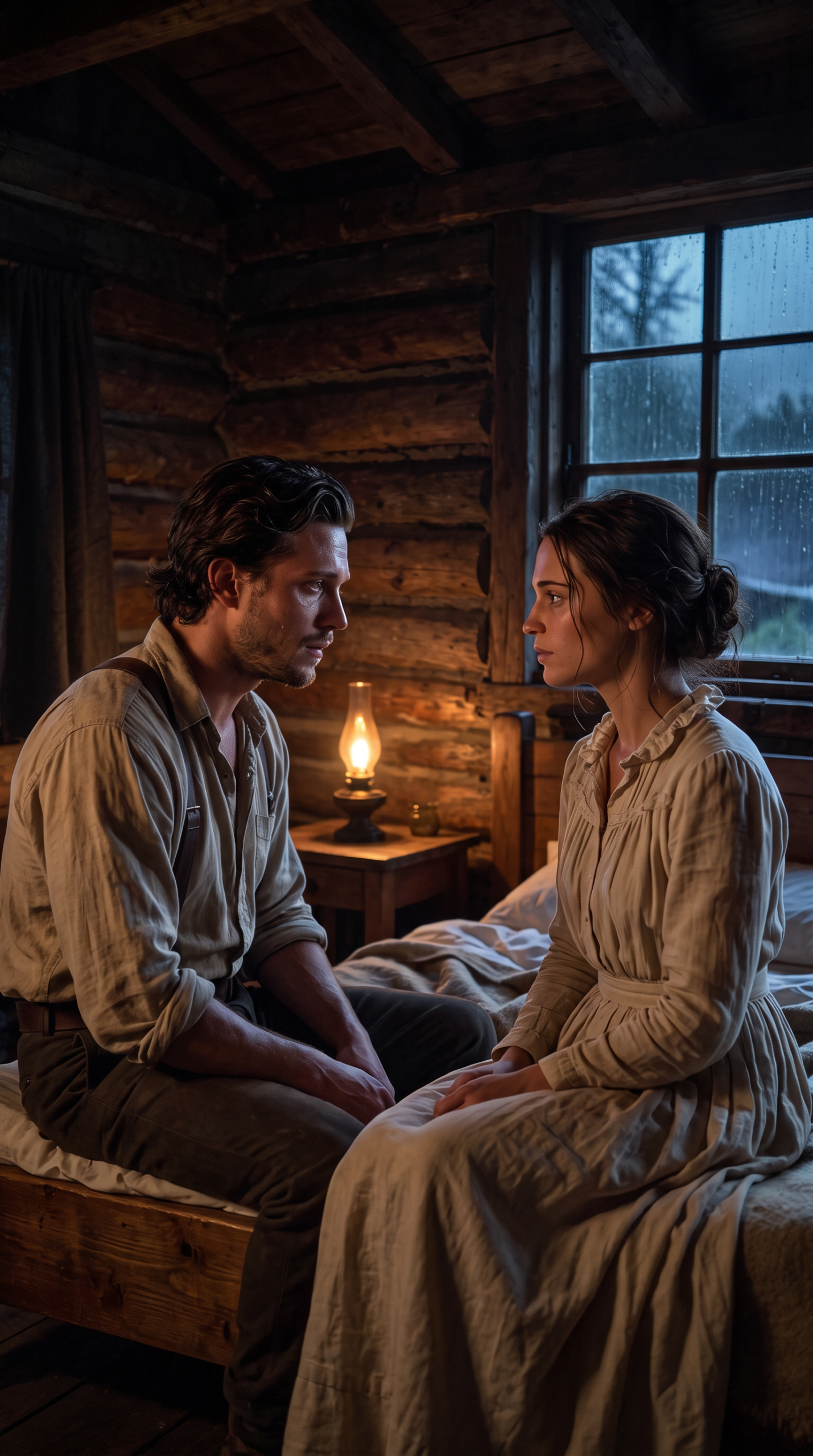
# “Sleep Next to Me, Just for Tonight,” the Lonely Blacksmith Whispered—And Her Reply Changed Everything
## Chapter 1: Three Knocks in the Rain
“Sleep next to me. Just for tonight.”
The words escaped my mouth before I could stop them.
The young woman standing near the bedroom doorway became completely still. Her fingers tightened around the folded quilt, and her eyes moved from my face to the empty bed behind me.
For a moment, I wished the floorboards would open and swallow me.
I was thirty-five years old. I had spent most of my life working with iron, fire, and stubborn horses. I had faced angry ranchers, drunk cowboys, broken machinery, and men twice my size. Yet nothing had ever made me feel as foolish as asking a stranger to share the same room with me.
“My name is Thomas Stone,” I said quietly, trying to explain myself. “I am not asking you for anything improper.”
She didn’t answer.
I raised both hands.
“You can have the bed. I’ll sleep above the blankets. I won’t lay a hand on you. You have my word.”
My voice weakened.
“It’s only that this house becomes unbearably quiet.”
She looked at me for several long seconds.
Outside, rain struck the roof of my cabin. The wind pushed against the wooden shutters, and somewhere beyond the window, thunder rolled across the Wyoming hills.
Finally, she lowered her eyes.
“All right, Mr. Stone.”
I released a breath I hadn’t realized I was holding.
“Thank you.”
She placed the quilt on the bed and settled near the far edge, leaving enough room between us for another person. I lay down carefully, keeping my boots on the floor and my hands folded over my chest.
Neither of us spoke.
I believed that was the end of our conversation.
Then, just as my eyes began to close, she turned her face toward me.
“Thomas?”
“Yes?”
“Could you tell me about your wife?”
I stared at the ceiling.
For six years, I had avoided that question.
But the rain was falling, the fire was dying, and a stranger had asked me to remember the woman I had spent six years trying not to forget.
So I began.
“My wife’s name was Hannah.”
And that was how everything changed.
Six hours earlier, I had believed my life would remain exactly as it had been for the rest of my days.
I was wrong.
My story begins on a Thursday evening in October, when the rain came down so heavily that the road outside Stillwater Crossing disappeared beneath brown water.
Stillwater Crossing was a small settlement in Wyoming Territory. It had one general store, one church, a post office, a doctor who visited twice a month, and a blacksmith’s workshop that had stood at the edge of town for nearly forty years.
My father had built that workshop.
After he died, I took over the business.
After Hannah died, I took over everything else.
Six winters had passed since I buried my wife, and I had become a man who knew how to work but had forgotten how to live.
Every morning, I woke before sunrise. I lit the forge, heated iron, shaped horseshoes, repaired wagon wheels, and worked until my shoulders ached.
In the evenings, I ate alone.
I kept two plates in the cupboard, though I had not used the second one in years.
Hannah’s chair remained beside the fireplace. I never sat in it. Her blue shawl still hung behind the bedroom door, and a small wooden box containing her letters rested on the highest shelf.
People in town had stopped asking when I would marry again.
They had learned that I preferred silence.
That Thursday, I was repairing a broken horseshoe when the first thunderclap shook the workshop.
I looked outside.
The sky had turned almost black.
I closed the workshop early and walked home with my coat pulled tightly around me. By the time I reached my cabin, rain was already running down the back of my neck.
I had just placed another log in the fireplace when I heard the knock.
Three gentle taps.
I reached for the rifle beside the hearth.
Nobody came to my door after dark unless they had a reason.
I waited.
Three more taps.
I picked up my lantern and approached the entrance.
When I opened the door, a young woman stood on the porch.
She was soaked through. Mud covered the bottom of her dress, her dark brown hair clung to her cheeks, and one hand held a worn leather medical bag.
She appeared to be around twenty-five.
Her lips were pale from the cold, but her eyes remained steady.
“I’m sorry to bother you,” she said. “I just need one night somewhere dry. That’s all I’m asking for.”
I looked beyond her.
The road was empty.
“Are you alone?”
“Yes.”
“Where are you coming from?”
“East.”
“That isn’t an answer.”
A faint, tired smile crossed her face.
“No, sir. I suppose it isn’t.”
I should have asked more questions. But the rain was growing heavier, and the woman was trembling.
“Come inside before you freeze.”
She hesitated.
Then she stepped through the doorway.
I closed the door behind her and placed another piece of wood in the fireplace.
“Sit near the fire.”
“Thank you.”
I brought her a towel and a clean nightdress.
“These belonged to my sister,” I said.
It was a lie.
The nightdress had belonged to Hannah.
I had kept it folded in a wooden drawer for six years, unable to throw away something that still carried the faintest trace of her.
The woman glanced at the clothing.
“Your sister?”
I nodded.
She looked at my face for a moment, then accepted the nightdress without asking anything else.
“I’ll return it in the morning.”
“You don’t need to.”
She disappeared into the bedroom.
I stood near the fireplace, listening to the rain.
For the first time in years, I wondered whether I should have asked someone to stay for supper.
## Chapter 2: A Stranger Named Clara
When the woman returned, she was wearing Hannah’s nightdress.
Her long dark hair had been twisted into a loose bun, and the damp ends rested against her shoulders.
She looked tired, but the warmth of the fire had brought some color back to her face.
I caught myself staring.
Not because she resembled Hannah.
She didn’t.
Hannah had been fair-haired, with bright blue eyes and a laugh that could fill an entire room.
This woman had dark eyes, a quiet expression, and a sadness that seemed to live somewhere deep inside her.
I looked away.
“There’s stew,” I said. “It isn’t much, but it’s warm.”
“I would be grateful for anything.”
We sat at the small wooden table.
I served two bowls of beef stew, added bread, and poured water into a pair of cups.
She ate slowly, as though she had become accustomed to making meals last.
“What’s your name?” I asked.
“Clara Bennett.”
“Where are you headed, Clara Bennett?”
She paused with her spoon halfway to her mouth.
“I don’t know anymore.”
I studied her face.
“That sounds like a difficult place to be.”
“It is.”
She looked down at her bowl.
“I used to have a destination. Now I only have a road.”
I understood that feeling better than I wanted to admit.
“Are you a doctor?”
“A nurse.”
She reached for her leather bag and opened it. Inside were neatly arranged instruments, bandages, small bottles of medicine, and a worn notebook.
“I studied nursing in Philadelphia,” she explained. “After that, I served in field hospitals during the war.”
The way she said the word war changed her expression.
I had seen that look before.
Men who returned from battle often carried it. Their bodies came home, but parts of their minds remained somewhere on a distant battlefield.
“What brought you to Wyoming?” I asked.
She closed the bag.
“I needed somewhere I could stop.”
I nodded.
I knew what it meant to need a place where nobody asked questions.
We finished our supper in silence.
Afterward, Clara helped me carry the dishes to the kitchen.
“You don’t have to do that,” I told her.
“I know.”
“Then why are you?”
“Because you gave me a meal.”
“That doesn’t mean you owe me anything.”
She smiled faintly.
“Perhaps I simply don’t like sitting still.”
For the first time that evening, I almost laughed.
I showed her the bedroom and explained that she could sleep there.
She looked toward the fireplace.
“Where will you sleep?”
“Near the fire.”
“It’s cold.”
“I’ve slept through worse.”
She glanced at the empty chair beside the hearth.
“Is your life always this quiet?”
I looked at the chair.
“Ever since Hannah passed away.”
She said nothing.
A few moments later, I asked her to share the bed with me.
Now, lying in the darkness, I heard Clara shift slightly.
“You said six years,” she whispered.
“Yes.”
“Were you married long?”
“Seven years.”
“Did you love her?”
I turned my head.
“That is a strange question.”
“I suppose it is.”
I looked toward the ceiling.
“I loved her more than I knew how to explain.”
“Then tell me.”
I was silent for a while.
Finally, I began.
## Chapter 3: The Woman Who Loved the Sound of Rain
“Hannah was twenty-two when I first met her,” I said.
“It was spring. I was standing outside my father’s workshop, trying to repair a wagon wheel, when she came riding into town with her father.”
I could still see that afternoon.
Her horse had a loose shoe, and she had insisted on bringing it to the blacksmith herself.
She was wearing a blue dress and a white ribbon in her hair.
“Are you the blacksmith?” she had asked.
“I am.”
“Then I need your help.”
I examined the horse.
“This animal needs a new shoe.”
“I thought so.”
“You could have brought him here yesterday.”
“I could have.”
“Then why didn’t you?”
She smiled.
“Because I wanted to meet the blacksmith.”
I remembered being unable to find a single intelligent response.
Hannah laughed.
She had the kind of laughter that made people turn their heads.
She returned the following week with another excuse. Then again the week after that.
Eventually, I stopped pretending that her visits had anything to do with horses.
“She used to bring me food,” I told Clara. “Sometimes biscuits, sometimes apple pie. Once she brought an entire pot of soup because she claimed I looked too thin.”
Clara listened quietly.
“She sounds kind.”
“She was stubborn.”
“That isn’t the same thing as being unkind.”
“No. It isn’t.”
I smiled into the darkness.
“Hannah loved rain. Whenever a storm came, she would open the window and listen to it. She said the sound made the world feel clean.”
Clara turned slightly toward me.
“And you?”
“I hated rain. It made the roads difficult, the workshop muddy, and the horses miserable.”
“What did she say?”
“She told me I had no imagination.”
Clara laughed softly.
The sound surprised me.
It reminded me how long it had been since I had heard someone laugh in my home.
I continued.
“We married in the church in Stillwater Crossing. There were only thirty people there, but Hannah insisted it was the finest wedding in the territory.”
“What happened after?”
“We built this cabin. She planted flowers beside the porch. We bought a little table for the kitchen. She wanted children.”
My voice slowed.
“She wanted a family.”
Clara waited.
“Did you have children?”
“No.”
“Did you try?”
I closed my eyes.
“We lost one.”
The room became quiet.
“Hannah was five months pregnant. One morning, she began bleeding. The doctor came, but there was nothing he could do.”
I swallowed.
“She held my hand while the doctor explained that the child was gone.”
Clara’s breathing changed.
“I am sorry.”
I nodded.
“We never spoke about having another child after that. Hannah said perhaps we would have one someday. She tried to smile whenever she said it.”
I looked toward the dark window.
“Two years later, she became ill.”
Clara didn’t interrupt.
“It started with a cough. Then fever. Then she couldn’t get out of bed. The doctor called it a lung infection. He gave her medicine, but it didn’t help.”
My hands tightened beneath the blanket.
“I stayed beside her every night. I held her hand. I told her she would recover.”
I paused.
“She died on a rainy morning.”
Clara whispered, “Thomas…”
“I was holding her hand when she stopped breathing.”
I could hear the fire crackling in the next room.
“Afterward, everyone told me I was strong. They said I should be grateful for the years we had together.”
I shook my head.
“I didn’t want to be strong. I wanted my wife.”
For a long moment, neither of us spoke.
Then Clara asked, “Did you ever say goodbye?”
I frowned.
“What?”
“Before she died. Did you tell her goodbye?”
I thought about it.
“No.”
“Why?”
“Because I believed she would recover.”
Clara looked toward the ceiling.
“Sometimes, the hardest part of losing someone is not only that they are gone. It’s all the things we believed we would have time to say.”
I turned toward her.
“How do you know that?”
She didn’t answer.
Instead, she pulled the quilt closer to her shoulders.
“Good night, Thomas.”
I knew then that Clara carried a story of her own.
And I knew she wasn’t ready to tell it.
## Chapter 4: The Morning After
I woke to the smell of coffee.
For a moment, I didn’t recognize my surroundings.
Then I remembered the storm, the woman at my door, and the conversation that had lasted until nearly midnight.
I sat up.
The other side of the bed was empty.
A faint sound came from the kitchen.
I found Clara standing beside the stove, holding a small pan.
“Good morning,” she said.
“You’re awake early.”
“I’ve always been an early riser.”
She was wearing her own dress again. It had dried overnight, though the mud still stained its hem.
On the table sat two cups of coffee and a plate of fried potatoes.
“I hope you don’t mind,” she said. “I found some potatoes in the pantry.”
“I don’t mind.”
I sat down.
She placed a plate in front of me.
“You didn’t have to cook.”
“I wanted to.”
We ate breakfast together.
The rain had stopped. Pale sunlight was breaking through the clouds, and the hills beyond the window were covered in silver mist.
For the first time in six years, I noticed how beautiful the morning looked.
After breakfast, Clara packed her medical bag.
“I should be going.”
I looked at the window.
“The road will be muddy.”
“I can manage.”
“Where will you go?”
“West, perhaps.”
“That’s not much of a plan.”
She smiled sadly.
“It is the only one I have.”
I stood.
“There is a boardinghouse in town. Mrs. Whitcomb runs it. She has a room above the kitchen.”
“Thank you.”
I hesitated.
“Do you have enough money?”
She reached into her bag and produced a few coins.
“Enough for a night or two.”
I looked at the coins.
“Keep them.”
“I can’t accept charity.”
“It isn’t charity. I have a broken wagon wheel behind the workshop. If you insist on paying me, you can help me carry the tools.”
She studied me.
Then she laughed.
“You are a difficult man, Mr. Stone.”
“I’ve been told.”
She agreed.
We walked into town together.
People noticed us.
A few nodded. Others stared.
Mrs. Whitcomb nearly dropped the basket she was carrying when she saw me.
“Thomas Stone! What brings you out with company?”
“This is Clara Bennett. She needs a room.”
Mrs. Whitcomb looked Clara up and down.
Then her expression softened.
“Well, any friend of Thomas is welcome.”
Clara glanced at me.
“Are we friends?”
“I suppose we are.”
It was a strange feeling, saying that word aloud.
Mrs. Whitcomb gave Clara a small room above the kitchen.
When we returned to the street, Clara stopped beside the general store.
“Thank you for everything.”
“You’re welcome.”
She looked toward the western road.
“I won’t forget it.”
I watched her walk away.
Then I returned to my workshop.
For the rest of the day, I made horseshoes and repaired a wagon axle.
But something was different.
I kept looking toward the road.
## Chapter 5: The Nurse at the Boardinghouse
Clara remained in Stillwater Crossing for three days.
On the second morning, a boy from the general store came running into my workshop.
“Mr. Stone! Mrs. Whitcomb says you need to come quickly!”
I put down my hammer.
“What happened?”
“It’s the rancher’s little girl. She fell off a fence.”
I grabbed my coat.
When I reached the boardinghouse, Clara was already kneeling beside a young girl on the floor.
The child was crying, and her mother looked terrified.
“Her arm is broken,” Clara said calmly. “I need clean cloth and some water.”
The mother nodded.
Clara examined the injury with careful hands.
“It’s going to hurt, sweetheart,” she told the girl. “But I will stay with you.”
She worked with a confidence that made the frightened mother relax.
I watched her prepare a temporary support for the arm.
“Have you done this before?” I asked.
She glanced at me.
“More times than I care to remember.”
Within half an hour, the child’s arm was supported, and Clara had arranged for the doctor to examine her properly.
When the mother thanked her, Clara simply smiled.
“It was nothing.”
But I knew it wasn’t nothing.
The people of Stillwater Crossing began talking about the nurse who had arrived during the storm.
By the end of the week, two families had asked her to visit sick relatives.
Clara helped wherever she could.
She never asked for payment.
One afternoon, I found her sitting on the boardinghouse porch, writing in a small notebook.
“What are you writing?”
“Names.”
“Of patients?”
She nodded.
“People who might need medicine. Mrs. Whitcomb has a fever. Mr. Harris has a wound on his leg. The Miller boy has been coughing for a week.”
“You’re making a list.”
“I suppose I am.”
“Why?”
She closed the notebook.
“Because I have learned that people are easier to forget when nobody writes their names down.”
I studied her face.
“That sounds like something a person learns the hard way.”
She looked toward the street.
“Yes.”
I wanted to ask more.
But before I could, she stood.
“Are you going to the workshop?”
“I am.”
“May I walk with you?”
“Of course.”
We walked slowly.
At the workshop, she watched me work.
She asked about the forge, the bellows, and the tools.
I showed her how iron changed color as it heated.
“Red means it is ready,” I explained. “Too much heat, and the metal becomes difficult to control.”
“Like people?”
I looked at her.
“Perhaps.”
She smiled.
For the first time, I began to wonder what it would be like if she stayed.
## Chapter 6: The Letter in the Medical Bag
A week passed.
Clara was still in town.
She had begun helping Mrs. Whitcomb with the boardinghouse and visiting families who needed medical attention.
I found myself inventing reasons to walk past the building.
Sometimes I brought firewood.
Sometimes I brought bread.
Once, I carried a broken chair that did not need repairing.
Clara noticed.
“You seem to have a great deal of free time, Mr. Stone.”
“I am a blacksmith. I make my own schedule.”
“Of course.”
She laughed.
One evening, she came to the workshop carrying her medical bag.
“Thomas, may I ask you something?”
“Certainly.”
“Do you have any clean cloth?”
“For what?”
“A patient with a badly infected wound.”
I searched the shelves and found a bundle of old linen.
She thanked me.
As she reached into her bag, a folded letter slipped out and landed on the floor.
I picked it up.
The envelope was old and worn.
There was no name on the outside, only a date written in dark ink.
Clara took it from me quickly.
“I’m sorry,” she said.
“You don’t have to apologize.”
She held the letter against her chest.
“It’s from someone I knew.”
“Someone you lost?”
Her eyes lowered.
“Yes.”
I waited.
She seemed to consider saying something.
Then she shook her head.
“Not tonight.”
I nodded.
“Not tonight.”
She stayed for supper.
Afterward, she helped me wash the dishes.
As she was leaving, I asked her whether she would like to walk with me the following afternoon.
She looked surprised.
“Where?”
“There’s a small lake beyond the western hill. Hannah used to go there.”
Her expression changed slightly.
“Are you sure?”
“No,” I answered honestly. “But I think I should go.”
Clara studied me.
Then she nodded.
“I would like that.”
## Chapter 7: The Lake Beyond the Hill
The following afternoon was clear.
We walked along a narrow path through yellow grass and scattered pine trees.
Clara carried no medical bag that day.
She wore a simple brown coat, and her dark hair was tied neatly behind her head.
The lake appeared beyond the hill.
It was small, surrounded by rocks and tall grass. The water reflected the pale autumn sky.
I stopped at the edge.
“Hannah loved this place.”
Clara stood beside me.
“Why?”
“She said the water reminded her that even quiet things could be deep.”
I smiled.
“She used to sit on that rock and read.”
Clara looked toward it.
“Did she come here alone?”
“Sometimes. Sometimes with me.”
I picked up a small stone and threw it into the water.
It skipped once, then sank.
“I haven’t been here since she died.”
Clara didn’t say anything.
We sat beneath a pine tree.
For a while, we listened to the wind.
Then Clara asked, “Do you think you are betraying her by being happy again?”
I turned toward her.
The question struck harder than I expected.
“I don’t know.”
She looked down at her hands.
“I think people sometimes confuse remembering someone with refusing to live.”
I studied her.
“Is that what you believe?”
“Yes.”
“Have you managed to do it?”
Her face became distant.
“Not yet.”
I wanted to ask about the letter.
Instead, I said, “I used to think that if I stopped hurting, it would mean I had stopped loving Hannah.”
“And now?”
“Now I think I have been hurting so long that I no longer know the difference.”
Clara’s eyes softened.
“Perhaps you don’t have to forget her to make room for something else.”
I looked at the lake.
For the first time, that possibility did not feel like an insult to Hannah’s memory.
It felt frightening.
But perhaps it also felt like hope.
## Chapter 8: The Man Who Came Looking
The trouble began on a Monday.
I was working at the forge when a stranger rode into town.
He was tall, dressed in a dark coat, and carried himself like a man who expected others to move out of his way.
He asked the storekeeper about Clara Bennett.
The storekeeper pointed toward the boardinghouse.
I noticed the exchange from across the street.
The stranger dismounted and approached Mrs. Whitcomb’s porch.
Clara stepped outside.
The moment she saw him, the color drained from her face.
“Edward.”
The man smiled.
“Hello, Clara.”
She stepped backward.
“What are you doing here?”
“Looking for you.”
“I told you not to follow me.”
Edward glanced toward the street.
“You’ve been difficult to find.”
“I don’t want to see you.”
His smile disappeared.
“We need to talk.”
“There is nothing left to discuss.”
He reached for her arm.
She pulled away.
I crossed the street.
“Is there a problem?”
Edward looked at me.
“Who are you?”
“Thomas Stone.”
“The blacksmith?”
“Yes.”
Edward’s eyes moved between us.
“Clara and I are old friends.”
Clara’s voice was cold.
“No, Edward. We are not.”
He smiled again.
“This is a private matter.”
“Then you can discuss it without grabbing her.”
Edward released a quiet laugh.
“You should be careful, blacksmith. You don’t know what you’re involving yourself in.”
I stepped closer.
“I know enough.”
For a moment, I thought he might strike me.
Then he looked at Clara.
“I’ll be staying at the hotel. We will speak tomorrow.”
He mounted his horse and rode away.
Clara stood perfectly still.
I turned toward her.
“Who is he?”
She swallowed.
“My past.”
“Does he have a right to be here?”
“No.”
“Then he can leave.”
She looked at me.
“You don’t understand.”
“Then help me understand.”
Her eyes filled.
“I can’t. Not yet.”
I wanted to press her.
But I remembered how she had allowed me to speak about Hannah without demanding answers.
So I simply nodded.
“Whenever you’re ready.”
That evening, Clara didn’t come to the workshop.
And for the first time since she had arrived, I was afraid she might leave without saying goodbye.
## Chapter 9: Clara’s Secret
The next morning, I found Clara sitting alone behind the boardinghouse.
She looked exhausted.
I sat beside her.
“May I?”
She nodded.
For several minutes, neither of us spoke.
Then she said, “Edward was my husband.”
I turned toward her.
“I see.”
“We married when I was twenty. He was a doctor. He was charming, intelligent, and admired by everyone.”
She stared at the ground.
“At first, he was kind. Then he began drinking. He became angry when I disagreed with him. He didn’t like that I worked. He said a wife should remain at home.”
I listened.
“He wanted me to stop nursing. I refused. I had spent years studying. I wanted to help people.”
She wiped her eyes.
“One night, after a terrible argument, he struck me.”
My jaw tightened.
“He hurt you?”
“Yes.”
She took a slow breath.
“I left the following morning. I went to Philadelphia, then volunteered at a field hospital. I thought the war would give me somewhere useful to put all the fear and anger inside me.”
“Did he find you?”
“He sent letters. I never answered.”
“Until now?”
“He found out I was traveling west.”
I looked toward the road.
“Why does he want you back?”
She gave a bitter laugh.
“He says he has changed. He says he loves me. But he doesn’t want me because he loves me. He wants me because I left.”
I remained silent.
“Why didn’t you tell me?”
“Because I was ashamed.”
“Of what?”
“That I stayed as long as I did.”
I shook my head.
“You have nothing to be ashamed of.”
She looked at me.
“I should have known better.”
“People who hurt others are responsible for their actions. Not the people they hurt.”
Her eyes filled again.
For a moment, I wanted to take her hand.
But I waited.
She slowly placed hers beside mine.
I covered it gently.
She didn’t pull away.
## Chapter 10: A Storm Outside and Inside
Edward stayed in Stillwater Crossing.
He visited the boardinghouse every day.
Sometimes he brought flowers. Sometimes he brought expensive food. Sometimes he simply stood across the street, watching.
Clara refused to speak with him.
The town began to notice.
One afternoon, Edward entered my workshop.
I was repairing a wagon wheel.
“Thomas Stone.”
I continued working.
“Can I help you?”
“I believe you can.”
I put down my hammer.
“Then speak.”
Edward removed his gloves.
“You seem to have become close to my wife.”
“She is not your property.”
He smiled.
“You don’t understand marriage.”
“I understand enough.”
“You are a lonely man, Stone. I know about your wife.”
My hands became still.
“Leave Hannah out of this.”
“Six years alone. A dead wife. An empty house. And now a pretty young woman appears at your door.”
He leaned closer.
“You think she will stay?”
I stared at him.
“You should go.”
Edward laughed.
“She’s damaged, you know. You cannot fix her.”
I stepped toward him.
“I am not trying to fix her.”
“Then what are you trying to do?”
“Treat her like a human being.”
For the first time, Edward’s smile disappeared.
He walked toward the door.
Before leaving, he turned.
“She will come back to me.”
“No,” I said. “She won’t.”
That evening, Clara arrived at the workshop.
She had heard about the visit.
“I’m sorry,” she said.
“You didn’t send him.”
“I brought trouble to your door.”
“You brought rain to my porch. The trouble came on its own horse.”
She smiled faintly.
Then her expression became serious.
“I think I should leave.”
I felt something cold settle in my chest.
“Why?”
“Because he will keep coming. I don’t want him hurting you.”
“He won’t.”
“You can’t promise that.”
“No. But I can promise I won’t let him decide where you belong.”
She looked at me for a long time.
Then she whispered, “You are a good man, Thomas.”
I looked away.
“I am only trying to be.”
## Chapter 11: The Night Everything Nearly Ended
Edward made his final mistake on a Friday night.
A storm had returned.
I was closing the workshop when I heard shouting from the boardinghouse.
I ran toward the sound.
Edward was standing in the doorway, gripping Clara’s wrist.
She was struggling to pull away.
“Let go of her!”
He turned.
“This is none of your concern.”
I moved forward.
“Let her go.”
Clara looked at me.
“Thomas, don’t.”
Edward tightened his grip.
“She is my wife.”
“She told you to let go.”
He shoved her toward the wall.
I grabbed his arm and pulled him away.
Edward swung at me.
His fist struck my cheek.
I stumbled backward.
Before he could strike again, Clara picked up a wooden chair and slammed it against the floor beside him.
“STOP!”
The sound echoed through the room.
Edward froze.
Clara stood trembling, but her voice was steady.
“I am not going back with you.”
He stared at her.
“You cannot survive without me.”
“I survived the war. I survived the nights you locked me in the house. I survived the day you struck me and told me it was my fault.”
She stepped forward.
“I survived leaving you. I will survive without you.”
Edward’s face twisted with anger.
He looked toward me.
Then he looked at Clara.
“You’ll regret this.”
He stormed outside.
Mrs. Whitcomb sent for the sheriff.
Edward was arrested before midnight for assault and disturbing the peace. The sheriff took Clara’s statement and promised to keep him away from her while the matter was investigated.
When everything was finally quiet, I found Clara sitting on the porch.
She was crying.
I sat beside her.
“Are you hurt?”
She shook her head.
“Not badly.”
I looked at her wrist.
There were red marks where Edward had held her.
I brought a clean cloth and wrapped it gently.
She watched me.
“Why did you come?”
“Because I heard you shouting.”
“You could have been hurt.”
“I know.”
She lowered her eyes.
“Why would you risk that?”
I thought about the question.
“Because I care what happens to you.”
She looked at me.
For a moment, neither of us spoke.
Then she leaned forward and rested her forehead against my shoulder.
I remained still.
After a few seconds, she began to cry.
I placed one arm around her.
And I understood that sometimes the greatest act of kindness was not rescuing someone.
It was simply staying when they were afraid.
## Chapter 12: The Truth About the Letter
Two days later, Clara came to my cabin.
She carried the old letter.
“I think you should know everything,” she said.
I invited her inside.
She sat beside the fireplace and placed the letter on the table.
“Before I married Edward, I had a younger sister named Rose.”
She opened the envelope.
“Rose died when she was seventeen. She had a fever. The doctor came, but he arrived too late.”
Clara looked at the paper.
“I was away studying. I had promised her I would come home for her birthday. I didn’t make it.”
Her voice trembled.
“When I returned, she was already buried.”
I said nothing.
“She had written me a letter before she died. She told me not to spend my life regretting things I could not change.”
Clara pressed the paper flat.
“I kept it with me through the war. Through my marriage. Through every town I visited.”
I looked at the letter.
“Is that why you became a nurse?”
“Partly. I wanted to help people. But I also wanted to believe I could make up for not being there when Rose needed me.”
She wiped her eyes.
“I know that isn’t possible.”
“No,” I said gently. “It isn’t.”
She looked at me.
“But it doesn’t mean you have to spend the rest of your life punishing yourself.”
Her eyes filled.
I recognized the words.
They were the same ones I had needed to hear six years earlier.
I reached for Hannah’s wooden box on the shelf.
Clara watched as I opened it.
Inside were several letters, a faded ribbon, and a small photograph.
I took out the photograph.
It showed Hannah standing beside the lake.
“This was taken two weeks before she died.”
Clara studied it.
“She looks happy.”
“She was.”
I sat beside her.
“I kept these things because I was afraid that if I put them away, I would lose her completely.”
Clara looked at the photograph.
“Maybe you don’t have to put them away.”
I frowned.
“What do you mean?”
“Perhaps you can keep them without living inside them.”
I looked at Hannah’s face.
For the first time, I considered placing the photograph somewhere it could be seen.
Not hidden.
Not guarded.
Simply remembered.
## Chapter 13: The Dance at the Autumn Gathering
The sheriff eventually released Edward under conditions that required him to leave Clara alone and remain away from the boardinghouse.
He left Stillwater Crossing three days later.
Clara watched his horse disappear down the eastern road.
Then she turned away.
“I think I am finally free.”
I nodded.
“You were free the moment you decided not to return.”
She smiled.
The following Saturday, the town held its annual autumn gathering.
There was music in the church hall, food in the square, and a small dance beneath lanterns.
Mrs. Whitcomb insisted that Clara attend.
She insisted even more strongly that I go with her.
“I am not a dancing man,” I told her.
“Then stand near the wall and look miserable,” she replied.
Clara laughed.
I offered her my arm.
We walked to the gathering together.
People greeted us.
The fiddle player began a slow tune.
Clara looked toward the dancers.
“Do you dance?”
“Not particularly well.”
“Neither do I.”
“That sounds dangerous.”
She smiled.
“Perhaps we should find out.”
I held out my hand.
She placed hers in it.
We stepped onto the floor.
At first, I was stiff and awkward. Clara laughed when I nearly stepped on her foot.
“Careful, Mr. Stone.”
“I work with iron, not dancing.”
“Then consider this a new skill.”
I smiled.
We moved slowly beneath the lanterns.
For a moment, I forgot the years of loneliness.
I forgot the empty chair.
I forgot that I had once believed happiness belonged only to the past.
When the music ended, Clara remained close.
“Thank you,” she said.
“For what?”
“For asking me to dance.”
I looked into her eyes.
“Thank you for saying yes.”
She lowered her gaze.
Then, quietly, she asked, “Thomas, do you think Hannah would have wanted you to be happy?”
The question caught me off guard.
I thought about Hannah.
Her laughter.
Her stubbornness.
Her love of rain.
“Yes,” I answered. “I think she would have.”
Clara smiled.
“Then perhaps you should let yourself be.”
## Chapter 14: The Empty Chair
Winter arrived early that year.
Snow covered the hills, and the road outside the cabin became difficult to travel.
Clara had decided to remain in Stillwater Crossing until spring.
She rented a small room above the boardinghouse and continued helping the townspeople.
I saw her almost every day.
Sometimes she visited the workshop.
Sometimes I walked her home.
Sometimes we shared supper.
We never hurried anything.
One evening, she came to my cabin carrying a small bundle.
“I brought you something.”
“What is it?”
She placed it on the table.
A blue cloth.
I recognized it immediately.
It was Hannah’s old shawl.
“I found it in the bedroom when you lent me the nightdress,” Clara explained. “I hope you don’t mind. I washed it and repaired the torn edge.”
I touched the fabric.
“You didn’t have to do that.”
“I wanted to.”
I looked at her.
“Thank you.”
She glanced toward the chair beside the fireplace.
“You never sit there.”
“No.”
“Would you like to?”
I hesitated.
Then I walked across the room and pulled it away from the wall.
The wooden legs scraped softly against the floor.
I sat down.
For the first time in six years, I occupied the chair Hannah had loved.
Clara sat opposite me.
Neither of us spoke.
But something inside me loosened.
I had believed that moving the chair would mean moving away from Hannah.
Instead, I felt closer to her than I had in years.
## Chapter 15: A Promise in the Snow
One afternoon in January, Clara received a letter from Philadelphia.
She read it beside the boardinghouse window.
I noticed her expression change.
“Bad news?”
She folded the letter.
“An opportunity.”
“What kind?”
“A hospital in Denver is looking for nurses. They need someone with field experience.”
I nodded.
“That sounds promising.”
“They are offering a position.”
“Then you should consider it.”
She looked at me.
“You want me to go?”
I was quiet.
The truth was that I didn’t.
I had grown accustomed to her presence. I had begun to look forward to mornings, meals, conversations, and the sound of her laughter.
But I knew she had spent too much of her life allowing other people to decide what she could do.
I would not become another person who asked her to stay for his own comfort.
“If it is what you want,” I said, “you should go.”
She lowered her eyes.
“And what if I don’t know what I want?”
“Then take the time to decide.”
She looked at me.
“You always make it sound so simple.”
“It isn’t simple.”
I stepped closer.
“I would miss you.”
Her eyes softened.
“But I won’t ask you to give up your future because I am afraid of being alone.”
She took my hand.
“Thomas…”
I looked at her.
“I have spent years running away from places and people,” she said. “For the first time, I have found somewhere I can breathe.”
I didn’t interrupt.
“I don’t want to stay because I am afraid of the road. I want to stay because I have begun to feel at home.”
My heart beat faster.
“Are you certain?”
She nodded.
“Not about everything. But about this.”
I gently held her hand.
“Then perhaps we can see what happens.”
She smiled.
Outside, snow began falling again.
## Chapter 16: The Fever
In February, Clara became ill.
At first, she insisted it was nothing.
A headache.
A cough.
A little exhaustion.
But by the following morning, she could barely stand.
I found her sitting on the boardinghouse bed, her face pale and her hands trembling.
“Clara?”
She tried to smile.
“I think I caught a cold.”
I touched her forehead.
She was burning.
I called the doctor immediately.
He examined her and suspected a serious chest infection.
He gave her medicine and instructed her to rest.
Clara hated being a patient.
“I am perfectly capable of looking after myself,” she muttered.
“Then you should have done a better job,” I replied.
She laughed weakly.
I stayed beside her.
For three days, her fever came and went.
I changed the water, prepared soup, brought fresh blankets, and sat beside her bed.
One night, she woke suddenly.
“Thomas?”
“I’m here.”
She looked frightened.
“I thought I was back there.”
“Where?”
“The hospital.”
She closed her eyes.
“I could hear the wounded calling for help. There were so many of them.”
I took her hand.
“You’re safe.”
“I couldn’t save everyone.”
“I know.”
“I tried.”
“I know.”
Her fingers tightened around mine.
“Sometimes I still hear them.”
I sat beside her until her breathing settled.
The next morning, her fever began to break.
When she opened her eyes, she found me asleep in the chair beside her.
She smiled faintly.
“You stayed.”
I woke.
“Of course.”
“You didn’t have to.”
I looked at her.
“Neither did you.”
She understood.
Her eyes filled with tears.
## Chapter 17: The Question I Had Been Afraid to Ask
By March, the snow had begun to melt.
Clara had recovered, and the town was preparing for spring.
One evening, she came to my cabin.
I had prepared supper.
She looked around the room.
The blue shawl hung beside the fireplace. Hannah’s photograph rested on the shelf. The second plate had been taken from the cupboard.
Clara noticed it.
“You have two plates.”
“I do.”
She smiled.
We ate together.
After supper, I brought two cups of coffee and sat across from her.
There was something I had wanted to say for weeks.
But I was afraid.
I had spent so many years believing that loving someone again would be a betrayal of Hannah.
Now I understood that the heart was not a house with only one room.
It could hold memories and still make space for new ones.
“Clara?”
“Yes?”
“I have something to ask you.”
She looked at me.
“Go ahead.”
“When you first knocked on my door, you said you needed one night somewhere dry.”
She smiled.
“I remember.”
“I thought you would leave the next morning.”
“I nearly did.”
“Why didn’t you?”
She looked toward the fireplace.
“Because someone gave me a place where I didn’t have to explain myself.”
I nodded.
“I want you to know something.”
She waited.
“I care about you.”
Her expression softened.
“I care about you too.”
“I don’t want to rush you. I don’t want to replace anyone. And I don’t want you to feel that you owe me anything because I gave you shelter.”
She reached across the table.
“You haven’t asked me for anything.”
I held her hand.
“Then I would like to ask you one thing now.”
“What?”
“Would you consider building a life here with me?”
Her eyes filled.
She looked around the cabin.
Then back at me.
“I think I already have.”
I smiled.
For a moment, neither of us spoke.
Then she leaned forward and kissed my cheek.
It was a small gesture.
But to me, it felt like the first warm day after a very long winter.
## Chapter 18: Hannah’s Last Letter
The following morning, I decided to open Hannah’s wooden box.
I had not read her letters in years.
Clara sat beside me while I removed the ribbon and unfolded the oldest envelope.
I recognized Hannah’s handwriting immediately.
It was a letter she had written shortly before she died.
I had never read it.
At the time, I had been too frightened to discover what it contained.
My hands trembled as I opened the paper.
*My dearest Thomas,*
*If you are reading this, then perhaps I have not been able to tell you everything I wanted to say.*
*I know you are frightened. I am frightened too.*
*But I need you to understand something.*
*You have always believed that love means holding on. I have tried to teach you that love also means letting someone breathe.*
*If I leave before you, please do not turn our home into a place where happiness is forbidden.*
*Keep the chair. Keep the photograph. Remember the lake. Remember the rain.*
*But please, Thomas, live.*
*If another person comes into your life and makes you smile, do not feel guilty.*
*You are not replacing me.*
*You are continuing.*
*I loved you in every season of our life together. I would never ask you to spend the rest of yours alone.*
*Your Hannah.*
I could not finish reading without stopping.
Tears blurred the paper.
Clara held my hand.
I read the final sentence again.
You are continuing.
For six years, I had believed I was protecting Hannah’s memory.
But perhaps I had been protecting myself from the possibility of losing her twice.
I folded the letter carefully.
Then I placed it beside her photograph.
“I think she would have liked you,” I whispered.
Clara smiled through her tears.
“I would have liked to meet her.”
“I wish you could have.”
“Perhaps, in some way, I have.”
I looked at her.
She gently touched the photograph.
“She helped you become the man who opened the door when I knocked.”
I stared at Hannah’s face.
And for the first time, remembering her did not hurt quite so much.
## Chapter 19: A New Spring
Spring came to Stillwater Crossing.
The road dried, flowers appeared beside the cabin, and the hills turned green.
Clara began working part-time with the local doctor.
Together, they arranged a small medical room in an unused building near the church. The townspeople helped furnish it.
I repaired the door, built shelves, and made a sturdy iron sign for the entrance.
Clara wanted to call it the Stillwater Clinic.
I suggested something simpler.
“Why not the Hannah and Rose Medical Room?”
She looked surprised.
“Are you sure?”
“Yes.”
I explained that Hannah had always wanted to help people, and Rose had inspired Clara to become a nurse.
Clara smiled.
“Then I think they would both approve.”
The clinic opened in May.
People came from nearby ranches, and the doctor began visiting more regularly.
Clara worked long hours, but she seemed happier than I had ever seen her.
I watched her speaking with a young mother one afternoon.
She was holding the woman’s baby while explaining how to care for a fever.
Her face was calm and warm.
I thought about the woman who had stood on my porch during the storm, soaked and frightened, asking for one night somewhere dry.
I wondered how much courage it had taken for her to knock.
That evening, I walked home with her.
The sky was orange above the hills.
“Thomas?”
“Yes?”
“Do you ever regret opening your door that night?”
I stopped.
“Not for a single moment.”
She smiled.
“Neither do I.”
## Chapter 20: The Second Knock
One year after Clara first arrived, another storm crossed the Wyoming hills.
The rain began after sunset.
I was sitting beside the fireplace, reading Hannah’s old letter, when three gentle knocks sounded at the door.
Clara looked up from her sewing.
“Were you expecting someone?”
“No.”
I stood and opened the door.
A young mother stood on the porch, holding a small child wrapped in a wet blanket.
Her face was pale with worry.
“Please,” she whispered. “My little boy is sick. I was told the nurse lives here.”
I stepped aside.
“Come inside before you freeze.”
Clara was already on her feet.
She brought the child to the fire and began examining him.
I fetched clean towels and heated water.
The mother watched us with frightened eyes.
“Will he be all right?”
Clara looked at her.
“We are going to do everything we can.”
The woman began to cry.
Clara gently touched her shoulder.
“You are not alone.”
I stood near the fireplace and listened.
Those words.
You are not alone.
I looked toward Hannah’s photograph.
For years, I had believed my home had become quiet because the person I loved was gone.
Now I understood something different.
A home was not made by the absence of grief.
It was made by the presence of kindness.
That night, while Clara cared for the child, I prepared soup for the mother.
When the little boy’s fever finally began to settle, the woman thanked us again and again.
Clara smiled.
“You don’t need to thank us. Just keep him warm.”
The storm continued until morning.
And when the mother and child finally left, Clara came to stand beside me.
“You were kind to open the door,” she said.
I looked at her.
“You were the one who taught me how.”
## Epilogue: The House That Was No Longer Quiet
Three years later, the people of Stillwater Crossing still remembered the night a nurse arrived in the middle of a storm.
They remembered the blacksmith who gave her shelter.
They remembered the little medical room that became a place of healing for families across the valley.
And they remembered how two lonely people had found their way back to life.
Clara and I married in the same church where Hannah and I had exchanged our vows.
There was no grand celebration.
Only a small gathering, a few friends, and the sound of rain beginning just before the ceremony.
When Clara walked toward me, she carried a simple bouquet of wildflowers.
She wore a cream-colored dress.
I thought about the first night she had worn Hannah’s old nightdress.
I thought about the question she had asked me.
Could you tell me about your wife?
And I realized that the question had changed everything because she had not asked me to forget Hannah.
She had asked me to remember her.
After the ceremony, Clara and I returned to the cabin.
Hannah’s photograph remained on the shelf.
Her blue shawl still hung beside the fireplace.
But the chair that had once stood empty was now used every evening.
Sometimes Clara sat in it while reading.
Sometimes I sat there with a cup of coffee.
Sometimes we sat together, listening to the rain.
One evening, Clara found me standing near the bedroom doorway.
“What are you thinking about?” she asked.
I smiled.
“Something you said a long time ago.”
“What was that?”
I looked at the bed.
“You asked me to tell you about Hannah.”
She came closer.
“And you did.”
“I did.”
“Do you regret it?”
I shook my head.
“No. I think telling you about her was the first time I allowed myself to remember her without trying to disappear into the past.”
Clara took my hand.
“Then I’m glad I asked.”
I looked into her eyes.
“So am I.”
Outside, rain began falling softly against the window.
The fire crackled.
The house was warm.
And for the first time in six years, the sound of another person moving through my home no longer felt like an interruption.
It felt like life.
I had once believed that the greatest tragedy was losing the person you loved.
Now I understood that another tragedy was allowing that loss to convince you that love had ended forever.
Hannah would always be part of my story.
Clara had become part of its next chapter.
And somewhere between those two truths, I had finally learned how to live again.
**Sometimes, a single knock at the door is not asking for shelter. Sometimes, it is asking whether two broken hearts are ready to find their way home.**