My name is Sandra Kowalski. I am thirty-nine years old. I live in Albuquerque, New Mexico. I have been riding for eight years. I am a nurse practitioner at an urgent care clinic on the west side of town. I have been in medicine for fourteen years.
I was married for seven years. My husband’s name was Derek. We were together for ten years total — three years before the wedding, seven years after. We did not have children. This was a choice we made together early on and then revisited at year four and revisited again at year six, and both times we arrived at the same answer, which I now understand was the answer that two people give when they are more committed to not disrupting their current arrangement than they are to each other.
We separated in the spring of 2021. The divorce was final in October of that year.
I am not going to tell you it was his fault or my fault because the honest answer is that it was the fault of two people who had grown in different directions and had spent two years pretending that wasn’t happening. The separation was quiet. The divorce was quieter. We divided things fairly. We are not enemies. We are simply people who no longer have a reason to be in the same room.
What I will tell you is what the year after felt like.
It felt like a house that had been emptied of furniture. Not destroyed — just emptied. All the familiar shapes of a life — the morning routines, the shared meals, the particular architecture of a shared existence — gone, and in their place, space. A lot of space. Space that I did not know how to fill and that I was not sure I wanted filled.
I had bought the bike in 2016, three years before the marriage started its slow unraveling. A Honda CB500F. Not a Harley, not a cruiser, not what most people picture when they picture a woman on a motorcycle. A naked bike. Practical. Quick. Mine.
Derek had never liked the bike. Not in a hostile way — he never asked me to get rid of it. He just held himself slightly apart from it, the way people hold themselves apart from the parts of a partner they don’t understand and have decided not to try to understand.
After he left, I rode more.
I rode the way you do things when something that was previously shared is suddenly entirely yours again. I rode on Saturday mornings and Sunday afternoons and sometimes on weeknights when the clinic was done and the apartment was too quiet and I needed the road more than I needed dinner.
The road is honest. That is the thing I would tell anyone who has never ridden. The road is honest in a way that almost nothing else is. It does not allow you to be somewhere else in your head. It requires all of you — your eyes, your hands, your weight, your judgment. When you are on the road you cannot also be in the past or the future. You are exactly where you are, moving through it at whatever speed you have chosen, and that is all.
For about eighteen months that was the closest I could get to peace.
I was not in a club then. I am not in a club now, though I have ridden with the local women’s chapter twice and may join. I rode alone most of the time, which suited me. I did not want to explain myself to anyone. The bike did not ask for explanations.
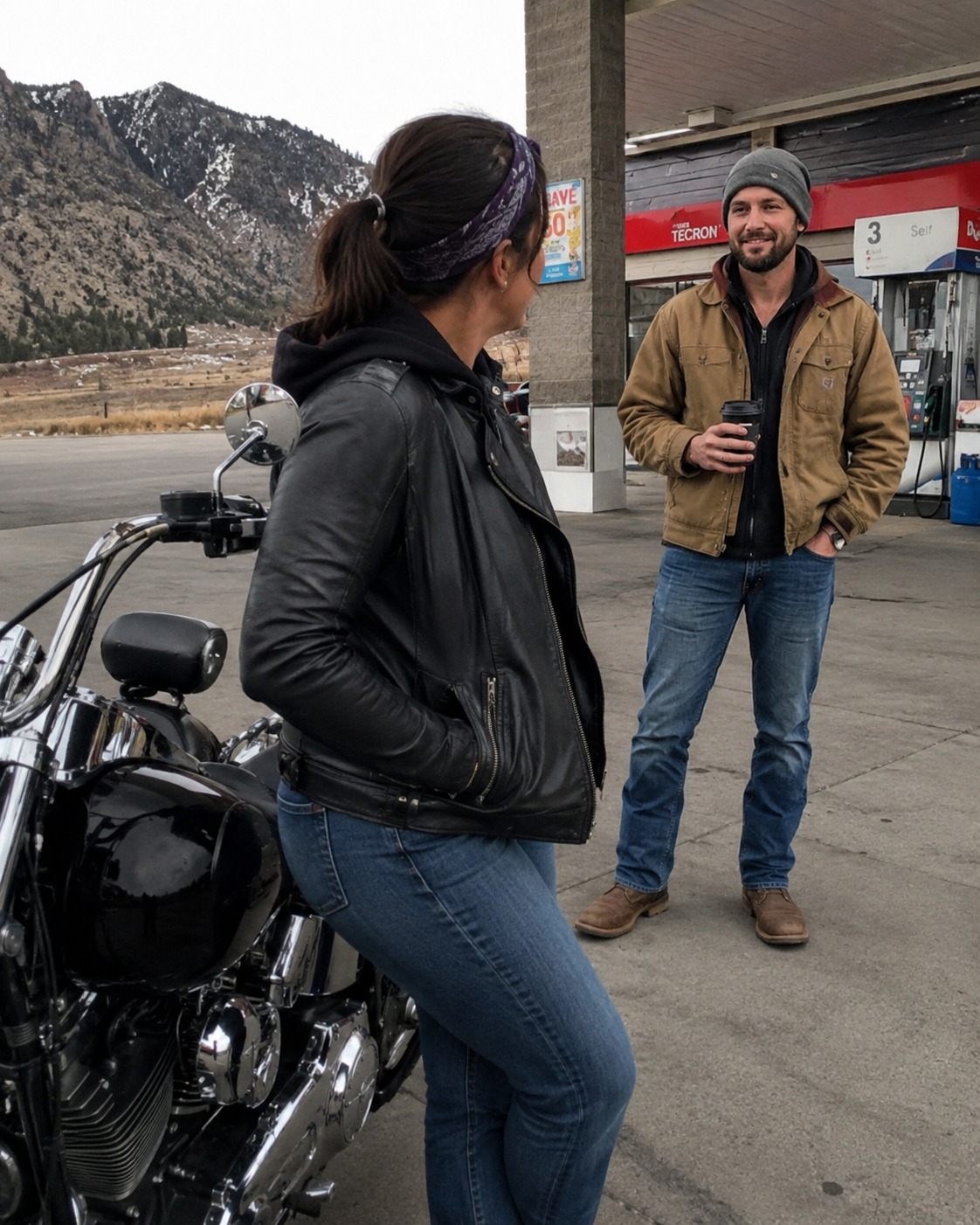
In February of 2022 I stopped at a gas station outside of Tijeras on my way back from a ride into the mountains. Cold day — high thirties, clear, the mountains still carrying snow on the upper elevations. I had been out for three hours. My hands were cold despite the gloves and I needed coffee and to be somewhere heated for ten minutes.
There was one other bike at the station. A large man — sixty, maybe sixty-five — filling up a touring bike. Big road bike, loaded with saddlebags, the kind of setup that says this is not a weekend machine. He had the look of someone who has put real miles behind him, not just on that day but over years.
I filled my tank. I went inside. I got coffee from the machine near the register, which was bad but hot. I paid. I stood at the window for a minute warming my hands on the cup.
The man came in behind me. He got coffee too. He stood at the same window.
We were quiet for a moment, which is normal. Riders at gas stations don’t always talk. Sometimes you just share the space.
Then he said, without looking at me, “How long have you been running from something?”
I turned and looked at him.
He was looking out the window. Not at me. At the road.
He said it without judgment, without assumption, in the tone of someone who is asking a question they already know the shape of the answer to.
I said, “What makes you say that?”
He said, “February. Mountains. Solo. Cold enough that you shouldn’t be out here if you had somewhere warm to be.” He paused. “I rode like that for two years after my wife passed. I know the look.”
I stood there with my bad gas station coffee.
I said, “I’m not running from something. I’m trying to find something.”
He nodded. He looked out the window for a moment.
Then he said, “Same road.”
He finished his coffee. He put the cup in the trash. He nodded at me once in the way riders nod — a small, sufficient acknowledgment — and he went back out to his bike.
I watched him pull out of the station and onto the road heading east. In thirty seconds he was gone.
Same road.
I stood at that gas station window for a while longer than I needed to.
I have thought about those two words more than I have thought about most things people have said to me in thirty-nine years. I have thought about them specifically and I have thought about what they mean and what the man understood when he said them that I was still figuring out.
Running from something. Looking for something. He said it was the same road. And he was right — not in the way of a fortune cookie, not as a vague comfort, but as a literal fact of what riding is. You ride away from what you cannot sit with and you ride toward what you cannot yet see and the road does not distinguish between those two directions. It just takes you.
I had thought, for eighteen months, that I was riding to find something. I had not admitted, even to myself, that I was also riding away. I had not admitted the apartment was too quiet. I had not admitted the space Derek left was not all space I had wanted back — some of it was space I had not known how to fill and had been filling with miles instead.
A stranger at a gas station in February said six words and I drove home understanding something I had been riding around for a year and a half.
I joined a grief support group two months later. Not for the divorce specifically — it was a general group, people processing various losses, which is what a divorce is even when it is the right thing, even when nobody is the villain.
I still ride. I will always ride. The CB500F has 34,000 miles on it now and I am going to ride it until it tells me it’s done.
But I ride differently now. I ride toward things as much as away. I ride on Saturday mornings because the mountains are there and the road is honest and I have learned to want both those things without needing them to save me.
The man at the gas station — I don’t know his name. I never asked. He was gone in thirty seconds and I was not fast enough to think to ask.
But I think about him when I’m on the road sometimes. I think about a man who lost his wife and rode for two years and came out the other side knowing the difference between running and looking — and knowing it didn’t matter, because it was the same road either way.
I hope he found what he was looking for.
I think maybe he did.
I think that’s why he could say it out loud to a stranger at a gas station in February.
You can only name the road when you’ve come to the end of it.