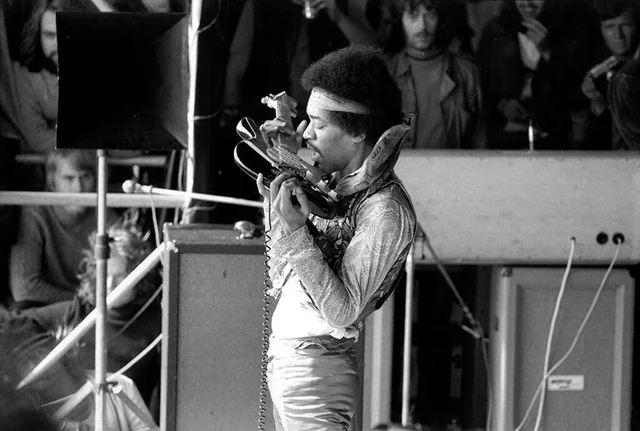
Jimi Hendrix passed away on September 18, 1970, leaving behind an extraordinary musical legacy that continues to inspire generations of rock fans. Widely regarded as one of the greatest guitarists in music history, Hendrix transformed rock with his revolutionary playing style, raw emotion, and unmatched creativity.
Just two days before his death, Hendrix made what is widely regarded as his final public performance. It wasn’t a massive concert or a spectacular farewell. Instead, it was an intimate, low-key appearance at Ronnie Scott’s Jazz Club in London, where he joined Eric Burdon and his band, War, for an impromptu jam session.
On September 16, 1970, Hendrix took the stage alongside Burdon and the musicians, performing covers of Memphis Slim’s “Mother Earth” and John D. Loudermilk’s “Tobacco Road.” The latter is remembered as the final song Hendrix performed live.
Despite the casual setting, his presence was unforgettable. Even among fellow musicians, Hendrix possessed a rare ability to elevate the music around him. Although he reportedly preferred to stay in the background that evening, his appearance became a significant moment in rock history.
After the performance, Hendrix briefly spoke with NME journalist Roy Carr about his future musical ambitions, including plans to collaborate with legendary artists such as Miles Davis and Gil Evans. Those conversations offered a glimpse of the creative possibilities that still lay ahead.
Tragically, Hendrix died in London just two days later, at only 27 years old. The world lost an extraordinary talent far too soon, leaving fans to wonder what other musical boundaries he might have broken.
His final performance was not a grand goodbye. It was simply Jimi Hendrix doing what he loved—making music alongside other musicians. And that is what makes the moment so powerful.
More than five decades later, his music continues to resonate, reminding us that true musical greatness never fades.