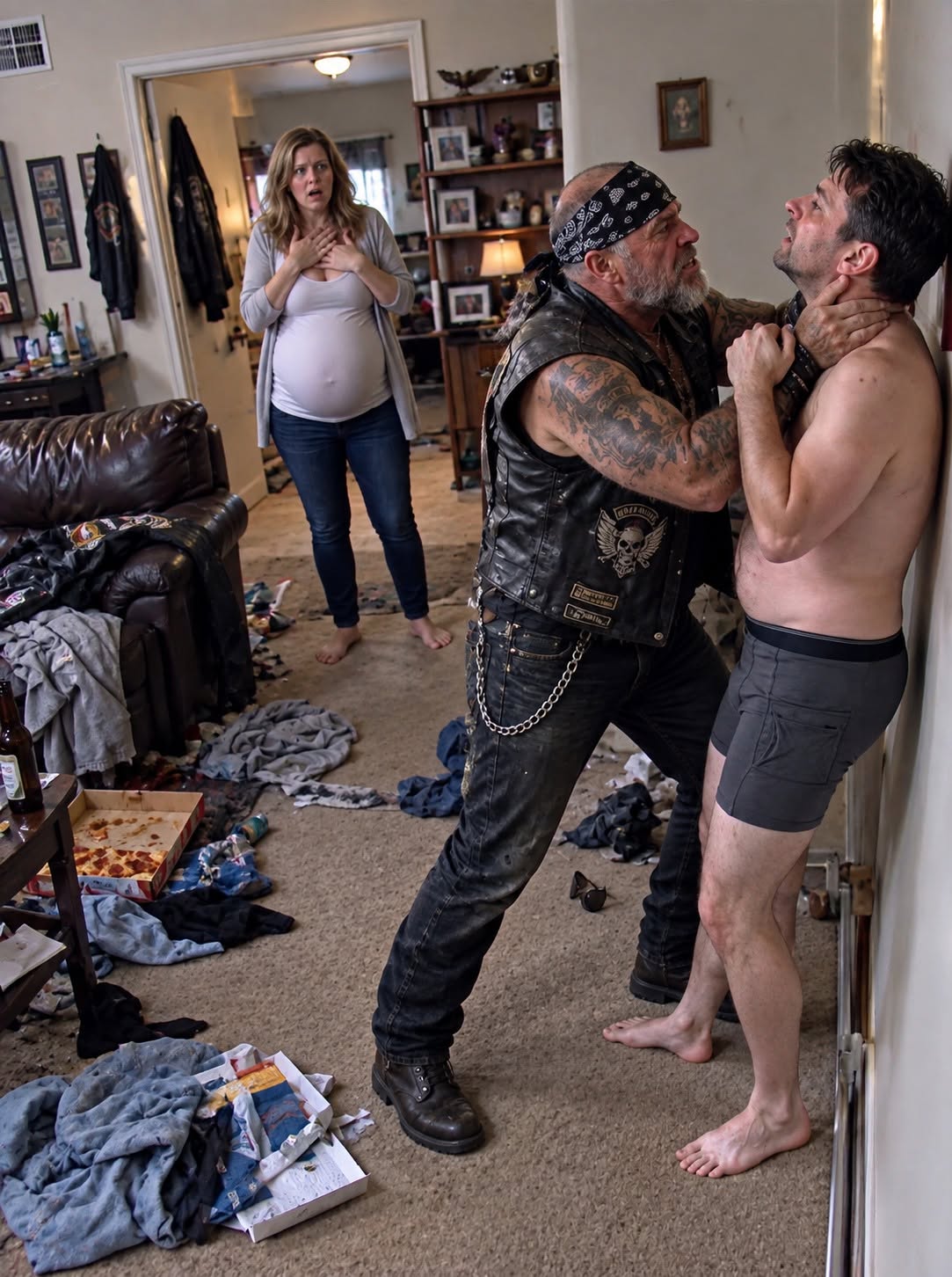
I never told my son-in-law that I had once been one of the toughest outlaw biker. He forced my pregnant daughter to scrub the floors while he sat playing video games.
I spent most of my life answering to a patch, not a rank. Black River MC. Sergeant-at-Arms for eleven years, then I hung the enforcer rocker in a locker at the clubhouse and told the table I was done bleeding for other men’s wars. I still rode. I still showed up when a brother called. But I wanted Mara to know me as Dad, and I wanted the baby she was carrying to know me as Pops, not as the man whose name still made certain bartenders go quiet when it came across a bar.
That Tuesday I rolled up her cul-de-sac on the old Road King with a brown paper sack in the saddbag. Inside was a stuffed hog with a crooked stitch across one ear and a tiny black vest that said PROSPECT in crooked white letters. She was eight months along. I had come to put a crib together.
I knew something was wrong before the kickstand was down.
Mara opened the door like she was expecting a bill collector. Skin damp. Movements small. Every time a shotgun blast rattled out of the living-room speakers she looked that way first, then at me, then at the floor.
“Did you ask him about the crib? I can have it standing before dark.”
“He’s in a tournament, Dad. It’s ranked. He said not to bother him.”
Brett was spilled across the sectional in basketball shorts, a nest of energy-drink cans and chip bags around him like a moat. He did not look at me. He did not look at his pregnant wife. He snapped his fingers toward the kitchen.
“Get me a Dew. The red one. Now.”
Mara turned immediately, swollen ankles and all. I followed her in and reached for a glass so she would not have to stretch. That was when she yanked her sleeve down too late. Concealer had sweated off the upper arm. Under it were fading ovals the exact size of a man’s fingertips.
“Mara.”
“I hit the pantry door. You know how I am.”
Brett bellowed for the drink again. She flinched so hard the ice rattled in the glass. That flinch scared me more than the bruises.
Back in the living room Brett had paused the match because he had found a scuff on the baseboard. He pointed at a scrub brush without getting up.
“I said clean it, Mara. Don’t smear it. You want dinner, you earn dinner. Miss a spot and you don’t eat.”
She started to lower herself toward the floor with that belly in the way and her eyes already wet. That was the end of the visit I thought I was making.
I walked to the entertainment stand and pulled the plug on his console.
The gunfire died. The house went so quiet I could hear the fridge kick on.
Brett came off the couch like I had stolen his wallet.
“You crazy old bastard. Do you know what that match was worth? That was—”
He came at me the way men come when they have only ever hit people who will not hit back. Youth, size, noise. I had spent twenty years reading that exact charge in parking lots and barrooms. I did not think about it. His swing went past my shoulder, his wrist folded the wrong way, and then he was on his knees with his own arm teaching him a lesson he had never signed up for.
I bent so he had to look at me.
“Listen close, boy. You do not run this house while I’m standing in it. Not today.”
Behind me Mara lifted her head. For the first time since I walked in, my daughter was not staring at the carpet.
I let him go and stepped off. He scrambled for his phone on the coffee table, voice cracking on the word *assault*.
“I’m calling the cops. This is my house.”
“Sit down, Mara. Feet up.”
“Dad—”
“Sit.”
She sat. Even with me between them she watched Brett the way a dog watches a hand that has hit it before. That told me everything I needed about the last three years.
I nodded at the brush.
“You wanted the floor clean. You clean it.”
“You don’t tell me what to do in my—”
I did not argue. I just did not move. Outlaw clubs teach you that silence is a tool. Eventually he picked up the brush because the other option was coming through me again, and he already knew how that ended.
He scrubbed the hall, the kitchen, the bathroom, the living room. He cursed his knees, his back, the heat, me.
“My spine’s killing me.”
“She’s been carrying your son for eight months. Keep moving.”
At first Mara watched like she was waiting for the explosion. Then something in her face changed. The giant he had built himself into started shrinking down to a sweating man on all fours with a yellow brush and a ruined tournament.
By dark he was wrung out and looking to her to save him.
“Babe. Tell him. He’s lost it. Tell him to leave.”
Mara looked at the floor.
Then she said, “He missed a spot by the vent, Dad.”
Brett’s face did a thing I have only seen on men who realize the room is no longer theirs.
He went for the knife block.
One big carving knife, the cheap kind with a fake-wood handle. He came around the counter pointing it at the space between me and her belly.
“Get out. Or I cut her.”
Mara’s hands went over the baby.
There is a moment in a fight when the noise drops out and the next two seconds are the only seconds that exist. I took the wrist, turned the edge away from her, put him on the tile, and kept him there with a knee and a hold that would not break his arm unless he made me. The knife skated under the fridge.
“Mara. Phone. Nine-one-one.”
She froze for one breath. Then she walked past him, past me, and picked up the phone without asking his permission.
That was the first free step she had taken in that house in a long time.
She told the dispatcher the truth in a shaking voice that still managed to be clear.
“My husband threatened me with a knife. My father stopped him.”
Red and blue painted the front windows. Two officers came in already tight because they saw the cut on the back of my vest before they saw anything else. One of them clocked the way I had Brett pinned without working him over.
“You club?”
“Black River. Retired from the table. Name’s Ellis Ward.”
The older officer’s mouth flattened. He knew the name, or the patch, or both. He still did his job.
“Let him up slow. Hands where I can see them.”
I let him up. They cuffed Brett while he screamed that a criminal had broken into his castle and assaulted him. The older officer looked at Mara’s arm, then at the knife under the fridge, then at the way she stood with both hands on her stomach and did not look at her husband.
“We’ve been here before,” the officer said to me, low. “Noise. Falls. Nobody ever gave us enough to walk him out.”
I looked at my daughter.
She opened the door that had been closed for three years.
She told them about the money he held, the rooms she was not allowed to leave, the way his voice could turn the whole house into a test she was always failing. She told them the bruises were not pantry doors. She told them about the knife.
“He tried to hurt me. My father stopped him.”
They walked Brett out still talking, still sure that one last threat would yank her back into line. She did not answer him.
When the cars were gone the quiet that settled was a different animal than the quiet of a paused video game. My hands started to shake the way they do when the work is over. My knees reminded me I was fifty-eight, not twenty-eight. Mara was staring at me like she had just watched a man she thought she knew climb out of my skin.
I picked up the paper sack and turned for the door.
“Dad.”
“I didn’t want you seeing that part of me. I spent years putting it in a box so you’d only get the version that puts cribs together.”
She came up behind me and wrapped her arms around my ribs, careful of the belly between us. Her voice was right against the patch.
“You’re not the dark. You’re the wall it hits. Don’t you ride off. Please.”
I had taken punches that hurt less than that. I turned around and held her without touching the marks on her arm, and I cried in my daughter’s kitchen like a man who had finally run out of places to put it.
Getting him out of the house was the easy mile. The rest was the road.
The next morning Mara started talking for real. Brett had not arrived as a monster. He arrived as criticism. Money. Chores. Who she could text. How she was allowed to look when he was losing. She kept thinking if she could just stop being the reason he got angry, the man she married would come back.
The earlier cop calls had followed fights loud enough to travel through drywall. He always went soft before the knock. Then he told her if she opened her mouth they would lose the house and she would be a pregnant woman with nowhere to put her feet.
The baby made the cage smaller. He held the accounts. He called doctor visits a luxury. Telling her to scrub a floor for dinner had started to feel like weather.
I sat there knowing I had drunk coffee in that kitchen a dozen times and believed every careful story she handed me. I had read rooms for a living. I had missed the one that mattered.
She saw it on my face.
“I hid it because I knew what you’d do.”
“What did you think I’d do?”
A tired almost-smile. “Pretty much exactly that.”
We laughed, and it sounded like a door unsticking.
In the weeks after, she wrote it all down. Old calls. Bank records. The knife. Brett’s people tried to sell a story about an unstable biker who kicked in a suburban door and humiliated a gamer. That story died against Mara’s voice and a carving knife with his prints on the handle.
She changed the locks. She split the money. His tower, his headsets, the ring of cans around the couch — all of it went out to the curb like trash after a rally. Brothers from the club offered to “talk to him.” I told them no. This one stayed inside the law because Mara was going to raise that boy in a house that did not owe the club a body.
Then we built the crib.
I opened the wrinkled sack from the day everything broke and set the stuffed hog in the corner of the mattress. The little vest still said PROSPECT.
Mara watched me.
“You still think you’re ready to be Pops?”
“Depends if this kid can follow a simple rule.”
“Which is?”
“You don’t raise a hand to family. Ever.”
She laughed and did not check another room to see if the laugh was allowed.
Three months later I came back to the same house and the air was different. Windows open. Board books where the console had been. Coffee and baby powder instead of energy drink and carpet cleaner.
Mara opened the door wrecked in the way new mothers are wrecked. She was smiling.
In her arms was the boy I had ridden over to meet in the first place.
I sat on the couch with Jonah against my chest in a blue blanket. He got my thumb in that fierce newborn grip that feels like a promise you have not earned yet.
“Strong hands,” I told him. “Good. The world pulls. You hold on.”
Mara brought coffee and sat down without asking anyone’s permission to take up space.
“He giving you trouble, Hound?”
“Negative. We’re covering house rules.”
“Rule one?”
“You respect your mother. She’s the toughest human you will ever meet.”
Jonah made a small sound that I decided was agreement.
“Rule two?”
“You don’t quit when it gets ugly. You ride through.”
“Rule three?”
I kissed the down on his head.
“Family stands up. That’s the whole patch.”
The stuffed hog watched from the crib. I thought about the man I had tried not to be in front of her, and about the sentence she had put on my back when I tried to leave.
Not the dark. The wall it hits.
There were no brothers waiting on a vote. No prospect sweating a punishment. No frightened woman measuring her breath against a man on a couch.
Just a house that did not flinch when a floorboard creaked.
I looked at my grandson.
“Prospect period’s over, little man. You’re in.”
Outside, the neighborhood went on being ordinary. Inside, Mara’s head found my shoulder and Jonah breathed against the old scar tissue over my heart.
For the first time since I pulled that plug, nobody in that house was waiting for a voice from the next room.
The door was locked because we chose it.
The unit was intact.
And for once, I let the engine cool.