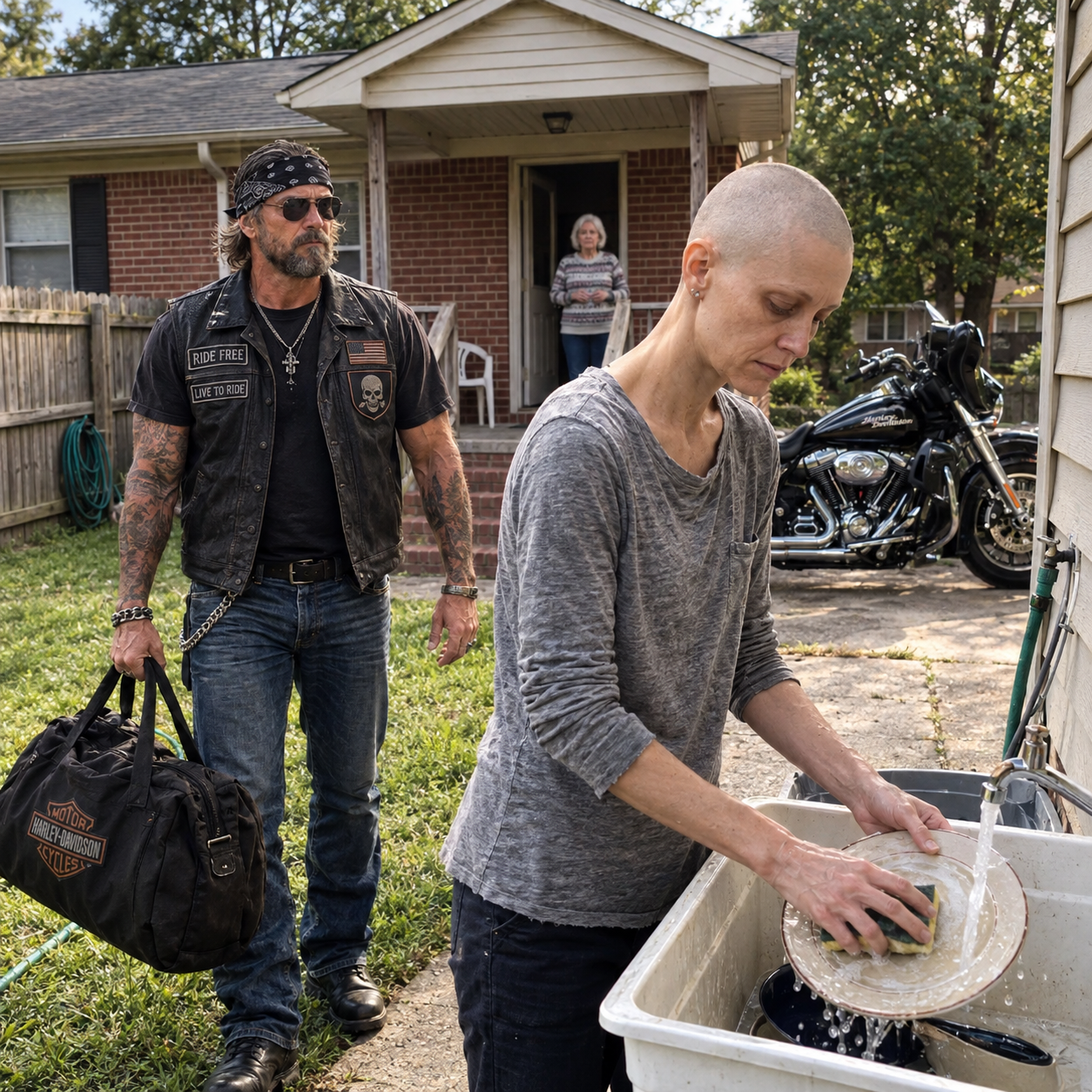
For three years, I believed I knew exactly what I was sacrificing for.
My wife. Our home. Our future.
Every dollar I earned in the frozen wilderness of Alaska was supposed to bring us closer to the life we had dreamed about.
Instead, when I finally came home without warning, I discovered that the people I trusted most had been living inside the house I paid for while my wife was fighting for her life behind it.
And what I learned that night almost destroyed me.
My name is Cole Mercer.
Most people who know me would describe me as a biker before they described me as anything else.
I rode a black Harley-Davidson Road King that I’d rebuilt with my own hands. The bike was loud, heavy, and scarred in places, just like me.
But beneath the leather vest, tattoos, boots, and beard, I was just a husband trying to provide for his family.
Three years earlier, I had accepted a job in Alaska.
It wasn’t glamorous.
It was dangerous, exhausting, and brutally cold.
I worked on remote industrial sites where the wind could cut through several layers of clothing, where darkness lasted longer than you wanted it to, and where one careless mistake could put you in a helicopter—or a body bag.
The money was good.
Very good.
But there was a price.
I would spend months away from home.
Sometimes I wouldn’t see my wife for half a year.
Her name was Mara.
And Mara was the reason I kept going.
Before I left, we had a small house and a simple dream.
Nothing fancy.
Just a comfortable place.
A reliable truck.
Maybe a bigger garage someday.
And enough money that neither of us would ever have to worry about medical bills, rent, or groceries again.
The morning I left for Alaska, Mara hugged me so tightly that I could barely breathe.
“Come back to me,” she whispered.
“I will.”
“You promise?”
I kissed her forehead.
“I promise.”
She smiled.
“Then I’ll wait.”
Those words stayed with me.
Every single day.
THE MONEY
My first year in Alaska was brutal.
The second was worse.
But I never complained.
Every paycheck went into our account.
I kept only enough for food, equipment, fuel, and the occasional beer with the guys after a shift.
The rest went home.
I wanted Mara to know that my being gone wasn’t pointless.
Whenever I called her, I’d ask the same question.
“Did you get the money?”
“Yes.”
“Are you okay?”
“I’m fine.”
“Need anything?”
“No, Cole.”
She always sounded tired.
But I assumed she was lonely.
I was lonely too.
One night, during a storm, I called her from a temporary camp.
The wind outside was screaming against the metal walls.
“Mara?”
“Yeah?”
“You sound different.”
“I’m just tired.”
“You sure?”
There was a pause.
Then she laughed softly.
“You’re always worrying.”
“That’s because you’re my wife.”
“I know.”
Another pause.
Then she said something that I didn’t understand at the time.
“I miss the old you.”
I smiled.
“The old me?”
“The guy who used to come home covered in grease and take me for a ride without telling me where we were going.”
I laughed.
“I still do that.”
“No.”
Her voice became quiet.
“You don’t.”
I didn’t think much of it.
I told her I loved her.
She said it back.
Then the call ended.
I went back to work.
Months passed.
Then years.
By the time my third year in Alaska was coming to an end, I’d sent home almost $120,000.
I thought we were building something.
Mara told me the house had been renovated.
Then she said there was a new truck.
Then new furniture.
I was proud.
I imagined coming home and seeing everything we’d worked for.
But something about Mara’s voice bothered me.
She rarely talked about the house.
She never sent pictures.
Whenever I asked, she’d change the subject.
“Why don’t you show me the renovations?”
“Later.”
“Why?”
“I’m busy.”
“You always say that.”
“I’m sorry.”
Eventually, I stopped asking.
I trusted her.
Or at least, I thought I did.
THE RETURN
Three months later, my contract ended unexpectedly.
I could have stayed another six months.
But an opportunity came up.
I was going home.
And I decided not to tell anyone.
Not Mara.
Not my family.
Nobody.
I wanted to surprise my wife.
I imagined pulling into the driveway on my Harley.
I imagined her opening the door.
I imagined her face.
Maybe she’d cry.
Maybe she’d jump into my arms.
I even bought her a necklace in Anchorage.
Nothing extravagant.
Just a small silver pendant.
I kept it in my jacket pocket.
On the flight home, I couldn’t stop smiling.
I felt like a kid.
After years of cold mornings, dangerous work, and sleeping in temporary camps, I was finally going home.
When I reached my hometown, I rented a truck and picked up my Harley from storage.
Then I rode toward the house.
I hadn’t seen it in years.
As I turned onto our street, I almost didn’t recognize the place.
The small house we’d bought was gone.
In its place stood a beautiful two-story home.
Fresh brick.
New windows.
Stone walkway.
Huge front gate.
A new black SUV sat in the driveway.
I slowed down.
My first thought was:
Mara did all this.
I felt proud.
Maybe she had managed our money better than I realized.
Maybe we’d finally made it.
I parked several houses away.
I didn’t want anyone to see me.
I walked toward the property.
Then I noticed something strange.
There were expensive curtains in the upstairs windows.
New furniture.
A large television visible through the glass.
Everything looked perfect.
Too perfect.
I walked around the side of the house.
That’s when I heard water running.
Then a plate breaking.
CRASH!
I froze.
A woman’s voice came from behind the house.
“Pick that up!”
Another voice answered.
Soft.
Weak.
“I’ll clean it.”
I knew that voice.
Mara.
I hurried around the corner.
And stopped.
My entire body went cold.
Mara was kneeling beside an old plastic basin.
Her hair was gone.
Completely gone.
She was wearing a loose gray sweater that looked several sizes too big.
Her arms were frighteningly thin.
She was washing dishes outside.
In the dirt.
There was a pile of broken plates beside her.
I couldn’t breathe.
“Mara?”
She froze.
Her hands stopped moving.
Slowly, she turned around.
Our eyes met.
For a second, neither of us moved.
Then she stood.
Or tried to.
Her knees almost gave out.
“Cole?”
Her voice was barely audible.
I walked toward her.
“Mara…”
She backed away.
“No.”
“What happened to you?”
She grabbed her head with both hands.
“Why are you here?”
“I came home.”
“You weren’t supposed to come home.”
Those words hit me harder than anything.
“What do you mean?”
She looked toward the house.
Fear appeared in her eyes.
Real fear.
“Cole, you need to leave.”
“What?”
“Please.”
Before I could answer, someone shouted from inside.
“Mara! Why are you standing around?”
Then a woman’s voice.
My mother’s voice.
Evelyn.
“Get back to the dishes!”
My blood ran cold.
My mother stepped through the back door.
She was wearing an expensive silk robe.
Gold bracelet.
Diamond earrings.
She looked nothing like the woman I remembered.
She stared at me.
For several seconds, her face went completely blank.
Then she smiled.
“Cole?”
I didn’t answer.
My sister Tessa appeared behind her.
She was holding a brand-new smartphone.
She looked at me.
Then at Mara.
Then back at me.
Her face changed.
“You’re home?”
I looked at my mother.
Then at my sister.
Then at Mara.
“What happened to my wife?”
My mother sighed.
“Oh, Cole.”
She walked toward me as if nothing was wrong.
“Mara has been struggling.”
“Struggling?”
“She became obsessed with losing weight.”
Tessa laughed.
“She barely ate.”
I looked at Mara.
She lowered her eyes.
My mother continued.
“And she destroyed her own hair with some cheap chemicals.”
I stared at the shaved scalp.
“Her hair?”
“Yes.”
My mother shrugged.
“She did it to herself.”
Tessa crossed her arms.
“She’s always been dramatic.”
I looked at Mara.
She didn’t defend herself.
That frightened me more than anything.
THE FIRST LIE
I walked closer to my wife.
“Mara, look at me.”
She wouldn’t.
I gently lifted her chin.
She flinched.
I immediately stopped.
“Who hurt you?”
“No one.”
“Don’t lie to me.”
“I’m not.”
My mother interrupted.
“Cole, you’re exhausted. You just got back.”
I turned toward her.
“Why is my wife washing dishes outside?”
“She prefers staying busy.”
“Why is she so thin?”
“Stress.”
“Why is she bald?”
“Like I said, she did it herself.”
“And why does she look afraid?”
My mother didn’t answer.
Tessa stepped forward.
“You’ve been away too long.”
I looked at her.
“What does that mean?”
“You don’t know what she’s like anymore.”
I felt something inside me snap.
But I didn’t show it.
Three years in Alaska had taught me something.
When you’re surrounded by danger, panic gets people killed.
You don’t react.
You observe.
You listen.
You wait.
So I forced a smile.
“You’re right.”
Everyone looked surprised.
I put my arm around Mara.
“I’m just shocked.”
My mother relaxed.
Tessa smiled.
Then I said:
“Actually, I came home with some great news.”
Their expressions changed immediately.
“I received a major contract completion bonus.”
Tessa’s eyes widened.
“How much?”
I smiled.
“Enough.”
My mother stepped closer.
“How much, exactly?”
“Almost four hundred thousand dollars.”
Silence.
Then Tessa smiled.
“Four hundred thousand?”
I nodded.
“That’s incredible.”
My mother grabbed my arm.
“I knew everything would work out.”
I looked at her hand.
Then at Mara.
My wife looked confused.
I kissed Mara’s forehead.
“We’ll talk tonight.”
She whispered:
“Cole…”
“It’s okay.”
But it wasn’t.
Not even close.
THE HOUSE
That evening, my mother prepared a huge dinner.
Steak.
Wine.
Expensive desserts.
Tessa talked about vacations.
My mother talked about renovating the kitchen.
Nobody mentioned Mara.
Nobody asked why she wasn’t eating.
She sat quietly at the end of the table.
I watched.
She barely touched her food.
Tessa noticed.
“You’re not hungry?”
Mara shook her head.
My mother rolled her eyes.
“See? She does this all the time.”
I kept eating.
But I wasn’t tasting anything.
I was watching.
Later, my mother showed me the house.
“Look at this kitchen.”
She smiled.
“Your money really changed everything.”
I stopped.
“My money?”
She laughed.
“Of course.”
“What happened to the old house?”
“We renovated.”
“With what?”
“With the money you sent.”
I looked around.
Everything was expensive.
But something didn’t add up.
I’d sent roughly $120,000.
This house looked like it had cost much more.
“Where’s Mara’s room?”
My mother pointed upstairs.
“She’s sleeping in the storage room right now.”
I stared at her.
“What?”
“She’s difficult.”
“You put my wife in a storage room?”
“Only temporarily.”
I walked upstairs.
I opened the door.
The room was dark.
A thin mattress lay on the floor.
A blanket.
One plastic box.
And a small photograph of me and Mara.
I picked it up.
It was from our wedding.
Mara looked happy.
Healthy.
Her eyes were bright.
I turned the photograph over.
Written on the back were four words:
“Please come home soon.”
My hands tightened around it.
Then I heard footsteps behind me.
Mara.
She whispered:
“Don’t ask questions here.”
“Why?”
“Because they’re listening.”
I looked toward the hallway.
“Who?”
She shook her head.
“Not here.”
THE STORAGE ROOM
Later that night, I waited until everyone was asleep.
Then Mara came downstairs.
She closed the door behind her.
I followed her into the storage room.
She sat on the mattress.
I sat beside her.
For a while, neither of us spoke.
Then I noticed something.
Her hands were shaking.
“Mara.”
She looked at me.
“What?”
“What happened?”
She swallowed.
“I didn’t want you to find out like this.”
“Find out what?”
She looked down.
Then slowly pulled the sleeve of her sweater upward.
There was a hospital bracelet around her wrist.
I stared at it.
“When was that?”
“Five months ago.”
“Why?”
She didn’t answer.
“Mara.”
She took a breath.
Then whispered:
“I have cancer.”
The world stopped.
I couldn’t hear anything.
The room seemed to disappear.
“What?”
“They found a tumor.”
My heart pounded.
“Where?”
She touched her side.
“I started getting sick months ago.”
“Why didn’t you tell me?”
“I tried.”
“What do you mean?”
“I called your mother.”
My jaw tightened.
“What did she say?”
Mara’s eyes filled with tears.
“I asked her for money.”
“How much?”
“Three hundred dollars.”
“For what?”
“A specialist.”
“And?”
“She told me you were sending enough money already.”
I stared at her.
“Then what?”
“She said I was trying to steal from you.”
My fists tightened.
“Who paid for the hospital?”
Mara looked away.
“I sold my hair.”
I couldn’t speak.
“You sold your hair?”
She nodded.
“They gave me $150.”
I touched my face.
She continued.
“I used it for transportation and the biopsy.”
I looked at her bald head.
The pieces finally came together.
She hadn’t shaved her head because she was obsessed with losing weight.
She had lost her hair because of treatment.
She had become thin because she was sick.
And while I was working thousands of miles away, the people I trusted had watched it happen.
“Mara…”
She grabbed my hand.
“Don’t.”
“Why didn’t you tell me?”
“I did.”
“What?”
“I sent you messages.”
I stared at her.
“I never got them.”
She nodded.
“I know.”
“What do you mean?”
“My calls stopped going through.”
“Who controlled the phone?”
She hesitated.
“Tessa.”
I felt my stomach drop.
“She said you were working and didn’t want distractions.”
I stood up.
“Where are the messages?”
“I don’t know.”
Then she said:
“There’s something else.”
I turned around.
“What?”
“The money.”
“What about it?”
She looked terrified.
“Not all of it went to the house.”
My heart began pounding again.
“Where did it go?”
“I don’t know.”
“But your mother and sister do.”
THE LEDGER
The next morning, I didn’t confront anyone.
Instead, I went into town.
I contacted the bank.
Because I was the primary account holder, I requested every statement from the last three years.
I sat in a coffee shop and opened the records.
At first, everything looked normal.
Mortgage.
Utilities.
Construction.
Furniture.
Then I saw withdrawals.
Thousands of dollars.
Repeatedly.
Cash withdrawals.
Transfers.
Luxury purchases.
Payments to a dealership.
A jewelry store.
A resort.
A private club.
My mother had been spending my money.
My sister had been spending my money.
But there was something even worse.
A transfer of $18,500 to an account I didn’t recognize.
Then another.
$12,000.
Then $9,700.
I wrote down every transaction.
By the time I finished, my hands were shaking.
Almost $70,000 was missing.
Money I thought was building our future.
Money my wife desperately needed.
Money that had apparently disappeared.
I called the bank.
“Can you tell me who authorized these transfers?”
They couldn’t give me details over the phone.
But they could flag the account.
I did.
Then I called an attorney.
And that’s when I discovered something that made everything darker.
The house wasn’t fully paid for.
The truck wasn’t paid for.
The furniture wasn’t paid for.
My family had taken out loans using my income as proof.
They had built a lifestyle on money they didn’t have.
And they were planning to use my supposed $400,000 bonus to keep it alive.
I sat in my truck for almost an hour.
Then I called one person.
A former friend from Alaska named Ray Dalton.
Ray had worked with me on the same remote sites.
He knew how I operated.
“What’s going on?” he asked.
“I need you to do something for me.”
“What?”
“Find someone who can investigate financial records.”
There was a pause.
Then he said:
“How bad?”
I looked at the house.
“Bad.”
THE SECRET PHONE
That night, Mara gave me an old phone.
“I hid this.”
“Why?”
“They took my other one.”
I turned it on.
There were dozens of unsent messages.
Some were addressed to me.
Cole, please call me.
I’m not feeling well.
Something is wrong.
I went to the hospital.
Please don’t be angry.
Then one message stopped me cold.
It was dated five months earlier.
Your mother knows I’m sick. She told me if I tell you, she’ll make sure you never come back to me.
I read it three times.
Then another message.
Tessa said she can make sure you think I’m cheating on you.
My blood ran cold.
I looked at Mara.
“Did they threaten you?”
She nodded.
“Every day.”
“Why didn’t you leave?”
“Where would I go?”
I had no answer.
Then she reached under the mattress.
She pulled out a small envelope.
Inside were hospital documents.
Diagnosis.
Treatment recommendations.
Invoices.
And a handwritten note.
I recognized the handwriting.
My mother’s.
I read it.
“Don’t waste Cole’s money on unnecessary treatment. He worked too hard for us to throw it away.”
My vision blurred.
Us.
Not Mara.
Us.
My mother had never considered my wife part of the family.
She considered herself and my sister the family.
And me?
I was the paycheck.
THE TRAP
The next morning, I announced that the $400,000 was ready.
Everyone celebrated.
My mother ordered champagne.
Tessa immediately started looking at luxury SUVs online.
I watched them.
Then I said:
“There’s one condition.”
They stopped.
“What condition?” my mother asked.
“The money will only be released through a financial manager.”
She frowned.
“Why?”
“Because of taxes.”
Tessa rolled her eyes.
“How much paperwork?”
“A lot.”
My mother smiled.
“Of course.”
I nodded.
“There’s another thing.”
“What?”
“I need everyone to sign some documents.”
“What documents?”
“Asset disclosures.”
My mother’s face changed.
“What?”
“It’s required.”
Tessa looked nervous.
“Why?”
“Because of the amount.”
They agreed.
They had no idea what I already knew.
The next two days were a waiting game.
My attorney gathered documents.
The bank investigated transfers.
Ray sent me information.
And then something unexpected happened.
The bank discovered that one of the accounts receiving my money belonged to a company connected to Tessa’s boyfriend.
That company didn’t actually operate.
It was a shell.
My sister had been moving money through it.
But why?
That question bothered me.
Then Ray called.
“Cole.”
“Yeah?”
“You need to sit down.”
I was already sitting.
“What?”
“The money wasn’t just spent.”
“What do you mean?”
“Some of it was transferred out of state.”
“Where?”
“Alaska.”
My heart stopped.
“Alaska?”
“Yeah.”
“Why would my sister send money to Alaska?”
“I don’t know.”
Then he sent me a name.
I stared at the screen.
The name belonged to a man I’d met once.
A private investigator.
My sister had apparently hired him.
To investigate me.
I called Ray.
“Why would Tessa investigate me?”
“I don’t know.”
Then he said:
“There’s one more thing.”
“What?”
“The investigator wasn’t only watching you.”
“Who was he watching?”
“Mara.”
THE REAL REASON
That night, I confronted Mara.
“Did someone follow you?”
She looked terrified.
“Yes.”
“Who?”
“I don’t know.”
“How long?”
“Months.”
“Why?”
She hesitated.
Then finally said:
“I found something.”
“What?”
“Your mother was taking money.”
“I know.”
“No.”
She shook her head.
“You don’t understand.”
“What?”
“She wasn’t just stealing from you.”
I stared at her.
“She was hiding something.”
“What?”
Mara looked toward the door.
Then whispered:
“The house.”
“What about it?”
“Your mother didn’t renovate it with your money.”
“Then who did?”
“She sold something.”
“What?”
Mara looked at me.
“Your father’s property.”
My entire body went numb.
My father had died years earlier.
Before he died, he’d left me a small piece of land.
It wasn’t worth millions.
But it was valuable.
And I had never sold it.
I had trusted my mother to manage the paperwork.
“She sold it?”
Mara nodded.
“While you were in Alaska.”
“How much?”
“Over two hundred thousand.”
I couldn’t breathe.
That money wasn’t mine to give away.
My father’s final gift to me had been sold without my permission.
And suddenly everything made sense.
The new house.
The expensive truck.
The jewelry.
The lifestyle.
My mother’s confidence.
She hadn’t just been spending my money.
She had been hiding the sale of my inheritance.
But there was still one question.
“Why was Tessa investigating you?”
Mara whispered:
“Because I found the documents.”
THE NIGHT EVERYTHING EXPLODED
I decided to confront them.
But not alone.
My attorney was waiting outside.
Two investigators were there.
Ray was on the phone.
And I had every bank statement printed.
I walked into the living room.
My mother and sister were sitting on the couch.
Tessa looked annoyed.
“What’s this about?”
I put a folder on the table.
“Everything.”
My mother frowned.
“What?”
I opened it.
“Every transfer.”
Silence.
“Every withdrawal.”
Tessa’s face went pale.
“Every purchase.”
My mother stood.
“Cole—”
“Don’t.”
She stopped.
I looked at her.
“You told me Mara was sick because she was irresponsible.”
Silence.
“You told me she cut her hair because of chemicals.”
Nothing.
“You told me she was starving herself.”
Tessa looked away.
“She was sick.”
My voice became quiet.
“She had cancer.”
My mother whispered:
“She exaggerated.”
That was the moment something inside me broke.
I slammed the hospital records onto the table.
“The doctors say otherwise.”
Tessa started crying.
My mother didn’t.
She looked angry.
“You have no idea how hard we worked to keep this family together.”
I laughed.
“Family?”
I pointed upstairs.
“My wife slept on a mattress in a storage room.”
Then I pointed at the kitchen.
“You ate steak while she couldn’t afford treatment.”
I pointed at the expensive furniture.
“She sold her hair for $150.”
Nobody spoke.
I took out another document.
“And this?”
My mother looked at it.
Her face changed.
“The property sale.”
She stepped backward.
“You weren’t supposed to know.”
“Exactly.”
THE CONFESSION
Tessa suddenly stood.
“Mom…”
“Be quiet.”
“No.”
Tessa began crying.
“Cole needs to know.”
My mother turned toward her.
“Don’t you dare.”
But Tessa kept talking.
“We thought you would stay in Alaska.”
I stared at her.
“Why?”
“Because you were making money.”
“So?”
“You were sending more every month.”
“And?”
She looked at my mother.
“We didn’t want Mara controlling it.”
My stomach turned.
“You stole from me.”
Tessa shook her head.
“We thought we were protecting you.”
“From my wife?”
She didn’t answer.
Then my mother finally said:
“Mara was going to leave you.”
“What?”
“She was sick. She was unstable. We thought if you knew, you’d come home and waste everything.”
I stared at her.
“You let my wife suffer so I wouldn’t stop sending money.”
My mother didn’t answer.
That was answer enough.
THE DECISION
The police eventually arrived.
The financial investigation continued.
My mother’s attorney arrived.
Tessa gave a statement.
The house became evidence in a case I never imagined I’d be part of.
But none of that mattered to me that night.
I went upstairs.
I found Mara sitting beside the window.
She looked exhausted.
I sat beside her.
“Come with me.”
She looked at me.
“Where?”
“Anywhere.”
She shook her head.
“I don’t want your family destroyed.”
I smiled sadly.
“Mara, they destroyed themselves.”
She began crying.
“I didn’t want you to lose everything.”
I took her hand.
“Everything?”
I looked at her.
“You are everything.”
She closed her eyes.
For the first time in years, she leaned against my shoulder.
THE HARLEY
Two days later, I brought my Harley around to the front of the house.
Mara looked at it.
“You still have that?”
I smiled.
“Of course.”
She laughed for the first time in months.
I helped her put on a jacket.
Then I handed her a helmet.
She stared at me.
“I haven’t ridden with you in years.”
“I know.”
“You sure I can?”
“I’ll go slow.”
She climbed onto the back.
I started the engine.
The familiar rumble filled the street.
For the first time in years, I wasn’t riding away from home.
I was taking my wife away from everything that had hurt her.
We drove toward the mountains.
The wind hit my face.
Mara wrapped her arms around me.
And for the first time since I had left for Alaska, I felt something I hadn’t felt in years.
Peace.
SIX MONTHS LATER
The investigation eventually uncovered far more than I expected.
The property sale had been unauthorized.
The financial records showed years of unexplained transfers.
Some money was recovered.
Some wasn’t.
Tessa cooperated with investigators.
My mother refused to admit wrongdoing until the evidence became impossible to deny.
But none of that changed the most important thing.
Mara survived.
Her treatment was difficult.
There were good days.
There were terrible days.
There were days when she couldn’t get out of bed.
But she fought.
And I stayed.
Every appointment.
Every test.
Every sleepless night.
I wasn’t going back to Alaska.
At least not for a while.
One afternoon, Mara and I sat outside a small café.
She had started growing her hair again.
It was short.
Soft.
Beautiful.
She touched it and smiled.
“Do you remember the first thing you said when you came home?”
I smiled.
“I asked what happened to you.”
She shook her head.
“No.”
“What?”
“You said, ‘I’m here.'”
I looked at her.
“Yeah.”
She smiled.
“That’s all I needed.”
I reached across the table and held her hand.
The Harley sat outside.
The same black bike.
The same scars.
The same engine.
But I wasn’t the same man who had left for Alaska.
I had gone north thinking money could protect the people I loved.
I came home understanding something completely different.
Money can build a house.
It can buy a truck.
It can fill a room with expensive furniture.
But it cannot buy loyalty.
It cannot buy love.
And it certainly cannot tell you who will stand beside you when everything falls apart.
That lesson almost cost me my marriage.
Almost cost my wife her life.
And nearly destroyed the family I thought I knew.
But sometimes the truth doesn’t arrive gently.
Sometimes it crashes into your life like a Harley engine roaring through a quiet street.
And when it does, you have only two choices.
Ignore it.
Or face it.
I chose to face it.
And that choice saved my wife’s life.
But there was one final thing Mara told me months later.
Something I’d never forget.
We were sitting on our porch when she looked at me and said:
“Cole?”
“Yeah?”
“If you hadn’t come home that day…”
She stopped.
I squeezed her hand.
“I did.”
“But what if you hadn’t?”
I looked at her.
“Then I would have come home the next day.”
She smiled through tears.
“How do you know?”
I kissed her forehead.
“Because no matter how far I ride…”
I looked toward the Harley parked beneath the porch light.
“…I always find my way back to you.”