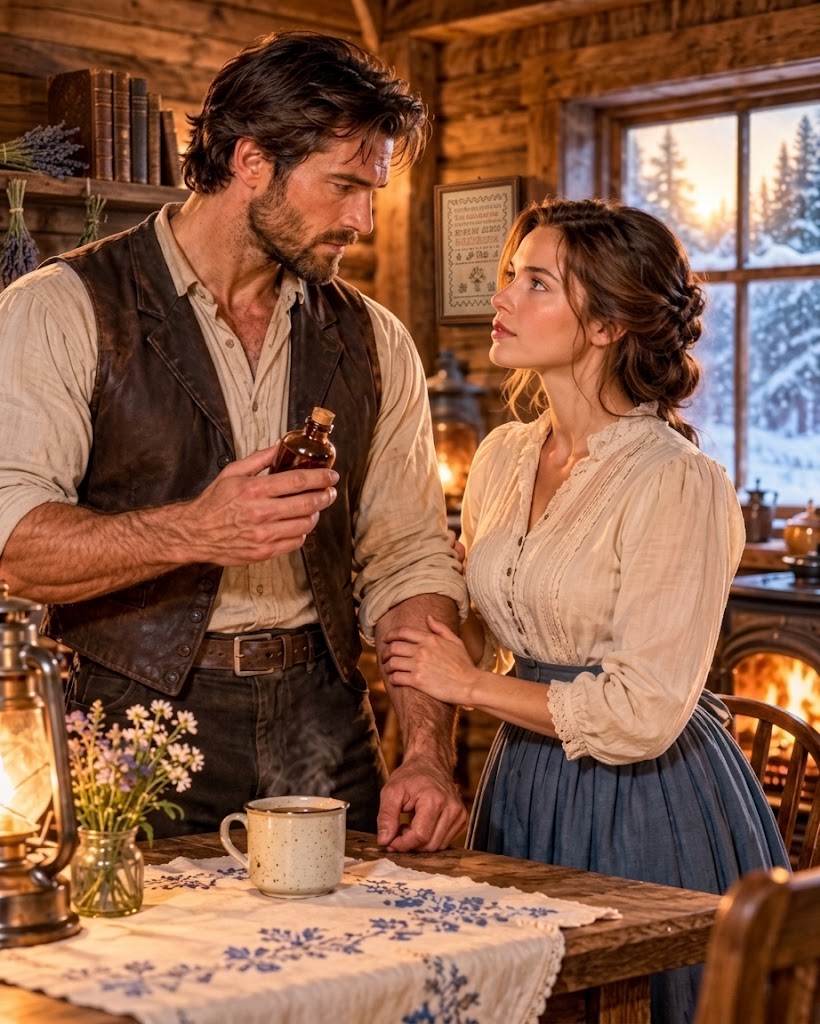
He Expected a Loveless Marriage—Until His Mail-Order Bride Left Something Beside His Coffee That Changed Everything
Silas Mercer had married a stranger expecting nothing more than a quiet woman to share his lonely Montana cabin. But when his mail-order bride placed a small brown medicine bottle beside his coffee, he realized she had noticed the pain he had desperately tried to hide. And for the first time in years, the hardened cowboy began to fear something more than loneliness: letting someone care about him.
Chapter One: The Stranger at the Station
Three weeks earlier, Clara Whitfield had arrived in Copper Ridge aboard a stagecoach long after sunset.
Snow clouds gathered above the mountains as Silas Mercer waited beneath the station’s weathered awning, clutching a faded photograph of the woman he had agreed to marry. He had read the letter that came with it so many times the folds had gone soft as cloth. Twenty-six years old. Healthy. Good with a needle and a stove. Asks nothing but a roof and an honest man.
An honest man. He could manage that much, at least.
He wanted a wife to share his home, not his heart. His heart, he had decided long ago, was buried on a hillside behind his cabin under a cross he had carved himself.
The stagecoach rocked to a stop in a spray of slush. The driver climbed down, grumbling about the cold, and swung open the door.
Clara stepped down carrying one battered suitcase. Chestnut curls had escaped her bonnet and clung to her cheeks in the damp air, and her steady brown eyes met his without hesitation. She was younger-looking than her photograph and more tired, as if the road had taken something from her that the picture had not yet lost.
“I’m Clara Whitfield.”
“I know.”
Those were nearly all the words they exchanged that evening.
The justice of the peace, a stooped man named Abner Cobb, had been waiting in the back of the general store with a lamp and a ledger. The ceremony took six minutes. Silas said “I do” in the voice of a man agreeing to a price at a cattle auction. Clara said it more quietly, but she did not look away from him while she said it, and that unsettled him more than tears would have.
When it was done, Abner Cobb signed the certificate with a flourish and wished them a long and happy life. Neither of them answered.
Silas helped her onto his horse, a tall bay gelding named Ransom, and they traveled through darkening pine forests toward his isolated cabin. The trail climbed steadily. Wind moved through the branches overhead with a sound like a long exhale.
Clara held the saddle rather than his waist.
Neither attempted to close the distance.
Somewhere in the second hour, as the first flakes began to fall, she spoke. “Is it far?”
“Another mile.”
“Thank you for coming for me.”
He didn’t know what to do with that, so he said nothing, and the horse carried them on.
Chapter Two: Blue Flowers on a Rough Table
The cabin was clean but painfully bare. Every chair, shelf, and household object seemed arranged to preserve a life that had stopped changing long ago. A single cup hung on a single hook. The bed in the main room had been made so tightly, and for so long, that the quilt had forgotten how to be slept under.
“The bedroom is yours,” Silas told her. “I’ll sleep upstairs.”
“You don’t have to–”
“I do.”
He disappeared up the ladder before she could finish.
Clara stood alone in the lamplight, listening to the boards creak above her as he settled. She had expected many things on the long journey from Missouri. She had prepared herself for cruelty, for coldness, even for a man who drank. She had not prepared herself for a stranger who gave away his own bed and climbed a ladder rather than make her uncomfortable.
She unpacked quietly.
The first thing she removed was a white tablecloth embroidered with delicate blue wildflowers, each tiny blossom stitched with a patience that spoke of long evenings and a steady hand. It was the only beautiful thing she had brought. Her mother had made it the winter before she died, and Clara had carried it through three train changes and a stagecoach, wrapped in her own shawl against the dust.
She spread it carefully across the rough dining table.
The cabin changed. It was a small change, only white cloth and blue thread, but the room seemed to breathe differently around it.
Silas stopped in the doorway at the foot of the ladder. He had come down for water, she realized, and had forgotten why.
For several seconds, he stared at those flowers with an expression Clara couldn’t understand. His jaw moved once as if he meant to speak. His hand tightened on the ladder rail until the knuckles whitened.
Then he turned away and climbed back up without the water.
Clara looked down at the cloth. She smoothed one wrinkle with her palm, though there was no wrinkle to smooth, and wondered what exactly she had done.
Chapter Three: A House of Few Words
Their days settled into an uneasy routine.
Clara cooked, washed, mended clothing, and kept the stove burning. She learned which floorboard by the window groaned and which latch on the pantry stuck in the cold. She learned that the cabin’s water came from a spring forty paces down the hill, and that the path to it needed shoveling every morning once the snow began in earnest.
Silas worked outside repairing fences, tending horses, and chopping firewood. He rose before dawn and returned after dark, and between those hours the sound of his axe came through the walls with a rhythm so regular she began to set her work by it.
They spoke only when necessary.
“Supper’s ready.”
“Obliged.”
“There’s more bread if you want it.”
“This is plenty.”
Yet Clara began noticing small kindnesses.
Silas always waited until she sat before eating, though he never made a show of it. He checked the front door twice every night, once at dusk and once before the lamp went out. And before climbing into the loft, he paused outside her bedroom door, listening for a moment, quietly ensuring she was safe.
She heard his footsteps stop there every single night. She never mentioned it.
He never asked for gratitude.
She never offered unnecessary questions.
But questions grew in her anyway, quiet as seedlings. Why was there only one cup on the hook until she hung a second beside it? Why did he never enter the small room off the kitchen, whose door was always shut? Why did he walk the long way around the hillside behind the cabin, and never over the crest of it?
She did not ask. A woman who has made a bargain does not demand more than the bargain offered.
Still, she noticed that the strength in his hands was gentle with everything it touched. He fed the horses before himself. He mended a bird’s nest the wind had torn from the eaves. And one cold morning she found a small pair of wool-lined gloves on the table beside her place, too small for any hand but hers. She hadn’t told him her hands were chapped from the washing. She never learned where he had found them.
She wore them without a word, and he pretended not to see.
Chapter Four: The Letter in the Lantern Light
One evening, Clara sat beneath the lantern writing to her younger sister in Missouri.
Dearest Lucy, she wrote. I am safe. The cabin is small and the winter is very large, but Mr. Mercer is a decent man and has done nothing to frighten me. Tell Mrs. Abernathy I am grateful for her kindness, and that I will send word as soon as the roads allow. Keep your lessons. Do not let anyone tell you the money is not enough.
She paused, pen hovering. The last line was not quite true, and she knew it.
From the loft, Silas watched her through a narrow opening between the floorboards. He had not meant to. He had come to the edge of the loft to hang a coat on its peg, and the lamplight had caught the curve of her bent head and held him there.
Her handwriting flowed across the page in graceful, carefully formed loops. It was the handwriting of a woman who had been taught properly, who had sat in a real schoolroom with a real teacher and been told her letters mattered.
Those letters suggested an education he hadn’t expected from a woman who had answered an advertisement for a husband in the Montana Territory.
Who was this woman he had married?
And what had brought her so far from home?
He lay back on his blankets and stared at the rafters. The questions pressed at him like a hand against a door. He knew what it was to carry something you did not speak of. He could not demand that she lay hers down.
Before he could discover the answers, winter trapped them together.
Chapter Five: The Storm
A fierce snowstorm buried the mountain trails beneath enormous drifts.
It began as an ordinary snowfall and became something else by midafternoon. The wind rose to a howl. The pines bent. The world beyond the window turned the color of milk, and the barn, thirty yards from the cabin door, vanished entirely.
Silas had gone to bring in the last of the stock from the high pasture. Clara watched the window, and the hours, and the lantern’s thin flame, and tried not to count how long he had been gone.
She told herself he knew the mountain. She told herself he had survived worse.
At dusk she lit a second lantern and set it in the window. At full dark, she set a third.
He returned hours late, staggering through the doorway with ice in his beard and one shoulder hanging painfully lower than the other. Snow fell from his coat in sheets. His lips were the color of slate.
Clara hurried toward him.
“You should’ve eaten,” he muttered. It was the first thing he thought to say, and it made no sense at all, and she understood it perfectly.
“I was waiting.”
She led him to the chair nearest the stove. She worked the frozen coat from his arms, careful of the shoulder, though he flinched anyway and tried to hide it. She pulled off his boots. She wrapped a blanket around him, and then another.
Then she poured hot coffee from the pot she had kept warm for three hours, and she pressed the cup into his frozen hands.
Their fingers touched.
Neither moved away.
Silas looked into her eyes, suddenly uncertain what to say. The lantern light made her face gold at the edges. There was snow melting in his beard and it ran down into his collar, and he did not notice. He noticed only that she was still holding the cup, that her hands were still around his, and that her hands were not steady.
Finally, he whispered, “I think that’s the warmest coffee I’ve ever had.”
Clara smiled faintly.
It was the first warmth between them that had nothing to do with the stove.
Chapter Six: What She Noticed
For three more weeks, snow surrounded their cabin.
The trails closed. The sky stayed low and gray. Wolves sang somewhere on the far ridge, and the nights were so cold the nails in the walls cracked like pistol shots. They had enough flour and salt pork and dried beans to last, but little else, and the days narrowed to chores and the sound of the stove.
Clara noticed Silas struggling with his injured shoulder each morning. He lifted the axe with his left arm only, and when he thought she wasn’t looking, he rolled the right shoulder slowly, grimacing, then forced the grimace away. He concealed his pain beneath his shirt, believing she hadn’t seen.
But she had.
She had seen it the way her mother taught her to see everything, with patience and without announcing it. Her mother had nursed half the valley back in Missouri. She used to say that most people will tell you where they hurt only after you have already begun to help.
One afternoon, while he worked outside, Clara opened her suitcase and retrieved a small bottle wrapped in linen.
It contained her late mother’s homemade liniment, prepared with camphor, pine oil, and herbs gathered from the Missouri hills. The glass was brown and slightly clouded. The cork had been sealed with wax. The label, in her mother’s handwriting, said only For aching things.
She had meant to save it for a day she needed it herself.
She stood holding it for a long time. Then she carried it to the table and set it down.
That evening, she placed it beside his coffee.
When Silas returned, snow clinging to his shoulders, his eyes fell upon the bottle.
He set down his gloves. He removed his hat. He crossed the room as if the floor might break beneath him, and he picked the bottle up slowly, turning it in his scarred fingers.
“What’s this?”
“Something my mother made for aching muscles.”
His expression tightened.
“You noticed?”
Clara looked at his injured shoulder.
“Silas, I’ve noticed more than you think.”
For a long moment, he stood completely still.
Then his gaze shifted toward the embroidered blue flowers on the table.
And Clara saw something unexpected in his eyes.
Not anger.
Not indifference.
Grief.
Chapter Seven: Rose
“Sit down,” Silas said, and his voice was so low she barely heard it. “Please.”
She sat. He did not. He stood with the little brown bottle in his hand and looked at the tablecloth as though it were a window onto a place he had spent years refusing to look.
“Her name was Rose,” he said.
Clara did not move.
“We married when I was twenty-four. She was nineteen. Came out from Ohio with her aunt, who had a cousin in Copper Ridge. She was the sort of person who talked to the horses and the horses answered.” Something almost like a smile crossed his face and went away. “She embroidered. Evenings, mostly. There was a pattern she loved, little blue flowers, harebells, the kind that grow up on the high meadow where the wind comes hardest. She said they were the only flowers stubborn enough to bloom here.”
He breathed in slowly.
“She made a cloth for that table. Took her a whole winter. Blue flowers on white. When you spread yours out the first night, I thought for one moment…”
His voice broke off. He pressed the heel of his hand against his eyes and held it there.
Clara said nothing. Her mother had taught her that too: some silences are a kindness, and you do not fill them.
“Three winters ago,” Silas said at last, “she was carrying our child. Seven months along. A storm came in like this one. She took sick on a Tuesday, fever, and by Thursday she could not rise. The doctor lives a day’s ride away in good weather.” His hand dropped. “It was not good weather.”
The stove ticked in the quiet.
“I rode out in the dark. The horse went down in a drift on the pass. I broke my shoulder, and I rode the rest of the way on it. I brought Doc Amos back through the worst of it. We were gone three days.”
He looked at her then, and his eyes were dry and awful.
“She was gone when we got back. The baby with her. I’d been twelve hours too slow, Clara. Twelve. And every winter since, this shoulder aches on that very pass of the calendar, and every winter I think, if I’d ridden faster. If I’d left sooner. If I’d never gone to the high pasture that morning for a horse I didn’t even need.”
“Silas.”
“I didn’t send for a wife to replace her.” The words came fast now, as if he had to say them before they turned to stone again. “I want you to know that. I couldn’t. I only thought, the cabin was too quiet, and the nights were too long, and a man cannot live forever with only the sound of his own breathing. I thought I could have company and nothing more. A person to set a second cup beside mine. I thought I could do that without–”
He stopped.
“Without what?”
“Without anyone getting close enough to lose.”
The lantern flickered. Outside, the wind lifted and fell.
Clara rose slowly. She crossed the small distance between them. She did not touch him. She stood near enough that he could have stepped away, and she watched him choose not to.
“I’m sorry,” she said. “I’m so sorry about Rose. And your child.”
He nodded once, unable to speak.
“The cloth,” she went on gently. “I’ll put it away, if you’d rather. I didn’t know.”
“No.” It came out rough, nearly a plea. “No. Leave it. I think… I think it’s been a long time since that table had anything on it worth looking at.”
Clara looked at the bottle in his hand.
“May I?” she asked.
He understood what she meant. He hesitated one long moment, and then, slowly, he nodded.
She uncorked the liniment. The sharp clean smell of pine and camphor filled the cabin, bright and strange against the woodsmoke. He pulled his shirt from the injured shoulder with a wince, and she saw the old crooked ridge of bone beneath the skin, the knotted muscle around it, the long pale scar where he had once ridden a night through snow on a broken body.
Her breath caught. She did not let it show.
She warmed the oil between her palms, as her mother used to, and set her hands against his shoulder.
Silas closed his eyes.
Neither of them spoke again that night. But when she finished, and he drew his shirt back up, he turned and looked at her for a long moment, and said, in a voice that sounded nothing like the man who had stood at the station:
“Thank you, Clara.”
It was the first time he had used her name since the wedding.
Chapter Eight: The Things She Had Not Said
Something shifted after that night. Not suddenly, and not entirely. Silas did not become a different man overnight. But the silence in the cabin changed shape, the way a lake changes when the ice begins to thin, not breaking but softening, holding the light differently.
He began to speak at supper. Small things at first: the way the north fence had sagged under snow, the sound a lame horse makes before it admits it is lame, a story about a bear that had once stolen a side of bacon from a neighbor’s cellar. Clara laughed at that one. The sound surprised them both.
He began leaving the door of the small shut room open a hand’s width. She did not go in. But one afternoon, sweeping, she saw through the gap a rocking chair and a small wooden cradle, carved with a delicate border of harebells, and she stood very still for a while before she moved on.
She began to hum while she worked. He began, in the evenings, to sit nearer the stove.
Every morning she rubbed liniment into the shoulder before he went out, and every morning he held very still, and every morning neither of them mentioned how long the moment lasted.
It was on the fifth such morning that he asked the question she had been waiting for.
“Why did you come, Clara?”
Her hands paused on his shoulder.
“You could’ve found a husband closer to home,” he went on. “A woman who writes the way you do. Who reads. Who… I’ve seen your books.”
“I did not come for want of choices,” she said slowly. “I came for want of time.”
He turned his head. She withdrew her hands and corked the bottle, and for a moment he thought she would not answer.
“My father was a schoolmaster,” she said. “A good one. A kind one. He taught Lucy and me everything himself, and when he fell ill, he made us promise to keep learning. But he’d borrowed against the schoolhouse to pay for his medicine, and when he died the loan passed to us.”
“To you.”
“To the house. To the debt. To a man named Harlan Pike.”
She said the name carefully, like touching a bruise.
“Mr. Pike was generous at first. He called on us after the funeral. Brought groceries. Spoke of my father with respect. And then he began to speak of the debt, and how it might be forgiven.” Her fingers tightened on the bottle. “If I married him.”
Silas went very still.
“He is fifty-three. He has buried two wives already. Lucy is only fifteen, and he said that in a house with a father, she would be so well provided for.” Her voice flattened. “He said it as though he were describing a bargain on a horse.”
“Clara.”
“I refused. He told me I had until spring.” She lifted her chin. “A friend of my mother’s, Mrs. Abernathy, showed me the advertisement. She said a woman who was already married could not be bargained for. I was ashamed, at first. I thought, what kind of woman answers such a notice? But then I thought, what kind of woman lets her sister be sold?”
She set the bottle on the table with great care.
“So I wrote to you. And I took the stage, and I married a stranger. I sent Lucy to Mrs. Abernathy’s, and I told her to stay indoors and keep her lessons and tell no one where I’d gone. And I told myself that whatever you were, you could not be worse than him.”
The wind pressed at the window. Neither of them moved.
“I should have told you sooner,” she said. “You have been honest with me, and I have kept the very thing that brought me here behind my teeth. I’m sorry.”
Silas stood. He did not touch her. But he turned to face her fully, and when he spoke, there was something in his voice that had not been there before. Something iron.
“Where is this man now?”
“Missouri. He does not know where I’ve gone.” She hesitated. “At least, I hope he does not.”
“If he finds out,” Silas said quietly, “he’ll find out that you are a married woman in the Montana Territory, with a husband.”
She looked at him, startled.
“I made a promise to you before a justice,” he said. “I may have made it like a man buying a plow. But I keep my promises, Clara Whitfield. I will keep this one.”
“Mercer,” she corrected softly. “Clara Mercer.”
For the first time in three years, Silas smiled.
It was crooked, and rusty, and it did not last. But it changed his whole face.
Chapter Nine: The Thaw
The snow broke in the last week of March.
It did not break all at once. First came a sound, a low steady dripping from the eaves that Clara woke to one morning and lay listening to in the dark, unsure what it was. Then came the mud, the glorious brown mud, and the creek below the spring that began to talk again, and the first dark patches of earth on the south slope where the sun reached.
Silas stood at the window that morning with his coffee, watching the water run off the roof in bright threads.
“It’s early,” he said. “Could freeze again.”
“But it might not.”
He glanced back at her, and the corner of his mouth moved. “It might not.”
The shoulder had eased. Not healed, perhaps it never would, but the stiffness no longer clamped him each dawn, and he lifted the axe with both arms now. He had said nothing about it, and neither had she. But she had begun to notice that he rolled his shoulder not with a wince, but with a kind of careful wonder, as if testing a door that had been stuck for years.
Three days later, he came in from the barn and stopped beside her at the table.
“There’s somewhere I’d like to take you,” he said. “If you’re willing.”
She knew where. She had known since the first night, when she had seen him walk the long way around the hill.
They climbed in the late afternoon, side by side, through pines dripping with melt. Silas walked slowly, and Clara matched him without comment. At the crest of the hill the trees opened onto a small meadow, tilted toward the south, where the snow had already drawn back and left the grass pale and flattened.
A wooden cross stood at the meadow’s edge. Beside it stood a smaller one.
The names were carved plainly. Rose Mercer. Beloved wife. And beneath, in smaller letters, Infant daughter. Not yet named.
Clara stood quietly. She did not speak and she did not touch anything. After a long moment she took off her bonnet and held it against her chest.
“I haven’t been up here since the funeral,” Silas said. “Not once. I told myself it was the snow. It wasn’t the snow.”
“Why today?”
He looked at the crosses. “Because I think she’d have liked you. And I didn’t want you to find this by accident, and wonder if I’d been hiding it from you.”
Clara turned to him. “You weren’t hiding it. You were grieving it.”
“It’s the same thing, most days.”
“No,” she said gently. “It isn’t.”
He was silent for a while. Then he knelt, with some effort, because of the shoulder, and brushed a drift of old pine needles from the base of the larger cross. His hand lingered on the weathered wood.
“I should’ve come sooner,” he said, not to Clara. “I’m sorry, Rose. I’m sorry I stayed away.”
Clara stayed where she was, giving him the privacy of her silence. A breeze moved across the meadow. Somewhere below, the creek ran loud with melt.
When he rose, his eyes were red and his face was unguarded, and Clara thought it was the most beautiful thing she had ever seen: a strong man letting himself be seen.
She spotted it then, at the foot of the cross, half hidden under last year’s grass. A tiny green shoot, with one unopened blue bud at its tip.
“Silas,” she said softly. “Look.”
He followed her gaze and went very still.
“Harebells,” he whispered. “They always bloom late. Sometimes not until June.” He crouched again. “But look at this one. It’s trying already.”
“Stubborn,” Clara said.
He let out a breath that was almost a laugh. “The only flowers stubborn enough to bloom here.”
She knelt beside him in the cold grass. For a long moment neither of them said anything. And then, slowly, as if he were afraid to startle something wild, Silas reached over and took her hand.
His palm was rough and warm. Hers fit inside it.
“I don’t know how to do this,” he said quietly. “I haven’t known how in a long time.”
“Neither do I,” Clara answered. “I think that’s all right.”
They stayed on the hillside until the shadows reached the meadow’s edge. When they walked back down, he did not let go of her hand, and she did not ask him to.
Chapter Ten: The Rider on the Trail
The first visitor of spring was not a welcome one.
It was a Thursday, bright and raw, the sort of morning when the mountain smells of wet earth and cold iron. Clara was hanging washing on the line behind the cabin when she heard hooves on the lower trail. More than one horse.
She stopped with a shirt halfway pinned.
Silas was at the far fence, mending a post. He lifted his head at the sound. She watched him turn, and she watched his whole body change, the easy swing of his shoulders going taut as wire.
Three riders came up out of the trees.
The man in front rode a glossy black horse and wore a good gray coat with a velvet collar, a coat that belonged in a parlor, not a mountain. He was heavyset and broad in the face, with a neatly trimmed beard going white at the chin, and he rode with the unhurried air of a man who owned every road he traveled. The two behind him were rougher, hired men, with rifles slung across their saddles and tired, bored eyes.
Clara’s hands went cold.
She had never met Harlan Pike on horseback. She had only known him in her father’s parlor, with a plate of cake balanced on his knee. But she knew the shape of his shoulders and the sound of his easy, genial laugh, and she knew it before he opened his mouth.
“Clara, my dear,” Harlan Pike called, reining in at the edge of the clearing. “There you are. You have led us on quite a chase.”
The shirt slipped from her fingers into the mud.
Silas was already crossing the yard. He did not run. He walked, steadily, with the axe still in his right hand and the left hanging easy at his side. He did not stop until he stood directly between Pike’s horse and the cabin, and then he stood with his boots planted, as unmovable as a post set in rock.
“State your business,” he said.
Pike’s eyes moved over him slowly, taking in the worn coat, the scarred hands, the old rifle leaning by the cabin door. A small smile touched his mouth.
“Mr. Mercer, I presume. Harlan Pike, of Pike and Sons Mercantile, Harmon County, Missouri. I regret the intrusion. I am here to collect what is owed.”
“There’s nothing owed here.”
“On the contrary.” Pike reached into his coat and drew out a folded paper, which he held up like a man displaying a winning hand. “Miss Whitfield’s late father signed a note against his schoolhouse, a note which passed to his daughters upon his death. A very considerable sum. I have been patient. I have been, if I may say so, generous. But Miss Whitfield fled the state rather than honor her obligation, and so I have come to settle the matter in person.”
“Miss Whitfield,” Silas said evenly, “is Mrs. Mercer. She has been for some while.”
Pike’s smile did not falter. But something behind it hardened, like ice forming over water.
“A hasty marriage by mail. How very convenient.” His gaze slid past Silas to Clara, who stood white-faced by the washing line. “I wonder, my dear, whether this gentleman understands the circumstances under which you accepted his hand. Whether he knows that you went to the altar with a debt on your shoulders.”
“He knows,” Clara said. Her voice shook, but it carried. “I told him myself.”
Something flickered in Pike’s face, surprise, perhaps, or irritation. Then it smoothed over. “How admirable.”
“Say what you came to say, Pike,” said Silas, “and then turn that horse around.”
“Very well.” Pike’s tone sharpened. “The debt stands at eleven hundred dollars. Principal, interest, and the cost of pursuing her. I will accept payment in full, today, in coin. Or…” He paused, enjoying it. “I will accept Miss Whitfield’s return to Missouri, where we will resolve the matter as we previously discussed.”
The wind moved through the pines.
“Marriage,” Clara said, so quietly that only Silas heard.
“Marriage,” Pike agreed pleasantly. “Which, I will remind you, I understand to be an arrangement easily set aside in the Territory. I have taken the liberty of consulting an attorney in Helena. A marriage contracted under such irregular circumstances, with such evident haste, might very well be found voidable.”
Silas did not move. But Clara saw his hand tighten on the axe handle, and she saw the muscle in his jaw jump once.
“Here is what I think about that,” he said, in the same quiet voice. “I think you have come a very long way to be wrong.”
Chapter Eleven: What a Man Will Stand For
Pike dismounted slowly, with the care of a heavy man descending from a tall horse. His two hired men stayed in their saddles, watching. One of them shifted his rifle across his knees, not threatening, not yet, but making sure it could be seen.
“Mr. Mercer,” Pike said, brushing dust from his sleeve. “Let us be reasonable men. You are a rancher of modest means. I am told your property is mortgaged in part to the bank at Copper Ridge.” He smiled thinly. “You cannot possibly produce eleven hundred dollars. I do not wish to ruin you. I wish only to retrieve my fiancée.”
“She was never your fiancée,” Clara said, stepping forward.
“Clara.” Silas did not look at her. “Stay back.”
“I will not stay back.” She walked to his side. Her hands trembled, but she lifted her chin, and she looked Harlan Pike in the face for the first time in two years. “I refused you. Three times. In my father’s parlor, in front of witnesses. You said you would give me until spring, and that was not a proposal, Mr. Pike. It was a threat.”
“My dear, you are overwrought–”
“My father signed a note for four hundred dollars,” she said. “I have seen the paper. I have read every line. It was four hundred, at six percent. And you have, somehow, in two years, made it eleven hundred.”
For the first time, something moved behind Pike’s eyes.
“Interest compounds, my dear. Legal fees accrue.”
“Do they? In the Territory of Montana, and the State of Missouri?” The voice came from behind them, dry and slow. “I’d be curious to see the arithmetic.”
Everyone turned.
Three more riders had come up the trail without a sound. The first was a lean, weathered man with a silver star pinned to his coat and a rifle laid carelessly across his saddle. Beside him rode a stooped figure in a rumpled black coat, whom Clara recognized with a leap of her heart as Abner Cobb, the justice of the peace. And behind them, on a gray mule, with a doctor’s bag lashed across the saddlebow, came a heavyset gray-whiskered man who raised one hand to Silas in greeting.
“Doc,” said Silas, in a strange voice.
“Silas,” said Doc Amos. “Sorry to arrive uninvited. But Abner was in town yesterday when this gentleman asked directions to your place. It struck him as worth riding up to see.”
“Sheriff Dalton,” said the man with the star, nodding politely to Clara. “Ma’am. Mr. Pike. Might I see that paper?”
Pike’s face had gone very smooth and very still. He held out the folded note without a word.
The sheriff took his time reading it. He read it twice. Then he passed it to Abner Cobb, who adjusted his spectacles and read it a third time, his lips moving faintly.
“Well,” Abner said at last. “This is interesting.”
“Is it?” said Pike.
“It’s a note for four hundred dollars. Six percent. Signed by Elias Whitfield, dated four years ago. It has been endorsed, here, with a second signature, which I note does not resemble the first, and a revised sum of eleven hundred. The ink on the revision is fresher.” He looked up over the rims of his spectacles. “Considerably fresher.”
The silence stretched.
“I am a respected merchant,” Pike began.
“I’m sure you are,” said Sheriff Dalton mildly. “I have a telegram from the sheriff of Harmon County, Missouri, on my desk in Copper Ridge. Came in two days ago, from a gentleman who wanted to know if I’d seen a young woman named Whitfield. Says there’s a complaint been filed about certain irregularities in a Mr. Pike’s accounts. Several widows, in fact. And a schoolteacher’s estate.”
Clara drew in a breath.
“Mrs. Abernathy,” she whispered.
Abner Cobb smiled very slightly. “She is a persistent woman. She wrote to the sheriff in Harmon County the same week you left, my dear. It took them some time to find the evidence they needed. But they began to find it.”
Pike’s easy, genial composure cracked at last. His face went from smooth to ugly in the space of a breath.
“You interfering–” He wheeled on Clara, one hand coming up, his fingers closing on her arm.
It happened very fast.
Silas moved. There was no wind-up and no shout. One moment he stood beside her and the next he had stepped between them, and his left hand closed around Pike’s wrist with a grip that stopped the man cold. His right shoulder, the old injured one, was braced in front of Clara like a wall.
“Take your hand off my wife,” Silas said.
Pike stared at him. Behind him, one of the hired men raised his rifle a few inches. Sheriff Dalton lifted his own, almost lazily, until it pointed at the ground between the man’s horse and his boots.
“I wouldn’t,” the sheriff said.
The hired man looked at the sheriff, and at the doctor, and at the justice, and at the silent mountain behind them all. He lowered his rifle.
“I said,” Silas repeated, very quietly, “let go.”
Pike’s fingers opened.
Silas released his wrist. Pike staggered back a step, rubbing it, his color high and his breath coming fast. He looked at the sheriff. He looked at the two hired men, one of whom was already turning his horse, having decided, apparently, that his wages did not extend this far.
“This is not finished,” Pike said. His voice cracked.
“I think it is,” said Abner Cobb gently. “The certificate of marriage is perfectly valid. I should know. I wrote it. Mrs. Mercer is of age, entered the union freely before a witness, and no court in this Territory will set it aside on the testimony of a man who forged a promissory note.” He tucked Pike’s paper carefully into his own coat. “I’ll be keeping this. As evidence.”
“You cannot–”
“Mr. Pike,” said Sheriff Dalton, in a voice so pleasant it was nearly gentle, “you can ride back down this mountain beside me, and I will accompany you to Copper Ridge, where the telegraph office is open until six. Or you can stay here and explain your arithmetic to a federal marshal when he arrives, which I understand will be some time next week. I would personally recommend the first option. It is a good deal more comfortable.”
Pike looked at him for a long moment. Then, without another word, he turned, climbed heavily onto his black horse, and rode down the mountain with the sheriff beside him. The remaining hired man followed at a distance, not looking back.
The clearing was very quiet when they were gone.
Clara stood where she was, her whole body trembling, as if every muscle had been strung tight for two years and had only now been cut loose. Silas turned and caught her before she knew she was falling. He held her against him with one arm, and the other hand rose, hesitated, and settled gently on the back of her head.
“It’s over,” he said into her hair. “Clara. It’s over.”
She was crying. She had not cried once in two years, not at her father’s funeral, not on the long road west, not on the cold night in the cabin when she thought she had made the worst mistake of her life. She cried now with her face pressed against his coat, great shuddering sobs that shook them both, and he held her through every one.
Doc Amos cleared his throat softly and turned his mule to inspect a fence post that did not need inspecting. Abner Cobb became very interested in the sky.
When the tears finally eased, Clara drew back, wiping her face with the heel of her hand. “I’m sorry,” she said. “I don’t know what–”
“Don’t you dare apologize,” Silas said roughly.
She laughed, shakily, and he laughed too, a startled, cracked sound that seemed to surprise him.
“You stepped in front of me,” she said. “With a man holding a rifle three yards away.”
“I did.”
“You could have been hurt.”
“Clara.” He lifted her chin, very gently, with one finger. “I’ve spent three years being afraid of one thing. Of caring about someone, and losing them. And I stood in my own yard just now, and I thought, if he touches her, I will lose nothing that matters more than this.” His voice dropped. “I think I’ve been wrong about what I was afraid of.”
“What do you mean?”
“I was afraid of losing something.” His thumb brushed the tear tracks from her cheek. “I should have been afraid of never having it at all.”
Clara looked up into his weathered, honest face, and she thought of a stage in the dusk, and a man with a photograph, and a ride in the dark with her hands on a saddle and not on him.
“I’m not going anywhere, Silas,” she said.
This time, when he kissed her, it was not like a bargain at all.
Chapter Twelve: What Doc Amos Said
Later that evening, after the sheriff had sent word that Pike was safely locked in the Copper Ridge jail awaiting the marshal, Doc Amos sat at the table in the cabin with a cup of Clara’s coffee and a slice of her bread, looking around at the white cloth with the blue flowers and nodding slowly.
“Rose would have liked this,” he said.
Silas, across from him, said nothing. But he did not look away.
The doctor set down his cup. “I’ve been meaning to say something to you for three years, son. I could never find the nerve. You made it so hard to find you.”
“Doc–”
“No. Let me.” He folded his heavy hands. “I’ve gone over that night more times than you have. I examined her myself, after, and I know what I saw. It was childbed fever, Silas. It came on fast, and it would have come on fast whether you’d ridden for me at midnight or at noon. There was nothing I could have done if I had been standing in the room. There was nothing anyone could have done. We didn’t have the knowledge then, and in most places we still don’t.”
Silas stared at the table.
“You didn’t ride too slow,” the doctor said. “You rode through a storm that killed your horse, on a broken shoulder, to fetch me. You rode it faster than any man alive could have. I have told you this before, and you weren’t ready to hear it, so I’m telling you again.” His voice thickened. “It was not your fault. It was never your fault.”
The fire popped in the stove.
Silas drew a long breath, and let it out, and something in his chest seemed to loosen, like a knot that had been pulled tight for years finally sliding free.
“I think,” he said hoarsely, “I might believe you this time.”
“Good.” Doc Amos wiped his eyes without embarrassment. “That’s a fine thing to hear from a stubborn man.” He glanced at Clara, who stood quietly at the stove, her hand pressed to her mouth. “Mrs. Mercer, I thank you for the coffee. And for the liniment. I can smell it from here. Your mother knew her herbs.”
“She did,” Clara said, smiling through her tears.
“She’d be proud of you,” said the doctor. “Walking up that mountain alone. Telling the truth to a man like Pike’s face. That took a good deal of courage.”
“I wasn’t alone,” Clara said, and she looked at Silas, and he looked back at her, and the doctor, who had been a physician for forty years and had seen every kind of human healing there was, finished his coffee and said nothing at all.
Chapter Thirteen: The Only Flowers Stubborn Enough to Bloom
It was June when Lucy came.
Clara had written to her the very night Pike was taken, and the answer arrived within a week, scrawled in a fifteen-year-old’s hasty, joyful hand. Mrs. Abernathy had put her on the next train west. She would be in Copper Ridge by the second Saturday of the month.
Silas drove the wagon to the station himself.
He stood beneath the weathered awning where, nearly six months before, he had waited with a photograph, and he found that his hands were not quite steady. Clara stood beside him, bareheaded, with her curls loose in the warm wind and her face turned toward the sound of the stage.
“What if she doesn’t like it here?” Clara said under her breath. “What if she thinks it’s too far? Too rough? What if–”
“Clara.”
“Yes?”
“Breathe.”
She laughed and breathed. Then the stagecoach rocked around the bend, trailing summer dust, and a slender girl with a braid of brown hair and a carpetbag leaned out of the window waving both arms like a windmill, and Clara forgot to be nervous at all.
“Clara!”
The girl tumbled out of the coach before it fully stopped and flew into her sister’s arms. The two of them clung together, laughing and crying, and Silas stood politely off to the side, holding his hat in both hands, until Lucy lifted her head from Clara’s shoulder and looked at him with bright, frank, assessing eyes.
“So you’re the husband,” she said.
“I suppose I am.”
“You’re taller than your photograph.”
“People tell me so.”
Lucy studied him a moment longer. Then she grinned. “Clara wrote that you’re kind. She didn’t say you were shy, too.”
Silas felt his ears go hot. Clara pressed her lips together to keep from laughing.
“Welcome to Montana, Lucy,” he said, and held out his hand.
Lucy ignored the hand and hugged him instead, quick and fierce, the way her sister had learned to. And Silas Mercer, who had spent three years believing he would never again be held by anyone, stood in the dust of a mountain town and let himself be hugged by a fifteen-year-old girl with a carpetbag, and found, to his considerable surprise, that his eyes were stinging.
That evening, the cabin was loud for the first time in memory.
Lucy exclaimed over everything, the ceiling, the stove, the horses, the stars. She helped Clara set the table, and she stopped short at the sight of the white cloth with its blue wildflowers.
“Mama’s tablecloth,” she breathed. “You brought it.”
“I did.”
“It looks so right here.”
Clara glanced at Silas. He met her eyes across the room, and smiled.
“It does,” he said.
After supper, as the last light turned the western ridges gold, the three of them climbed the hill. Silas carried a small trowel and a bundle wrapped in damp cloth. Clara carried a lantern she did not yet need. Lucy, who had been told the story that afternoon and had listened in respectful silence, walked a little behind them, picking her way through the grass.
The meadow was ablaze.
All across the south-facing slope, thousands of tiny blue bells nodded in the evening wind, a rippling sea of them, bright as a piece of the sky fallen to earth. They crowded around the foot of the two weathered crosses. They spilled down the slope in drifts. The air was sweet with them.
Silas stopped at the edge of the meadow, and for a long moment he could not speak.
“She told me they were stubborn,” he said at last. “She said they would bloom anywhere the wind was hard enough.”
“They’ve been waiting,” Clara said softly. “For you to come back.”
He knelt in the grass beside the larger cross, and, slowly, unwrapped the damp cloth. Inside lay a handful of small green seedlings, harebells he had dug that morning from the thickest part of the meadow.
“I thought I might plant some by the cabin,” he said. “Near the door. Where we’d see them every day.” He looked up at Clara. “If that’s all right. I don’t want to forget her. But I don’t want to live as though she’s the only thing worth remembering, either.”
Clara knelt beside him. She took one of the seedlings gently, her fingers brushing his.
“I think she’d want that,” she said. “I think she’d want you to have a house with flowers at the door.”
They planted them together, the three of them, in the last gold light, as the first stars came out over the mountains. Lucy held the lantern. Clara firmed the earth around each little root. And Silas, kneeling in the soft dirt with the shoulder that no longer hurt, said a few words to the silent hillside that only he and the wind ever heard.
When they walked back down, the cabin windows glowed in the dusk. Smoke curled from the chimney. A second cup hung on its hook beside the first, and a third beside that, and on the dining table, spread smooth under the lamp, a white cloth with blue wildflowers waited like a promise.
Silas paused at the door. He looked at the flowers they had planted, still small and trembling, and then at the woman beside him, and the girl behind her, and the lit window beyond.
He had married a stranger expecting a quiet life and a quiet house. He had wanted a wife to share his home, and nothing more.
He had been wrong about nearly everything.
“Clara,” he said.
“Yes?”
“That bottle you left beside my coffee. I never told you what it did.”
She smiled up at him. “It eased your shoulder.”
“No,” Silas said, and drew her gently against his side, beneath the lantern light, with the sweet wild smell of the harebells rising around them. “It told me I was seen. I’d gone so long believing no one would look. And then you did. You looked, and you didn’t look away.”
He kissed her forehead, quietly.
“Thank you for noticing.”
Clara rested her head against his shoulder, the strong one, the mended one, and they stood together in the doorway of the little cabin while the last light faded from the mountains and the first blue flowers turned toward the stars.
It was no longer a lonely house.
It was home.
THE END
If this story touched your heart, share it with someone who loves a good western romance, and leave a comment below to tell me your favorite moment! 💙