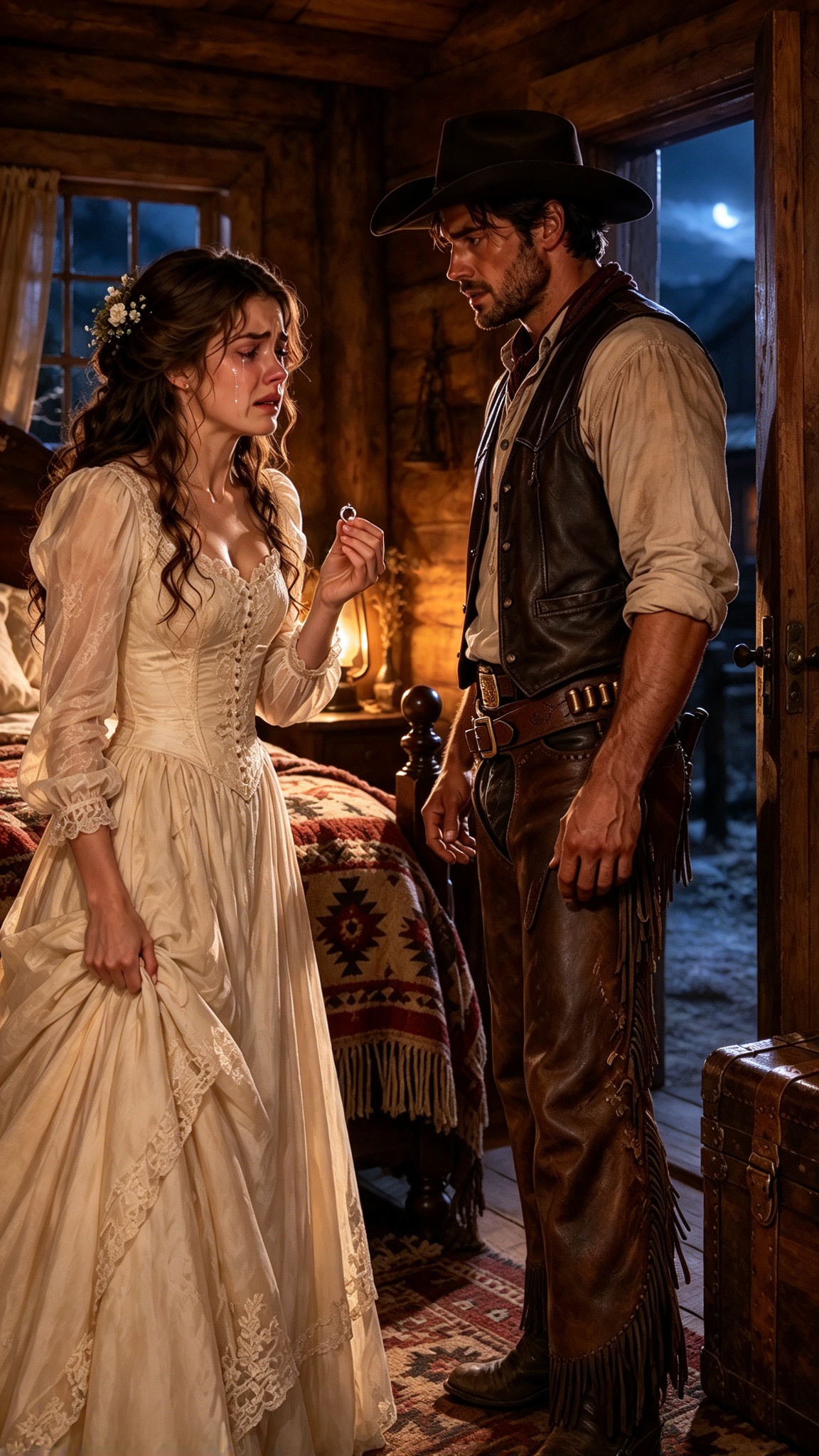
# EVERYONE CALLED HER THE LUCKIEST BRIDE IN TOWN—BUT HER HUSBAND WALKED AWAY ON THEIR WEDDING NIGHT
## Chapter 1: The Bride Everyone Envied
Colorado Territory, October 1886. By the time Ruth Holloway stepped out of the little white church, everyone in Bellweather had decided she was the luckiest woman in town.
At twenty-two, she had married Jonah Clay, a respected rancher who owned hundreds of acres, employed several families, and had never been known to break his word. Women smiled at Ruth as though her troubles had finally ended, while others whispered that Jonah had performed a generous act by taking a disgraced boardinghouse girl for his wife.
Ruth heard the whispers, but she kept smiling. Her wedding dress was borrowed, her bouquet had been arranged by the minister’s wife, and the only family member who might have attended was a father she had not seen in eight years.
Beside her stood Jonah, thirty-four years old, broad-shouldered, quiet, and almost impossible to read. He had held her hand during the ceremony, but he had barely spoken to her since the minister pronounced them husband and wife.
The guests congratulated them beneath the church bell, and someone called out, “Jonah, you’ve made yourself a lucky man!”
Jonah gave a polite smile. “I hope I have.”
For reasons Ruth could not explain, the words hurt more than they should have. He had spoken as though he were discussing a business arrangement, not the beginning of a marriage.
Only three weeks earlier, Ruth had believed she was going to marry Charles Whitmore, the handsome son of Bellweather’s wealthiest banker. Charles had courted her secretly, brought her flowers, and promised to take her away from the town where she had spent her life working for other people.
He told her that his father would eventually accept them. He said money and family names meant little compared with love, and Ruth, who had never been offered much affection in her life, wanted desperately to believe him.
Then Silas Whitmore discovered their relationship. He arrived at the boardinghouse with two bank employees and confronted Ruth in the kitchen, where she was preparing supper.
“You actually believe my son intends to marry you?” he asked, loud enough for every boarder to hear. “A girl who washes other people’s sheets wants to become a Whitmore?”
Ruth looked at Charles, expecting him to defend her. Instead, he stared at the floor.
“Tell him what you promised me,” she whispered.
Charles swallowed. “Ruth, I think you’ve misunderstood.”
Those words destroyed everything. By the following morning, Charles had disappeared from the boardinghouse, Silas had spread his version of the story throughout Bellweather, and Ruth had become the subject of every conversation.
People who had once greeted her warmly now looked away. The general store refused to extend her credit, and the boardinghouse owner warned that Ruth’s presence was damaging her reputation.
Ruth had not deceived anyone, but she discovered that the truth meant very little when the person telling the lie possessed money, influence, and a respectable surname.
She considered leaving town, though she had barely enough money to reach Denver. Then Jonah Clay appeared on the boardinghouse porch one rainy afternoon.
He brought no flowers and made no romantic promises. He removed his hat, waited until Ruth agreed to speak with him, and asked a question that would change both their lives.
“Would you rather wear my name than let them keep chewing on yours?”
Ruth stared at him. “Why would you marry someone you barely know?”
“Because I know what happens when a whole town decides it understands a person’s life better than the person living it.”
She asked whether he wanted a wife, and Jonah’s expression grew strangely serious.
“I want to offer you a home, a fair chance, and a name nobody has the right to use against you. I won’t ask you to pretend you love me, and I won’t expect you to repay me for helping you.”
He promised her a separate bedroom and complete freedom to leave if she ever regretted accepting his offer. He made no demands about children, affection, or what a marriage was supposed to look like.
Ruth should have asked why a man like Jonah needed a wife at all. Instead, she accepted because she was exhausted, frightened, and tired of having to prove she deserved a place in the world.
Now, as the wedding guests departed, she wondered whether she had mistaken kindness for affection. Perhaps Jonah had never wanted her; perhaps he had simply been unable to watch the town destroy another helpless woman.
The thought followed her into the wagon that carried them toward his ranch. Jonah held the reins while Ruth sat beside him, watching the golden leaves scatter across the road.
After several miles, he finally spoke. “If there’s anything about this arrangement that troubles you, Ruth, you can tell me.”
She turned toward him. “Does anything about it trouble you?”
Jonah’s fingers tightened around the reins. For a moment, he looked as though he might answer honestly, but then he turned his attention to the road.
“There’s something you should know about me,” he said. “I don’t always make it easy for people to understand me.”
Ruth looked away. She had a terrible feeling that she was about to discover exactly what he meant.
## Chapter 2: The Empty Bedroom
Jonah’s ranch stood twelve miles outside Bellweather, surrounded by open pasture, low hills, and a creek that reflected the evening sky. The house was larger than Ruth had expected, with whitewashed walls, a wide porch, and a chimney that sent a thin trail of smoke into the cold air.
Jonah helped her down from the wagon and carried her trunk inside. He showed her the sitting room, the kitchen, and a small library where books lined the walls, then led her upstairs to a bedroom at the end of the hall.
The room had fresh sheets, a washbasin, a quilt folded neatly across the bed, and a jar of wildflowers on the dresser. Someone had thought carefully about her comfort, and Ruth felt a brief warmth in her chest.
“You prepared all this for me?” she asked.
“Mrs. Harlan helped. She’s better at making a room feel welcoming than I am.”
Ruth smiled faintly. “You could have done worse.”
Jonah almost smiled back, but the expression vanished before it fully appeared. He placed her trunk beside the wardrobe and stepped toward the door.
“Where will you sleep?” Ruth asked.
He looked toward the window, where the barn stood beneath the darkening sky. “In the barn tonight. There’s a bedroll in the loft.”
For several seconds, Ruth believed he was joking. When she realized he was serious, the warmth she had felt disappeared.
“You’re leaving your own house on our wedding night?”
“I don’t want you to feel that marrying me means you owe me anything. You have been through enough already.”
“I never said I was afraid of you.”
“No,” he replied quietly. “But you haven’t had much choice about anything lately, and I won’t be another person making decisions for you.”
His answer was considerate, perhaps even noble. Yet Ruth could not stop the painful thought forming in her mind.
“You married me because you felt sorry for me.”
Jonah looked at her sharply. “That isn’t what I said.”
“Then what did you mean? Everyone in Bellweather thinks you’re a hero for marrying a disgraced woman. Perhaps you wanted to prove you were better than them.”
His face hardened, but not with anger. It was the expression of a man who had been struck somewhere that still hurt.
“You deserve better than a marriage built on pity,” he said.
Ruth felt her eyes sting. “Then why did you marry me?”
Jonah opened his mouth, but no answer came. He looked toward the hallway, as though he were listening for someone who was not there.
“I’ll explain when I can,” he said at last.
“When you can?” Ruth repeated. “I am your wife, Jonah. When exactly will I be allowed to understand my own marriage?”
He lowered his eyes. “Soon.”
Then he stepped into the hallway. Ruth stood motionless as he reached for the door to the stairs, unable to believe that her first night as a married woman was ending with her husband abandoning her upstairs.
She wanted to call him back, but pride held her silent. She had spent too many weeks begging people to believe her, and she would not beg a husband to want her.
Jonah descended the stairs. A moment later, she heard the front door open and close.
Ruth sat on the edge of the bed, still wearing her wedding dress. She removed the ring from her finger, stared at it, and wondered whether the people of Bellweather would laugh if they knew what had happened.
Then she heard a sound from outside.
A horse was moving near the barn, its hooves scraping the frozen ground. Someone spoke in a low voice, followed by the creak of the barn door.
Ruth went to the window. Jonah stood beneath the lantern, facing a second man who had apparently arrived while she was upstairs.
The stranger wore a dark coat and a hat pulled low over his forehead. He was too far away for Ruth to recognize his face, but she saw him place something in Jonah’s hand.
Jonah glanced toward the house. Even from that distance, Ruth could tell that he was afraid.
The stranger said something else. Jonah shook his head, and the man stepped closer until they were standing almost chest to chest.
Then the stranger raised one finger and pointed toward the upstairs window.
Ruth stumbled away from the glass.
A moment later, the stranger mounted his horse and disappeared down the road. Jonah remained outside, staring after him, the object clenched in his fist.
Ruth waited for her husband to come inside. Instead, he stayed in the barn until long after midnight.
And when she finally lay down, she discovered that the loneliness of a strange bedroom was nothing compared with the fear of knowing that her husband was hiding something from her.
## Chapter 3: A Name in the Darkness
Ruth woke shortly before dawn to the sound of a man shouting. She sat up, confused, then heard Jonah’s voice coming from the floor below.
“No! You can’t go out there!”
The words were followed by a heavy crash. Ruth hurried to the doorway, her heart pounding, and looked down the stairs.
Jonah stood in the sitting room, gripping the edge of a table. His face was pale, and sweat darkened the collar of his shirt despite the cold morning air.
For a moment, he did not seem to know where he was. Then he looked toward the staircase and saw her.
“Are you all right?” Ruth asked.
Jonah straightened. “Yes. I’m sorry if I woke you.”
“You were shouting.”
“Just a bad dream.”
He picked up a fallen chair and returned it to the table. His hands trembled slightly, and Ruth noticed that he was trying to hide them.
“Was it about your first wife?” she asked.
Jonah stopped moving.
Ruth regretted the question immediately, but he did not become angry. Instead, he looked toward the photograph on the mantel.
“Abigail died five years ago,” he said. “Some mornings, I still wake up believing she’s in the next room.”
Ruth understood grief. She had learned to live with the memory of her mother, whose voice she sometimes imagined hearing in the kitchen when she was tired.
“I’m sorry,” she whispered.
Jonah nodded once. “You don’t have to be.”
He went to prepare coffee, and Ruth watched him with a growing sense that the house contained more sorrow than its quiet rooms revealed.
Over breakfast, Jonah explained the ranch’s routine. She could use the kitchen, read the books, visit the nearby settlement, or ride one of the gentle horses if she wished to learn.
“You don’t have to work for your place here,” he told her. “You already have it.”
Ruth stared into her cup. “You speak as though I might disappear tomorrow.”
Jonah’s expression changed. “People disappear for all kinds of reasons.”
Before she could ask what he meant, someone knocked on the front door. Jonah answered it and found Mrs. Harlan standing on the porch with a basket of bread.
Mrs. Harlan was a stout woman in her fifties, with silver beginning to show in her brown hair and a face that seemed permanently caught between kindness and suspicion. She had helped Jonah maintain the house since Abigail’s death, and she looked at Ruth with obvious sympathy.
“Poor thing,” she murmured, taking Ruth’s hands. “You must be exhausted after everything that’s happened.”
Ruth thanked her, then noticed the older woman’s gaze drift toward the stairs.
“Have you settled into the room at the end of the hall?” Mrs. Harlan asked.
“Yes.”
“Good. That’s where Jonah’s sister used to sleep when she visited.”
Jonah appeared behind them so suddenly that Mrs. Harlan dropped a spoon.
“Mrs. Harlan,” he said, his voice unusually sharp.
The older woman turned pale. “I only meant—”
“I know what you meant.”
Silence filled the kitchen. Ruth looked from one to the other, certain she had stumbled into a conversation that had been taking place long before her arrival.
Jonah apologized for his tone and escorted Mrs. Harlan to the door. When he returned, Ruth was standing beside the table.
“You have a sister?”
He hesitated. “I did.”
The past tense struck her. “Did she die?”
Jonah looked at her for a long moment. “Yes.”
“How?”
His face became unreadable. “It happened a long time ago.”
Ruth felt a cold uneasiness settle over her. “Why does everyone in this house speak as though there are things I must never ask about?”
“Because some things are difficult to explain.”
“Then explain them.”
Jonah turned toward the window. “Not yet.”
Ruth had heard those words too many times already. She wanted to scream, but instead she returned to her bedroom and closed the door.
For the rest of the morning, she tried to occupy herself by unpacking her trunk. She arranged her dresses in the wardrobe, placed her few books on the bedside table, and folded her mother’s old shawl beneath the pillow.
At the bottom of the trunk, she found a small envelope containing a photograph she had kept for years. It showed her mother standing outside a modest wooden house, with one hand resting on Ruth’s shoulder.
Ruth touched the photograph and remembered the last thing her mother had told her.
“Never let another person’s shame become your own, child.”
She had tried to follow that advice, but the world had made it difficult. Now she was married to a man who treated her kindly yet refused to tell her why he had chosen her.
Late that afternoon, Ruth went downstairs to find a book. She searched the library shelves, found a collection of poems, and settled into a chair beside the window.
As she reached for a volume on the lower shelf, she noticed a narrow wooden door partly hidden behind a curtain. It was locked.
She might have ignored it if she had not heard a faint scratching sound from the other side.
Ruth stood still. The sound came again, followed by what seemed like the soft rustle of paper.
She called Jonah’s name, but there was no answer. The ranch hands were working in the distant pasture, and the house was silent.
The door had a small brass keyhole. Ruth tried the handle, then noticed a key resting on the mantel beneath Abigail’s photograph.
She hesitated before taking it. She knew it was wrong to enter a locked room without permission, but the scratching sound had stopped, and a strange sense of dread had begun to replace her curiosity.
The key turned with a soft click.
Inside was a narrow storage room filled with old trunks, folded blankets, and boxes covered in dust. A small desk stood beneath a window, and on it lay a leather-bound journal.
Ruth stepped inside. She had just reached for the journal when she noticed a photograph pinned to the wall.
It showed Jonah as a younger man, standing beside a woman with dark hair and a little boy whose face was turned toward the camera. The woman was smiling, but Jonah’s expression was solemn.
Beneath the photograph, someone had written three names.
**Jonah. Sarah. Samuel.**
Ruth heard footsteps behind her.
She turned.
Jonah stood in the doorway, his face drained of color.
“What are you doing in here?” he asked.
Ruth held up the photograph. “Who are Sarah and Samuel?”
Jonah looked at the picture as though it had become a weapon in her hands.
“My sister,” he whispered. “And her son.”
Ruth lowered the photograph. “Mrs. Harlan said you had a sister, but she spoke as though—”
“They’re dead.”
The words came out so quietly that Ruth almost did not hear them.
Jonah stepped into the room and took the photograph from her. His fingers brushed the frame with extraordinary care.
“Please don’t come in here again,” he said.
“Jonah, I wasn’t trying to—”
“I said please.”
He closed the door and locked it. Ruth stood in the hallway, ashamed of having entered the room but more frightened than ever by what she had discovered.
That night, she heard him crying in the barn.
It was a quiet, broken sound, so unlike the man she had married that Ruth initially thought it might be an injured animal. Then she heard him whisper two names again and again.
“Sarah. Samuel. I’m sorry.”
Ruth sat on the edge of her bed, tears filling her eyes. For the first time, she wondered whether Jonah’s distance had nothing to do with her at all.
Perhaps he had not married her because he pitied her.
Perhaps he had married her because he was trying to save someone from a tragedy he had never forgiven himself for allowing.
## Chapter 4: The Letter Under the Floorboards
The next morning, Jonah left the house before sunrise. He told Ruth he needed to inspect a fence on the northern pasture, but she noticed that he had saddled his horse with unusual haste.
She waited until he disappeared beyond the ridge before returning to the storage room. The locked door troubled her, and she could not shake the feeling that the dead woman and child in the photograph were somehow connected to her own marriage.
She did not intend to search for anything private. She wanted only to understand why a man who had offered her safety seemed terrified of allowing her to know him.
The key remained on the mantel. Ruth unlocked the door and entered, careful to leave everything exactly as she found it.
She examined the desk, the trunks, and the shelves. The journal contained entries about cattle prices, weather, and ranch repairs, but several pages had been torn out near the middle.
Behind a stack of folded blankets, she found a small wooden box. It was tied with a faded blue ribbon, and the lid bore the faint outline of a child’s name.
Ruth lifted it carefully. Inside lay a tiny knitted sock, a silver locket, and several letters bound together with string.
The top letter was addressed to Jonah. The handwriting was delicate and hurried, and the date was five years earlier.
Ruth knew she should put it back. But when she saw the first sentence, her breath caught.
*My dearest Jonah, if you are reading this, then I have failed to come home again.*
Her hands began to shake.
The letter was from Sarah, Jonah’s sister. She wrote that she had been frightened for months because her husband, Daniel, had become cruel and unpredictable.
She described how he had taken money from her, threatened to keep her son, and warned her that no one would believe a woman who accused a respectable man of wrongdoing.
Sarah had written that she wanted to leave, but Daniel had powerful friends and had convinced people in their community that she was unstable.
Ruth felt the familiar sting of recognition. Sarah had been trapped by the same kind of judgment that had nearly destroyed Ruth.
The letter continued.
*You told me I could come to your ranch whenever I needed you. I know I have asked too much already, but I have nowhere else to go. If Daniel discovers that I am leaving, he will do everything he can to stop me.*
Ruth pressed a hand to her mouth.
The final paragraph was shorter, written in a different ink as though Sarah had added it later.
*Please do not blame yourself for what happens. You have been the only person who has ever made me feel safe.*
The letter ended without a signature.
Ruth lowered it and looked at the date. It had been written just days before the terrible winter storm that, according to Mrs. Harlan, had taken Sarah and Samuel.
She searched the box and found a folded newspaper clipping. Its headline announced that a woman and child had died in a blizzard while traveling along the northern road.
The article did not name the woman, but a handwritten note in the margin identified her as Sarah Clay.
Ruth read the article twice. It stated that the bodies had been found near an overturned wagon several miles from Jonah’s ranch.
A sentence near the bottom made her stomach turn.
*Local authorities believe the woman may have been attempting to leave the county without her husband’s knowledge.*
Ruth suddenly understood why Jonah had reacted so violently when she asked about his sister.
Sarah had been trying to escape an abusive marriage, and she had died before she could reach safety.
But why had Jonah blamed himself?
She was still holding the clipping when she heard the front door open.
Ruth hurried to put the letters away, but one slipped from her fingers and landed beneath the desk. She bent to retrieve it and noticed that the floorboard near the wall was loose.
A corner of paper protruded from beneath it.
She lifted the board just enough to pull out a small envelope. Unlike the other letters, this one had never been opened.
On the front, in Jonah’s handwriting, were the words:
**For the day I can finally tell the truth.**
Ruth stared at the envelope. Her name was written beneath the first line.
She heard Jonah cross the sitting room.
For one terrible moment, she considered hiding the letter and pretending she had found nothing. But the envelope had been addressed to her, and she could no longer endure living inside a marriage built around a secret she did not understand.
She opened it.
Inside was a single sheet of paper.
*Ruth,*
*If you are reading this, I have failed to tell you what I should have told you before our wedding. I did not marry you because I pitied you, and I did not marry you to prove anything to Bellweather.*
*I married you because I recognized your name.*
Ruth stopped breathing.
The letter continued.
*Your mother was the last person who tried to help my sister before she died. She sent me a message about Sarah, and I never understood why she had kept silent until it was too late.*
*There is a reason I recognized you when I saw you at the boardinghouse. There is a reason I asked you to marry me instead of simply offering you money.*
*And there is a reason I cannot sleep in the same room as you.*
*Before you decide whether you can trust me, you must know what happened on the night Sarah died.*
The letter ended there.
Ruth read the final sentence again and again. Her mother had known Jonah’s sister. Jonah had recognized her name. And his decision to marry her had been connected to something that happened years before Ruth had ever met him.
She heard footsteps in the hallway.
Jonah appeared in the doorway and saw the open envelope in her hand.
For several seconds, neither spoke.
Then he closed his eyes.
“I hoped you’d never find that letter,” he said.
Ruth held it up. “You wrote this to me. Why?”
Jonah looked older than he had the day before. “Because I wanted to tell you the truth, but I didn’t know how to begin.”
“Then begin now.”
He glanced toward the locked room, then back at Ruth.
“My sister didn’t die because she was careless,” he said. “She died because someone made sure she couldn’t reach the help she needed.”
Ruth felt the room tilt around her.
“Who?”
Jonah’s jaw tightened.
“Silas Whitmore.”
## Chapter 5: The Man Who Knew Too Much
Ruth stepped backward as though Jonah had struck her. Silas Whitmore, Charles’s father, was the man who had destroyed her reputation, driven her out of the boardinghouse, and watched her suffer without a trace of regret.
Now Jonah was telling her that the same man had played a role in his sister’s death.
“You’re saying the banker killed your sister?” Ruth asked.
“No.” Jonah’s voice was strained. “I’m saying he knew she was in danger and helped make sure no one reached her in time.”
Ruth shook her head. “That is a serious accusation.”
“I know.”
“Then why didn’t you tell the sheriff?”
Jonah looked toward the window. “Because the sheriff was one of Silas’s friends, and the evidence disappeared before anyone could examine it properly.”
He explained that Sarah had married Daniel Mercer, a man who presented himself as charming and respectable but became violent behind closed doors. When Sarah tried to leave him, Daniel threatened to have her declared unfit to care for Samuel.
Jonah had offered his sister a home at the ranch. He had promised that she and the boy could stay as long as they needed, and he had arranged for a doctor to meet them along the northern road.
But on the night Sarah fled, the storm arrived earlier than expected. The road became dangerous, the wagon overturned, and Sarah and Samuel died before they reached the meeting point.
Jonah had ridden out looking for them, but he found only the broken wagon and the frozen tracks of the horses.
“I was too late,” he said. “I’ve spent five years wondering whether I could have saved them if I’d gone to meet them myself.”
Ruth felt tears fill her eyes. “You can’t know that.”
“No. That’s what makes it unbearable.”
He told her that Silas had been the last influential man to see Sarah before she left the county. According to a stable worker, Silas had warned her that Jonah’s ranch was not a safe place for her and had insisted that Daniel was willing to reconcile.
Sarah had believed him long enough to delay her departure. By the time she realized she had been deceived, the weather had turned dangerous.
Jonah had tried to investigate, but the stable worker vanished, and the sheriff dismissed the testimony of the few people who were willing to speak.
“Why would Silas care whether your sister escaped her husband?” Ruth asked.
“Daniel owed him money. Silas wanted to keep Daniel under his control, and a divorce would have exposed financial arrangements that neither man wanted anyone to see.”
Ruth stared at him. “And you believe Charles is involved too?”
“I don’t know what Charles knows. That’s one of the reasons I married you.”
The words struck her harder than she expected.
“You married me to investigate his family?”
Jonah immediately shook his head. “No. I married you because I knew Silas would never leave you alone after what happened. I thought that if you had my name, he would have to think twice before threatening you again.”
“But you recognized me before you proposed.”
“Yes.”
“You knew my mother.”
Jonah nodded slowly. “I knew of her. She worked as a nurse for a family near the ranch when I was younger. She helped Sarah once, after Daniel hurt her.”
Ruth felt as though the floor had vanished beneath her feet. Her mother had never told her about the Clays, and she could not imagine why she would have kept such a secret.
“What did my mother have to do with Sarah’s death?”
Jonah hesitated. “She left something behind. A letter, perhaps. I never found it, but I believed she might have taken a copy of the doctor’s report after Sarah died.”
Ruth sat down, suddenly exhausted.
“My mother died when I was fourteen. She never mentioned any of this.”
“I know. I tried to find her, but by the time I learned her name, she had already passed away.”
Ruth looked at the letter in her hands. “So you married me because you believed I might know something about a death that happened years ago?”
Jonah’s face tightened with shame. “That was part of it. But it wasn’t the only reason.”
“What was the other reason?”
He looked directly into her eyes. “Because I saw a woman being destroyed by people who had decided she was worthless, and I couldn’t stand by and watch it happen again.”
Ruth wanted to believe him. She wanted to believe that he had acted out of compassion rather than calculation, but she could not ignore the fact that he had withheld the truth from her.
“You could have told me,” she whispered.
“Yes.”
“You could have trusted me to decide whether I wanted to marry you.”
“Yes.”
“Instead, you made the decision for both of us.”
Jonah lowered his head. “I did.”
The honesty of his answer left her with nothing to argue against. She had expected him to defend himself, to insist that he had done the right thing, but he simply stood there and accepted the weight of what he had done.
Ruth walked to the window. The ranch stretched beneath a pale morning sky, peaceful and beautiful, yet she felt as though she were standing in the middle of a storm.
“Why did you sleep in the barn?” she asked without turning around.
Jonah was silent for so long that she thought he might refuse to answer.
“Because I was afraid,” he finally said.
“Of me?”
“No. Of myself.”
She turned.
Jonah’s eyes were wet, though he seemed unaware of it. “After Abigail died, I spent years believing that anyone who came close to me would eventually suffer because of it. When I saw you, I wanted to help you, but I was terrified that I’d make your life worse.”
Ruth’s anger softened, but it did not disappear.
“You don’t get to decide that I am too fragile to stand beside you,” she said. “I have survived worse than an unhappy marriage.”
Jonah looked at her as though the words had reached a place he had kept hidden even from himself.
“I know,” he whispered. “That’s what frightens me. You deserve a life that isn’t built around my ghosts.”
Ruth looked at her wedding ring. She had accepted it because she wanted safety, but now she realized that safety without honesty could become another kind of prison.
“I don’t need you to be fearless, Jonah. I need you to stop treating me like someone who must be protected from the truth.”
He nodded slowly.
Before he could answer, a horse thundered toward the house.
Both of them turned toward the window.
A rider was approaching at full speed, his coat flapping behind him. When he reached the porch, he nearly fell from the saddle.
It was the ranch’s youngest hired hand, Thomas Reed, a boy of seventeen who had worked for Jonah since his father died.
Thomas burst through the front door, breathless and white-faced.
“Mr. Clay, the sheriff is coming,” he said. “And he’s not alone.”
Jonah stepped toward him. “Who is with him?”
Thomas swallowed.
“Silas Whitmore.”
## Chapter 6: The Warning at the Door
The sheriff arrived less than twenty minutes later. He was a thickset man named Harlan Price, whose badge shone brightly against a dusty coat and whose smile rarely reached his eyes.
Silas Whitmore rode beside him, dressed in a dark suit that looked entirely unsuitable for the muddy road. Charles followed a few yards behind, his face pale and his shoulders hunched.
Jonah met them on the porch. Ruth stood just inside the doorway, listening.
“Clay,” the sheriff said, dismounting. “We need to speak about your sister’s death.”
Jonah’s expression did not change. “After five years, you’ve finally become interested?”
“There’s new information.”
Silas removed his gloves. “A matter of considerable importance, I’m afraid.”
Ruth stepped onto the porch. “Then why have you brought Charles?”
Silas looked at her with open contempt. “This does not concern you.”
“She is my wife,” Jonah said.
“And that makes her a Clay, does it? How convenient.”
Ruth felt her face grow hot, but Jonah did not move. He simply stood between her and Silas, his expression as steady as stone.
The sheriff explained that an old witness had returned to Bellweather and claimed that Jonah had threatened Sarah before she left the county. According to the statement, Jonah had been angry about her decision to leave Daniel and had refused to help her.
The accusation was so absurd that Ruth initially thought she had misheard.
“That’s a lie,” she said.
The sheriff raised an eyebrow. “You weren’t there, Mrs. Clay.”
“No, but I have read Sarah’s letters. She wrote that Jonah offered her a home.”
Silas’s face changed almost imperceptibly. It was only a flicker, but Ruth noticed it.
“Letters?” he repeated.
Jonah looked at Ruth, then back at Silas. “You should leave.”
Silas laughed softly. “You have no authority to tell me where to go.”
“I have authority over my own land.”
The sheriff stepped forward. “Let’s not make this difficult, Clay. We have a statement, and we have reason to believe you concealed evidence related to Sarah’s death.”
Ruth saw Jonah’s hands curl into fists. For one frightening moment, she thought he might strike the sheriff, but he slowly relaxed them.
“What evidence?” he asked.
The sheriff produced a folded document. It bore an official seal and a signature that appeared to be Jonah’s.
According to the document, Jonah had signed a statement admitting that he had refused to assist Sarah when she asked for help. The date was several days after the storm.
Ruth stared at the paper. “That signature is false.”
Silas smiled. “You seem very certain for a woman who knows nothing about the matter.”
“I know my husband.”
“You’ve been married for less than a day.”
The words cut deep, but Ruth refused to look away.
“Long enough to know when someone is lying.”
For the first time, Silas’s smile disappeared completely.
The sheriff demanded to search the house. Jonah agreed, provided the search was conducted in front of witnesses and nothing was removed without being recorded.
They searched the sitting room, the library, the bedrooms, and the kitchen. When they reached the locked storage room, Silas stopped at the door.
“What do you keep in there, Clay?”
“Personal belongings.”
“Then you won’t mind if we look.”
Jonah unlocked the door. The sheriff entered first, followed by Silas and Charles.
Ruth remained near the threshold. She watched Silas’s gaze move over the desk, the trunks, and the photograph of Sarah and Samuel.
Then his eyes landed on the wooden box.
He moved toward it so quickly that Jonah stepped in front of him.
“Don’t touch that.”
Silas’s expression turned cold. “Why? Is there something inside you don’t want us to see?”
Jonah said nothing.
The sheriff opened the box himself. He examined the tiny sock, the locket, and the letters, then turned toward Jonah with an expression that suggested he had found exactly what he expected.
“These will have to come with us.”
“No,” Ruth said.
Every man in the room turned toward her.
She stepped forward, her hands trembling but her voice clear. “Those letters belong to Sarah’s family. You cannot simply take them because Silas Whitmore asks you to.”
The sheriff looked amused. “I believe I understand my duties rather better than you do, Mrs. Clay.”
“Then explain why you have brought a document with a signature my husband says is false, but you haven’t asked an independent person to examine it.”
The sheriff’s smile faded.
Ruth continued. “And why are you searching for evidence of a crime that happened five years ago only days after Silas Whitmore ruined my reputation?”
Silas moved toward her. “Be careful, girl.”
Jonah stepped between them. “Don’t speak to her that way.”
Silas’s eyes narrowed. “You should have stayed alone, Clay. You were better at it.”
The remark revealed more than Silas intended. Jonah’s expression changed, and for a moment Ruth saw something dangerous beneath his quiet manner.
“You know what happened to Sarah,” Jonah said.
Silas did not answer.
“You knew she was trying to escape Daniel. You knew she was traveling through the storm. And you knew the doctor was supposed to meet her.”
Charles looked sharply at his father.
The sheriff’s attention shifted between them. “What doctor?”
Jonah held Silas’s gaze. “Dr. Bennett. He was supposed to meet Sarah on the northern road, but someone sent him a message telling him the meeting had been canceled.”
Silas’s face hardened.
Ruth felt the pieces beginning to come together. If the doctor had been prevented from meeting Sarah, then someone had deliberately removed her chance of reaching safety.
“Who sent the message?” she asked.
Jonah looked at Silas.
For several seconds, nobody spoke.
Then Charles took a step backward.
“I didn’t know she was going to die,” he whispered.
Silas turned toward his son with terrifying speed. “Be quiet.”
Charles looked at Ruth, his face filled with shame. “I didn’t know about Sarah. I swear I didn’t.”
Jonah’s voice was low. “But you knew about Ruth.”
Charles closed his eyes.
The room seemed to grow smaller around him. His father stared at him with an expression of absolute fury, while the sheriff slowly lowered the document he had been holding.
Ruth could barely breathe.
“Tell the truth, Charles,” she said.
He opened his eyes, and tears began to gather in them.
“My father told me to end our relationship,” he said. “He said Ruth would become a problem for the bank, and that I would lose everything if I continued seeing her.”
“You told me you loved me,” Ruth whispered.
“I did.”
“Then why did you let him destroy me?”
Charles looked toward his father. “Because I was a coward.”
The admission landed like a stone. Ruth had imagined many explanations for Charles’s betrayal, but hearing him name his own weakness did not make the wound any smaller.
Silas stepped toward the door. “This conversation is over.”
“No,” Jonah said. “It is only beginning.”
## Chapter 7: The Woman Who Refused to Be Silent
The sheriff left the ranch with the forged statement but was forced to leave Sarah’s letters behind after Jonah demanded a written inventory and threatened to take the matter to the territorial judge.
Silas departed without another word. Charles remained on the porch for a moment, looking at Ruth as though he hoped she might forgive him simply because he finally admitted what he had done.
She turned away before he could speak.
That evening, Ruth sat alone in the kitchen while Jonah repaired a broken latch near the back door. Neither had spoken much since the confrontation, and the silence between them felt heavier than it had the previous night.
Finally, Jonah placed his tools on the table.
“You were brave today,” he said.
Ruth gave a bitter laugh. “I was terrified.”
“Those things aren’t opposites.”
She looked at him. “I don’t want to be brave every day. I’m tired of being strong because nobody else will do what is right.”
Jonah sat across from her. “I know.”
“No, you don’t. You had a ranch to return to when people treated you badly. You had land, a name, and a reputation that protected you. I had a room in a boardinghouse and a few coins in a drawer.”
He accepted her words without protest.
“You’re right,” he said. “I don’t know what that was like for you.”
Ruth looked down at her hands. She had expected him to defend himself, but his willingness to listen made her anger more complicated.
“I don’t hate you for sleeping in the barn,” she said after a moment. “I hate that you made me believe I was unwanted when you were really afraid of something else.”
Jonah’s eyes filled with pain. “I am sorry.”
“I need more than an apology.”
“What do you need?”
“The truth. All of it. No more deciding what I can bear to hear.”
Jonah nodded. “Then I’ll tell you everything I know.”
He explained that Dr. Bennett had been the physician who treated Sarah after Daniel first injured her. The doctor had encouraged her to leave, but he had been reluctant to challenge Daniel publicly because the man had friends among the sheriff’s office and the bank.
Jonah had arranged for Sarah and Samuel to meet Dr. Bennett at a small station near the northern road. The doctor was supposed to take them to a safe house beyond the county line.
But on the night of the storm, the doctor received a message claiming that Sarah had changed her mind. He stayed home, believing the danger had passed.
The next morning, he learned that Sarah and Samuel were dead.
“Did you ever speak to him?” Ruth asked.
“Once. He said the message had arrived with a rider he didn’t recognize. He believed it was sent by someone connected to Daniel.”
“Why didn’t he tell the sheriff?”
“Because the sheriff told him that accusing a respected man without proof would ruin his practice.”
Ruth felt sick. Every person who might have helped Sarah had been frightened into silence, and every person who had harmed her had relied on that silence to escape blame.
“What happened to the rider?”
“No one knows. He disappeared.”
Ruth looked toward the window. “Then we find him.”
Jonah studied her face. “That may be dangerous.”
“So was staying silent.”
For the first time since their wedding, Jonah smiled without trying to hide it. It was a small, weary smile, but it changed his face in a way Ruth had not expected.
“You remind me of your mother,” he said.
Ruth felt her throat tighten. “You barely knew her.”
“I knew enough to understand that she was afraid of powerful people, but she helped Sarah anyway.”
He went upstairs and returned with a small leather notebook. It contained the names of people Jonah had questioned after Sarah’s death, along with dates, addresses, and notes about conversations.
One name appeared several times: Amos Pike, a former stable hand who had worked for Daniel Mercer and had disappeared shortly after the storm.
Jonah believed Amos had delivered the false message to Dr. Bennett.
“If we find him,” Ruth said, “we might finally learn who sent him.”
Jonah closed the notebook. “I have searched for him for five years.”
“Then perhaps you have been searching alone for too long.”
They began the following morning. Jonah visited neighboring ranches and old mining camps, while Ruth went to Bellweather to speak with people who might remember Amos.
At the general store, the shopkeeper refused to answer her questions. At the hotel, a maid claimed she had never heard the name. By midday, Ruth had received more suspicious looks than useful information.
She was preparing to leave town when an elderly woman approached her outside the church.
“Mrs. Clay?”
Ruth turned. The woman was small and thin, with a shawl pulled tightly around her shoulders.
“My name is Martha Ellis,” she said. “I worked at the hotel when your mother was alive.”
Ruth felt her heart begin to race. “You knew my mother?”
Martha nodded. “She asked me to keep something safe for her. I was afraid to give it to anyone, but after what happened yesterday, I think it’s time.”
She led Ruth to a small house behind the church and locked the door. Inside, she opened a wooden chest and removed a folded piece of paper.
It was a letter in Ruth’s mother’s handwriting.
Ruth recognized the familiar loops and careful strokes immediately. Her hands trembled as she unfolded it.
*If anything happens to Sarah Clay, someone must know that she was not abandoned by her family. She was frightened, and she asked for help. I have copied the doctor’s note because I do not trust the men who claim to be investigating her death.*
Beneath the message was a second page containing a brief statement from Dr. Bennett. It recorded that he had been instructed to meet Sarah and her son on the northern road, but that a message arrived canceling the meeting.
At the bottom, the doctor had written a name.
**Silas Whitmore.**
Ruth stared at the paper, unable to speak.
Martha sat beside her. “Your mother was going to take that letter to the sheriff. Then she became frightened after someone threatened you.”
Ruth looked up sharply. “Threatened me?”
Martha’s eyes filled with tears. “You were only a child. Your mother believed they would hurt you if she spoke.”
Ruth felt the room tilt around her. Her mother had carried the truth for years, protecting her daughter at the cost of her own peace.
“Why didn’t she tell me?”
“Because she thought silence would keep you safe.”
Ruth folded the letter carefully and placed it inside her coat. For the first time, she understood the terrible price of silence.
It had not protected her mother. It had not protected Sarah. And it had not protected Ruth from the people who had decided her life was theirs to control.
When she returned to the ranch, Jonah was waiting on the porch. One look at her face told him that something had changed.
Ruth handed him the letter.
He read it slowly, then sat down on the porch step as though his legs could no longer support him.
“Your mother tried to save Sarah,” he whispered.
“And she tried to save the truth.”
Jonah pressed the letter to his chest. His shoulders began to shake, and Ruth sat beside him without speaking.
For the first time, he did not turn away when she reached for his hand.
## Chapter 8: The Doctor’s Confession
Dr. Bennett arrived at the ranch two days later. He was an elderly man with a silver beard, tired eyes, and a walking stick polished smooth by years of use.
Jonah met him at the gate, but Ruth stood beside her husband instead of waiting inside. She wanted the doctor to see that the truth could no longer be confined to a locked room.
“I received your message,” Dr. Bennett said. “I wish I had come sooner.”
Jonah’s face was rigid. “You should have come five years ago.”
“I know.”
The doctor removed his hat and looked at Ruth. “Your mother was a courageous woman. I have regretted my silence ever since she died.”
They brought him into the sitting room and placed the letters on the table. Dr. Bennett examined the note from Ruth’s mother, then closed his eyes.
“I wrote that statement the morning after Sarah died,” he said. “Silas Whitmore came to see me before I could take it to the sheriff.”
“What did he say?” Ruth asked.
“He told me that the message canceling the meeting had come from Sarah herself. He claimed she had decided to return to Daniel, and he warned me that accusing him without proof would destroy my reputation.”
“Did you believe him?”
“No. But I was afraid.”
The doctor explained that Silas had threatened to expose a mistake in his medical records if he continued asking questions. The mistake was unrelated to Sarah’s death, but the banker had enough influence to turn it into a scandal.
“So you remained silent,” Jonah said.
“Yes.”
“And Sarah died believing no one was coming.”
Dr. Bennett bowed his head. “I have asked God to forgive me for that every day.”
Jonah stood abruptly and walked to the window. Ruth could see that he wanted to condemn the doctor, but she also understood that anger alone would not restore the years they had lost.
“What happened to the rider who delivered the message?” she asked.
The doctor opened his leather bag and removed a small notebook. He had kept it hidden for years, afraid that it might be discovered during a search of his office.
“The rider signed the delivery receipt with a false name. But I remember something unusual about him. He had a scar across his left hand, and he wore a ring with a black stone.”
Jonah turned from the window.
“Amos Pike,” he said.
Dr. Bennett nodded. “I believe so. I saw him working at Daniel’s stable before Sarah died.”
Ruth looked at the notebook. “Can you testify to this?”
The doctor hesitated, then met her eyes. “Yes. I should have done so years ago.”
The words brought no immediate relief. Sarah and Samuel would not return, and Jonah could never reclaim the years he had spent blaming himself. But for the first time, the truth had witnesses who were willing to speak.
That afternoon, Jonah and Ruth rode into Bellweather with the letters and the doctor’s statement. They planned to deliver the evidence to the territorial judge in the neighboring town, whose authority extended beyond the sheriff’s influence.
Before they reached the road, however, a rider appeared at the gate.
It was Charles Whitmore.
He looked as though he had not slept. His coat was dusty, his hair disheveled, and the confident expression Ruth once found so charming had disappeared.
“I need to speak with you,” he said.
Jonah moved between Charles and Ruth. “You have said enough.”
Charles shook his head. “Not about this.”
He looked at Ruth. “My father knows you found the letter. He has sent men to search for Amos Pike, and I think he intends to make sure the man never speaks.”
Ruth’s stomach tightened. “Why are you telling us?”
“Because I can’t live with what I’ve done.”
“You could have thought of that before you let your father destroy me.”
Charles flinched. “I know.”
He reached inside his coat and produced a folded document. It was a copy of a ledger showing payments made from the Whitmore bank to Daniel Mercer, including a large payment issued shortly before Sarah’s death.
Jonah examined it carefully. “Where did you get this?”
“My father’s office. I copied it last night.”
“Why?”
Charles looked toward Ruth. “Because the money was connected to the message that stopped the doctor from meeting Sarah. I found a note in my father’s desk saying the payment was for a messenger.”
Ruth felt a wave of anger rise in her chest. “And you kept this hidden?”
“I was afraid of him.”
“So was everyone else,” she said. “That is how he got away with it.”
Charles lowered his head. “I know.”
Jonah took the document but did not thank him. “If this is genuine, you’ll have to testify.”
Charles nodded. “I will.”
Ruth studied him, searching for the young man she had once loved. She found only a frightened stranger who had finally discovered that cowardice could destroy more than one life.
“I don’t forgive you,” she said. “Not today.”
“I don’t expect you to.”
“Then do the one decent thing you can still do. Tell the truth, even if it costs you everything.”
Charles looked at her for a long moment, then mounted his horse and rode toward town.
Jonah watched him disappear. “Do you believe him?”
“I believe he’s frightened,” Ruth replied. “Whether that makes him honest remains to be seen.”
They continued toward the territorial judge’s office, carrying the letters, the doctor’s statement, and the ledger copy. They had almost reached the road when they heard the sound of horses behind them.
Jonah turned.
Three riders were approaching from the direction of Bellweather. The man in front wore a black hat and a dark coat.
Ruth recognized him from the night of her wedding.
It was the stranger who had spoken to Jonah outside the barn.
He carried a rifle across his saddle.
## Chapter 9: The Road Through the Storm
Jonah pulled Ruth’s horse to a stop. “Stay behind me.”
The riders spread across the road, blocking their path. The man in front dismounted slowly, keeping one hand near the rifle.
“Mr. Clay,” he said. “You should have left this matter alone.”
Jonah’s expression was cold. “Who are you?”
“You know who sent me.”
Ruth felt fear rise in her throat, but she forced herself to look directly at the man. “Silas Whitmore?”
The stranger smiled without humor. “You ask too many questions, Mrs. Clay.”
Jonah stepped forward. “Let us pass.”
“Give me the papers.”
“No.”
The stranger glanced at the doctor’s statement protruding from Jonah’s coat. “Those papers are worth more trouble than you understand.”
Ruth thought of Sarah and Samuel, of her mother hiding the truth, and of the years Jonah had spent believing he was responsible for their deaths.
“You don’t get to decide what the truth is worth,” she said.
The man’s smile disappeared. He raised the rifle slightly.
Jonah moved so quickly that Ruth barely saw him. He grabbed the man’s wrist, forcing the barrel toward the sky as the rifle discharged with a deafening crack.
The horses panicked. Ruth’s mount reared, and she lost her grip on the reins.
She fell hard onto the road, striking her shoulder against the frozen ground. Pain flashed through her arm, and for several seconds she could not breathe.
Jonah released the attacker and rushed toward her.
“Ruth!”
She tried to sit up, but the world spun around her. Jonah knelt beside her, his face pale with terror.
“Look at me,” he said. “Stay with me.”
“I am here,” she gasped.
Behind them, the two other riders had dismounted. One seized Jonah from behind, while the other reached for the documents in his coat.
Ruth saw the papers fall into the mud.
Without thinking, she crawled toward them. Her injured shoulder screamed with pain, but she grabbed the bundle and shoved it inside her coat.
The second man caught her by the wrist.
“Give them to me!”
Ruth twisted free and struck him with the heavy metal clasp of her riding bag. He staggered backward, swearing.
Jonah broke free from the first attacker and drove him to the ground. The struggle was brief but brutal, with boots scraping against gravel and fists striking coats and shoulders.
The man with the rifle recovered it and pointed it toward Jonah.
Then a gunshot rang out from the road behind them.
Everyone froze.
Dr. Bennett stood several yards away, his walking stick in one hand and a revolver in the other. He had followed them in his wagon, expecting trouble after receiving a warning from Charles.
“Drop the weapon,” he ordered.
The attacker hesitated.
Dr. Bennett fired into the dirt near his boots. “I said drop it!”
The rifle hit the ground.
Within minutes, Jonah had disarmed the men and tied their hands with rope from the wagon. The attackers protested, claiming they had been hired to retrieve stolen documents, but none could explain why they had brought weapons.
Ruth sat on the wagon seat while Dr. Bennett examined her shoulder. It was badly bruised but not broken, and the doctor wrapped it tightly before helping her drink water.
Jonah stood beside the horses, staring at the road. His hands were shaking.
Ruth approached him carefully. “Jonah?”
He turned, and the fear in his face was so raw that she forgot her own pain.
“I thought I had lost you,” he said.
Ruth swallowed. “You didn’t.”
He looked down at her injured shoulder. “I should never have let you come.”
Anger flared through her exhaustion. “Don’t do that.”
“Ruth—”
“No. Don’t turn this into another reason to keep me away from the truth.”
Jonah closed his eyes.
“I was afraid,” he whispered. “When you fell, I thought the same thing had happened again. I thought I had brought another person into danger because I couldn’t leave the past alone.”
Ruth reached for his hand. “I chose to come with you.”
“But—”
“I chose it, Jonah. I knew it was dangerous, and I chose it because Sarah deserved the truth. Because my mother deserved the truth. And because I deserve a life where I don’t have to run every time a powerful man becomes angry.”
He stared at her, unable to speak.
Ruth squeezed his hand. “You don’t have to save me from every danger. You only have to stand beside me when I face it.”
For a long moment, Jonah said nothing. Then he lifted her hand to his lips and kissed her fingers, so gently that tears filled her eyes.
It was the first time he had touched her with anything resembling tenderness since their wedding.
“I don’t know how to do this,” he admitted.
“Neither do I.”
He gave a broken laugh. “That isn’t very reassuring.”
“It’s the truth.”
Jonah looked at her, and something in his expression finally softened. The distance that had stood between them since the church seemed to shrink, not because their problems had disappeared, but because neither of them was pretending to be unafraid anymore.
Then Dr. Bennett called from the wagon.
“We need to get to the judge. Those men won’t be the last people Silas sends.”
Jonah helped Ruth onto her horse. This time, he did not tell her to stay behind him.
They rode together.
## Chapter 10: The Trial of Bellweather
The territorial judge agreed to hear the case three days later. By then, news of the confrontation had spread throughout Bellweather, and the town that had once whispered about Ruth’s supposed disgrace was suddenly eager to hear what she had discovered.
Some people apologized when she passed them in the street. Others avoided her entirely, afraid that their own names might appear in the evidence.
Ruth accepted neither their apologies nor their fear as proof of anything. She had learned that people could change their opinions without changing their character.
The hearing took place in a crowded courtroom above the county offices. Jonah sat beside Ruth, while Dr. Bennett waited with the documents and Charles stood near the door, pale but determined.
Silas Whitmore arrived wearing a dark suit and an expression of offended dignity. He looked around the courtroom as though he expected everyone to remember who paid their debts and controlled their livelihoods.
The judge did not appear impressed.
The proceedings began with the forged statement bearing Jonah’s signature. A handwriting expert testified that the signature had been copied from an older document and that several phrases had been added afterward.
The sheriff claimed he had received the statement from an anonymous source. When the judge asked why he had treated it as genuine without verifying it, the sheriff’s answers became increasingly uncertain.
Then Dr. Bennett took the stand.
He described the arrangement he had made to help Sarah and Samuel escape Daniel. He explained the message that canceled their meeting and produced the note he had preserved for five years.
Silas’s lawyer objected repeatedly, arguing that the doctor had no proof of who sent the message. The judge allowed the testimony to continue, noting that the payment ledger might help establish a connection.
Charles was called next.
He looked at his father before taking the oath. Silas gave him a warning stare, but Charles turned toward the judge.
“My father paid a messenger shortly before Sarah Clay died,” he said. “I found the record in the bank’s private ledger.”
Silas rose abruptly. “You ungrateful fool!”
The judge struck the table with his gavel. “You will remain silent.”
Charles continued, his voice shaking. He admitted that his father had ordered him to end his relationship with Ruth and had threatened to cut him off financially if he refused.
He also testified that Silas had told him the Clay family was dangerous and that Jonah would eventually destroy anyone who became involved with him.
“Did you believe your father?” the judge asked.
Charles looked at Ruth. “I wanted to believe him because it was easier than standing against him.”
Ruth felt a sharp ache in her chest. She had once loved Charles enough to imagine spending her life with him, but the man standing before the court was no longer the person she had imagined.
The judge asked whether Charles knew that Silas had been involved in Sarah’s death.
“I didn’t know the details,” Charles said. “But I knew my father was hiding something. I knew he had paid men to keep people quiet, and I was afraid to ask why.”
The courtroom fell silent.
Silas’s lawyer attempted to discredit Charles by pointing out that he had only come forward after losing Ruth. Charles admitted that he had acted out of guilt, but he refused to withdraw his testimony.
“I was a coward when it mattered most,” he said. “That doesn’t make the evidence false.”
Then Ruth was called.
She walked to the witness stand with her hands trembling. She described the relationship she had shared with Charles, the promises he had made, and the humiliation she suffered after Silas confronted her at the boardinghouse.
She explained that no one had asked for her side of the story. The town had accepted the banker’s version because he was wealthy, while her poverty was treated as proof that she must have been dishonest.
“Why did you agree to marry Jonah Clay?” the judge asked.
Ruth glanced at her husband.
“Because he offered me a home without asking me to surrender my dignity. At the time, I believed he was helping me because he pitied me.”
“Do you still believe that?”
Ruth paused.
“No. I believe he was frightened of losing someone else, and he made a mistake by keeping the truth from me. But he has never asked me to lie for him, and he has never tried to make me smaller so that he could feel bigger.”
Jonah lowered his eyes, visibly moved.
Ruth continued. “I am not here because my husband needs me to defend him. I am here because Sarah and Samuel cannot speak for themselves, and because the truth should not depend on whether a dead woman had enough money to make people listen.”
The judge listened without interrupting.
When Ruth finished, the courtroom remained silent for several seconds. Then an elderly man seated near the back rose and asked permission to speak.
His name was Amos Pike.
Ruth felt Jonah’s hand tighten around hers.
Amos was older than the man described in the original reports, with a deep scar across his left hand and a black stone ring on his finger. He admitted that he had delivered the message canceling Dr. Bennett’s meeting with Sarah.
He had been paid by Daniel Mercer, but Silas Whitmore had arranged the payment. Amos said he had been told that Sarah was returning to her husband and that no one would be harmed.
“I believed them,” he said. “I was a fool, and I was afraid of what they’d do if I refused.”
The judge asked why he had waited five years to come forward.
Amos looked at Jonah. “Because I knew what I’d done. Every time I thought about telling the truth, I remembered the boy and the woman who died because I carried that message.”
His voice broke.
“I can’t bring them back. I can only tell you what happened.”
Jonah stood. For a moment, Ruth thought he might approach Amos in anger, but instead he remained beside the table, his face pale and his eyes filled with tears.
“Did Sarah know the message was false?” he asked.
Amos shook his head. “No. She believed the doctor had canceled the meeting. She turned the wagon around, trying to find another route, and the storm caught them before they reached the main road.”
Jonah closed his eyes.
For five years, he had imagined Sarah dying alone because he had failed to reach her. Now he learned that she had been deceived by people who knew she was frightened and desperate.
The truth did not ease his grief. It gave the grief a different shape.
The judge ordered an investigation into Silas’s payments, the forged statement, and the sheriff’s handling of the case. He also dismissed the accusation against Jonah and referred the evidence of fraud and obstruction to the territorial authorities.
Silas rose in fury, declaring that the entire proceeding was a conspiracy against him. But no one moved to defend him.
For the first time in his life, the banker discovered that his name could not silence a room simply because he demanded it.
As the hearing ended, Ruth stepped into the sunlight outside the courthouse. She had expected to feel triumphant, but instead she felt exhausted and strangely empty.
Jonah came to stand beside her.
“It’s over,” he said.
She looked at the courthouse doors. “The hearing is over. The grief isn’t.”
“No.”
“And what happened to Sarah will never be undone.”
“No.”
Ruth took his hand. “But at least no one can tell us anymore that we imagined it.”
Jonah looked at her with tears shining in his eyes.
“Thank you,” he whispered.
She shook her head. “Don’t thank me for standing beside you. Just promise you’ll let me do it.”
He lifted her hand and kissed it again.
“I promise.”
## Chapter 11: The Truth About the Wedding Night
They returned to the ranch as the sun began to set. The house looked exactly as it had on the day Ruth arrived, yet everything seemed different.
The locked storage room was open. Sarah’s photograph rested on the mantel beside Abigail’s, and the tiny blue ribbon lay carefully folded in the wooden box.
Jonah had spent the afternoon arranging the letters and documents so that they could be preserved. He had also written to a distant relative of Sarah’s, hoping to find someone who might want a copy of the photograph and the story of what had happened.
Ruth watched him from the doorway.
“You don’t have to do everything tonight,” she said.
“I know.”
“But you’re going to anyway.”
Jonah smiled faintly. “Probably.”
She crossed the room and sat beside him. For a while, they listened to the wind moving through the trees outside.
Finally, Ruth asked the question she had been carrying since their wedding night.
“Why did you really sleep in the barn?”
Jonah looked down at his hands. “Because I was afraid that if I stayed in that room, I would begin to want something I had no right to ask from you.”
Ruth’s heart began to beat faster.
“I didn’t marry you because I expected you to love me,” he continued. “I married you because I wanted you to have a safe place to stand. But when I saw you in that dress, standing in a room I had prepared for you, I realized I wanted more than I had allowed myself to admit.”
He paused, struggling to continue.
“I wanted you to look at me without fear. I wanted you to laugh in this house. I wanted to hear you coming down the stairs in the morning and know that you had chosen to stay.”
Ruth’s eyes filled with tears.
“Then why did you leave?”
“Because I was afraid that wanting you would make me selfish. I thought that if I stayed away, you would never have to wonder whether you owed me affection because I had helped you.”
Ruth shook her head. “You thought leaving me alone would make me feel safe?”
“No,” he whispered. “I thought it would keep me from hurting you.”
She looked at him for a long time. “Jonah, I have been hurt by men who wanted to own me. I have been hurt by people who thought my poverty made me less worthy of respect. But you hurt me by assuming that I could not choose you freely.”
He nodded, his eyes lowered. “I know that now.”
“I don’t want a husband who disappears whenever he feels afraid. I want a husband who tells me the truth, even when the truth is difficult.”
Jonah looked up. “And if the truth is that I want to love you?”
Ruth felt the words settle into her heart. They were not a grand declaration, and they did not promise that their future would be easy, but they were honest.
“Then you should tell me,” she whispered. “And give me the chance to decide what I feel.”
He reached for her hand, stopping just before touching it. Even now, he seemed afraid of crossing a line she had not invited him to cross.
Ruth closed the distance herself and placed her fingers in his.
For a moment, neither moved.
Then Jonah asked, “May I kiss you?”
Ruth smiled through her tears. “Yes.”
He leaned toward her slowly, giving her every opportunity to change her mind. Their first kiss was gentle and uncertain, carrying none of the demands Ruth had feared and none of the desperate promises she had once mistaken for love.
When they drew apart, Jonah rested his forehead against hers.
“I should have told you all of this before we married,” he whispered.
“Yes,” Ruth replied. “You should have.”
He laughed softly, and she laughed with him.
It was the first time they had laughed together, and the sound seemed to change the room more than the firelight or the open door.
Ruth did not suddenly forget the hurt of the previous days. She did not forgive every silence or decide that love could repair everything without effort.
But she finally understood that Jonah’s distance had not been a judgment of her worth. It had been the frightened habit of a man who believed that keeping people away was the only way to prevent another loss.
And Jonah began to understand that love was not proven by how much pain a person was willing to endure alone. It was proven by the courage to let another person see the pain and remain free to choose whether to stay.
That night, Jonah did not go to the barn.
He slept in the small bedroom across the hall, leaving Ruth’s door open only as far as she wished. Before they said goodnight, he asked whether she wanted him to stay a little longer.
She did.
They sat together by the fire, speaking of ordinary things: the horses, the coming winter, the books in the library, and the flowers Ruth hoped to plant in spring.
For the first time, they talked about a future that was not defined by Silas Whitmore, Charles’s betrayal, or the tragedy of Sarah and Samuel.
It was a small beginning, but it was theirs.
## Chapter 12: A Home Built on Truth
Winter arrived early that year. Snow covered the pastures, the creek froze along its banks, and the wind swept across the ranch with a force that rattled the windows.
Ruth discovered that country life was more demanding than she had imagined. The mornings began before sunrise, the kitchen stove required constant attention, and the work seemed endless when the weather turned bitter.
But the ranch also gave her things she had never possessed before. She had a room she could decorate, books she could read without interruption, and a husband who asked her opinion when decisions affected them both.
Jonah kept his promises in small ways. He told her when he planned to ride into town, explained the ranch’s finances without treating her questions as foolish, and never entered her bedroom without knocking.
Ruth, in turn, began to understand the silences that had once frightened her. Sometimes Jonah still woke from dreams about Sarah, and sometimes he withdrew into himself when the weather turned violent.
She no longer assumed that his quietness meant he regretted marrying her. She would sit beside him, offer her hand, and remind him that he did not have to carry every memory alone.
One evening, while they were preparing supper, Jonah found Ruth studying a small patch of blue ribbon that she had taken from Sarah’s box.
“Why are you keeping that?” he asked.
“Because it belonged to someone who deserved to be remembered for more than the way she died.”
Jonah looked at the ribbon for a long time. Then he placed it in a small wooden frame beside Sarah’s photograph.
“She used to tie ribbons in Samuel’s hair,” he said. “He hated having his hair brushed, but he loved the ribbons.”
Ruth smiled sadly. “Then we should remember that too.”
They began telling stories about Sarah and Samuel, not only the frightening ones but the ordinary moments that had made them beloved. Jonah spoke about Samuel’s fascination with horses and how the little boy had once insisted that every animal needed a name.
Ruth told Jonah about her mother, about the songs she sang while washing clothes and the way she could make a meal from almost nothing. For the first time, Ruth spoke openly about the years after her mother’s death, when she had learned to hide her grief because people expected a poor girl to work rather than mourn.
Jonah listened without trying to fix the past. Sometimes he asked questions, and sometimes he simply held her hand.
By the time spring arrived, the ranch house had changed. Ruth had planted flowers beneath the windows, arranged the books in the library, and turned the little storage room into a place where the family’s memories could be kept without fear.
The locked door remained, but Jonah gave Ruth her own key.
“No more secrets behind closed doors,” he told her.
She smiled. “Some surprises are still allowed.”
He laughed. “I’ll remember that.”
The investigation into Silas Whitmore’s affairs continued for months. The banker’s influence weakened as more people came forward with evidence of fraudulent payments and threats against those who had challenged him.
The sheriff was removed from his position, and the men who had attacked Jonah and Ruth were charged with assault and intimidation. Amos Pike testified about the false message, while Dr. Bennett provided the medical records he had preserved.
Charles left Bellweather to begin a new life elsewhere. He sent Ruth a letter asking for forgiveness, but she did not reply immediately.
Eventually, she wrote back that she hoped he would become a better man, but she could not return to the future he had once promised her. She did not wish him misery; she simply refused to let his regret become another responsibility she had to carry.
When the letter was finished, Ruth folded it and placed it in the fire.
Jonah watched the paper burn. “Do you feel better?”
“I feel finished,” she replied.
He nodded, understanding the difference.
That summer, Ruth and Jonah visited the small cemetery where Sarah and Samuel were buried. The graves had been neglected for years, but Jonah had arranged for new stones to be placed there, each bearing a name and a short inscription.
Ruth laid wildflowers beside the stones. Jonah stood silently, his hand resting on her shoulder.
“I spent five years believing that I had failed them,” he said. “I thought if I blamed myself enough, it might somehow mean I had loved them enough.”
Ruth turned toward him. “You never had to suffer to prove you loved them.”
He looked at the graves. “I know that now.”
They remained there until the sun began to set. On the ride home, Jonah reached for Ruth’s hand, and she took it without hesitation.
For the first time in years, he did not look back toward the cemetery.
He looked toward home.
## Epilogue: The Luckiest Woman in Town
One year after their wedding, Bellweather gathered again outside the little white church. This time, there was no ceremony, no borrowed wedding dress, and no crowd waiting to decide whether Ruth Holloway had been fortunate enough to deserve happiness.
There was simply a church supper to raise money for families struggling through the winter. Ruth had helped prepare the meal, and Jonah had donated a portion of the ranch’s earnings to buy coal and supplies.
People greeted Ruth warmly as she entered the church. Some of the women who had once whispered about her now asked for her advice, while others seemed embarrassed whenever their eyes met hers.
Ruth did not demand apologies. She had learned that she could not control what people believed, but she could decide how much power their opinions would hold over her life.
An elderly woman approached her near the doorway. “You are a lucky woman, Ruth. Jonah is a good man.”
Ruth glanced across the room, where Jonah was helping a young boy carry a heavy basket.
“Yes,” she said. “He is.”
The woman smiled. “You must have been so fortunate that he chose you.”
Ruth thought about the wedding night, the empty bedroom, the locked room, and the letter that had changed everything. She remembered the fear in Jonah’s eyes when she fell on the road and the tenderness with which he had asked permission to kiss her.
Then she shook her head gently.
“I think we were both fortunate that we finally learned how to choose each other.”
That evening, they rode home beneath a sky full of stars. The ranch house glowed warmly against the dark fields, and smoke rose from the chimney into the cold air.
Jonah helped Ruth down from the wagon and carried the basket inside. As they reached the porch, he stopped and looked at her.
“Do you ever regret marrying me?” he asked.
Ruth studied him. “Sometimes I regret that you made me spend our wedding night wondering whether my own husband wanted me.”
Jonah winced. “I deserved that.”
“But I don’t regret marrying you.”
His shoulders relaxed, and she took his hand.
“I don’t need you to be a perfect man, Jonah. I need you to be honest with me, and I need you to remember that I am strong enough to stand beside you.”
He lifted her hand to his lips. “I will.”
They entered the house together. The fire was burning in the sitting room, the photographs of Abigail, Sarah, and Samuel rested on the mantel, and the little blue ribbon caught the light beside them.
Jonah paused before the photographs.
“Do you think Sarah would have liked you?” he asked.
Ruth smiled. “I think she would have told me that you were stubborn, difficult, and far too fond of keeping secrets.”
Jonah laughed, a real laugh that filled the room.
“She would have been right.”
Ruth leaned against him. “And I think she would have been glad you finally learned that love doesn’t mean sending someone away before they can hurt you.”
He wrapped his arms around her, holding her gently.
Outside, the wind moved across the pasture, but the house was warm. There were no locked doors between them, no promises that demanded silence, and no fear that a question would cause one of them to disappear.
The town had called Ruth the luckiest bride in Bellweather because a wealthy rancher had given her his name. They had assumed that her salvation lay in being chosen by a man whose reputation could protect her.
But they had misunderstood the story.
Ruth’s life changed not because Jonah rescued her, but because he eventually learned to stand beside her without deciding what she could bear. And Jonah’s life changed because Ruth showed him that the past could be remembered without being allowed to control every future day.
Their marriage had not begun with a declaration of love. It had begun with fear, grief, and a decision made by two wounded people who did not yet know how to trust.
Love came later, quietly and imperfectly, through difficult conversations, shared work, and the courage to tell the truth.
And on the nights when the wind rattled the windows, Jonah no longer carried his blankets to the barn. He stayed beside his wife, knowing that the safest place in the world was not a room without pain, but a home where neither of them had to face it alone.
**THE END**