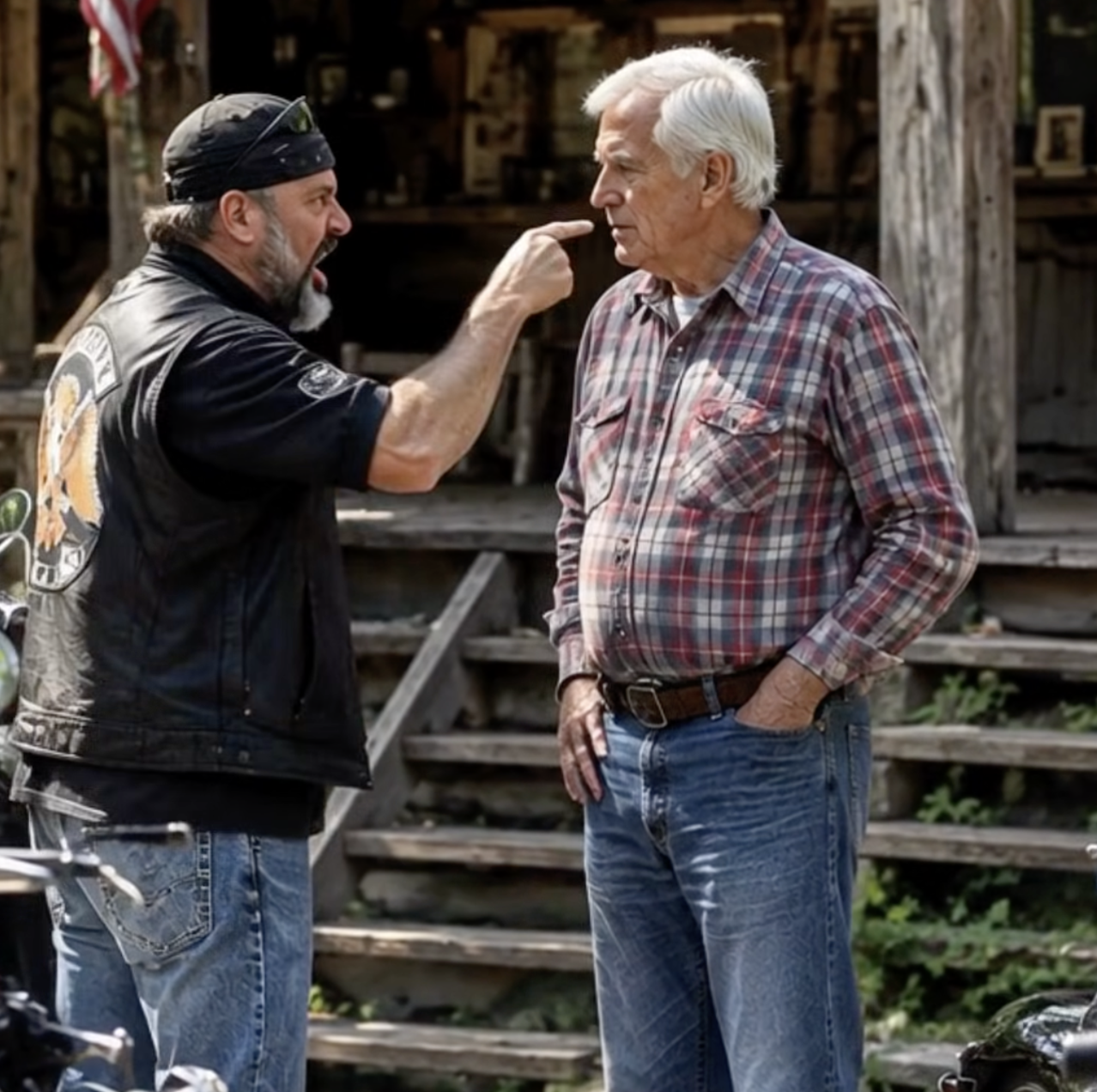
Silas Pendleton had spent most of his life standing between other people and the dark. At seventy-two he had decided the dark could find someone else.
He had been a combat medic in the Central Highlands when he was barely more than a boy, then a trauma nurse in a city hospital that never slept, then a husband who learned that some bleedings could not be packed and some fevers would not break. Helen lasted fourteen months after the diagnosis.
When the house in Flagstaff went quiet he sold it, bought forty acres of ponderosa and volcanic rock in the Coconino National Forest, and moved into a cabin that had no neighbors closer than fourteen miles of rutted dirt. His only regular companion was Barnaby, a three-legged golden retriever who had arrived at the county shelter already missing a hind limb and most of his trust. Silas had taken him because the dog looked the way Silas felt: used up in one place and still somehow standing.
The cabin sat in a fold of the mountain where the wind came down the draw like a living thing. Thick log walls, a stone hearth, a generator he ran only when he had to, a well that tasted of iron and pine. He kept a trauma kit under the sink out of habit, the way some men keep a rifle by the door. He told himself he would never open it again.
On the night of October fourteenth the power died early. Rain came sideways, freezing as it hit. Branches cracked in the dark like rifle shots. Silas sat in the rocking chair with a paperback and a kerosene lantern, listening to the fire lose its argument with the draft under the floorboards. Barnaby slept on the rag rug until he didn’t.
The growl was not the lazy sound the dog made at raccoons. Hackles rose in a stiff ridge. Barnaby limped to the oak door and barked into the storm as if the storm might answer.
Silas set the book down. His pulse did what it had always done in bad rooms: it slowed. Out here a knock usually meant a lost hunter or a hiker who had trusted a map more than the weather. He was reaching for the lantern when something heavy hit the door, then a scream that had almost no air left in it.
He threw the deadbolt and pulled.
She collapsed across the threshold and brought the night in with her: freezing rain, wet leather, and the copper smell he had spent a lifetime trying to forget. Young. Mid-twenties. Blond hair glued to a face the color of old paper. She wore a motorcycle jacket several sizes too large. The dark stain spreading under it was not rain.
“Help,” she said. It was barely a word. “They’re coming.”
He did not ask who. He hooked his arms under hers and dragged her onto the rug, kicked the door shut, and the sudden indoor quiet was worse than the wind. Barnaby circled, whining. Silas told him to stay back and went for the canvas kit.
She was sliding into shock, shivering so hard her teeth clicked. When he unzipped the jacket his breath caught for a reason that had nothing to do with temperature. She was heavily pregnant, seven months at least. The blood was not coming from the womb. It welled from a jagged, pulsing hole just below the right clavicle. The white maternity shirt around it was scorched at the edges. Close-range gunshot. Exit through the scapula, miraculously clear of the great vessels, still enough blood on the floor to frighten anyone who had never packed a wound in a rice paddy or a city bay at three in the morning.
“Stay with me,” he said, and the old voice came back without invitation: low, even, the voice that had talked soldiers and drunks and terrified teenagers through the worst minutes of their lives. “I’m Silas. You’re safe. What’s your name?”
“Chloe.” Her eyes rolled. “My baby. Please.”
“Your baby is going to be fine. So are you. But I have to stop this first.”
He tore open a dressing and put crushing pressure on the shoulder. She screamed and arched. The oversized jacket slid. On the back, stitched in the center, was a winged skull in a helmet. Upper rocker: Hells Angels. Lower: Arizona. On the breast pocket a smaller patch: Property of Tommy Callahan, President.
Silas knew the name. Everyone who drove the high desert corridors knew it. Tommy “Ironclad” Callahan ran the most feared charter in the region. Highways, desert routes, a reputation that made even people who hated outlaw clubs speak softly. The woman bleeding on Silas’s rug was his wife.
He wrapped a compression bandage under the arm and over the shoulder. “Did you crash? Where’s the vehicle?”
“Ran me off the ridge.” She coughed and a speck of blood hit her lip. “Black SUV. They shot into the car. I crawled.”
He checked her back. Clean exit. Blood loss severe. Worse: her abdomen had gone board-hard. Trauma and terror had started labor far too early.
“Silas.” She gripped his wrist with surprising strength. “My water. It just broke.”
The grandfather clock struck two. Outside, thunder walked the ridges. Inside, he moved her to the oak dining table because it was the highest, cleanest surface he had. He built the fire until it roared, hung wool blankets over every window so the cabin would not become a lantern in the trees, boiled water, laid out clamps and scissors and iodine, and kept his face calm while his mind ran the inventory of everything he did not have: an OR, blood products, a neonatal warmer, a surgeon.
“Breathe, Chloe. Slow.”
“It’s too early.”
“Babies keep their own clocks.”
Between contractions she talked in broken pieces. Tommy’s charter had pushed a cartel offshoot out of the Flagstaff corridor. The cartel had answered not by hitting patched members but by going after families. She had been coming home from a prenatal visit in Phoenix when the SUV found her on 89. They did not want a warning. They wanted the heir gone. Tommy had made her carry a compact satellite communicator. She had hit SOS when the car left the road. Whether the signal lived through the storm she did not know.
Barnaby growled from the hearth, ears swiveling toward the drive.
Silas took the Colt M1911 from the drawer, racked it, and told her not to make a sound. He peeled back a sliver of blanket. Two hard white beams crawled up the muddy track. Not an ambulance. A black SUV with tinted glass.
He unlocked the door and stepped onto the covered porch, pistol hidden under flannel. The vehicle stopped a few yards out. Two men in expensive raincoats that did not belong in the Coconino. One had a flashlight. The other had a suppressed weapon half-hidden in the fold of his coat.
“Evening, old man.” The light hit Silas in the eyes. “We had an accident down the ridge. Blonde, pregnant. Trying to help her. You seen her?”
Silas let his shoulders drop and played the deaf hermit. Magazines, bad night for it, only woman here was Helen and she was gone, highway back that way.
The beam dropped to the boards. Rain had taken most of the blood. A faint pink smear remained by the jamb.
“What’s that, Grandpa?”
“Where I dressed a buck yesterday. I’m missing my radio. Get off my land.”
The armed man came up a step. “Mind if we look inside?”
The frail act ended. Silas brought the Colt up into the man’s chest, hammer back, hands still as stone.
“I mind. This is private property. Arizona castle law. One more step with that weapon and I will paint these pines with what’s left of you.”
They looked at the gun, then at his eyes. The eyes did not belong to a man who had only ever gutted deer. They backed to the SUV. Silas did not lower the pistol until the taillights drowned in rain.
He locked the door. Chloe could not hold the next contraction. “It’s time.”
What followed was four hours that compressed a career into a single room. He talked her through each wave. He watched color, breathing, the bandage, the baby’s station. He had delivered in worse places with less, but never with a gunshot and a cartel possibly still in the trees. Just as the first gray leaked around the blankets, the cabin filled with a cry that shoved the dying storm aside.
A boy. Small. Premature. Lungs that meant business. Silas cleared the airway, clamped and cut, wrapped him in a sterile towel warmed at the hearth, and laid him on Chloe’s chest. She kissed the damp head and looked at Silas as if he had walked out of a story she had stopped believing.
He sat in the rocker. Shoulder holding. Infant pink and furious. Against the math of the night, they were both still here.
By seven the rain had stopped. Sun broke on wet needles. Silas stood to make coffee and the tin began to rattle. Cups chimed. The skillet trembled. Barnaby whined.
Not an earthquake. A low, rhythmic thunder with a clear sky.
He pulled the blanket from the front window and forgot to breathe.
Harleys filled the road, the drive, the yard, the first rank of pines. Chrome threw the morning back at him. Black cuts, the same death’s head, an ocean of them. He counted in blocks and gave up somewhere past several hundred. Later he would hear the number eight hundred and believe it.
At the front a massive man with a black beard and eyes like slag cut his engine, unholstered a revolver, and looked at the door as if it had personally offended him.
They had the ping. They did not have the story. To them Silas was not a retired medic. He was the last place Chloe’s beacon had spoken before she vanished.
“Stay out of sight,” he told her. “Not a sound.”
He left the Colt on the counter. A gun in his hand now would only write the ending faster. He opened the door, empty hands high, and stepped out.
One by one the engines died. The quiet after that many machines is a weight. Leather boots hit mud in a ragged rhythm.
Tommy Callahan did not use the stairs. He came onto the porch like a man who owned the mountain. Tattoos climbed his neck. A small diamond on the lapel read Filthy Few. Behind him, Vice President Boone Harrison dragged a man in a ruined raincoat—the flashlight man from the night, face already wrecked, still breathing.
“Her SOS hit fifty yards from this porch,” Tommy said. The voice was gravel under a truck tire. “We caught this trash trying to limp out. You tell me what happened to Chloe or I will take you apart on your own boards.”
The hitman laughed through blood. “We chased her here. She was banging. He shot her. We heard her screaming. The old man finished it.”
Tommy’s face changed. He put the .44 against Silas’s forehead. The hammer went back. Behind him a forest of hands found knives, chains, grips.
“Five seconds.”
Silas looked past the muzzle.
“If I wanted her dead I would not have spent the night boiling instruments. She’s inside. Bullet in the shoulder. She lost a lot of blood. She’s alive. I was a medic in the Ia Drang and an ER nurse for thirty years. I know a hemorrhage and I know a delivery. Your son was born about two hours ago. Take the gun out of my face, wipe your boots, and come in. You bring that heat in there and scare her, I will take that revolver away from you and use it for something besides shooting.”
Boone surged. Tommy barked him down. He stared at the door as if it might lie. He told Boone to tie the hitman to a bike. If the old man was lying, they would burn the cabin to the nails.
Tommy went in.
The room looked like a massacre until the thin cry cut it open. Blood on oak. Towels in a heap. Steel in iodine. Copper in the warm air. Then the sofa, the fire, Chloe pale and bandaged with an IV taped from Silas’s kit, a bundle in a blue plaid cloth against her chest.
“Tommy,” she whispered.
The man who ran highways and terrified syndicates went to his knees and crawled the last feet and buried his face in her good shoulder. She told him the rest: Navarro, the ridge, the porch, the old man with the pistol who had sent the hunters away, then the long night and the boy.
Tommy looked at the infant. A tattooed finger, a tiny fist closing on it.
When he stood, the tears were gone and something heavier sat in their place. He put his arms around Silas hard enough to remind the older man that gratitude can feel like assault.
“I owe you a debt I cannot pay. My life. My blood. Yours.”
“Just take care of them,” Silas said. “And keep your friends off the grass. I reseeded.”
Tommy laughed once, sharp and short, and went back to the porch.
“She’s alive,” he roared, fists up. “I have a son.”
The mountain answered. Men shouted, engines barked, a few celebratory rounds went into dirt instead of sky. Then Tommy’s voice changed when it found the man on the ground. The van. Phoenix and Tucson. The Navarro charter ended today.
A medical transport arrived by late morning, club drivers who moved Chloe and the baby as if the road itself might bruise them. Before he left, Tommy pressed a thick brass coin into Silas’s palm. Death’s head one side, charter crest the other.
“You show this to any man in our colors, anywhere, and they will put themselves between you and whatever is coming. You are protected. Always.”
Silas turned the coin in the light and said nothing. He had never asked for an army.
The war that followed did not look like war on the evening news. It looked like a network coming apart: houses emptied, shipments that never arrived, men who simply were not there anymore. Deputies scratched their heads. Silas drank coffee and did not.
His life returned to the shape he had chosen, with a new geometry around it. Every Sunday two riders came up the drive with groceries, fifty-pound bags of food for Barnaby, and split pine stacked neat as a promise. When a January blizzard killed the generator, six of them arrived in two hours with an industrial unit and installed it in snow while Silas stayed inside with a pot of coffee and the sense that arguing would be rude. Side trails grew discreet markers that made lost four-wheelers turn around. Hunters who used to cut across the lower meadow stopped coming. The forest had acquired a rumor, and rumors in that country travel farther than maps.
Sometimes he sat on the porch with the coin in his pocket and watched a man the size of a door split wood at the edge of the yard, respectful, silent, present. Barnaby, who trusted almost no one, eventually accepted the visitors the way he accepted weather: as a fact that did not require his opinion.
Silas had come here to finish being useful. He had wanted silence and a dog and the particular peace of a place that asked nothing of his hands.
The storm had asked anyway.
He thought of Helen more often after that night, not because the cabin felt haunted but because she would have understood the joke. You spend a life trying to leave the blood behind and the blood finds the last dirt road on the map and knocks. You open the door because that is the only trick you ever learned.
He had saved a woman and a boy who would grow up hearing a story about an old man in the pines and eight hundred engines at sunrise. In return he had been given something he had not wanted and could no longer quite refuse: the knowledge that if the dark came up that driveway again, it would not find him alone.
On a late spring morning, frost still in the shadows, he poured two cups out of habit and set the second on the railing for no one. Barnaby thumped his tail. Down at the bend a familiar rumble gathered, not an army this time, just the Sunday pair with a crate and a joke he would pretend not to hear.
Silas picked up the extra cup, drank it himself, and went down the steps to meet them.
The forest was still his. It was simply no longer only his. And for a man who had spent decades pulling strangers back from the edge, that was a stranger kind of peace than the one he had come looking for—but it held. It held the way a well-tied dressing holds, the way a cabin holds against weather, the way a debt, once named in brass and kept in a pocket, changes the shape of a life without asking permission.