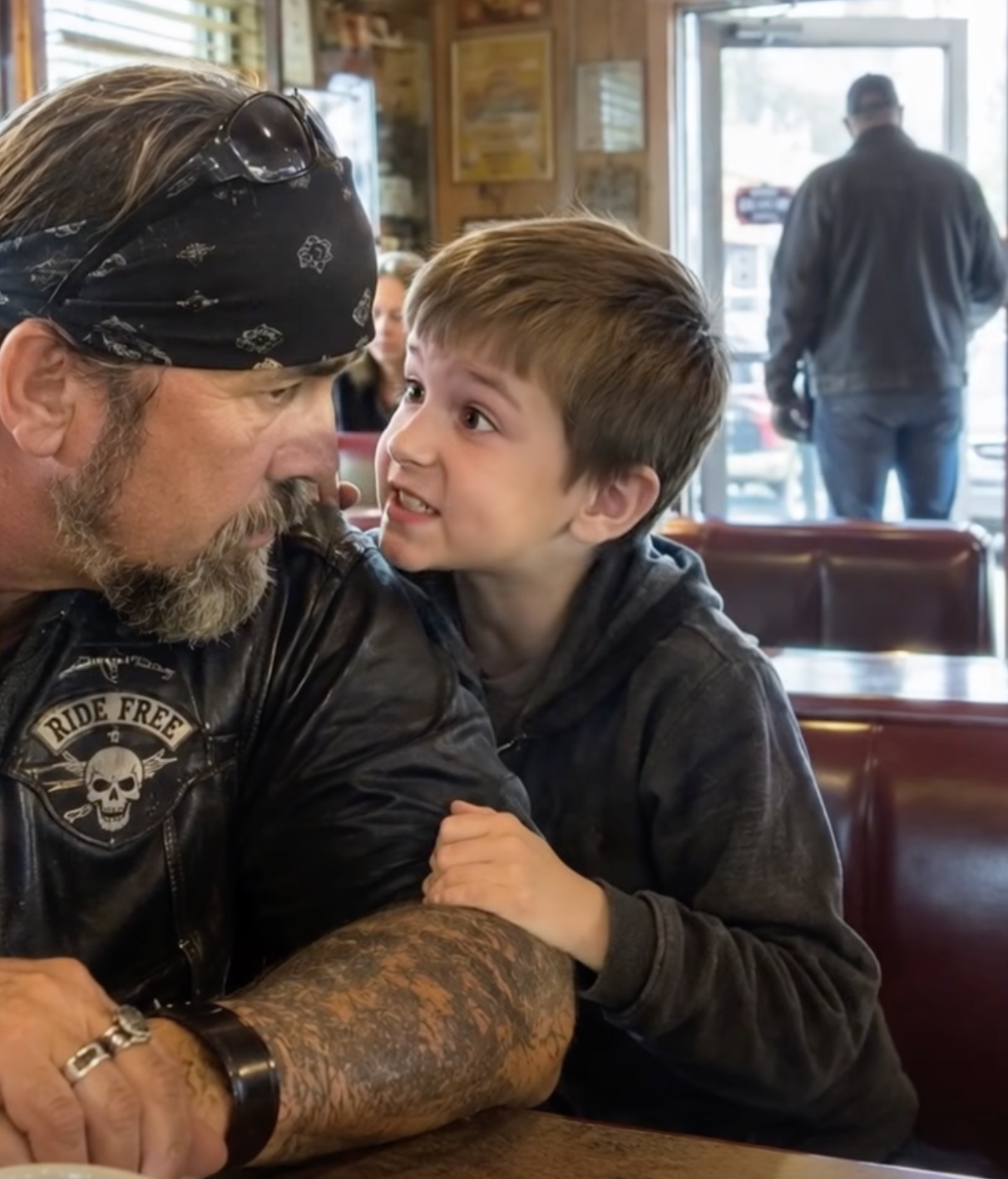
The lunch rush at Miller’s Ridge Diner had finally begun to thin.
Outside, the Arizona sun sat hard over Prescott Valley. Pickup trucks baked in the gravel lot. A few motorcycles leaned near the front windows, chrome flashing in the afternoon light. Inside, coffee cups clicked against saucers, an old speaker leaked soft country music, and the air smelled of grilled onions and black pepper.
At the corner table, four bikers sat over fries and coffee. They were not loud. They were not looking for trouble. They were men who had ridden long roads and kept longer silences—the kind that come from memories nobody ever asked them to explain.
The largest of them was Daryl Boone: late fifties, broad through the shoulders, gray beard, kind eyes, and a worn leather vest stitched with charity-ride patches. People often decided who he was before he opened his mouth.
Children never did.
That was why, when the front door slammed open hard enough to make the bell jump on its hook, Daryl looked up first.
A boy stood in the doorway.
He was maybe ten, small for it, dusty sneakers, faded blue hoodie, hair flattened by wind. His face was pale. His eyes were too wide. One hand locked on the doorframe as if it were the only thing holding him up.
For a second the diner held its breath.
Then the boy whispered, “Please… I need help.”
Nobody moved except the bikers.
A waitress froze with a coffee pot in midair. A father pulled his daughter closer. An older couple turned in their booth and stayed seated.
The boy kept glancing over his shoulder toward the parking lot.
Daryl pushed his chair back slowly. Not fast enough to scare the child. Not loud enough to startle the room. Just enough to show he had heard.
“Hey, son,” he said, voice low. “Come over here.”
The boy didn’t hesitate. He crossed the floor quickly and slipped in beside Daryl’s table, breathing so hard his shoulders shook. Ronan Pike, quiet even among quiet men, shifted his chair so it blocked the line of sight from the door.
Daryl crouched a little, bringing himself closer to the boy’s height.
“What’s your name?”
The boy swallowed.
“Miles.”
“Okay, Miles. I’m Daryl. You’re safe right here. Tell me what happened.”
Miles tried. No words came. His lips trembled. He pointed at the floor, then toward the street.
One of the others frowned. “You fall?”
Miles shook his head.
“No,” he whispered. “Under.”
Daryl’s face changed, but his voice did not.
“Under what?”
Miles looked around the diner as if the walls might answer for him. Then he leaned in.
“Under my grandma’s house.”
Before Daryl could ask another question, footsteps sounded outside.
Slow.
Measured.
Not running. Not calling a name. Just coming closer.
Miles went white. His small fingers closed on Daryl’s sleeve.
“He found me,” the boy whispered.
Daryl covered the boy’s hand with one steady one.
“Who found you?”
Miles didn’t answer.
The diner door opened.
A man stepped in wearing a clean gray suit, polished shoes, and a smile that looked practiced rather than kind. Forties. Handsome in the way men get when they are used to being believed. Hair perfect. Watch expensive. His eyes moved across the room not with worry, but with calculation.
When he saw Miles beside the bikers, the smile tightened.
“There you are,” he said smoothly. “You scared everyone, Miles.”
Miles moved behind Daryl.
Daryl stood.
The man’s gaze flicked to the vest, then back to the child.
“I appreciate your concern,” he said, “but this is a family matter.”
Daryl didn’t step aside.
“Then the boy can tell me that himself.”
The man gave a small laugh with no humor in it.
“He’s confused. His grandmother has been filling his head with things he doesn’t understand.”
Miles shook his head hard.
“That’s not true.”
The man’s face changed for half a second.
Only half a second.
Daryl saw it.
He lowered his voice.
“Miles. Look at me. What did you see?”
The boy’s eyes filled, but he did not cry. He looked at the man in the suit, then back at Daryl.
His voice came out small.
“He’s trying to take Grandma’s house.”
The smile vanished.
The diner went quieter still.
Daryl looked down at Miles.
–
Miles dug into the front pocket of his hoodie and pulled out a folded sheet. His hands shook so badly Daryl had to steady the paper while they opened it.
It was not a full packet. One page. Signatures. Dates. A company name printed across the top in heavy type.
Coppergate Development Group.
Daryl stared at it.
Ronan leaned in and read Daryl’s face.
“You know them?”
Daryl’s jaw tightened.
“I know enough.”
Graham stepped closer.
“That document is private. The child took something he had no right to touch.”
Miles found his voice all at once.
“You left it on Grandma’s kitchen table. You told her it was just for repairs. You said if she didn’t sign today, the county would take everything.”
Graham’s eyes sharpened.
“Miles. Stop talking.”
The boy shook his head. Tears finally spilled.
“You thought I was outside. I was in the hallway. I heard you.”
Then he said the sentence that locked the room in place.
“You thought I didn’t see you hide the real papers under the floor.”
Lillian Voss had lived on Juniper Lane for forty-two years.
The house was a white one-story with blue shutters, a cracked walkway, and roses that came back every spring along the fence. Her husband had built the back porch with his own hands. Her daughter had taken first steps across that living-room floor. Miles had learned to ride a bike in the driveway, scraping his knees on the same gravel that still sat there.
To a developer, it was a lot.
To Lillian, it was the map of a life.
For months Coppergate had been buying the street. They wanted bright signs, office space, a parking lot where the roses were. Most families sold. Lillian did not.
Then the pressure arrived in envelopes, phone calls, inspection notices, and polite men who told an old woman she was too tired to keep a house. That morning Graham Sutter had sat at her kitchen table with a friendly voice and a folder full of careful language.
He told her he could help.
He told her the papers were only a repair grant.
He told her she would be protected.
Miles had seen the second set.
The ones slipped under the loose board by the old pantry door.
The ones that transferred the house.
Daryl had heard Graham Sutter’s name before.
Two years earlier a widow in Chino Valley signed what she thought was a maintenance agreement and lost her home. A veteran near Camp Verde missed one buried deadline and was gone. Another family left town because they could not afford a lawyer long enough to fight.
Nobody had proof that stuck.
Nobody had a witness.
Until a ten-year-old boy ran into a diner.
Daryl looked at Graham and spoke loud enough for the whole room, quiet enough to stay calm.
“You need to step back from that boy.”
Graham’s eyes narrowed.
“You have no idea what you are involving yourself in.”
Daryl nodded once.
“Maybe not. But I know what a scared child looks like. And I know what a man looks like when he’s afraid of what that child knows.”
Bethany set the coffee pot down and reached for the phone behind the counter.
Graham saw it.
“There is no need for that.”
Bethany looked at Daryl.
Daryl never took his eyes off Graham.
“Call the sheriff’s office. Ask for Deputy Maren Lowell. Tell her it concerns Coppergate and a child witness.”
Graham’s face changed again.
This time nobody missed it.
Twenty minutes later two deputies walked into Miller’s Ridge.
Miles stayed beside Daryl the whole time, a clean diner apron wrapped around his shoulders like a blanket. When Deputy Maren Lowell came in, she did not treat him like a problem. She knelt.
“Miles, I’m here to listen. You are not in trouble.”
That was when the boy finally cried. Quietly. The way a child cries after holding himself together too long.
Daryl stayed close and let her work.
Miles told it again. The papers. The floorboard. The conversation. Graham seeing him with the copy. The run.
Graham tried to cut in twice.
Lowell stopped him both times.
“Sir, you will have your chance. Right now the child is speaking.”
By late afternoon they were on Juniper Lane.
Lillian Voss stood on the porch in a pale yellow cardigan, one hand pressed to her chest. Miles ran up the cracked walkway and into her arms.
“Grandma, I’m sorry.”
She held him as if the street itself might try to take him back.
“No, baby. You came back. That’s all that matters.”
Behind them, Daryl looked at the house—the blue shutters, the roses, the porch a dead man had built—and then at the loose board no one had lifted yet.
Ready for the final part whenever you send it.
—
The loose board was exactly where Miles said it would be.
Near the pantry. Under an old braided rug that had been there longer than he had been alive.
Deputy Lowell lifted it while Lillian sat at the kitchen table with both hands wrapped around a glass of water she was not drinking. The wood came up with a dry scrape.
Inside: a sealed envelope. Unsigned forms. A deed transfer with Lillian’s name already typed into the wrong lines.
There were notes, too.
Pressure points. Medical appointment dates. Family names. Hours when the house would be empty.
Daryl stood in the doorway and did not speak.
Graham Sutter no longer looked like a man who belonged in a clean gray suit. Nothing had touched him. The room had simply filled with what he had hidden, and it made him smaller.
Lowell finished the last page and looked up.
“You’ll need to come with us and answer some questions.”
Graham tried one last smile.
“This is a misunderstanding.”
Miles stepped forward, still holding his grandmother’s hand. His voice was small. It did not shake.
“No. It isn’t.”
The kitchen went still.
The boy lifted his chin.
“You told her the house wasn’t worth fighting for. But it is.”
By nightfall the story was already moving through Prescott Valley. Not because anyone wanted a spectacle. Because too many people recognized the shape of it.
Neighbors came forward. Former homeowners called Lowell’s office. A retired teacher brought a stack of letters she had never thrown away. A church volunteer remembered driving Lillian to a meeting where Graham had kept talking until the old woman’s hands were shaking on the table.
By the end of the week, Coppergate’s plans on Juniper Lane were frozen. Investigators opened files that had sat quiet for years.
Lillian did not lose the house.
A local attorney took her case without a fee. Miller’s Ridge started a jar on the counter for roof nails and porch paint. On Saturday Daryl’s riders arrived with ladders, toolboxes, and enough sandwiches to feed the block. They worked until the shutters were blue again and the porch boards no longer complained underfoot.
Miles painted the lowest slats of the fence, tongue between his teeth, careful as a person twice his age.
Daryl held the ladder.
Lillian stood in the yard and watched her small white house fill with people who had no reason to be there except that they had decided to be.
“I thought nobody cared anymore,” she said.
Daryl looked at the boy at the fence post.
“Sometimes they do,” he said. “They just need one voice loud enough to wake them.”
A month later the diner looked the same. Coffee. Plates. Chrome outside the window.
One thing was different.
Near the counter Bethany had hung a framed photograph: Lillian’s house after the work, shutters bright, roses trimmed, Miles on the porch beside his grandmother. Under it she had written, in her own hand:
Listen when a child says something is wrong.
Daryl came in on Thursdays. Miles and Lillian came with him.
One afternoon Miles looked across the table.
“Were you scared that day?”
Daryl thought about it.
“A little.”
Miles frowned, surprised.
“Really?”
“Being brave isn’t the absence of fear,” Daryl said. “It’s knowing somebody needs you more than the fear does.”
Miles looked at his fries.
“I thought nobody would believe me.”
Daryl leaned in.
“I believed you the second you came through that door.”
Miles smiled then—not the tight, watchful look he had worn in the doorway, but the ordinary smile of a boy who could finally sit still and eat.
Outside, the Arizona light lay across the gravel lot. Inside, the speaker kept playing the same old country station. The house on Juniper Lane still stood, roses against the fence, a loose board nailed down for good.
And every Thursday, at the corner table, a child who had run toward strangers for help sat with the men who had stood up when the rest of the room had not.