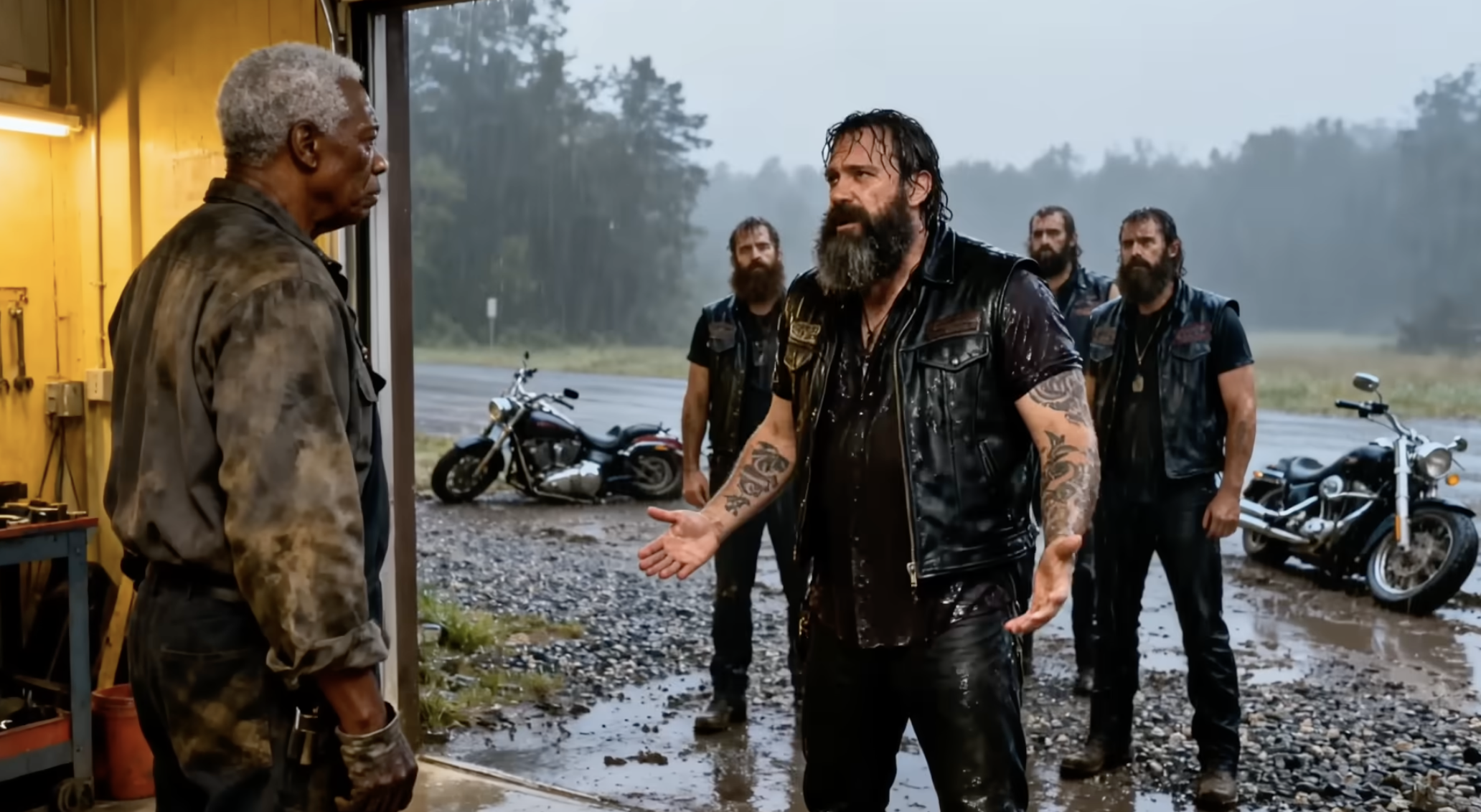
Mister, please. Is there anybody in this whole damn town who will help us?
Four men stood in the rain, their leather vests completely soaked. Their tattooed arms were covered with water, and rain dripped from their beards. Behind them sat four dead Harleys. Behind those bikes were six closed doors.
Booker Tate was 68 years old. He had $43 in his cash box and a bank notice on his desk that said Tuesday.
“Sir, we got turned away everywhere,” one of the bikers said. “The cops told us to move along. My brother is sick.”
Booker looked at the biggest man.
“How sick?”
“Heart,” the biker answered. “He needs to sit down now.”
Booker glanced toward the house.
Hattie was already standing in the doorway with a dish towel in her hand.
“Come in, Booker. I see what they need. Bring them in.”
The biker’s voice cracked.
“Ma’am, five doors said no.”
Booker simply nodded.
“This one says yes, boy. Come on.”
Five days later, 60 Harleys would roll into that same driveway.
And the Tate name would be carried across four states.
But 48 hours before those four men knocked on Booker’s door, Booker Tate was doing what he had done every morning for 43 years.
At exactly 5:00 a.m., he flipped the open sign at Tate’s Garage. Before doing anything else, he touched the corner of his father’s photograph above the workbench.
Then he whispered, “Morning, Daddy.”
After that, he walked next door to kiss his wife.
Hattie was already standing at the griddle. Her apron was tied around her waist, coffee was ready, and the smell of biscuits and bacon filled the gray Ohio morning.
“Morning, sugar.”
“Morning, baby.”
“Sleep all right?”
“Mhm. Roof leaked again.”
“I know. Heard the bucket.”
She handed him a mug without even looking up.
They had done this every morning for 43 years.
They didn’t need to look at each other anymore.
They just knew.
The Tate property sat on Route 9, four miles outside Blainboro.
There were two old buildings and a tired little house behind them.
Tate’s Garage stood on one side. Booker’s father, Ezekiel, had built it in 1954.
Hattie’s Pantry stood on the other side. Hattie had added it in 1982 after leaving the diner in town so she could work closer to her husband.
A narrow breezeway connected the two buildings.
Every day at noon, Booker and Hattie ate lunch there together.
Two mugs.
Two plates.
Forty-three years.
That was their life.
It wasn’t big.
It wasn’t fancy.
But it was quiet, honest, and theirs.
And it was about to end.
The bank notice had been sitting on Booker’s desk for two months.
He kept turning it face down.
Hattie kept pretending she didn’t notice.
Tuesday was the deadline.
That morning, Booker counted the cash in the box.
Forty-three dollars.
Two singles.
One five.
Three tens.
And a worn-out fifty-dollar bill he had been saving in case the truck needed a new battery.
He closed the cash box and stared at his hands.
Those hands had rebuilt more than 3,000 engines.
Those hands had once splinted a child’s broken wrist when a family broke down outside the shop during a thunderstorm.
Those hands had buried his mother.
His father.
And his only son.
Now those same hands were going to hand over the keys to the garage.
He hadn’t told Hattie that yet.
But she already knew.
She always knew.
Neither of them was ready to say it out loud.
For ten years, the chain auto shop two miles up Route 9 had slowly taken away their customers.
It had bright signs.
Coupon books.
A loyalty app on a phone.
Young people didn’t seem to know what a master mechanic was anymore.
They knew what a 15% off sticker was.
Booker had only three regular customers left.
There was Hollister, whose husband had passed away in the spring.
The Peterson kids, who still brought their father’s old truck in on Sundays.
And Russ from the gas station up the road.
Russ came in once a month for an oil change and usually stayed long enough to eat biscuits.
That was it.
That was the entire garage business.
Hattie’s Pantry was doing a little better.
Truckers stopped there for her sweet tea, which was famous all the way to Cleveland.
But even that wasn’t enough to save them.
Hattie kept a little tin on the counter.
A handwritten sign on it said:
“Coffee. Pay what you can.”
Most days, Hattie lost money on that tin.
Some days, she didn’t.
Every once in a while, a trucker would put a twenty-dollar bill inside and walk out before she could give him any change.
That was Hattie.
She gave people coffee before she counted the coins.
That morning, two truckers came in at 5:15 for biscuits.
They were friendly men. They knew Booker’s name. They paid and left.
After the door closed behind them, Booker spoke quietly.
“You notice how that one always waits for the other to pay?”
Hattie didn’t look up.
“Mhm.”
“My daddy used to say you learn who folks are by how they pay you. Or how they don’t.”
“He said a lot of things, your daddy.”
“He did.”
Booker drank his coffee.
Hattie wiped the counter.
Neither of them mentioned the other thing.
The thing Ezekiel used to say back in 1962.
The thing about being a Black mechanic in a town that wouldn’t even let him buy a sandwich at the diner across the street.
They didn’t need to say it.
Some things live in the silence between two people who have been married for 43 years.
The hardest part of the morning came at 7:00.
Their granddaughter Naomi stopped by before school.
She was 17 years old and at the top of her class.
When she was 13, she had built a working hydraulic engine for the science fair.
A week earlier, a letter had arrived.
Purdue University.
College of Engineering.
Accepted.
Naomi had run down Route 9 holding that letter like it was something fragile.
Booker had cried right there in the garage.
Grease was still on his hands.
The tuition was $41,000 a year.
They had $43 in the cash box.
And a bank notice that said Tuesday.
Naomi knew nothing about the notice.
Hattie had made that clear.
“She won’t hear it from me, baby. Not until after she signs whatever she needs to sign.”
“She’s going to fight for it.”
“Let her fight for it.”
So that morning, Naomi sat at the counter eating a biscuit and talking excitedly about thermodynamics.
Booker sat across from her with a smile on his face.
His hand rested around his coffee mug.
The lie of the morning felt like it weighed 40 pounds in his chest.
Hattie watched him from the griddle.
Their eyes met once.
She slowly shook her head.
Don’t, baby.
Not yet.
Booker nodded.
He took another bite of his biscuit.
And kept smiling.
That was Thursday.
By Saturday afternoon, the rain would begin.
By Saturday evening, four soaked strangers would be standing in his driveway.
And by Sunday morning, the entire shape of their lives would begin to change.
The rain started Saturday at noon.
This wasn’t normal Ohio rain.
It wasn’t the kind that came hard for 20 minutes and then disappeared.
This was different.
This was the kind of rain that refused to stop.
By 2:00, the ditches were filling.
By 3:00, the low areas on Route 9 had turned into rivers.
By 4:00, the tornado watch was being announced on the radio every 15 minutes.
By 5:00, Hattie had pulled in her open sign and was wiping down the counter.
The pantry hadn’t had a customer since lunch.
Booker stood inside the garage bay watching the rain blow sideways across the parking lot.
A transmission was sitting half apart on his workbench.
It was a job that would pay him $80.
The customer wasn’t coming today.
The customer probably wasn’t coming Monday either.
Booker was about to flip his own sign and walk over to the pantry for an early supper when he heard something.
Not a car engine.
Not the high, clean sound of a passenger vehicle.
Something heavier.
Something lower.
Four motorcycles.
But they weren’t being ridden.
They were being pushed.
Booker couldn’t see them yet.
They were still about half a mile down the road, only dark shapes moving through the gray wall of rain.
But he could hear the clicking of dead chains.
Four men leaned into four enormous motorcycles.
They were pushing those bikes up the shoulder of Route 9 like men dragging dead bodies.
Booker didn’t know what had happened yet.
He would learn the story later, piece by piece, from the men themselves.
About a mile back, the road dipped into a hollow where a creek passed beneath a low concrete bridge.
By noon, that hollow had become a lake.
By the time the four bikers reached the rise and saw the water, it was already nine inches deep across the road and still rising.
The lead rider was a man everyone called Diesel.
He was as big as a barn door.
He carefully eased his Harley into the water at about three miles per hour, trying to walk the bike across.
It was a custom Harley.
Two thousand dollars a foot to replace.
He thought he could make it.
He couldn’t.
The water reached the air intake halfway across.
The engine choked.
Then it died.
The three bikes behind him made it about 20 feet farther before they died too.
One.
Two.
Three.
Almost like a string of firecrackers going out one after another.
Four dead Harleys.
Four huge men standing waist-deep in cold October water during an Ohio storm.
It took them an hour to push the motorcycles out of the hollow and onto dry road.
Then they began knocking on doors.
The first house had a porch light on.
A woman pulled back the curtain.
She looked at them.
Then she shut the curtain.
They knocked twice more.
Nothing.
At the second house, an old farmer opened the door.
A shotgun rested against the wall behind him.
“You boys keep moving.”
Then he shut the door.
The third house never opened.
The men saw a face in an upstairs window.
Then it disappeared.
The fourth place was a small auto repair shop.
Diesel had been certain that another mechanic would help.
The owner was inside the bay working on a Dodge.
They could see him through the glass.
They knocked.
He looked up.
He walked to the front door.
Then he turned the closed sign around.
It wasn’t even 2:30 in the afternoon.
The fifth stop was a gas station.
Reaper went inside alone because he figured the others looked too intimidating as a group.
He asked for a tow.
The kid behind the counter said the pump was broken.
The air machine was broken.
The tow truck was broken.
Then a Ford F-150 pulled into the station.
The kid walked outside and filled it without saying a word.
Reaper stood there shivering.
The sixth door was the worst.
It was a nice ranch-style house with a swing set in the backyard.
They knocked.
A woman opened the door about three inches, with the chain still attached.
The men started explaining what had happened.
She slammed the door shut.
Two minutes later, they heard her speaking on the phone through the open kitchen window.
“There are four of them. Big men. Tattoos. I’m scared, officer.”
A sheriff’s deputy arrived 15 minutes later.
He checked all four IDs.
He ran their names.
There was nothing to find.
Because there was nothing to find.
These men were a welder, a long-haul trucker, a contractor, and a medic who had served two tours in Iraq.
The deputy was respectful.
He even seemed apologetic.
But before he drove away, he said:
“Boys, this isn’t a friendly stretch for folks who look like you. I’d keep pushing.”
So they pushed.
They pushed those bikes another two miles through the rain.
They were soaked through.
They were shivering.
They were hungry.
And Diesel was coughing harder with every step.
His face had begun turning gray.
Then they came around a long bend.
Through the rain, they saw a sign.
Tate’s Garage.
Hattie’s Pantry.
Established 1954.
A warm yellow light glowed in the window.
Diesel was 6’3″ and about 280 pounds.
His beard reached his chest.
A tattoo of his daughter’s name stretched across his throat.
He leaned heavily on the handlebars of his dead bike and looked at the other three men.
He coughed once.
Hard.
“Last try, fellas,” he rasped. “If they say no, I’m done.”
Booker watched them come up the driveway.
He didn’t move.
Four large men.
Soaked leather vests.
Black rain dripping from their beards.
Four dead bikes being pushed one slow step at a time.
The biggest man was leaning on his handlebars like he couldn’t stand without them.
For one full second, Booker didn’t move.
He saw the patches.
He saw the beards.
He saw the tattoos climbing up the necks of two of them.
And inside his own head, he heard every voice in town that had ever whispered about people like that.
He thought about the bank notice sitting on his desk.
He thought about what his remaining customers might say.
He thought about Naomi.
For one second.
Then the door behind him opened.
Hattie stepped into the breezeway wearing her apron.
She looked at the four men.
Then she looked at her husband.
“Booker?”
He turned.
“Booker. Bring them in.”
“Hattie, they’re—”
“I see what they are. Bring them in.”
That was it.
Booker took his coat from the hook and walked out into the rain.
The four men stopped at the edge of the lot.
They looked almost afraid to move any closer until someone invited them.
“Park them under the overhang,” Booker called. “Get them out of the rain. Then come inside.”
The big man tried to say thank you.
Instead, he started coughing.
The coughing wouldn’t stop.
The other three men grabbed him before he fell.
Booker moved quickly for a 68-year-old man with arthritis.
He put Diesel’s other arm over his shoulder and helped him toward the pantry door.
“What’s your name, brother?”
“D-Diesel.”
“Dalton?”
“Yeah.”
“Okay, Dalton. We’re getting you inside.”
“Sir, heart. I got a heart thing from the Army. Pills are in my—”
“In your saddlebag?”
“Yes.”
“What kind?”
“Beta blocker?”
Booker looked over his shoulder.
The man with the medic patch was already moving.
“Son, get his pills. Now.”
“Yes, sir.”
Hammer, the medic, was already running toward the bike.
Inside the pantry, Hattie had already lit the wood stove in the back room.
She pulled quilts from the shelf.
She didn’t even stop to think about how large the men were.
She walked directly toward Dalton.
She put one small hand against his cheek.
“Oh, baby. You’re freezing. Sit down before you fall down.”
Dalton was 6’3″.
He weighed 280 pounds.
He was a professional welder.
But he sat down like a little boy.
Hattie had his vest off in 30 seconds.
She folded it carefully across the back of a chair.
She handled it the same way you would handle a man’s uniform.
Then she helped him out of his soaked T-shirt.
She wrapped him in a quilt she had sewn the winter their granddaughter was born.
“Where are those pills?”
“Coming, ma’am,” Hammer called from the door.
Hattie helped Dalton take one with small sips of warm water.
She wiped his forehead with a clean cloth.
Then she placed two fingers against his neck.
His pulse was slow but steady.
“Booker?”
“Yeah?”
“He’s running hot.”
“I see it.”
She didn’t ask who he was.
She didn’t ask what club they belonged to.
She didn’t ask whether they were dangerous.
She simply treated him like he was her own son.
“Dalton, baby. You got a wife at home?”
“Yes, ma’am.”
“And a daughter?”
“Lily.”
“Lily. That’s a pretty name.”
“Yes, ma’am.”
“You’re going to see her, all right? You hold on to that. Picture her face.”
Dalton’s eyes filled with tears.
He nodded.
Out in the main pantry, the other three men were dripping water onto Hattie’s floor.
Tank was 6’4″ and had a tattoo covering his neck.
Reaper was 52 and had a face that looked carved from stone.
Hammer was the medic who had already gotten Dalton’s medicine.
Hattie looked at the three men.
“You.”
She pointed at Tank.
“You.”
She pointed at Reaper.
“You.”
She pointed at Hammer.
“Sit. Now.”
Tank sat down at the counter like a child who had just been scolded.
“You’re soaked.”
“Yes, ma’am.”
“You’re scared for your friend.”
“Yes, ma’am.”
“You can’t help him better than I can.”
They didn’t answer.
“So you’re going to eat. Then you’re going to sit there and let me work. You understand?”
“Yes, ma’am,” Tank said quietly.
Hattie put three plates on the counter.
Fried chicken left over from lunch.
Biscuits.
Gravy.
Sweet tea from a sweating glass pitcher.
Tank picked up a biscuit.
His hand was shaking.
He took a bite.
Then another.
His jaw began to tremble.
He put the biscuit down and wiped his enormous face with the back of his enormous hand.
“Ma’am, I’m sorry. I haven’t—”
“This is—”
“Eat your biscuit, son. I made it this morning.”
Tank looked at her.
“Made with worry.”
She smiled faintly.
“Tastes different.”
He ate.
Tears ran down into his beard the entire time.
Reaper didn’t say anything.
He simply watched Hattie work.
He watched how carefully she moved.
He watched how she touched Dalton’s shoulder every time she walked away from him.
Finally, Reaper spoke in a low voice.
“Five doors said no to us today.”
Hattie didn’t look up from the soup pot.
“Folks see what they want to see.”
“Ma’am, you didn’t even ask if we were dangerous.”
She finally looked at him.
“You’re cold and hungry. That’s all I needed to know.”
Reaper’s eyes became wet.
He turned toward the window so the others wouldn’t see.
They saw anyway.
Nobody said anything.
In the back room, Booker was on the CB radio.
The volunteer fire department had confirmed the bridge was underwater.
The ambulance couldn’t cross until at least 9:30.
Booker explained Dalton’s heart condition.
The dispatcher told him to keep Dalton warm, still, and hydrated.
Booker hung up.
He returned to the pantry.
Hattie was already pulling clothes from a paper bag in the back closet.
“Booker’s old work shirts. Hammer, these should be about your size.”
She held up several flannels.
“These will fit two of you.”
Then she pointed toward a basket.
“Dry socks are in there. Basin is under the sink. There’s a curtain in the storeroom if you need privacy.”
She said everything like a foreman giving instructions.
The three men followed every order.
Hammer paused at the storeroom door.
He looked at Booker.
“Sir, we didn’t deserve this.”
Booker looked at him.
“Six houses said no.”
Booker didn’t answer immediately.
He thought about his father.
He thought about 1962.
He thought about the story Ezekiel had told him for years about being turned away from a diner across the street from his own shop.
He remembered what that kind of rejection did to a man’s stomach.
Finally, he said:
“Get out of those wet clothes, son.”
By 10:15, the bridge had cleared.
The ambulance finally arrived.
The paramedic checked Dalton’s vital signs.
Then he quietly said to Hattie:
“Ma’am, those pills and keeping him warm may have saved his life. He could have coded tonight without them.”
Hattie simply nodded.
She squeezed Dalton’s hand at the doorway.
He held on.
“Mrs. Tate?”
“Yeah, baby?”
“What’s your name?”
“Hattie Tate.”
“Your full name. I need to remember.”
“Hattie Tate.”
“And that’s my husband, Booker.”
Dalton repeated the names three times under his breath as they wheeled him outside.
Like a prayer.
Reaper pulled an envelope from his vest.
Inside was $2,000.
Everything the four men had on them.
He pushed it across the counter.
Hattie immediately pushed it back.
“Honey, put that away.”
“Ma’am—”
“We helped because you needed it. Money has nothing to do with it.”
Reaper’s eyes filled with tears again.
This time, he didn’t hide them.
“Ma’am, nobody stops for us.”
He looked toward the door.
“Y’all stopped.”
At the door, Hammer quietly slid a playing card underneath the coffee tin.
Hattie didn’t see him do it.
The bikes stayed in the lot, covered with tarps.
The men were gone by midnight.
At 11:00, Booker and Hattie sat together in the breezeway with two mugs of coffee.
They had done that every night for 43 years.
Booker looked at his wife.
“Think you’ll be okay?”
She smiled.
“He’ll be okay, sugar.”
She squeezed his hand.
“He’ll be okay.”
Neither of them knew that five days later, the road outside their shop would be filled with 60 Harleys.
Sunday morning arrived gray and cold.
The rain had finally stopped.
Booker was outside by 6:00, looking over the damage.
The storm had done what storms do.
The gutter on the garage hung from two nails.
More shingles were missing from the pantry roof.
The front sign had tilted another inch toward the road.
Booker stood there in his work coat with a cup of coffee.
He looked at everything.
But he didn’t feel much.
Instead, he kept thinking about Dalton’s eyes when he said:
“Lily. She’s seven.”
Hattie opened the pantry at 6:30, just as she had done every Sunday for 43 years.
Two truckers came in for biscuits.
One of them, Earl, drove for a feed company out of Akron.
He leaned an elbow against the counter.
“Hattie, my buddy was driving past here last night around dark. Said he saw bikers at your place. Big fellows. Tattoos. You all right?”
Hattie wiped a coffee ring from the counter.
“One of them was sick.”
“Sick how?”
“Sick enough.”
Earl lowered his voice.
“Hattie, you be careful here. Folks like that—”
“Earl, you want another biscuit or not?”
He raised both hands.
“Yes, ma’am.”
She refilled his coffee.
She didn’t say another word about it.
Out in the garage, Booker rolled Dalton’s wrecked Harley farther into the bay.
He pulled off the tarp.
It was a beautiful machine, even damaged.
Custom black paint covered the tank.
A hand-painted skull with wings stretched across it.
The frame was straight.
The fork was damaged but repairable.
The engine was the big question.
Booker placed one hand flat against the seat without thinking.
He had done that to a thousand motorcycles during his lifetime.
“Listening with your palm,” his daddy used to say.
The pantry phone rang at 7:15.
Hattie picked it up.
“Tate’s Pantry?”
“Mrs. Tate?”
“Yes, baby.”
“It’s Hammer from last night. I’m calling from the hospital.”
Hattie put down the rag in her hand.
“How is he?”
“He’s going to be okay, ma’am.”
Her shoulders relaxed.
“The cardiac team caught everything. They said another 20 minutes without those meds and the warmth, it could have gone very bad.”
“Is he awake?”
“Yes.”
“What’s he doing?”
“Asking about y’all.”
Hattie’s eyes filled with tears.
She turned away from the truckers and walked into the storeroom.
“You tell him we’re glad.”
“I will, ma’am.”
“And Mrs. Tate?”
“Yes?”
“Something else.”
“What?”
“Some folks might come by your place over the next few days.”
Hattie paused.
“Just don’t be scared.”
“What folks?”
“Brothers, ma’am.”
She didn’t understand.
“Just brothers. Y’all did something last night. The kind of thing that doesn’t stay quiet.”
Hattie was silent for a moment.
“Okay.”
She hung up.
Then she walked back into the pantry.
Booker was coming through the garage door.
Their eyes met.
“Hattie?”
“He’s all right, baby.”
“Praise God.”
She didn’t tell him the rest.
Not yet.
She wasn’t sure what it meant either.
She had tucked the plain card Hammer left under the coffee tin into her apron pocket.
It had two things written on it.
Iron Crows MC.
And a phone number.
Hattie had never heard of an Iron Crows MC.
Neither had Booker.
What they didn’t know was that, at that exact moment, 60 miles south in a hospital room, Dalton was on the phone with a man called Bones.
Bones had a voice like gravel being poured through a cement mixer.
When Dalton finished telling him what had happened, he mentioned the five doors.
The police.
The old man in the rain.
The old woman with the biscuits.
Then Bones said only two things.
The first was:
“God damn it, Dalton.”
The second was:
“Don’t move. Don’t argue with the doctors. Let me make some calls.”
Then he hung up.
By Sunday evening, 60 phones across four states would ring.
By Monday morning, 60 men would begin packing tools.
But Booker and Hattie didn’t know any of that.
They thought it was over.
Monday morning, Hattie opened at 5:00 a.m., just like always.
There was a box on her porch.
Plain brown cardboard.
No tape.
No label.
She bent down and opened it.
Inside was a roll of high-grade electrical tape.
Two Napa oil filters in their original packaging.
A fresh tube of brake cleaner.
A bag of clean shop rags.
About $50 worth of supplies.
There was no note.
No card.
Hattie carried the box inside.
She placed it on the counter.
Then she stood there staring at it.
Finally, she went and got Booker.
“Somebody left this on the porch.”
“Who’d leave this?”
“I don’t know, baby.”
“Maybe a customer.”
“Maybe.”
“Maybe somebody dropping off something they couldn’t pay for last time.”
“Maybe.”
Booker went back to the garage.
But Hattie didn’t put the box away.
She left it sitting on the counter where she could see it.
She looked at it three more times before lunch.
Monday evening, two men Hattie had never seen before pulled into the parking lot in a pickup.
They came inside politely.
They didn’t cause trouble.
They ordered three sandwiches and two coffees.
Then one of them asked:
“How long has this pantry been here?”
Hattie told him.
The man nodded.
“Mind if I get a picture of the sign? My wife collects pictures of old roadside signs.”
“Sure.”
He took two photographs.
Then they left a $50 tip on a $12 order.
Hattie showed the money to Booker later.
He looked at the bills.
“Some folks are just generous.”
“Mhm.”
She put the $50 into a separate envelope.
Tuesday morning came.
The morning the bank notice was due.
Booker drove to Russ’s gas station to buy milk.
He stopped in front of the corkboard near the entrance.
He had walked past that board hundreds of times.
The faded flyer was still there.
Iron Crows MC annual toy run.
A skull with crow wings.
The same logo that had been painted on Dalton’s gas tank.
This time, Booker stopped and read the small print.
Annual toy run for St. Jude’s Children’s Hospital.
The Iron Crows MC had donated more than $200,000 since 1996.
Booker stood there for a long time.
Russ walked over with the milk.
“That flyer’s been there forever.”
He shrugged.
“Probably some kind of scam.”
Booker didn’t answer.
He simply walked out.
Tuesday afternoon, a reporter called.
“Sir, I’d like to talk about—”
Booker hung up.
Then he pulled the curtain.
Tuesday night, at 11:46 p.m., Hattie’s phone buzzed on the kitchen table.
She picked it up.
The message was from Hammer.
“Mrs. T, open at 6:00 tomorrow morning, please. Got some brothers coming through. Don’t be scared. They look worse than they are.”
She read it twice.
Then she walked into the bedroom and showed it to Booker.
He read it.
Then he read it again.
“How many brothers?”
Hattie looked toward the kitchen.
“Don’t say they look worse than they are.”
Her eyes moved toward the box of supplies sitting on the counter.
Then she looked back at her husband.
“Booker, we’re going to need a bigger pot of coffee.”
At 5:58 Wednesday morning, Hattie brewed three pots of coffee instead of one.
By 6:15, she would understand exactly why.
Booker was outside dragging the trash can toward the side of the lot.
Every two minutes, he glanced toward the highway.
He didn’t say it out loud.
But he was nervous.
The bank notice was folded inside his back pocket like a man carrying a court summons.
Mist hung low over Route 9.
The sky was the color of an old nickel.
The parking lot was empty.
Then Booker heard something.
A low rumble.
Far away.
Coming from the south.
Then another.
Then another.
The sound kept growing.
Soon, it stopped sounding like separate engines.
It sounded like a wall.
A moving wall coming up the road.
Booker put down the trash can.
Hattie stepped out of the pantry doorway.
The dish towel was still in her hands.
She walked to the edge of the breezeway.
The mist began to break.
Then she saw them.
60 Harleys.
Sixty.
They came up Route 9 in a tight formation, two by two, like a parade nobody had warned the town about.
Behind them were three pickup trucks loaded with toolboxes.
A flatbed was stacked with lumber.
There were shingles.
Drywall.
Paint cans.
Two contractor vans.
One was marked Brooks Construction.
The other said Anderson Roofing.
There was a food truck.
And a man carrying a camera who was also wearing a leather vest.
The convoy pulled into the parking lot.
Engines idled.
Then, with a hand signal nobody could see, every engine shut off at once.
Silence fell over the property like a blanket.
Booker didn’t move.
Sixty bearded men stood in his driveway.
Sixty pairs of boots stood on his gravel.
Sixty patches showed crows, skulls, chapter names, memorial tattoos, and mothers’ names.
Every story Glenboro had ever whispered about bikers like these seemed to be standing in Booker’s lot at 6:00 that morning.
The lead rider climbed off his Harley.
He was bald.
A silver beard reached his sternum.
He wore dark sunglasses even though the sun wasn’t up yet.
A P rocker was stitched across the back of his cut.
A crow tattoo climbed the side of his neck.
He walked across the gravel slowly.
Then stopped in front of Booker.
He held out a hand the size of a Bible.
“MOM” was tattooed across his knuckles.
“You Booker Tate?”
“Yes, sir.”
“Bones Harrison Sutton.”
He paused.
“Vice president, Iron Crows MC, Columbus chapter.”
Booker nodded.
“You the son who pulled Diesel out of that storm Saturday?”
“I—yes, sir.”
“Then shake my hand, brother, before I get emotional and embarrass the hell out of myself in front of 60 grown men.”
Booker shook his hand.
Bones’ grip was like iron.
He held on for three seconds longer than a normal handshake.
Then he released him.
He coughed.
“Damn allergies.”
Bones turned toward the parking lot.
His voice suddenly sounded like a parade-ground sergeant.
“All right. Y’all know why we’re here.”
He paused.
“Tools out. Mouths shut. Work fast.”
He pointed toward the buildings.
“We’ve got until sundown.”
Then his voice became serious.
“And nobody scares Mrs. Tate’s customers.”
The men nodded.
“Park your bikes around back. Take off your bandannas if she asks. We’re guests here.”
He looked around.
“Act like it.”
The entire convoy began moving almost like one organism.
Tarps came off.
Ladders went up.
Tools came out.
Tank gently helped Dalton out of the passenger seat of the lead pickup.
Dalton’s leg was in a walking cast.
He was grinning like a kid on his birthday.
Hattie walked slowly down the breezeway.
One hand covered her mouth.
Dalton hobbled toward her on his crutch.
He was 280 pounds.
He had a beard.
He had a tattoo of his daughter’s name across his throat.
He was the man people in Glenboro had crossed the street to avoid.
He stopped two feet from Hattie.
Then he lowered his head.
“Mrs. Tate?”
“Yes, baby?”
“Diesel.”
She smiled.
“My daughter’s name is Lily.”
Hattie nodded.
“She just turned seven last month.”
Dalton swallowed.
“Saturday night, I was supposed to leave her without a daddy.”
Hattie’s eyes filled with tears.
“You gave her her daddy back.”
Dalton began crying.
Right there.
In front of 60 men.
Hattie pulled the giant man against her shoulder.
He sobbed once into her apron.
It was a hard, raw cry.
The kind that comes from a man who hasn’t allowed himself to cry in a very long time.
The 60 men suddenly found their tools extremely interesting.
Nobody looked directly at Dalton.
Bones stood beside Booker.
He took off his sunglasses.
His eyes were red.
“That’s the toughest son I’ve ever known, Mr. Tate.”
He nodded toward Dalton.
“Two tours overseas. Killed men. Hasn’t cried since his mama died in 2003.”
Bones looked at Booker.
“Y’all broke him in the best way a man can be broken.”
Booker couldn’t speak.
He just stared at his wife.
Then at the giant man in her arms.
Bones cleared his throat.
“Look, I ain’t going to make a speech.”
He shook his head.
“I hate speeches.”
Then he looked at Booker.
“But my brother called me Sunday morning from a hospital bed.”
He pointed toward Dalton.
“He said five doors said no to him that day.”
He continued.
“He said the cops came.”
“He said two old folks on Route 9 looked at four bikers in the rain and didn’t even hesitate.”
Bones paused.
“He said y’all had nothing, and the wife shoved $2,000 right back across the counter.”
His voice became quieter.
“Mr. Tate, people look at us.”
He glanced at the 60 men.
“They see the patches.”
“They see the beards.”
“They see the tattoos.”
“And they assume.”
“They assume we deal drugs.”
“They assume we beat our wives.”
“They assume we’re trash.”
Bones shook his head.
“Five doors proved them right Saturday by leaving my brother to die.”
Then he looked directly at Booker.
“Y’all didn’t assume.”
He pointed toward the pantry.
“You just opened the damn door.”
Behind him, men were already working on ladders.
Roofing nails came out of bags.
Dalton, leaning on his crutch beside Hattie, found his voice.
“Mr. Tate, Reaper over there owns Brooks Construction.”
He pointed toward one of the men.
“He’s donating the labor and materials. Top to bottom.”
Then he pointed again.
“Hammer owns Anderson Roofing. He’s doing your roof.”
Hattie covered her mouth.
She hadn’t told anyone about the leaking bedroom roof.
Dalton continued.
“And he’s doing the house roof in the back too.”
Booker finally found his voice.
“Sir, we just helped a man.”
Bones turned toward him.
“You helped a man everybody else walked away from.”
He stepped closer.
“Don’t you ever say ‘just’ to me again, Mr. Tate.”
Booker nodded.
“Yes, sir.”
Bones put a hand on his shoulder.
Then his voice softened.
“Mrs. Tate?”
“Yes?”
“Where’s the damn coffee?”
Hattie smiled.
“Inside, Bones.”
He turned toward the pantry.
The work began.
And it didn’t stop for 11 weeks.
That first Wednesday alone, 60 men removed rotten siding from the garage.
They hauled away a dumpster full of broken shingles.
Before sunset, they poured a fresh concrete pad in front of both buildings.
By the second weekend, Reaper’s crew had stripped the garage down to the studs.
Then they rebuilt it from the inside out.
A modern hydraulic lift went in.
A club member who owned a parts warehouse two counties away donated it.
A new compressor arrived.
New lighting.
New workbenches.
But there was one rule.
Every old tool Ezekiel Tate had hung on the back wall in 1954 had to be protected.
Every wrench.
Every spanner.
Every soldering iron.
They were moved temporarily.
Photographed.
Catalogued.
And then rehung in exactly the same spots after the wall was rebuilt.
Bones had given one order.
“Nobody touches Daddy’s wall.”
The pantry received the same attention.
Six new booths went in.
A proper coffee station was installed.
A new griddle arrived, large enough to feed a small army.
A member who owned a restaurant supply company in Cleveland donated it.
The breezeway between the two buildings was rebuilt.
It now had a covered roof and outdoor seating.
Years earlier, Hattie had once mentioned that she always wanted a small porch garden.
By week six, she had one.
Three raised beds.
Two rose bushes.
A little wooden bench.
Nobody told Hattie that they remembered her saying it.
They simply listened.
Out back, Tank’s father’s roofing crew finished the house in two days.
Three plumbers from the club repaired every pipe.
A window and glass member from Akron replaced the bedroom window Hattie had patched with cardboard six winters earlier.
The buckets disappeared from the bedroom.
They went straight to the curb.
Hattie cried when she saw them sitting beside the trash bin.
Forty club members worked as mechanics in their regular jobs.
There were body shop owners.
Diesel mechanics.
Custom builders.
Parts specialists.
They showed up on the second weekend in shifts and worked beside Booker on every vehicle waiting in his backlog.
Mrs. Hollister’s transmission.
The Peterson kids’ truck.
An old farmer’s combine clutch that had been sitting in the lot for three months.
Booker stood in the middle of all of it.
He taught the younger men the tricks his father had taught him.
He showed them how to find a bad bearing by placing a screwdriver against your ear.
“Like a doctor with a stethoscope,” he said.
On the sixth day, Booker took a break.
He sat behind the garage on a milk crate with a cup of coffee.
An older man came around the corner carrying two cups.
He looked to be in his mid-70s.
His face was leathery.
His vest was covered with patches that went all the way back to Vietnam.
He sat on the other crate without asking.
Then he handed Booker one of the coffees.
For a while, they simply drank.
Neither man spoke.
Finally, the older man said quietly:
“My daddy ran a body shop in Mansfield.”
Booker looked at him.
“1968.”
The man took a sip.
“A Black mechanic walked in looking for work.”
He stared toward the garage.
“Best hands my old man ever saw.”
Booker waited.
“He told me that 30 years later.”
The older man lowered his cup.
“He told the man he didn’t have anything for him.”
He took another sip.
“My daddy died in ’96.”
The man stared at the ground.
“The one thing he said sorry for was that.”
He swallowed.
“Just that one thing.”
“Out loud?”
The man nodded.
“Out loud. Two days before he died. In a hospital bed.”
He stood slowly.
“Folks look at this vest, Mr. Tate, and they see a scary white biker.”
He looked at Booker.
“Folks look at you and see what their granddaddy taught them to see.”
He turned toward the garage.
“Sixty of us riding down here this week.”
He smiled sadly.
“For some of us, this is a couple generations late from both sides.”
He held out his hand.
“Name’s Earl.”
“They call me Preacher.”
Then he walked back toward the work.
Booker sat there for a long time.
That night, he didn’t tell Hattie.
He told her two weeks later.
They were lying in bed in the dark after a long, quiet day.
Hattie simply took his hand.
She didn’t say anything.
At the end of week three, the renovation was in full swing.
Bones walked through the breezeway and dropped a manila folder onto the table where Booker was eating lunch.
“One more thing.”
Booker looked up.
“Brothers voted.”
He opened the folder.
Inside was a scholarship letter.
Iron Crows MC Trade and Engineering Fund.
Recipient:
Naomi Tate.
Purdue University.
College of Engineering.
Four years.
Tuition.
Books.
Housing.
Stipend.
Funded entirely by member contributions.
Total value: $98,000.
Booker stared at the paper.
He slowly put his sandwich down.
His eyes filled with tears.
They ran down his face and into his coffee.
“Bones?”
“Don’t go soft on me, Tate.”
“Bones, we can’t—”
“You can.”
Booker shook his head.
“We can’t.”
Bones leaned back.
“On one condition.”
Booker looked at him.
“What?”
“Make it permanent.”
Bones frowned.
“What?”
“Every year.”
Booker pointed at the letter.
“One scholarship every year.”
Bones stared at him.
“For a kid from a county like this one.”
He continued.
“Black, white, brown. Doesn’t matter.”
“Trade school. Engineering. Culinary. Whatever they want.”
Bones remained silent.
“One rule,” Booker said.
“They have to do one free job every year for somebody who can’t pay.”
He looked directly at Bones.
“Forever.”
Bones stared at him for a long moment.
Then he pulled a pen from his vest pocket.
He clicked it.
Set it on the table.
“You’re a pain in the ass, you know that?”
“Yes, sir.”
Bones nodded.
“Done.”
He stood.
“I’ll bully the board into it Monday.”
Then he pushed the pen toward Booker.
“Sign.”
Booker signed.
Bones clapped him on the back hard enough to make him cough.
Reopening day came on a Sunday.
Eleven weeks after the storm.
The whole town came.
Banners hung across the rebuilt breezeway.
There was a red ribbon.
The mayor gave a speech.
Eighty Iron Crows stood in full formation.
Their motorcycles were lined up like a military parade.
Naomi cut the ribbon.
Hattie cried.
Booker shook hands until his arm hurt.
At the end of the ceremony, Dalton hobbled toward Hattie carrying a small framed photograph.
He handed it to her without saying a word.
It was a child’s drawing.
Crayon.
A bearded man.
A woman wearing an apron.
A house with a heart on the roof.
Across the bottom, in careful seven-year-old handwriting, were the words:
“Thank you for saving my daddy. Love, Lily.”
Hattie hung it behind the diner counter that same afternoon.
It is still there.
The story didn’t stay local.
By Tuesday after the reopening, a regional newspaper out of Columbus ran a front-page photograph of Hattie hugging Dalton in the breezeway.
The headline read:
“Six Doors Said No, the Seventh Said Yes.”
By Friday, the story was being distributed more widely.
By the following Monday, a video of Bones’s speech in the parking lot had reached 8 million views online.
The photographer who rode in with the convoy had captured it.
The Iron Crows MC social media account, which Booker had never even heard of, had 180,000 followers.
By the end of the month, it had reached 400,000.
People left comments in languages from all over the world.
A woman in Glasgow wrote that she was crying on a bus.
Saturdays on Route 9 stopped looking like ordinary Saturdays.
By the third weekend after reopening, the parking lot was full from sunrise.
Bikers from four states came to shake Booker’s hand.
Couples drove down from Cleveland just to eat at Hattie’s diner.
Truckers began rerouting their trips through Glenboro so they could pick up a mason jar of Hattie’s sweet tea for the road.
Six months later, Booker had a four-week waiting list for major repairs.
He hired his first apprentice in 20 years.
His name was Devon Wilson.
He was 22.
He was Black.
He drove from two counties away after seeing the story in the news.
He knocked on the garage door.
“Mr. Tate?”
Booker looked up.
“I’d like to learn from you.”
Booker hired him before lunch.
Hattie hired two single mothers from the trailer park down the road.
She paid them above minimum wage.
Every night, she sent them home with whatever was left in the warming tray.
One of them was a woman named Cheyenne.
She had been preparing to move her children into her sister’s spare room because her rent was due.
She didn’t have to.
The town began changing.
Slowly.
But it changed.
The same people who had whispered about “those types” two months earlier now stopped on Saturdays to look at the Harleys filling the new lot.
The mayor of Glenboro eventually appeared at a town council meeting and called it the Iron Crows’ tourism boom.
The hardware store reopened.
The diner across the highway hired three new workers.
Russ at the gas station took down the skeptical look he used to make whenever the toy-run flyer was mentioned.
Then he quietly placed a donation jar on his counter.
Up at Purdue, Naomi started her freshman year in the College of Engineering.
She hung her great-grandfather Ezekiel’s old work apron on the wall of her dorm room.
Next to it, she pinned an Iron Crows patch.
Dalton had mailed it to her in a Manila envelope.
There was a handwritten note.
“Honorary member. Lifetime.”
Naomi FaceTimed home every Sunday after church.
Hattie always held the phone.
Booker always waved from behind a transmission.
A year after the storm, the first official Iron Crows MC Trade and Engineering Scholarship was awarded.
The recipient was a 19-year-old single mother named Tasha Brooks.
She was studying diesel mechanics at the community college.
Two months later, a second scholarship went to an 18-year-old named Marisol Garcia.
She wanted to become a chef.
Booker handed both young women their certificates at the diner.
Hattie sent each of them home with a peach pie.
Then she gave them the same line.
The same line she had given Naomi.
“Now go, baby.”
She smiled.
“And don’t forget the rule.”
A bronze plaque was eventually placed beside the front door of the new building.
Bones had paid for it himself.
It read:
“This place stayed open because two people answered the door when no one else would.
The Iron Crows MC with gratitude forever.”
Earl Mason, Preacher, drove down from Mansfield once a month.
He always bought an oil change he didn’t need.
And a slice of pie he definitely did.
He and Booker never talked much.
They would simply look across the parking lot at each other.
Then nod.
Hattie watched them from behind the counter.
She knew exactly what those nods meant.
Dalton began bringing his daughter Lily down on weekends.
She would sit on a milk crate in the garage and watch Booker work.
She asked him a thousand questions.
Eventually, she started calling him Granddaddy Tate.
One Sunday, Lily fell asleep with her cheek resting against a tire.
Booker picked her up.
He carried her into the pantry so Hattie could put her down on the cot in the back room.
Hattie stood there looking at the little girl for a long time.
Then she covered her with the same quilt she had wrapped around Dalton on the worst night of his life.
She didn’t say anything.
She just smiled.
One year after the storm, on a foggy October morning, a stranger pulled into Tate’s Garage.
It was 5:20 a.m.
The sun hadn’t come up.
Booker was 69 now.
He was already inside the garage with a pot of coffee sitting on the workbench.
Next door, Hattie’s biscuits were going into the new oven.
Fog covered Route 9.
It was thick enough to swallow headlights from 50 feet away.
A rusted sedan limped into the parking lot.
Steam rose from beneath the hood.
The driver was a young woman in her early 20s.
She stepped out shaking.
She wore a thrift-store blazer and cheap flats.
Her eyes were puffy from crying.
She walked toward the garage holding a folded piece of paper.
Her hands trembled.
“Sir, I don’t have any money.”
Booker looked at her.
“I have a job interview in Columbus in two hours.”
She swallowed.
“It’s a real one.”
She looked down.
“The first real one.”
Then she looked back at him.
“Please. Is there any way you can help me?”
Booker raised one hand.
It was the same hand he had raised to Dalton one year earlier in the rain.
“Pop the hood, sweetheart.”
Hattie appeared in the breezeway doorway with her dish towel.
She looked at the young woman.
Then she looked at Booker.
“Honey, when’s the last time you ate?”
The girl couldn’t answer.
Hattie nodded once.
“Come sit at the counter.”
She smiled.
“Biscuits are coming up.”
“Coffee’s on.”
“We’ll feed you while he works.”
Forty minutes later, the car was running.
Booker had tightened a hose.
He used a belt from his scrap pile.
He topped off everything that was empty.
The young woman had eaten two biscuits with sausage gravy.
She had drunk an entire cup of coffee.
Hattie packed her a brown paper bag.
Inside were two more biscuits.
An apple.
A hard-boiled egg.
“You eat the egg before the interview, baby.”
The girl looked confused.
“Protein helps your nerves.”
The woman tried to leave her phone on the counter as collateral.
Booker immediately stopped her.
Instead, he pressed something into her hand.
A business card.
The new Tate’s Garage logo was printed on one side.
On the other side, Booker had written something himself.
“You don’t owe us.”
Underneath it:
“Pass it on someday.”
The young woman looked at the card.
Then she looked at Booker.
Tears filled her eyes.
She thanked them.
Then she drove away into the fog.
Booker and Hattie watched her taillights disappear.
Naomi was home for fall break.
She was in the garage rebuilding a transmission.
She looked up from the parts spread across the floor.
“Granddaddy?”
Booker looked over.
“Yeah?”
“Grandma?”
Hattie turned.
“You didn’t charge her anything?”
Hattie wiped her hands on her apron.
“Baby, a year ago, 60 men everybody else was scared of came down this road to save us.”
She smiled.
“You think we’re going to charge that girl for a belt and a biscuit?”
Booker chuckled.
Naomi smiled.
Then she went back to her transmission.
Somewhere out on Route 9, faint through the fog, came the sound of Harleys.
Saturday riders were making their way down the road.
By 9:00 that morning, the fog had burned away.
Booker and Hattie sat together in the breezeway with two mugs of coffee.
They had been doing it every morning for 44 years now.
The bronze plaque caught the early sunlight behind them.
Somewhere down Route 9, a single Harley passed.
The rider tapped his horn twice.
Hattie gently clinked her mug against her husband’s.
“Morning, sugar.”
“Morning, baby.”
Six doors said no.
The seventh said yes.
And that one yes, spoken by a 68-year-old Black mechanic and his wife, who never flinched when four strangers appeared on their porch in the rain, changed everything.
It changed the garage.
It changed the pantry.
It changed their family.
It changed their town.
And maybe it changed something much bigger than that.
You know what gets me about Booker and Hattie Tate?
It wasn’t simply that they helped four bikers.
It was their heart.
That’s it.
That’s the whole thing.
We forget how rare that kind of kindness can be.
Other people saw four large men in leather vests during a storm and decided their fear of how those men looked was more important than the fact that one of them was having a heart emergency.
One person called the cops.
Another person told them to keep moving.
Door after door closed.
Then Hattie opened hers.
She called that man “baby” before she even knew his last name.
She fed him.
She kept him warm.
She gave him medicine.
She cared for him while he cried.
She didn’t ask what club they belonged to.
She didn’t ask what they had done.
She didn’t ask whether they were dangerous.
She simply asked:
“When’s the last time you ate?”
And honestly, that question makes me ask something else.
Would I have opened that door?
If I saw a huge man in a leather vest covered in tattoos standing outside my home in the rain, would I have been brave enough to open it?
Five neighbors had already said no.
The police had told them to move along.
Would I have been the seventh door?
Tell me the truth in the comments.
Not the answer that makes you look good.
The real one.
Would you have opened the door?
If their story moved you, drop a heart in the comments.
Share this with somebody who may have forgotten that quiet kindness still exists.
Because somewhere on a road tonight, somebody is still knocking.
And maybe the only thing they need is one person willing to open the door.
Be the seventh door.