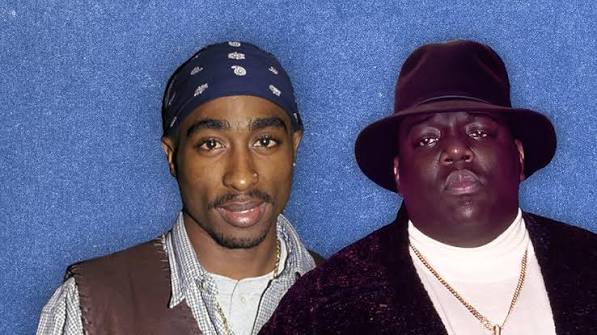
The East Coast-West Coast hip hop rivalry of the mid-1990s is the most documented conflict in popular music history and the one whose consequences were the most permanent and the most irreversible. It ended with two people dead. It began, by most serious accounts, not as a genuine personal conflict between two artists who hated each other but as something considerably more manufactured — a rivalry amplified and in significant ways constructed by the commercial interests of the record labels, the music press, and the specific culture of competitive posturing that characterized hip hop’s relationship with its own mythology.
Tupac Shakur and The Notorious B.I.G. — Christopher Wallace — had met before the rivalry and had, by multiple accounts from people who knew both men, a relationship that was characterized by mutual respect and genuine warmth that the subsequent events have made difficult to accurately convey without seeming revisionist. They were not friends in the sustained, daily sense of the word. They were two young men from similar circumstances — poverty, absent fathers, early exposure to violence and its consequences — who had each found in music an exit from those circumstances and who recognized in each other the specific intelligence and talent that the exit required.
The conflict that emerged between them was real in the sense that real things were said and real grievances accumulated. Tupac’s shooting in a New York recording studio in November 1994 — an event he blamed on Biggie and his associates, a blame that Biggie consistently denied and that has never been established as accurate — converted what had been professional competition into something with a different emotional register. The songs that followed on both sides — the diss tracks, the pointed references, the escalating public rhetoric — were both genuine expressions of real feeling and performances for audiences who wanted the conflict to be more total and more defined than it actually was.
People who knew Tupac in the months before his death in September 1996 have said, in interviews given carefully and with the awareness that the accounts are not comfortable, that the public version of his feelings about Biggie and the private version were not identical. That the performance of hostility required by the narrative the labels and the press had constructed was something Tupac maintained publicly and was more ambivalent about privately. That the shooting had produced a genuine grievance that the record companies and the media had then amplified far beyond what Tupac alone would have sustained.
Biggie’s response to Tupac’s death — reported by people who were with him — was not the response of a man who felt he had won something. It was grief, complicated by guilt that was not the guilt of someone who had done what Tupac accused him of but the guilt of someone who understood that the escalation of a conflict neither of them had fully chosen had ended with a person he had known and respected dead at 25.
Biggie was killed in Los Angeles six months later, in March 1997, at 24. The murders of both men remain officially unsolved. The record labels that had profited from the rivalry continued to profit from it after both artists were dead.
Puffy Combs — Sean Combs, Biggie’s label head — and Suge Knight — Tupac’s label head — have both given accounts of the period that are self-serving in the ways that accounts given by people who had commercial interests in the conflict tend to be self-serving. What the musicians who were close to both Tupac and Biggie have said, in the interviews most worth reading, is simpler and sadder: that both men were too smart for what was happening to them, too aware of how the machinery was working, and too caught in it to get out.