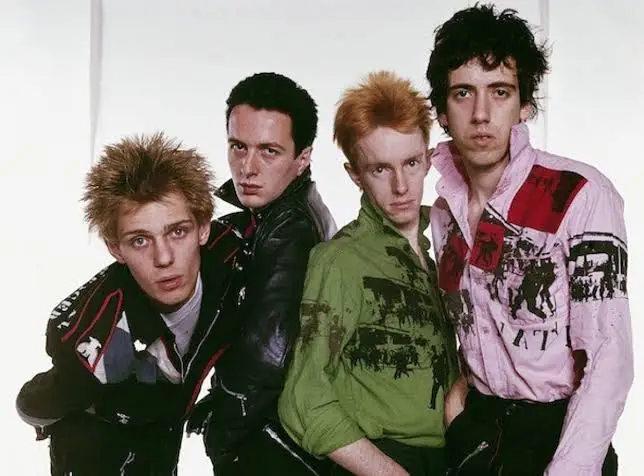
Joe Strummer died on December 22, 2002, of an undiagnosed congenital heart defect, alone at his home in Somerset, England, at the age of 50. He was found by his wife Lucinda, who has described the specific quality of the loss — the suddenness of it, the absence of warning, the fact that he had seemed entirely healthy — in terms that emphasize the specific cruelty of deaths that arrive without preparation. He had been walking his dogs. He had come home. He had died.
The Clash had been finished for nearly two decades by then — broken up in 1986 in circumstances that involved the firing of Mick Jones, the subsequent disintegration of the band’s identity without its primary creative partnership, and a final, largely forgotten album that Strummer has since described with the specific embarrassment reserved for things that should not have been done. He had spent the intervening years doing various things — acting, producing, collaborating, eventually forming the Mescaleros in the late 1990s and making records that received critical admiration and modest commercial attention.
But the Clash is what he is remembered for. And the Clash at their greatest were something that exceeded the punk category they were placed in and exceeded the new wave category that followed punk and exceeded, ultimately, any category that the music industry’s organizational instinct tried to assign them to, because what they were doing drew on reggae and rockabilly and soul and jazz and R&B and the blues tradition and the British music hall tradition and the specific fury of working-class London in the late 1970s in a combination that was entirely their own and that has not been replicated.
1. White Man in Hammersmith Palais (1978)
Strummer has said this is the song he is most proud of in the entire Clash catalog — a song about going to see a reggae concert, being disappointed by the gap between the music’s revolutionary promise and its commercial reality, and extending that disappointment into a broader critique of the left’s relationship with authenticity and compromise. It is a song that is doing several things simultaneously — cultural commentary, political analysis, personal disappointment, self-examination — and doing all of them in less than four minutes over a reggae-inflected groove that is one of the most sophisticated pieces of musical construction the band ever produced. It was not a hit. Strummer considered it his masterpiece.
2. Lost in the Supermarket (1979)
Written from the perspective of a child of suburban alienation — a person who grew up in a featureless environment of shopping centers and television and consumer plenty and who has consequently no inner life that the outer world did not provide, no self that was not assembled from purchased components. Strummer has said the song is about the generation the Clash was speaking to — the generation that the consumer society had produced and that had nothing to rebel against except the rebellion that had been packaged and sold back to them. It is one of the most precise cultural analyses of the late 1970s available in any form.
3. The Card Cheat (1979)
A song from London Calling that is often overlooked in discussions of the album because it is not punk, not reggae, not rockabilly, not any of the forms the album’s versatility is usually praised for — it is a piece of theatrical rock built on piano and strings that sounds more like Phil Spector than anything the Clash had previously produced. Strummer said it was about men who cheat at cards and the specific loneliness of people who cannot win honestly and cannot stop playing. He also said it was about Mick Jones, which he said with the affection of someone describing someone they understand completely and cannot change.
4. Spanish Bombs (1979)
A song that connects the Spanish Civil War to the contemporary conflict in Northern Ireland, moving between languages and time periods with a confidence that should not work and does completely. The Clash were not educated musicians in the formal sense — Strummer had studied at art school and Jones had similar background, but neither had the academic credentials that the song’s historical ambition might suggest were required. What they had was curiosity and commitment, and in Spanish Bombs those qualities produced something that history teachers have used in classrooms because it contains more accessible emotional truth about the Spanish Civil War than most academic texts.
5. Straight to Hell (1982)
From Combat Rock — the band’s commercial peak album, the one that contained Rock the Casbah and Should I Stay or Should I Go and that sold millions of copies and made the Clash as famous as they were ever going to be. Straight to Hell is the song on that album that Strummer considered the most important — a meditation on the children left behind by American soldiers in Vietnam and Korea and the Philippines, children who belonged to no country and no culture and no community, who were straight to hell in the specific sense of having been made orphans by the political decisions of people who would not be held accountable for the consequences. M.I.A. sampled it for Paper Planes. A generation that had never heard of the Clash heard the sample and went backward to find the original.
Strummer said in one of his last interviews that the Clash had tried to put the world in their songs — to make music that was about everything happening at the same time they were making it, in a way that would still mean something to people who encountered it in different circumstances later. The evidence suggests they succeeded more completely than they knew.