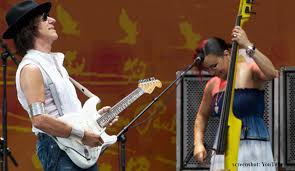
When legendary guitarist Jeff Beck died of bacterial meningitis on January 10, 2023, at the age of 78, the music world lost one of its most innovative and respected artists. In its obituary, The New York Times described Beck as “one of the most skilled, admired and influential guitarists in rock history.” It was a remarkable tribute, yet one echoed by fellow musicians, critics, and fans alike—from Jimmy Page and Mick Jagger to Brian May and countless others.
What set Jeff Beck apart was not simply his extraordinary technical ability, but his relentless pursuit of new sounds and musical possibilities. Though primarily known as a rock guitarist, Beck refused to be confined by genre. Throughout his career, he drew inspiration from jazz, Indian music, blues, and classical traditions, creating a unique musical voice that was instantly recognizable.
One of the finest examples of Beck’s artistry is his breathtaking interpretation of Puccini’s Nessun Dorma. Rather than merely reproducing the famous aria, Beck transformed it into something uniquely his own while preserving the emotional depth and grandeur of the original composition. As Classic FM’s Kyle MacDonald observed, Beck achieved this by bending notes and stretching rhythms with remarkable sensitivity, allowing his guitar to mimic the expressive qualities of the human voice. The result is a performance that demonstrates why so many listeners felt that Jeff Beck’s guitar truly sang.
Beck’s fascination with classical music was not a late-career development. As far back as 1966, he recorded Beck’s Bolero, an instrumental inspired by Maurice Ravel’s famous composition. Although released under his own name, Beck was still a member of the Yardbirds at the time. The recording showcased not only his technical prowess but also his willingness to blend rock with classical influences in ways that few musicians had attempted before.
His classical interpretations continued throughout his career. Among the most celebrated are his haunting renditions of the Adagietto from Gustav Mahler’s Fifth Symphony and Benjamin Britten’s Corpus Christi Carol. These performances reveal a musician capable of translating the emotional complexity of orchestral works into the language of the electric guitar.
Beck first rose to prominence when he joined The Yardbirds in March 1965, replacing Eric Clapton on the recommendation of fellow guitarist Jimmy Page. During his two years with the band, Beck became known for pioneering the use of fuzz, distortion, and feedback, helping to redefine what the electric guitar could do. His experimentation pushed rock music into new territory and influenced generations of guitarists who followed.
However, Beck’s tenure with the Yardbirds was short-lived. In 1967, he was dismissed during a U.S. tour, reportedly due to repeated lateness and tensions arising from his perfectionist nature. Yet what could have been a setback instead became the beginning of a new chapter.
Soon after, Beck formed the Jeff Beck Group, featuring future rock stars Rod Stewart and Ron Wood. This lineup is widely regarded as one of the finest ensembles Beck ever assembled. Their music combined blues, hard rock, and soulful energy, laying groundwork for what would later become heavy rock and heavy metal. Although this incarnation of the group lasted only until 1969, its influence remains profound.
Commercial success arrived with Blow by Blow in 1975. Produced by George Martin, famed for his work with the Beatles, the album showcased Beck’s growing interest in jazz fusion and instrumental music. It became his most successful release and remains one of the defining albums of his career.
Despite his fame, Beck never seemed comfortable with celebrity culture. He cultivated a reputation as a reluctant star, preferring music over publicity. One of the most notable examples was his decision to decline an invitation to perform at Live Aid in 1985. Beck later explained that he was uncomfortable performing before enormous crowds, a rare stance in an industry often driven by spectacle.
In the later decades of his career, Beck continued to record, tour, and collaborate selectively. His 2010 album Emotion & Commotion featured his acclaimed version of Nessun Dorma, which earned the Grammy Award for Best Pop Instrumental Performance in 2011. The recording served as a reminder that Beck’s creativity and technical mastery had not diminished with age.
His final studio album, 18, a collaboration with actor and musician Johnny Depp, was released in July 2022. It would be the last chapter in a recording career that spanned nearly six decades.
Jeff Beck leaves behind a legacy that extends far beyond awards, album sales, or chart success. He expanded the expressive possibilities of the electric guitar, bridging genres and inspiring musicians across generations. Whether interpreting Puccini, Mahler, or a blistering rock solo, Beck approached every performance with curiosity, imagination, and a relentless commitment to artistic excellence.
Few guitarists have ever possessed such technical brilliance. Even fewer have matched his willingness to explore new musical horizons. Jeff Beck did both, and in doing so, secured his place among the greatest guitarists the world has ever known.