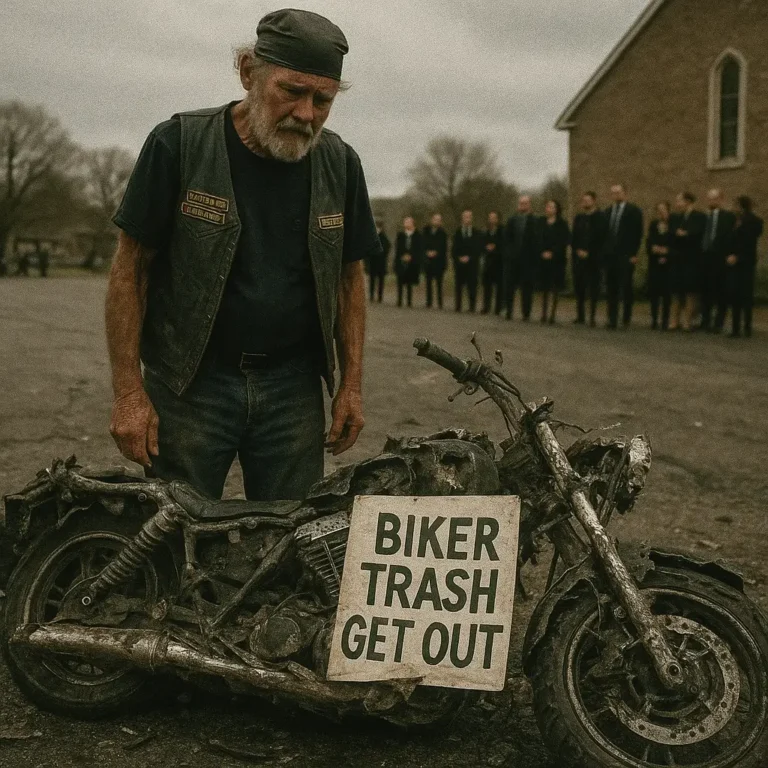
They wrecked my motorcycle while I was inside the church saying goodbye to my wife, and they did it in the parking lot like it was nothing. All because an old man in a leather vest didn’t match the polished, country-club image they wanted for their perfect little world.
I’d rolled up on my meticulously maintained 2009 Harley Electra Glide that morning—the Shadow, the same bike that had carried me across deserts and mountains and through two back surgeries. I left it parked neatly during Ruth’s service. When I walked out afterward, my chest already carved hollow by grief, I found it tipped over, mirrors shattered, fuel tank dented, and a handwritten sign taped across the handlebars that read: “BIKER TRASH—STAY OUT.”
It wasn’t some random kids. This was deliberate, from the same “good neighbors” who had smiled through the eulogies and offered their fake condolences to Ruth’s widower.
The trouble had started six months earlier when we moved into Glenwood Estates, the “premier planned community” in the valley. Ruth’s cancer had returned—this time stage four—and our old two-story place had become too much for her. Our daughter Lauren found us what she called “the perfect single-story rancher in a nice area.” Translation: quiet streets, no visible eyesores, and definitely no motorcycles.
I was seventy-two. I wasn’t about to start pretending to be someone else. The Shadow came with us, same as always. The harassment began the day the moving truck pulled away.
Victor Langston, president of the homeowners’ association, didn’t even let us finish unpacking. He appeared on the porch with a binder and a smile that looked practiced in a mirror.
“Welcome to Glenwood Estates,” he said, eyes drifting past me toward Ruth as she rested on the couch. “Just dropping off the community rules. You’ll want to pay special attention to section 9-C on visible vehicles and storage.”
I flipped to the page before he could finish. “No motorcycles, RVs, or boats may be parked in driveways or visible from the street.”
“Shadow stays in the garage,” I told him, holding his stare. “Always has.”
His smile pinched tighter. “Of course, for now. But folks here tend to prefer… more conventional transportation. We do have standards.”
Ruth stepped up beside me, thin as a rail from the chemo but still carrying that same iron in her voice I’d heard for fifty years.
“My husband has ridden that motorcycle longer than you’ve been alive, Mr. Langston. It’s not going anywhere.”
Victor’s gaze flicked to her headscarf. His nerve cracked.
“We can revisit this later,” he muttered, already backing down the steps. “Enjoy the neighborhood.”
And today, the same Victor stood across the church lot watching the scene unfold. The faint curl at the corner of his mouth told me he thought he’d finally won.
For the next six months Ruth fought the cancer while I fought the neighborhood. The community patrol called in “excessive noise” complaints every time I fired up the bike before eight. Anonymous notes showed up about “oil drips” on the driveway (there were none—I kept the Shadow cleaner than most people keep their kitchens). Little yellow warning slips appeared on the seat whenever I had it out for maintenance.
Each time, Victor would show up at my door with that binder and the same tight smile.
“Just another friendly reminder about section 9-C,” he’d say. “Several residents have voiced concerns.”
Ruth, even as the disease ate away at her, would chuckle from her recliner.
“They’re terrified a motorcycle will tank their property values?” she’d rasp. “Wait till I start rattling their windows from the other side.”
After Ruth passed on a quiet Wednesday morning in October—I was holding her hand when she went—the funeral was scheduled for Friday. Lauren flew in from Chicago, our son Tyler drove up from Denver. The house filled with casseroles and awkward hugs from the same neighbors who’d filed complaints about my bike the week before.
“Dad,” Lauren said softly the night before the service, “maybe it’s time to let the motorcycle go. Mom’s gone. You’re seventy-two. And this neighborhood… it’s just not a good fit.”
I looked at my daughter—the corporate executive, mother of two, driver of a spotless crossover—and remembered the little girl who used to beg for rides in the sidecar wearing a pint-sized leather jacket.
“The Shadow stays,” I said quietly. “Your mother never asked me to give it up. Not once.”
“But Mom’s not—” She stopped herself. The rest hung in the air.
“The Shadow stays,” I repeated, and that was the end of it.
The morning of the funeral I rode the bike to the church early to speak with the pastor. The deep rumble turned heads among the early arrivals, but I didn’t care. Ruth would have wanted me to arrive the same way she’d known me for half a century—on two wheels, leather vest over my suit, Vietnam Veteran patch on one shoulder and the Road Warriors MC colors on the other.
The service was everything she deserved. Victor and half the Glenwood Estates crowd were there, nodding solemnly, shaking my hand with the right amount of sympathy. I even caught Victor giving my suit an approving glance, as if surprised I owned anything without grease on it.
Then I stepped outside and saw what they’d done to the Shadow.
Lauren gasped and rushed over. “Dad… I’m so sorry.”
I said nothing. Just stood there looking at the damage and the ugly sign while the other mourners murmured in disbelief. I noticed how few of my neighbors looked shocked.
The responding officer shook his head while filling out the report.
“People who mess with bikes are the worst kind of cowards,” he said.
“This wasn’t random,” I told him. “This was personal.”
He glanced up. “At your wife’s funeral?”
My eyes drifted across the lot to where Victor stood with a cluster of Glenwood residents, watching with quiet satisfaction.
“More enemies than I realized,” I answered.
The bike was still drivable. Lauren begged me to load it into her rental and let her drive me home. I refused.
“I’ve ridden through worse,” I said.
Truth was, I needed that ride home—the wind, the familiar thunder, the vibration that had been part of me longer than most of these people had been alive. I needed to feel anything except the emptiness Ruth had left behind.
Back at the house the reception was underway. I changed into jeans and a button-up but kept the leather vest on. Victor found me near the coffee urn, plate of untouched food in his hand.
“Terrible thing about your motorcycle,” he said, not sounding the least bit sorry. “Maybe it’s a sign it’s time to consider something more… suitable for Glenwood Estates.”
I looked him dead in the eye.
“The only sign I see is that someone in this neighborhood is gutless enough to vandalize a man’s bike on the day he buries his wife.”
His face reddened. “I wouldn’t know anything about that.”
“Didn’t say you did,” I replied. “But whoever did it needs to understand one thing about me.”
He waited.
“I’ve buried my wife, both my parents, and seventeen brothers from the club. At this point in my life I’ve got nothing left to lose.” I leaned in closer. “And I always find out who crosses me.”