The sun hammered the blacktop outside Maple Crest Elementary in Wichita, Kansas, turning every hopscotch square and four-square court into a shimmering mirage. It was late September, a Thursday afternoon that still carried the heavy breath of summer.
The air smelled of sun-baked asphalt, dry grass from the soccer field, and the faint sweetness of the honeysuckle vines that climbed the chain-link fence along the east side.
At 3:35, the double doors burst open and children spilled out in bright, noisy waves—lunchboxes clacking, backpacks half-zipped, jackets tied around waists like superhero capes. Teachers waved orange safety flags. Parents leaned against idling vehicles, one eye on their phones, the other on the growing river of small bodies.
Across the street, beneath the tired spread of an old oak whose leaves had already begun to crisp at the edges, a man sat motionless on a motorcycle.
The Harley had once been a deep, glossy black. Now it was the color of storm clouds and old roads, rust freckling the pipes, saddlebags pale where years of sun and wind had worn the leather thin.
Walt Harlan didn’t fidget. He rarely did on these afternoons. One boot rested flat on the pavement, the other on the peg. His arms were folded across a chest gone lean with age but still carrying the hard lines of a man who had once been built for trouble and had never entirely lost the look of it.
The sleeveless leather vest over his faded work shirt bore no bright patches, no club colors that might invite questions. Just scars in the leather and a face carved deep by time—gray beard tugged by the hot wind, eyes the pale gray of winter sky.
He had been there twenty-three minutes.
Long enough for the noticing to begin.
A cluster of mothers near the crosswalk had started the low murmur. One in yoga pants and oversized sunglasses said, “He’s been here three Thursdays in a row now. Just sits. Doesn’t even get off the bike most days.”
Her friend adjusted the toddler on her hip. “I told the office last week. They said they’d ‘look into it.’ Fat lot of good that does when he’s right there staring at our kids.”
A father in khakis and a company polo—Rick from the accounting firm two blocks over—said nothing, but his jaw worked as he watched. A second-grader pointed openly until his mother swatted his hand down. “Don’t stare, baby. Some people are just… different.”
The children felt it too. The air around the pickup line had changed, the way it does when adults go quiet in that particular, ugly way.
Then Emma Ruiz fell.
She was six, small for her age, with wild dark curls fighting their way out of crooked pigtails and a gap where her front tooth had recently disappeared.
Her sneakers were bright pink with little flashing lights in the soles that blinked when she ran. Her backpack glittered with star patches, one of them peeling at the corner.
She had been walking backward, waving at her friend Sophia near the bus line. “See you at practice tomorrow!”
Her shoelace—pink to match everything else—had come undone during recess. It caught the rough lip of the curb. Her arms flew up once, twice.
Then she went down hard, the sound a sickening mix of thud and the ripping of fabric as her backpack seam gave way. Crayons scattered in a bright arc. A water bottle rolled into the pickup lane, gurgling.
Her permission slip for the fall festival fluttered like a wounded bird. And the gray stuffed rabbit—well-loved, one ear hanging by a thread—tumbled out beside her.
Emma’s cry started high and thin, then deepened into the broken, gasping sobs of real pain. Her left wrist had taken the worst of it, twisted beneath her at an angle that made the nearest adults flinch.
She tried to push herself up, small fingers scraping across the rough pavement, grinding tiny bits of gravel deeper into her palm.
Mrs. Kline, her teacher, dropped her flag and started running.
But Walt was already moving.
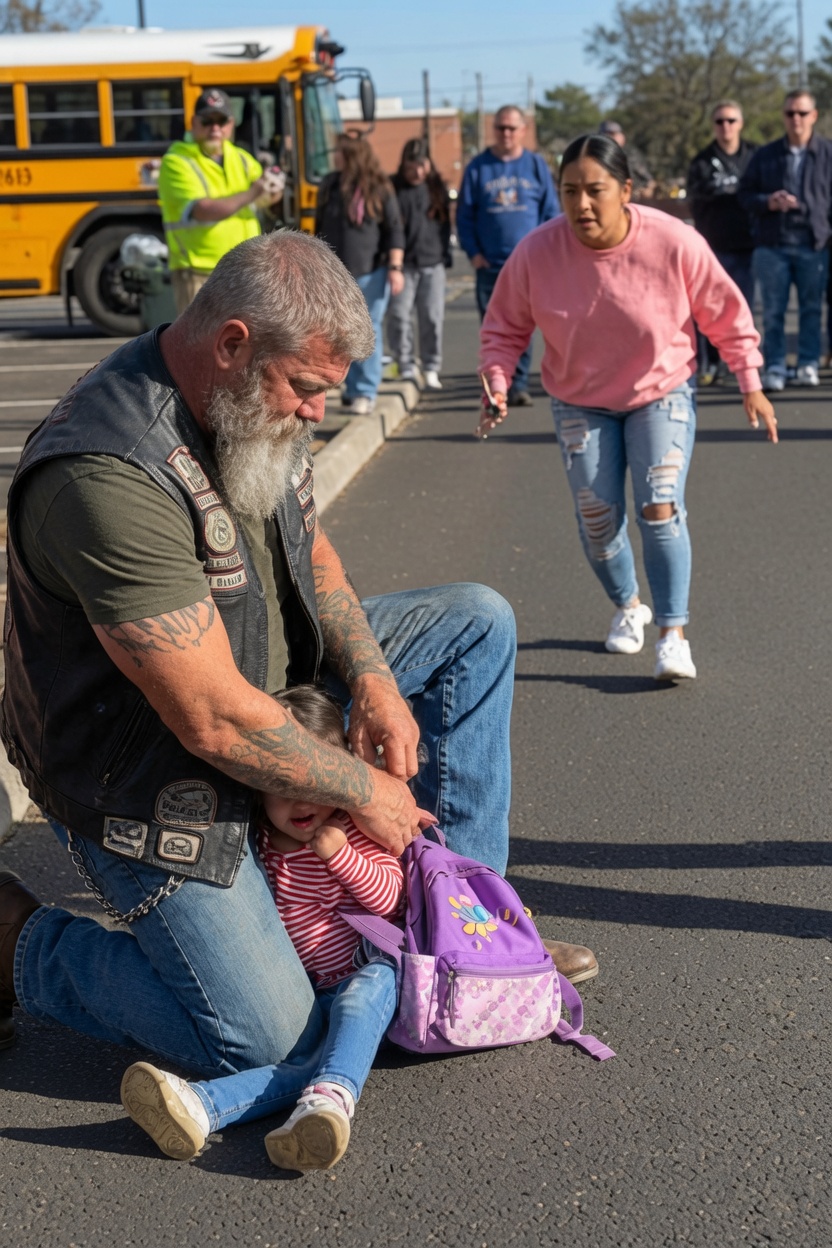
He came off the bike in one fluid motion, the engine ticking as heat left it. His boots hit the street with that heavy, certain rhythm that makes people instinctively step back. He crossed the two lanes without looking left or right—there was no traffic left to worry about—and dropped to one knee beside the crying girl before any other adult reached her. The leather of his vest creaked. Up close, the lines in his face were even deeper, the scars across his knuckles pale against sun-browned skin.
He saw everything at once: the unnatural tilt of the wrist, the way Emma’s uninjured hand had clenched into a fist around the gravel, the way every sob made her fingers tighten and drive the grit deeper. He had seen injuries like this before. He knew what not to do.
“Easy now, sweetheart,” he said, voice low and rough, like tires on gravel but somehow steady. “Don’t move that arm. Not one inch. You hear me?”
From ten yards away, it looked exactly like every parent’s worst nightmare.
A rough old biker in a weathered vest, kneeling over a fallen child, one gloved hand near her shoulder, the other reaching toward her spilled backpack.
“Keep those kids away from him!” Isabella Ruiz screamed.
Emma’s mother had been standing by her tired Honda in the pickup line, phone in one hand, coffee cooling in the cup holder. She worked nights at the clinic and these afternoon pickups were the only time she got to see her daughter awake and smiling. When she saw Emma go down, saw the stranger already beside her, something primal and terrible took over. She dropped everything and ran, purse banging against her hip, face already twisted with panic.
Other parents surged forward but stopped short, forming a loose, wary semicircle. Phones lifted—not to call 911, but to record. The man in the blue polo started narrating under his breath for whatever platform he was feeding. A teacher shouted, “Sir! Step back from the student immediately!”
Walt did not step back.
He stayed exactly where he was, body angled between the tightening circle of adults and the small girl on the ground. Not crowding her. Not touching more than necessary. Just… there. Solid. Unmoving.
Isabella reached them first, trying to shove past him to get to her daughter. Walt lifted one arm—palm out, calm, unyielding. “Don’t. Not yet. Her wrist’s hurt bad. If she moves it wrong it’ll be worse.”
The words detonated.
Rick from accounting pushed forward, face already red. “You don’t get to tell a mother what to do with her own child, you—”
Officer Daniel Mercer arrived at a run from the front office, radio bouncing, one hand already raised. Mid-forties, broad-shouldered, the kind of school resource officer who could calm a kindergartener’s nightmare or shut down a hallway fight with the same level voice. He took in the scene in one practiced sweep: crying child, furious mother, old biker on one knee, circle of phones and fear tightening like a noose.
“Everybody back up,” he snapped. “Sir, stand up and move away from the child. Right now.”
Walt looked up. Those pale gray eyes met Mercer’s without flinching, without pleading, without anger. Just tired certainty.
“No.”
The word landed like a slap.
Mercer took another step, hand near his radio now. “That wasn’t a request.”
Walt reached slowly into his vest with his free hand. Three people shouted at once. Someone pulled a child behind a minivan. Mrs. Evelyn Porter, the seventy-two-year-old crossing guard, nearly lost her footing at the curb, her stop sign clattering. Mercer moved fast, grabbing Walt’s wrist to control it.
What came out wasn’t a weapon.
It was a clean, pressed white handkerchief, the kind some men still carried out of habit from another era.
For one strange second, nobody knew what to do with that.
Walt didn’t pull away. He simply nodded toward Emma’s clenched fist. “Gravel in her palm. Every time she cries she squeezes harder. It’s going deeper. I was going to wrap the rabbit’s ear with it so she has something to look at besides the hurt.”
Mercer’s grip loosened slightly. He looked down. Saw the bits of rock embedded in the small hand, the way Emma’s breathing had started to hitch less violently as she focused on the gray bunny Walt now held where she could see it.
“Stay with the rabbit, little one,” Walt said quietly. “He’s been through worse. One ear’s already half gone and he’s still smiling.”
Emma hiccuped. Her eyes—wet, wide, terrified—locked on the stuffed animal. Her fingers loosened a fraction.
The paramedics’ siren rose in the distance, getting closer.
Mercer studied the old man for another long second, then spoke more quietly. “You medical?”
Walt didn’t answer that. Instead he said, “If she rolls wrong on that wrist it’ll be a real break instead of a bad sprain. Crowd’s not helping.”
Mrs. Porter had crept closer despite herself. Her neon vest was bright against her thin frame. She stared at Walt’s face—the lines, the eyes, the way he held himself between the child and the fear—and something old and half-forgotten clicked into place.
“Walt?” she whispered. “Walt Harlan? After all these years…”
The name moved through the nearest adults like a current.
Mercer glanced at her. “You know him?”
Mrs. Porter nodded slowly, eyes filling. She pointed with a trembling hand toward the far edge of the playground, near the old chain-link fence and the unused basketball hoop where a small, faded blue ribbon was tied to one of the posts, fluttering in the hot wind.
“He used to stand right there,” she said. “Every Thursday. Four years ago… there was an accident. A little girl named Lila. His granddaughter. She was seven. Didn’t like being the last one picked up. Her mother was running late—traffic or a meeting or something. Lila kept watching the street. Walt was parked across the way, like always. He came on Thursdays because he’d promised her he’d always be there if she needed someone. Even if it was just to watch from a distance so she didn’t feel so alone.”
Mrs. Porter’s voice cracked. “Lila saw a car she thought was her mom’s. She got excited. Ran forward… right into the path of another car turning in. The driver never saw her. Walt ran across the street faster than I’ve ever seen a man his age move. He got there just as… just as it was too late. He held her hand while we waited for help. She didn’t make it to the hospital.”
The silence that followed was the kind that settles when old wounds are suddenly opened in daylight.
Walt finally spoke, voice low enough that only those closest heard. “She dropped a blue ribbon that day. From her hair during the… during everything. I picked it up. I’ve tied one there every Thursday since. To remember. To keep the promise I made her.”
He reached into his vest again—slower this time, no one panicked—and pulled out a small, folded piece of paper, edges worn soft from years of being carried close to his heart. He placed it gently on the ground beside Emma, where the little girl could see it through her tears if she wanted.
It was a child’s drawing in crayon. Two stick figures holding hands beneath a bright yellow sun. At the bottom, in uneven blue letters: WAIT FOR ME.
Mercer picked it up carefully after the paramedics had begun working. “This was hers?”
Walt nodded once. “Lila made it the week before. Gave it to me and said, ‘This way you won’t forget to wait for me sometimes, Grandpa.’ I told her I’d always be there. Even on the days she couldn’t see me.”
Emma had gone quiet now, breathing steadier, eyes moving between the rabbit, the drawing, and the old man who had somehow made the world feel less terrifying in the middle of the worst pain she’d ever known. The paramedics worked quickly—splint, careful hands, quiet praise for whoever had kept her still. One of them glanced up at Walt. “Good call on the arm. That could’ve been a lot worse.”
Isabella was allowed closer. She dropped to her knees beside her daughter, tears still falling, but the wild panic in her eyes had shifted into something more complicated—grief recognizing grief.
Before they lifted Emma onto the stretcher, the little girl looked up at Walt with solemn, trusting eyes.
“Are you coming with us?” she asked softly.
The question hung in the suddenly quiet air.
Walt stood slowly, his knee cracking from the long minutes on hard pavement. He looked at Emma, then at the waiting ambulance, then reached into his vest one final time. He pulled out a faded photograph, edges thin from handling. He stepped just close enough to hand it to Isabella instead of the child.
She took it with shaking hands.
The photo showed a smiling little girl with dark curls and a missing front tooth standing in front of this exact school on a day very much like this one. Same curb. Same painted lines. Same angle of sunlight. She was holding a piece of paper. Behind her, barely visible near the fence, stood a younger Walt—watching, not posing, just… there.
Isabella’s breath caught. She looked up at him, eyes wide with sudden, painful understanding.
Walt met Emma’s gaze one last time. “No, little one. But I’ll be here next Thursday. And the Thursday after that. If you ever need someone to keep an eye on the playground… I’ll be watching.”
Emma nodded, as if that was the most reasonable answer in the world.
They loaded her carefully. Isabella climbed in beside her, still clutching the photograph and the drawing Mercer had returned to her. As the ambulance doors closed and the siren rose again, the crowd didn’t move right away. Phones lowered. Voices stayed quiet. Something invisible had shifted in the space between them.
Mrs. Porter placed a gentle hand on Walt’s arm. “You kept your promise, Walt. Even when nobody knew why you were keeping it.”
He gave a small nod. “Wasn’t for them to know.”
Then he walked back across the street, mounted the old Harley, and started the engine. It came to life with a low, steady rumble rather than a roar—like something that had learned long ago that some things are better done quietly.
He didn’t look back as he rode away.
But on the blacktop where a little girl had fallen and a story had quietly rewritten itself, something remained. Not loud. Not dramatic. Just the understanding that sometimes the people who look the most dangerous are the ones carrying the heaviest promises—and the deepest grief—while the rest of the world learns, too late, how to see them clearly.
The blue ribbon on the fence post fluttered in the fading light, and the pickup line slowly began to move again, parents holding their children’s hands a little tighter than they had that morning.