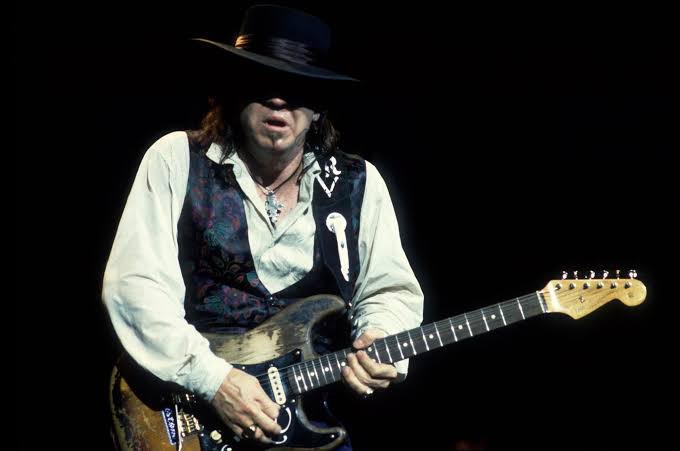
In the early hours of August 27, 1990, blues guitarist Stevie Ray Vaughan climbed aboard a helicopter leaving Wisconsin’s Alpine Valley Music Theatre after one of the best performances of his career. Minutes later, the helicopter slammed into a hillside in thick fog, killing Vaughan and everyone else aboard. He had only secured his place on that particular aircraft by asking his own brother to give up the seat.
Vaughan had spent that evening performing alongside Eric Clapton, Buddy Guy, Robert Cray, and his older brother Jimmie Vaughan in what became one of the most celebrated all-star jam sessions in blues history, closing out a sold-out two-night run at the venue. Backstage afterward, drummer Chris Layton recalled sitting with Vaughan for a long, unusually open conversation, both of them feeling a rare sense of calm and looking forward to the band’s next album together. Nobody backstage that night had any reason to suspect anything was wrong.
Four helicopters had been arranged to fly the musicians and their crews back to Chicago through dense overnight fog. One was specifically reserved for Vaughan, his brother Jimmie, and Jimmie’s wife Connie. But several members of Eric Clapton’s road crew had already taken seats on a different helicopter by the time the Vaughans arrived, leaving Stevie eager to get back to Chicago sooner rather than wait around. He asked Jimmie and Connie if he could take the one remaining open seat on an earlier flight instead of waiting for their own. They agreed.
That decision put Vaughan aboard a Bell 206B helicopter piloted by Jeff Brown, alongside three members of Clapton’s crew. Visibility that night was so poor that the local sheriff later recalled barely being able to see the helicopters sitting on the ground before takeoff, openly wondering how any pilot could fly safely in those conditions. Minutes after leaving the ground, the helicopter banked unexpectedly and crashed directly into the side of a nearby ski hill, killing all five people aboard instantly. A subsequent federal investigation found no evidence of mechanical failure or substance use among the crew, attributing the crash instead to pilot error, specifically a failure to gain enough altitude to clear the rising terrain ahead.
Adding an eerie layer to the tragedy, Vaughan had reportedly told bandmates the previous day about a disturbing dream in which he witnessed his own funeral. He was only 35 years old, and had spent the prior several years rebuilding both his career and his personal life after publicly battling drug and alcohol addiction. More than 1,500 mourners attended his funeral in Dallas, including fellow musicians Stevie Wonder, Bonnie Raitt, and Buddy Guy. Decades later, a memorial statue honoring him still stands on the banks of Austin’s Lady Bird Lake, a tribute to a guitarist whose final, fatal decision was simply wanting to get home a little bit sooner. His brother Jimmie has said in the years since that he has never stopped replaying that one small exchange backstage, the moment he and Connie agreed to give up their seat without any sense that doing so would cost his younger brother his life.