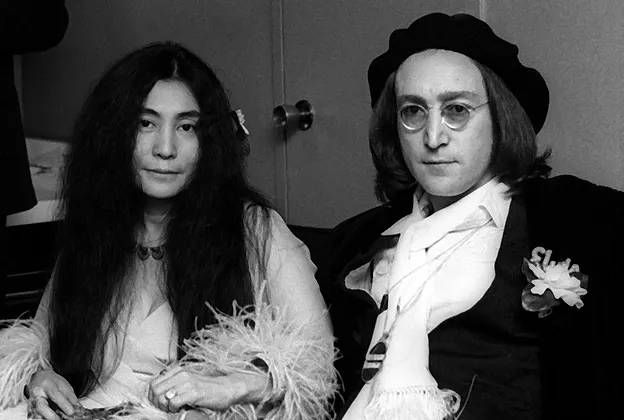
History needed a simple story and Yoko Ono was available to be the simple story. She was present. She was visible. She was different from everything the Beatles had been — Japanese, avant-garde, older, a serious conceptual artist who made demands on Lennon’s attention and time that the band resented openly. She sat in on recording sessions. She gave opinions. She was there in a space that had previously been exclusively theirs and her presence changed the atmosphere in ways that everyone in the room could feel.
So she became the explanation. And the explanation stuck — has stuck for fifty years, in pub arguments and music documentaries and casual conversation — because it was clean and it was available and it meant that nobody had to look at the more complicated and more uncomfortable truth underneath it.
The truth is this: John Lennon had outgrown the Beatles before Yoko Ono entered the picture. Not outgrown them musically — the music they were still capable of making together was extraordinary, as the White Album and Abbey Road prove. But outgrown the structure. Outgrown the dynamic. Outgrown the specific way that being a Beatle required him to be a particular version of himself that no longer matched who he actually was.
The Beatles formed when they were teenagers. The identity of the band — the roles each member played, the way decisions were made, the hierarchy of whose ideas were taken seriously and whose were set aside — was established before any of them were fully formed as adults. And those early structures are remarkably hard to escape. You can grow and change and evolve entirely as a person but the group will keep placing you in the position you occupied when you were seventeen because that is what groups do.
Lennon by the late 1960s was a different person than the one who had formed that band in Liverpool. He had read things, thought things, experienced things that had changed his understanding of himself and the world in profound and permanent ways. He had political convictions he wanted to act on. He had artistic experiments he wanted to pursue. He had a complete creative vision that the Beatles format could not contain.
Paul McCartney, meanwhile, was becoming more invested in the band rather than less. More committed to its continuation, more focused on its output, more controlling of its direction. The tension between a man who needed to leave and a man who needed to stay created a friction that eventually became unbearable.
Yoko Ono did not cause that friction. She arrived after it already existed and she gave Lennon something the Beatles never had given him: complete, unconditional belief in everything he wanted to be, including the parts that were difficult and experimental and commercially inconvenient.
She didn’t break up the Beatles. She showed John Lennon what it felt like to be fully seen. And once he knew what that felt like, the thing he had been willing to settle for before was no longer enough.
That is the real story. It is less convenient than the other one. But it is the truth. And Lennon, of all people, would have wanted the truth told.