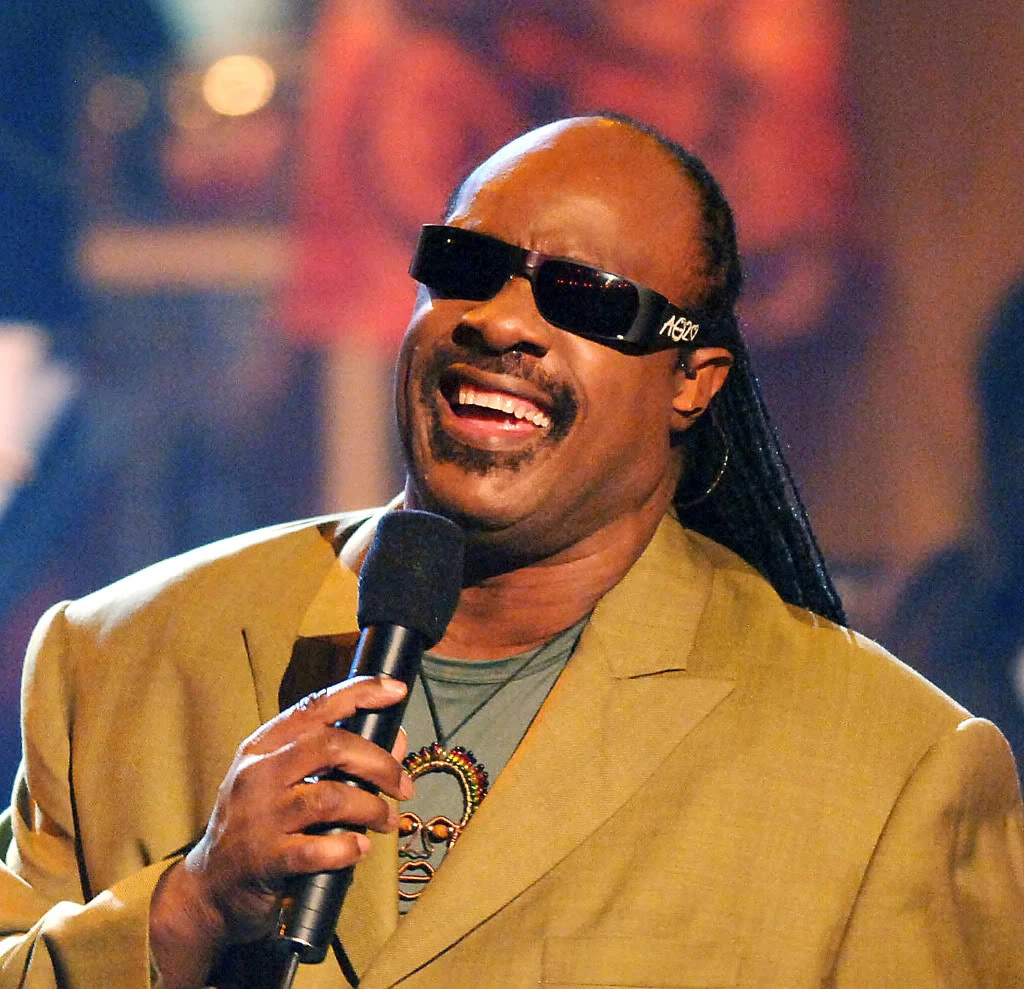
Stevie Wonder lost his sight as an infant — an excess of oxygen in the incubator he was placed in after premature birth damaged his retinas permanently. He has been blind his entire conscious life. He has also, by the consistent assessment of virtually every musician who has worked alongside him for sixty years, possessed the most acute musical hearing of anyone who has ever entered a recording studio.
This is not a metaphor. It is a technical description of a capacity that engineers and producers and fellow musicians have documented with specific, repeated examples. Wonder hears frequencies that other people in the room do not register. He detects tuning discrepancies in instruments that trained ears with full sight miss entirely. He identifies problems in a mix from the sound coming through studio monitors that engineers with forty years of experience have to look at the meters to confirm. He hears the music in three dimensions — as spatial, as physical — in a way that people who rely primarily on visual information cannot replicate.
But the musician Wonder himself has cited as possessing something beyond even his own capacity for musical perception is Ray Charles.
The specific quality Wonder describes is not technical. It is not about frequency range or pitch perception. It is about emotional hearing — the ability to hear what a song needs emotionally and respond to it in real time, in performance, in ways that cannot be planned or rehearsed. Wonder has said that listening to Ray Charles was the experience that taught him the difference between singing correctly and singing truly — between technical execution and emotional truth.
Charles’s genius was in the space between notes. In the breath before a phrase. In the slight delay before landing on a word that, in any technically correct performance, would fall on the beat. Charles was always negotiating with time — arriving just after the moment in a way that made the moment feel more significant, the way a pause in speech before an important word makes the word land harder.
Wonder has spoken specifically about Charles’s recording of Georgia on My Mind and about sitting as a young man and listening to it repeatedly, trying to understand where the emotion was coming from. He could identify everything Charles was doing technically. He could not fully account for the effect. There was something left over — something in Charles’s relationship to the song, to the melody, to the specific grief of that particular piece of music — that technical description could not capture.
This is Wonder’s highest form of praise: not that Charles was technically superior, but that he produced effects that exceeded technical explanation. That his hearing — his emotional hearing, his sense of what music required and what he owed it — operated at a level that even Stevie Wonder, with the most acute musical perception of any living musician, found instructive.
Two blind musicians. One who changed American music. One who may have been, in Wonder’s estimation, still ahead of him.