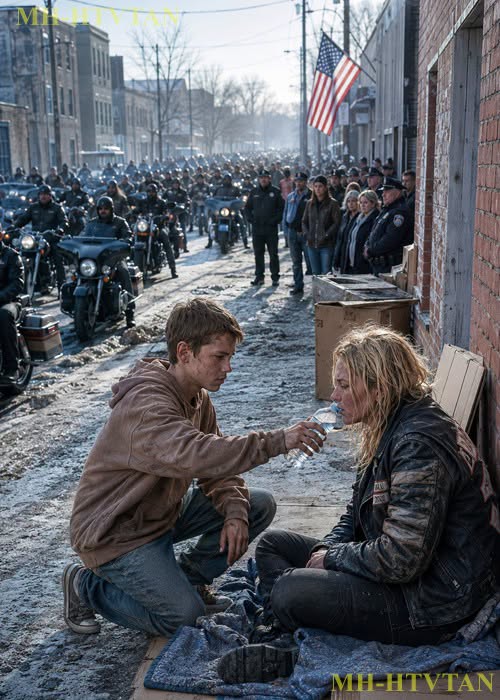
My eyes snapped open because my body had stopped shivering. That was the first rule of freezing to death that the older street guys had taught me before they disappeared: When you stop feeling the cold, Eli, that’s when the ground is winning.
I scrambled backward, my knees cracking like dry twigs. My hands were white, the skin tight and shiny across my knuckles. But the woman beside me—the woman with the winged skull on her back—was breathing. It wasn’t the shallow, rattle-like breath from last night. It was deeper now. Steady.
My jacket and the torn blanket were still draped over her, but she had rolled onto her side, her face pressed into the cardboard. A tiny patch of color, a faint pink like the edge of a winter dawn, had returned to her cheekbones.
Suddenly, her eyes flew open.
They were sharp, a startling, Piercing blue that didn’t look like they belonged to someone who had almost died in a snowdrift. In a fraction of a second, she was awake, alert, and tracking me. Her hand went instantly to her hip, searching for something beneath the heavy leather, before she realized her fingers were too stiff to move properly.
She tried to sit up, but her muscles betrayed her. A low, ragged groan escaped her lips, and she sank back onto the wooden pallet.
“Easy,” I croaked. My voice sounded like gravel being ground under a boot. “You’re… you’re behind the old grocery store. On 4th Street.”
She blinked, squinting through the dim light of the alley, taking in the blue tarp, the rusted dumpster, and finally, my bare arms, goosebumped and purple from the exposure. She looked down at the small, fraying boy’s jacket spread across her chest, then back at me.
“You,” she rasped. Her voice was like dry leaves scraping across asphalt. “Where’s my bike?”
“Out front. By the light pole,” I said, my teeth starting to chatter again now that the adrenaline was wearing off. “It’s tipped over. I couldn’t move it. It was too heavy. But I moved you.”
She closed her eyes for a long moment, inhaling slowly through her nose. When she opened them again, the hard, defensive edge had softened just a fraction.
“You dragged me into this hole?”
“Took me twenty minutes,” I muttered, wrapping my arms around my chest to try and catch a spark of heat. “Everyone else just drove past.”
She stared at me, really stared, looking at my oversized, worn-out shoes, my ripped jeans, and the fierce, stubborn set of my jaw. A slow, grim smile touched the corner of her mouth, though it looked like it hurt her face to do it.
“People are cowards,” she said. She forced her arms to move, pushing herself up into a sitting position against the brick wall. She shook her head, dislodging a few stray flakes of frost from her dark hair. “What’s your name, kid?”
“Eli,” I said. “Eli Carter.”
“Well, Eli Carter,” she said, reaching out to hand me my jacket. Her hand was trembling, but her grip was steady when I took the coat back. “My name is Sarah. And you just made a very heavy deposit into a bank that doesn’t forget its debts.”
The Cold Morning After
Sarah couldn’t walk right away. Her boots were stiff, and her knees kept buckling under the weight of her heavy leather gear. I helped her up, letting her lean her considerable weight against my shoulder, and together we limped out of the alley toward the front of the abandoned grocery store.
The motorcycle was exactly where it had fallen, looking like a dead iron beast under a fresh layer of morning snow.
Sarah cursed under her breath—a long, colorful string of words I’d heard from the drunks outside the diner but never spoken with such clinical precision. She knelt beside the machine, checking the handlebars, the fuel line, and the heavy leather saddlebags strapped to the back.
“Shifter’s bent,” she muttered, her fingers tracing the metal. “Battery’s probably sluggish from the freeze, but she’ll turn. She always turns.”
“Are you going to call someone?” I asked, standing a few feet away, my hands shoved deep into my pockets.
She paused, looking over her shoulder at me. “My phone died three miles before the engine coughed, kid. And out here, in the Ridge? Signal is a myth anyway. No, I don’t need to call. They already know I’m missing.”
“Who’s they?”
She stood up, brushing the snow off her thighs, and pointed a gloved thumb toward the winged skull on her back. “The club. My husband is the President of the Iron Ridge chapter. We got separated in the blizzard last night coming back from the state line. He thinks I’m at the clubhouse. The clubhouse thinks I’m with him.”
A cold dread, entirely separate from the winter air, pooled in my stomach. The Hells Angels weren’t just a myth in these parts; they were the shadow government of the valley. People whispered about them in the diners, locked their doors when the thunder of twenty bikes rolled down Main Street, and never, ever looked them in the eye.
“They’re gonna be mad,” I whispered.
“At who?” Sarah asked, her brow furrowing.
“At the town. At… everyone.”
Sarah looked down the empty, gray street of Iron Ridge. A single pickup truck rumbled past three blocks away, its tailpipe spewing white exhaust. The driver didn’t even turn his head toward us.
“They should be mad,” Sarah said softly, her voice dropping into a dangerous, quiet register. “A lot of people saw me go down. I remember the headlights. I remember the brake lights. They stopped, Eli. They looked at me through their warm glass, and then they hit the gas.”
She turned back to her bike, grabbing the handlebar with both hands. With a fierce, grunting heave that showed the sheer strength hidden beneath her frame, she yanked the heavy machine upright. The kickstand snapped down into the ice with a sharp clack.
“But they didn’t see you,” she added, looking back at me. “Get your stuff, Eli.”
I blinked. “What?”
“Your stuff. Whatever you have in that cardboard box back there. Grab it. You’re not staying here.”
“I can’t leave,” I said, panic flaring in my chest. This alley was miserable, but it was my miserable. I knew which loose board let the wind in. I knew which dumpster had the baker’s discarded rolls on Tuesdays. “I don’t know anywhere else.”
Sarah walked over to me, her heavy boots crunching with a finality that brooked no argument. She reached out, placing a heavy, leather-clad hand on my shoulder.
“The wind is turning, kid. And when my family finds out what happened here, this town is going to get very loud, very fast. You don’t want to be sleeping in an alley when the storm arrives.”
The Gathering Thunder
We didn’t leave right away. Sarah’s bike needed work, and my legs were too weak to carry me far. We spent the next two hours huddled inside the ruined foyer of the grocery store, breaking through the boarded-up side door to get out of the wind.
Sarah used a heavy wrench from her saddlebag to straighten the shifter, her movements methodical and angry. Every few minutes, she would glance out the cracked glass toward the road, her blue eyes scanning the horizon.
Around noon, the air changed.
It wasn’t a sound at first. It was a vibration. A low, rhythmic thrum that started in the soles of my shoes and vibrated up through my shinbones. It felt like an earthquake, but steady. Persistent.
“They’re here,” Sarah said, dropping the wrench into the snow. She didn’t look worried. She looked relieved.
I crept to the window, peering through a gap in the plywood.
Down the main vein of Iron Ridge, past the rusted water tower and the shuttered mills, the highway was turning black. It wasn’t cars. It was a solid, unbroken wall of iron and leather.
Two by two, the riders emerged from the gray mist. The sound was deafening now—a roaring, mechanical monster that shook the loose glass in the grocery store frames. The chrome caught the dull winter light, throwing jagged sparks of reflection against the snowbanks.
Five hundred. A thousand. The line kept coming, stretching back until the tail of the procession was lost in the mountain passes.
They didn’t slow down for the town’s single traffic light. They didn’t care about the speed limit. They rode with the absolute authority of an invading army, their leather jackets bearing the same winged skull I had seen buried in the snow the night before.
“Jesus,” I whispered, pulling back from the window.
“That’s not Jesus, Eli,” Sarah said, walking past me and kicking the side door open. “That’s the Jackals. And they’re looking for me.”
The lead rider—a massive man with a silver-streaked beard that reached his chest and a face carved from granite—slammed his brakes, bringing his heavy chopper to a sliding halt right in front of the grocery store. The entire line behind him mirrored the movement, a synchronized wave of iron stopping on a dime. The engines idled, a collective, mechanical growl that made the very air feel thick.
The big man cut his engine. The sudden silence was almost louder than the roar had been.
He swung his leg off the bike, his boots sinking deep into the slush. His eyes, dark and wild with a mix of fury and terror, swept the front of the building until they landed on Sarah.
“Sarah!” he roared, his voice carrying across the empty street like a crack of thunder.
“I’m here, Marcus,” she called back, her voice steady.
Marcus moved faster than a man his size should have been able to. He crossed the distance between them in three giant strides, throwing his massive arms around her, pulling her into a fierce, desperate embrace. I could see his shoulders shaking under his heavy leather vest.
“We logged three hundred miles looking for you,” he growled into her hair. “The boys from the valley, the brothers from the coast—everyone came out. We thought you were down in the ravine.”
“I was down,” Sarah said, pulling back just enough to look him in the eye. “Right here. On the pavement. For four hours.”
Marcus’s face darkened, the skin around his jaw tightening until it looked like stone. He turned his head, looking at the quiet, shuttered houses across the street, where curtains were twitching as the townspeople peeked out in terror.
“Nobody called it in?” Marcus asked, his voice dropping into a register that made my skin crawl. “Nobody stopped?”
“They drove right past,” Sarah said.
A low murmur rippled through the hundreds of riders sitting on their idling bikes. Hands tightened on throttles. The air grew instantly hostile, the kind of tension that precedes a lightning strike.
“But someone did stop,” Sarah added, her voice softening. She reached back and caught my arm, gently pulling me out from behind the shelter of the doorway.
Standing in the Light
I felt smaller than I ever had in my life. Four thousand eyes—hard, scarred, weather-beaten eyes—shifted from Sarah to me. I was wearing a jacket that was three sizes too small, my face was smudged with soot from my alley fires, and I was trembling so hard I thought my knees would snap.
Marcus looked down at me. To a twelve-year-old kid, he looked like a giant from an old storybook. A golden chain hung from his wallet, and a long hunting knife was strapped to his belt.
“This is Eli,” Sarah said, her hand resting firmly on my shoulder. “He dragged me into his alley. He gave me his blanket. And when I didn’t warm up, he gave me his coat and held onto me until the morning. He’s the only reason I’m standing here, Marcus.”
The giant biker stared at me for what felt like an eternity. The wind blew a stray piece of trash down the street, the sound loud in the dead silence.
Then, slowly, Marcus sank down onto one knee.
He didn’t care about the slush soaking into his denim. He brought himself down to my eye level. The terrifying aura around him didn’t vanish, but it shifted, turning into something heavy and protective.
“You’re Eli?” he asked.
I nodded, unable to find my voice.
“You look hungry, Eli,” he said, a faint, rough edge of warmth appearing in his dark eyes.
“I’m… I’m always hungry,” I whispered.
Marcus reached out with a hand the size of a dinner plate and placed it gently against the side of my neck, his thumb brushing against my frostbitten cheek.
“Not anymore,” he said.
He stood up, turning back toward the massive sea of riders blocking the highway. He raised one fist high into the gray winter sky.
“Listen up!” Marcus bellowed, his voice echoing off the brick walls of Iron Ridge. “This kid right here is Eli Carter! He’s a Jackal now! If anyone in this valley so much as looks at him wrong, they answer to the whole line! Do you hear me?”
A roar went up from the crowd—not a mechanical roar, but a human one. Four thousand men and women shouting my name, their voices rising above the wind, shattering the quiet, cowardly silence of Iron Ridge. Horns blared, engines revved, and for the first time in my life, the world wasn’t a place I had to hide from.
Sarah looked down at me, her blue eyes bright. “I told you, Eli. We don’t forget our debts.”
Marcus walked over to his bike, unstrapping a heavy, thick leather jacket from the back seat—one he usually kept for spare parts or extra warmth. He brought it back and draped it over my shoulders. It was huge, smelling of leather and old oil, hanging down past my knees like a royal robe.
“Let’s get some food,” Marcus said, swinging his leg over his chopper. “And then, we’re going to have a little talk with the mayor of this town about how they treat our family.”
I didn’t look back at my cardboard shelter as Sarah lifted me onto the back of her repaired motorcycle. I didn’t look at the alley that had been my whole world for three years.
As the engines erupted into a deafening chorus and the four thousand riders turned their machines around, protecting us in a fortress of iron and leather, I knew one thing for certain.
The cold wasn’t ever going to touch me again.