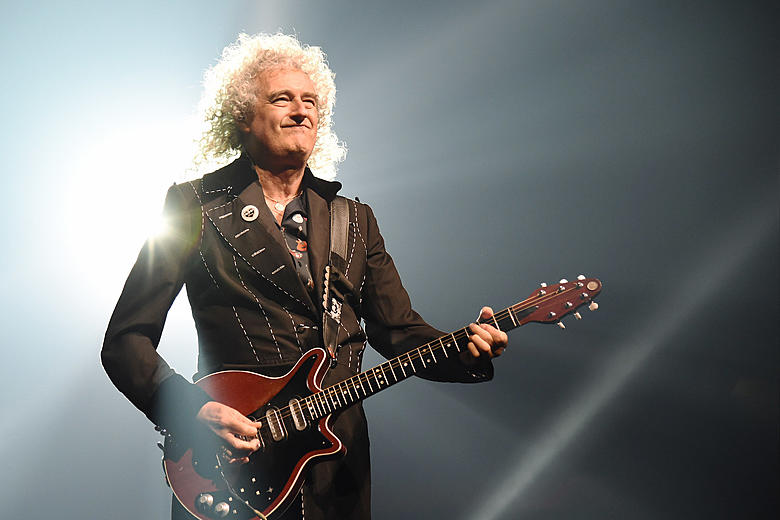
When Freddie Mercury stepped onto a stage, it wasn’t just a performance—it was a full-blown explosion of charisma, control, and raw rock energy. Alongside him, Brian May crafted some of the most iconic guitar work in rock history. Together in Queen, they built a legacy that felt almost untouchable.
But when Mercury passed away in 1991, that legacy faced its most difficult question: what comes next?
Life After Mercury
There’s no replacing a frontman like Freddie Mercury—no understudy waiting in the wings, no easy continuation. When Queen released Made in Heaven, it felt less like a bold new chapter and more like a heartfelt farewell. A tribute. A closing note.
But for Brian May, the story wasn’t over.
He still had music to make, something to prove—not just as Queen’s guitarist, but as an artist in his own right.
Enter Cozy Powell: The Backbone of May’s Solo Vision
If May had the vision, Cozy Powell had the thunder.
Powell wasn’t just another session drummer. He was a force of nature—someone who didn’t just keep time but drove the music forward with sheer physicality. When May began working on his solo material, especially Back to the Light, Powell became his right-hand man in the studio.
May could have assembled a supergroup filled with flashy names, but instead, he chose consistency, chemistry, and power. Powell delivered all three.
A Drummer Cut from a Different Cloth
Before teaming up with May, Powell had already built a résumé most drummers could only dream of. He played with giants like Rainbow and Black Sabbath, working alongside legends such as Ritchie Blackmore and Tony Iommi.
Yet despite this, he often flew under the radar.
Unlike the hyper-technical drummers emerging in later years, Powell belonged to a lineage of raw power—players like John Bonham and Carmine Appice. His style wasn’t about finesse alone; it was about impact. Every hit felt like it could tear through the speakers.
And that’s exactly what May needed.
The Ripple Effect on Modern Rock Drumming
Powell’s influence didn’t stop in the ‘70s or ‘80s. You can hear echoes of his approach in modern drummers like Chad Smith and Taylor Hawkins—players who bring physical intensity and groove in equal measure.
That “hit-it-like-you-mean-it” philosophy? Powell helped define it.
The Perfect Match for May’s Solo Sound
Brian May was always the heaviest rocker within Queen’s eclectic sound. So when he stepped into his solo career, he leaned fully into that identity. Tracks like Too Much Love Will Kill You needed more than just technical precision—they needed emotional weight and a solid backbone.
Powell gave those songs gravity.
His drumming didn’t just support May’s guitar—it elevated it, pushed it, challenged it.
The Unsung Hero
In later years, Queen would collaborate with artists like Paul Rodgers and Adam Lambert, both of whom brought their own strengths to the band’s evolving legacy. But long before those chapters, Cozy Powell was already playing a crucial role behind the scenes.
He may not have had the spotlight, but his presence was undeniable.
Brian May once reflected on Powell’s legacy, noting the incredible list of legends he worked with—including Jeff Beck—and emphasizing that Powell truly deserved recognition as one of the greats.
And he was right.
Final Thoughts
Cozy Powell wasn’t just a drummer—he was a catalyst. For Brian May’s solo career, he was the grounding force that turned ideas into something powerful and real.
Rock history often celebrates the frontmen and the virtuosos, but sometimes, it’s the players just behind them—the ones holding everything together—who make the biggest difference.