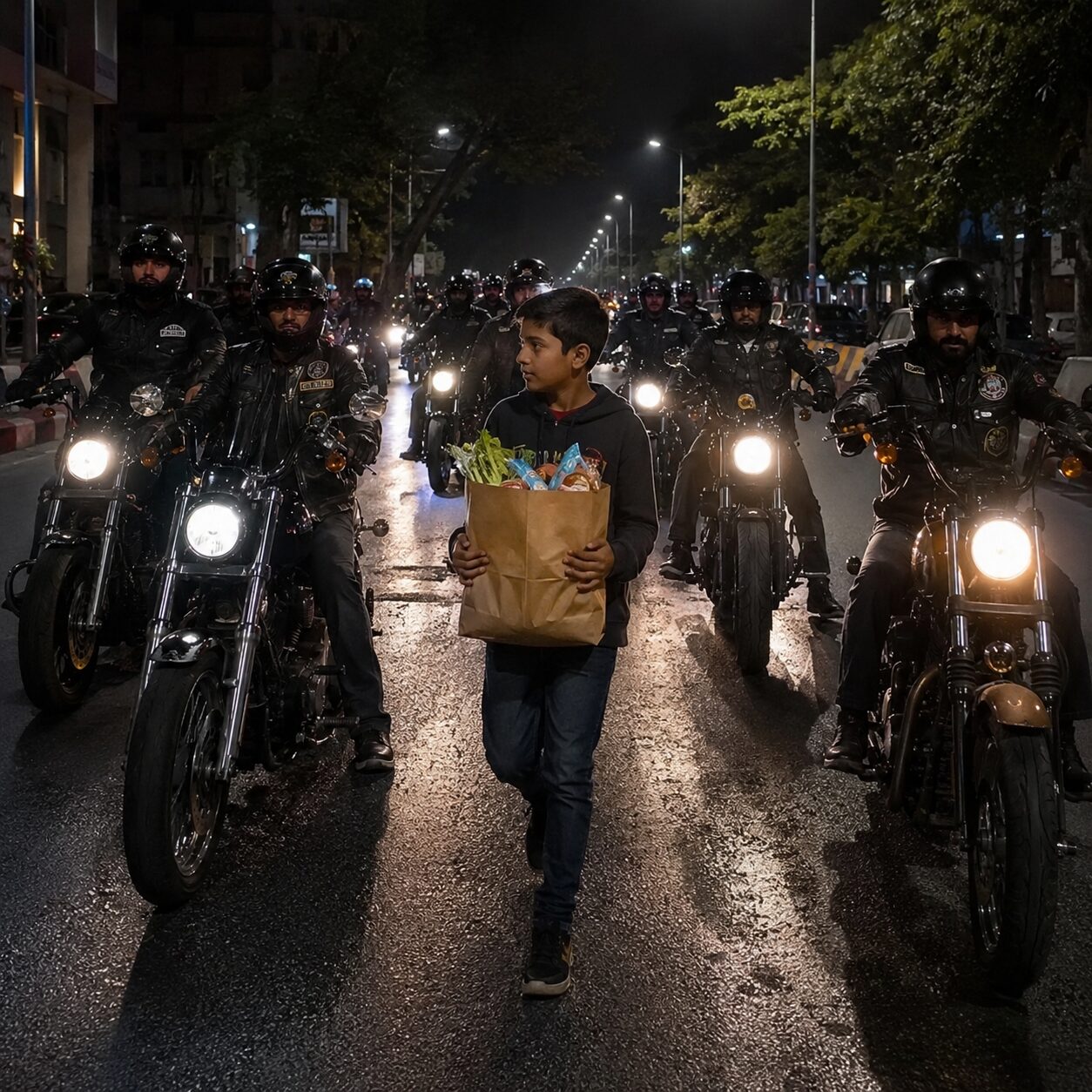
The rain came down in cold, needling sheets that night, turning the cracked sidewalks of the old industrial district into slick black mirrors. Sam hunched his shoulders against it, the thin gray hoodie already plastered to his back.
At thirteen, he had learned how to move through the dark without drawing attention—quick steps, eyes down, one hand always ready to readjust the slipping grocery bag. The plastic had torn at the bottom an hour ago. Now the carton of milk rode awkwardly against his ribs, threatening to burst through with every step.
Two miles still stretched ahead. The all-night corner store’s fluorescent lights had long faded behind him. His shift stocking shelves ended at eleven. The walk home always felt longer in the rain.
Then the engines came.
Not the sharp scream of sport bikes or the angry bark of muscle cars. These were deeper, slower—sixteen low, rolling thunderclaps rolling down the empty street behind him. Headlights bloomed in the mist like yellow eyes. Sam’s stomach dropped. He glanced back once and nearly dropped the whole load.
Sixteen motorcycles. Leather vests. Broad shoulders. They were moving at a crawl, deliberate, staying well back but unmistakably following.
Sam’s heart hammered against his ribs. He walked faster, shoes squelching. The bag tore another inch. A can of generic soup clattered onto the pavement. He snatched it up without stopping.
One bike eased ahead of the pack and pulled to the curb twenty yards in front of him. The rider killed the engine. Even seated, the man looked enormous—thick gray-streaked beard, a nose that had been broken and set crooked more than once, forearms like fence posts covered in faded ink. He swung off the bike slowly, hands open and visible.
“Easy, kid,” the man said. His voice was gravel and smoke, but quiet. “Name’s Bones. You look like you’re carrying half the store.”
Sam froze. Rain dripped off his chin. He clutched the bags tighter, as if they were armor.
“I ain’t got money,” he said. The words came out smaller than he wanted.
Bones didn’t laugh. He didn’t step closer. “Didn’t ask for any.” He nodded at the torn bag. “Looks like that thing’s fighting you. How far you going?”
Sam’s throat felt tight. He could still run, maybe cut through the alley behind the old tire shop. But the milk would slow him down, and his legs already ached from standing eight hours. “Two miles.”
“Two miles in this?” Bones glanced at the sky like it had personally offended him. “What’s your name?”
“…Sam.”
“How old, Sam?”
“Thirteen.”
Bones exhaled through his nose, a sound that wasn’t quite a sigh. Behind him, the other fifteen bikes had stopped. Engines idling low. No one revved. No one shouted. They just waited, rain beading on chrome and leather.
“You got folks waiting on these groceries?” Bones asked.
Sam hesitated. The list in his pocket felt like a confession: cheap soup, store-brand bread, the blood-pressure pills Grandpa needed, the big bag of dog food for Buster because the old mutt still had to eat even when everything else ran out.
“My grandpa,” Sam said finally. “He can’t… he had a stroke. Truck’s broke. I work after school.”
Bones studied him for a long moment. Rain ran down the lines of his face. Then he turned and made a small gesture with two fingers. Three riders dismounted at once. One of them—built like a refrigerator, bald head shining under his helmet—stepped forward and gently took the torn bag from Sam’s arms before the boy could protest.
“Name’s Moose,” the big man rumbled. “This ain’t heavy. I’ve lifted transmissions that weighed more than you.”
Another rider chuckled softly from the shadows. “Still complains about it every time.”
“Shut up, Sparks.”
Sam’s face burned with embarrassment, but something in his chest loosened just a fraction. They weren’t crowding him. They weren’t reaching for his pockets. They were just… there.
The slow procession continued. Sixteen motorcycles rolling at walking speed, forming a loose, protective crescent around one soaked thirteen-year-old boy carrying survival in plastic bags. No one spoke much. The rain did the talking.
When they reached the sagging little house on Maple Lane, Sam’s stomach twisted again. The porch leaned like a drunk. One window was patched with cardboard. The roof sagged in the middle. Buster’s weak bark came from inside, followed by the slow scrape of a wheelchair.
Sam opened the door. “Grandpa? It’s me. And… some people.”
Henry Thompson—seventy-six, rail-thin, left side still partially paralyzed from the stroke two months earlier—rolled into the narrow hallway. His eyes widened at the wall of leather and chrome filling the doorway. Fear flashed across his face, then confusion, then something closer to shame.
“Sam,” he said, voice thick. “What did you do?”
“Nothing,” Sam said quickly. “They just… followed me.”
Bones stepped inside, ducking his head under the low doorframe. He held up the grocery bags like an offering. “Your boy was doing a midnight run in the rain, sir. We figured that ain’t right for nobody, let alone a kid.”
Henry’s hands trembled on the wheelchair wheels. “We manage.”
“No,” Moose said quietly from the kitchen doorway, where he’d already set the bags on the counter and opened the fridge. “You really don’t.”
What happened next unfolded without anyone asking permission. Sparks found the breaker box and the faulty heater with the instincts of a man who’d fixed worse things in worse places. Wrench—tall, quiet, tool roll already in his hand—went to work on the leaking kitchen sink. Another rider whose name Sam never caught started a pot of soup on the ancient stove while Moose organized the medicine bottles lined up crooked on the counter.
Henry kept apologizing in a low, broken voice. Bones finally pulled a chair close and sat so they were eye level.
“Stop saying sorry,” Bones said. “Ain’t nothing here you caused.”
“Stroke took the truck money,” Henry murmured. “Savings went fast. Boy started working before I even knew. Walks every night so I don’t have to worry about him riding with strangers.” His eyes filled. “He stopped being a kid too damn quick.”
In the kitchen, Sam stood at the sink washing the same bowl three times because his hands needed something to do. He could hear the low rumble of the bikers’ voices, the occasional soft laugh when Moose burned the toast and blamed the stove. For the first time in months, the house didn’t feel like it was holding its breath.
They didn’t leave until nearly four in the morning. One of them—Sam thought it might have been the quiet one called Preacher—slipped a folded stack of bills under the salt shaker when no one was looking. Another had already tacked a tarp over the worst part of the roof. The heater coughed and rattled but stayed on.
The next day they came back.
And the day after.
Word spread through the club the way it does when something matters. By the end of the week the front porch had been leveled and reinforced. A proper wheelchair ramp appeared like it had grown overnight. The school counselor received a polite but very firm visit from three large men in leather who explained, without raising their voices, that Sam needed support, not judgment. Social services got involved the right way—meals delivered, utility assistance, physical therapy for Henry that actually stuck.
Every Friday the sixteen motorcycles returned like clockwork. The house filled with noise that wasn’t fear. Moose taught Sam how to season a brisket on a small grill they dragged into the backyard. Sparks tried to help with algebra and got every other answer wrong on purpose just to hear Sam correct him. Wrench spent three weekends coaxing the old truck back to life until it actually started without sounding like it was dying.
Henry smiled more. His color improved. Sam started sleeping through the night instead of waking at every creak, wondering if the power would stay on or if the fridge would be empty again.
Then the big winter storm hit.
Power lines went down across three counties. Roads became impassable. Inside the little house on Maple Lane it was dark and getting colder by the hour. Henry’s breathing grew labored—the stroke had left his lungs weaker than they admitted. Sam sat on the floor beside the wheelchair, wrapped in every blanket they owned, one hand on Buster’s graying head, the other checking his grandfather’s pulse every few minutes like he’d seen nurses do.
He didn’t know what to do.
Then the engines came again.
Sixteen motorcycles fought their way through snow that had already buried cars. They arrived with a generator lashed to a trailer, thermoses of hot soup, extra blankets still in plastic from the store, and the specific blood-pressure medication Henry’s pharmacy had run out of three days earlier. Bones stomped snow off his boots in the doorway, beard frosted white, and looked at Sam like the boy had personally summoned the storm just to test them.
“Thought a little weather was gonna stop us?” Bones asked.
Sam laughed—actually laughed—for the first time in what felt like years. “You guys are insane.”
“Professional level,” Bones agreed.
They stayed through the night. The generator hummed. The house warmed. Henry’s breathing eased. At some point near dawn, when the worst of the wind had passed, Bones sat on the floor beside Sam and spoke so only the boy could hear.
“Half the men in this club grew up carrying more than they should’ve,” he said. “Some of us had parents who disappeared. Some had parents who stayed but wished they hadn’t. We know what it looks like when a kid starts doing the math on how to keep everybody alive.” He glanced toward Henry, dozing in the wheelchair. “Figured somebody oughta carry the damn groceries with you for a change.”
Sam didn’t answer right away. His throat felt too tight. Outside, the motorcycles were lined up under a fresh blanket of snow, chrome dulled but still solid, still there.
Years later, when Sam was twenty-two and renting a small apartment across town, when Henry had passed peacefully in his sleep with the club’s old leather vest folded at the foot of the bed, Sam still thought about that first night every time he carried groceries.
He never walked alone in the rain if he could help it. Sometimes, on Friday evenings, he still heard the low thunder of engines pulling up outside. The same sixteen men—older now, a little grayer, still loud when they laughed—would fill whatever space he called home with too much food and worse jokes and the quiet certainty that nobody had to carry the weight by themselves.
Because sometimes the people who show up when the rain won’t stop and the world feels too heavy don’t arrive in shining armor.
They arrive in leather, engines idling low, and they say, without ever needing the words:
*Kid. You ain’t doing this alone anymore.*