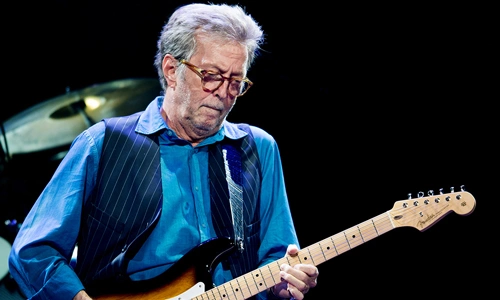
Eric Clapton has spent sixty years being called the greatest guitarist who ever lived, and sixty years being more honest about his own limitations than the people making that claim. The specific quality that distinguishes Clapton’s self-assessment from false modesty is its precision — he does not make general gestures of humility toward the guitar-playing community. He identifies specific people, specific qualities, specific moments where he encountered something that recalibrated his understanding of what was possible, and he names them with the directness of a man who has decided that honest accounting is more respectful to music than protective mythology.
1. Robert Johnson
The foundational one. Johnson recorded thirty-two songs in a Texas hotel room in 1936 and 1937 before dying at 27 under circumstances that remain unclear. Clapton has said Johnson’s recordings were the most important musical experience of his life — that hearing Cross Road Blues and Love in Vain as a teenager in England in the late 1950s was the moment he understood what music could be and what it was trying to reach. He has said Johnson plays things on those recordings that he still cannot fully account for technically, that the emotion in them exceeds what the technical description of what he is doing should produce.
2. BB King
The living master Clapton returns to most consistently. He has said King’s ability to say more with one note than most guitarists say with twenty is a quality he has spent his entire career trying to approach and has never fully reached. The economy of King’s playing — the space between notes, the conviction with which each individual note lands — represents for Clapton the highest expression of blues guitar, the form reduced to its purest elements without loss of emotional power.
3. Duane Allman
The Layla sessions — Derek and the Dominos, 1970, recorded with Allman as a guest who became essential — produced some of Clapton’s most celebrated playing, and Clapton has consistently attributed the quality of those sessions largely to Allman’s presence. He has said Allman made him play differently, better, with more commitment and more risk, because Allman’s standard was higher than what Clapton produced alone and the proximity raised his own level. Allman died in a motorcycle accident in 1971, aged 24. Clapton has said it was one of the most significant losses of his musical life.
4. Wes Montgomery
Clapton’s jazz admission — the acknowledgment that his blues and rock guitar playing, however accomplished, exists in a different and arguably less harmonically sophisticated tradition than what the great jazz guitarists achieved. Montgomery, who played with his thumb rather than a pick and developed a technique of octave playing that redefined jazz guitar, represents for Clapton a peak of musical intelligence on the instrument that his own work does not approach. He has said so clearly and without apparent discomfort.
5. Stevie Ray Vaughan
Their relationship as touring partners and fellow blues devotees produced one of the most documented mutual-admiration stories in 1980s rock. Clapton has said Vaughan was the most exciting blues guitarist he heard after Hendrix — and that hearing Vaughan in the early 1980s produced the same specific combination of inspiration and inadequacy that Hendrix had produced fifteen years earlier. Vaughan died in 1990. Clapton delivered the eulogy at his memorial and has spoken about the loss with genuine grief in every subsequent decade.
6. Jeff Beck
The most complicated relationship on this list — two men who came up together, who have been compared to each other for sixty years, who have expressed mutual respect in careful language while each being privately aware of the ways they differ and the ways those differences constitute different kinds of excellence. Clapton has said Beck is the most technically gifted guitarist he has personally known — that Beck’s experimental relationship with the instrument, his refusal to be bounded by any genre or technique, represents a freedom Clapton has admired and has not replicated.
The One He Said Was in a Different Universe: Jimi Hendrix
Every conversation about Clapton’s assessment of other guitarists arrives here eventually. He has described Hendrix in terms he uses for no one else — not better, not more skilled, but operating in a category that the normal vocabulary of guitar evaluation does not adequately describe. He left a concert early. He went home and considered quitting. He has told this story many times and it has never become a performance. The bewilderment in it is still present, fifty years later, when he talks about the forty minutes that changed everything he thought he understood about what a human being could do with six strings.
🎬 https://www.youtube.com/watch?v=ByK9OlCNqrg