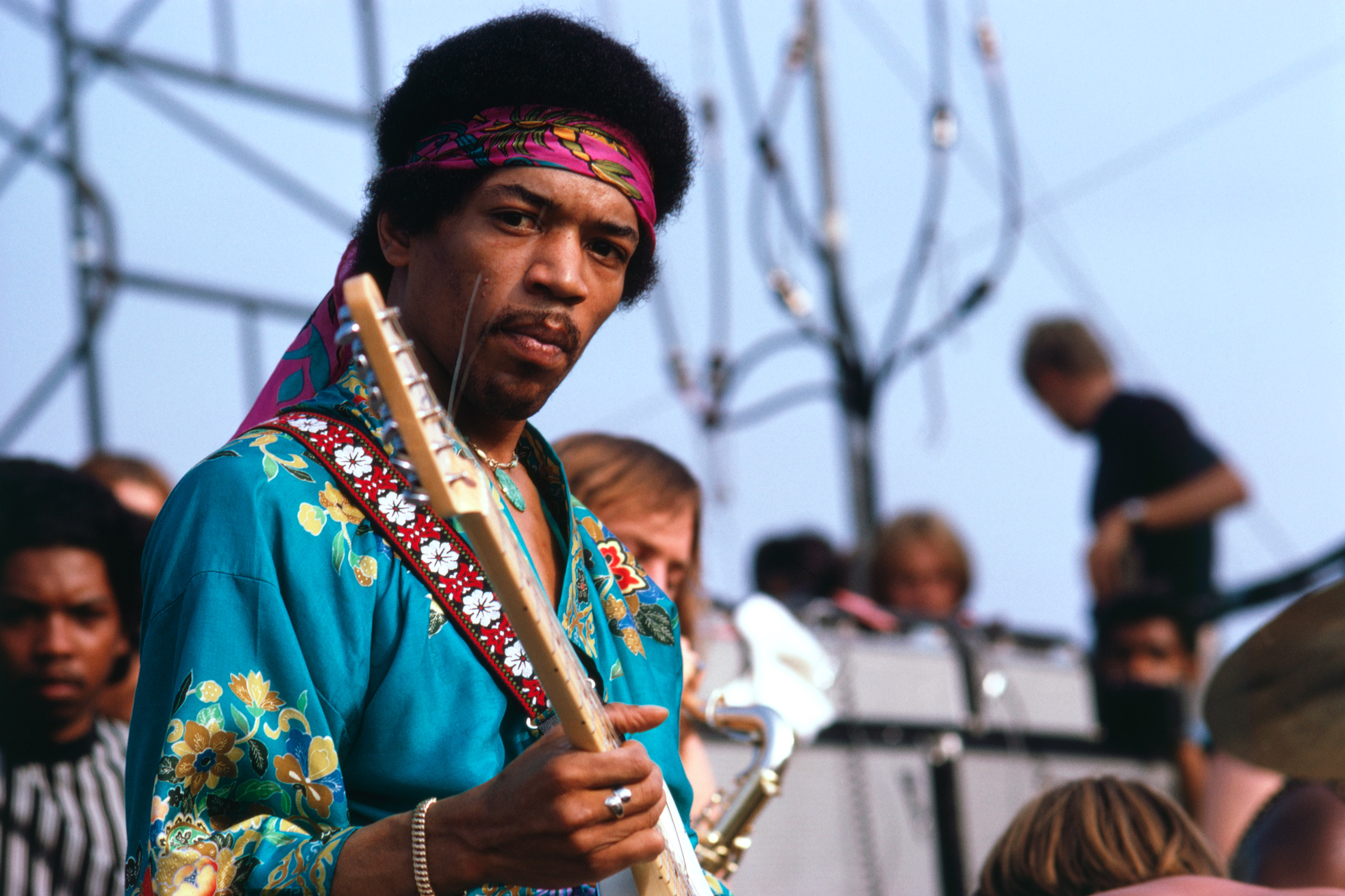
The consistent pattern in accounts of encountering Jimi Hendrix — in concert, in a recording studio, in a rehearsal room, in a small club in the mid-1960s before anyone outside a specific London circle knew who he was — is the response of people who have dedicated their lives to an instrument encountering someone for whom the instrument appears to have no limits. Not the limits of technique, which can be extended through practice. Not the limits of style, which can be expanded through study. The limits of what is possible. What musicians who heard Hendrix describe, repeatedly and with remarkable consistency, is the specific sensation of having those limits removed from their understanding of the instrument while simultaneously being shown that Hendrix himself did not experience them.
1. Eric Clapton
The most documented encounter. Clapton left the Bag O’Nails club in London in January 1967 before Hendrix’s set was finished. He went home. He sat alone. He seriously considered giving up the guitar — not as a dramatic gesture but as a genuine response to having encountered something that called his entire understanding of what he was doing into question. He has told this story in every decade since and it has never become performance. The bewilderment is still present when he talks about it.
2. Pete Townshend
Townshend has described seeing Hendrix perform for the first time with the specific language of a man describing a natural disaster — something that happened to him rather than something he watched. He and Hendrix became friends, performed at the same events, were associated in the public mind as part of the same London moment. Townshend has said that the friendship did not diminish the discomfort of knowing that Hendrix was doing something with a guitar that he was not doing and could not do.
3. Jeff Beck
Beck encountered Hendrix early — in the period immediately after Hendrix arrived in London in September 1966, when the two guitarists moved in overlapping circles and mutual awareness was immediate. Beck has been the most technically specific of all the guitarists who have described the Hendrix experience — he has attempted to describe what Hendrix was doing physically on the guitar, the specific techniques, and has said that the techniques themselves explain only a portion of the effect. There is something left over. He has been trying to account for that remainder for fifty years.
4. Carlos Santana
Santana saw Hendrix at Woodstock and has described the experience as the most significant musical event of his life up to that point. He has said Hendrix’s performance of The Star-Spangled Banner — the controlled feedback, the sounds of war extracted from the national anthem — was the moment he understood that music could do things he had not previously imagined. He has said it changed what he thought his own guitar playing was for.
5. Stevie Ray Vaughan
Vaughan discovered Hendrix as a child in Texas and has said the discovery was not gradual but immediate — that he heard Voodoo Child and understood in a single listening that this was the thing he wanted to spend his life pursuing. He has also said, in later interviews, that he spent his entire career aware that what Hendrix had done was not something he had fully reached — that he was pursuing something whose outer limit he could see but not touch. He died in 1990 at 35 before whatever he might have produced in his fifties could resolve that pursuit.
6. Keith Richards
Richards has spoken about Hendrix with the combination of admiration and philosophical unease that the very best guitar players seem to experience when they discuss him — the sense that Hendrix belonged to a different argument than the one Richards was having with his instrument, that they were using the same tool to say fundamentally different things, and that what Hendrix was saying was larger. He has been careful about this — he is not a man who easily concedes larger — but it is what his more unguarded comments amount to.
7. Paul McCartney
McCartney attended one of Hendrix’s early London performances and has described sitting in the audience with John Lennon — both of them experiencing the specific disorientation of people who had been, until very recently, the most innovative musicians in their peer group, watching someone who had arrived from outside their frame of reference and was doing something they had not predicted. He has said both he and Lennon were quiet on the way home, which from the two men most likely to fill any silence with something, was its own kind of statement.
The One Who Actually Did Quit: Jack Bruce
Bruce — the bass player and vocalist for Cream, one of the most gifted musicians of his generation — has said in interviews that after a period of extended exposure to Hendrix’s playing, during which Cream and the Jimi Hendrix Experience shared bills and social spaces in London in 1967, he underwent a period of genuine creative crisis that resulted in him stopping playing bass for several months. Not a dramatic announcement. Simply putting the instrument down and not picking it up, because what he was hearing from Hendrix made what he was doing feel insufficient in a way he could not immediately resolve. He returned to the bass. He continued making extraordinary music. The period of silence was real.