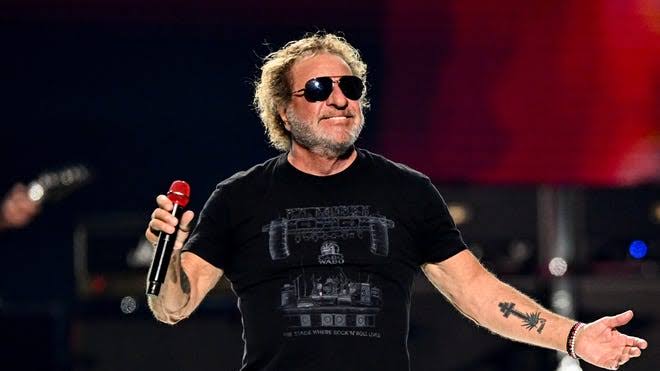
When Sammy Hagar agreed to perform at the Freedom 250 Fourth of July celebration in Washington, D.C., he expected to deliver a heartfelt message of unity before launching into Right Now. Instead, severe thunderstorms canceled the entire musical program, leaving fans to debate an appearance that never actually happened.
Although Hagar never stepped on stage, his planned participation quickly became a talking point online, with some fans criticizing him for appearing at an event associated with President Donald Trump. The longtime rocker has since responded, insisting his involvement was never about politics—it was about celebrating America’s 250th birthday.
Thunderstorms Cancel the Music at Freedom 250
The Freedom 250 celebration featured a lineup that included Lynyrd Skynyrd, Gretchen Wilson, and Hagar, who was scheduled to make a surprise appearance.
However, heavy thunderstorms swept through Washington, D.C., forcing organizers to cancel every scheduled musical performance.
The celebration continued with remarks from President Donald Trump, followed by a fireworks display and a performance by the United States Air Force Band. But for music fans, the performances they had anticipated never happened.
Hagar Says His Appearance Was Never Political
Despite never performing, Hagar soon found himself responding to criticism on social media.
Many questioned why he agreed to appear at an event connected to the Trump administration. Hagar answered directly on Instagram, emphasizing that he viewed the event as a celebration of the nation’s anniversary—not of any political party or president.
According to Hagar, America’s 250th birthday belongs to everyone, regardless of who occupies the White House. He said the country has experienced both successes and struggles throughout its history and expressed hope that the nation continues to move forward with less hatred, violence, and prejudice.
His message centered on unity rather than politics, encouraging Americans to come together despite their differences.
The Speech Fans Never Heard
After the event, Hagar shared a photo of the handwritten speech he had planned to deliver before performing “Right Now.”
He revealed that he had been practicing the speech every night during recent concerts so he could deliver it perfectly on Independence Day.
The speech called on Americans to reunite, reject violence and hate, respect one another, and remember the phrase, “United we stand, divided we fall.” It concluded with a simple message of hope and love before wishing America a happy 250th birthday.
The choice of “Right Now” was especially meaningful. Originally released by Van Halen in 1991, the song has long been associated with themes of action, change, and social awareness. Hagar’s planned introduction reflected those same ideas by encouraging people to come together rather than remain divided.
Why the Reaction Was So Strong
Even though Hagar never performed, the announcement of his participation sparked heated discussion online.
In today’s political climate, many fans view appearances at nationally organized events through a political lens, regardless of an artist’s intentions. For veteran musicians with audiences spanning generations and differing political beliefs, public events can quickly become controversial.
Hagar argued that celebrating the country’s birthday should rise above politics. Whether fans agree often depends more on today’s polarized environment than on the message itself.
What’s Next for Sammy Hagar?
With the Freedom 250 event behind him, Hagar is moving ahead with a busy touring schedule.
He is set to perform in England before returning to Las Vegas later this year for another installment of his Best of All Worlds residency.
Although the Washington performance never happened, the handwritten speech has given fans a glimpse of what Hagar hoped to say—a message focused on unity, respect, and bringing people together during a milestone celebration for the nation.
Final Thoughts
The Freedom 250 controversy became less about music and more about perception. While some fans questioned Hagar’s decision to appear at the event, the speech he planned to deliver suggests his focus was on unity rather than politics.
Ironically, the storms that prevented the performance may have amplified the conversation surrounding it. Instead of being remembered for a live rendition of “Right Now,” the event has become a reminder of how quickly public appearances can become political flashpoints—even when the intended message is one of togetherness.