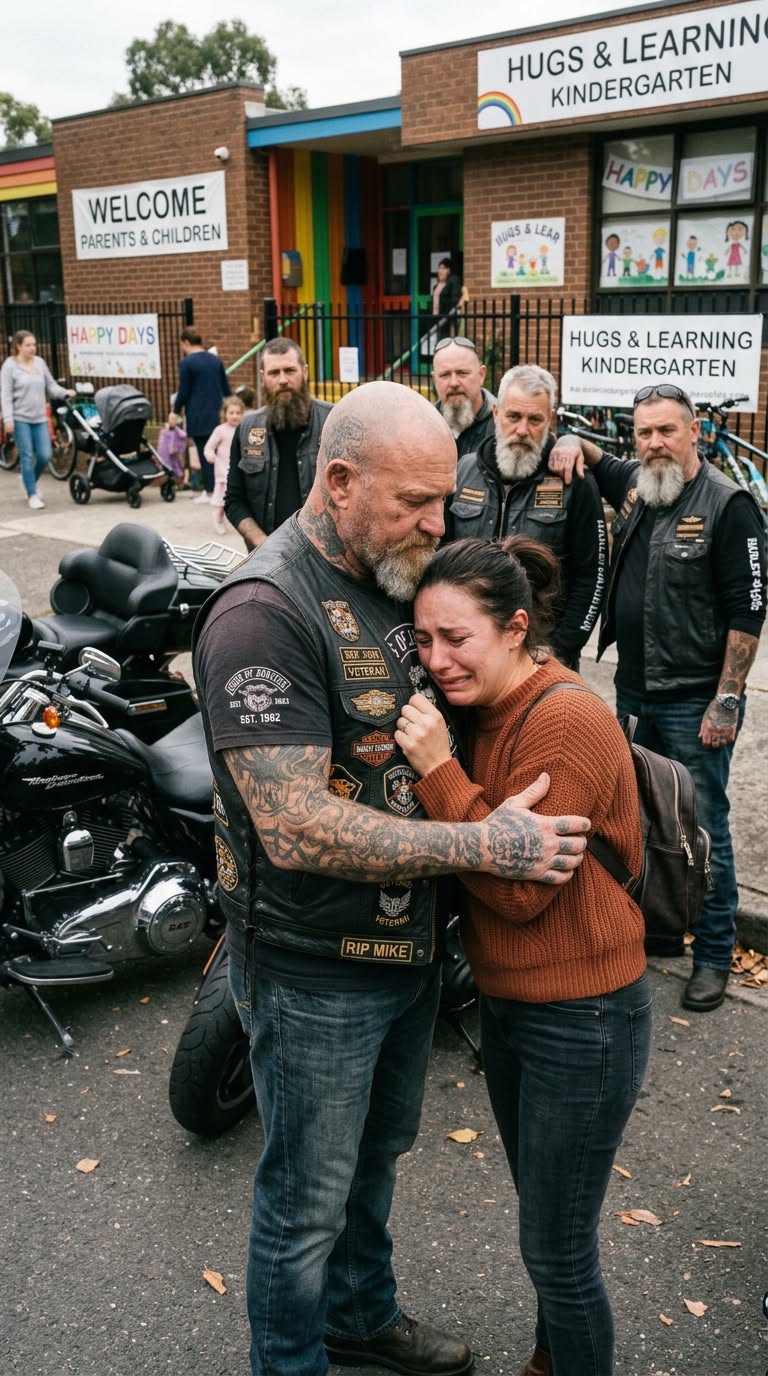
Road did not raise his voice.
He simply looked at the woman and held out his hand.
“May I see those papers again?”
For the first time, the smile slipped completely.
The woman clutched the folder a little tighter.
“I’ve already shown them to the school.”
“I know,” Road replied. “I’d like to see them myself.”
Behind him, the office door opened. Principal Helen Morris stepped outside with the school secretary and two teachers. Their faces were tense.
“We’ve already contacted law enforcement,” Principal Morris announced. “No child is leaving this building until officers verify every adult’s identity.”
The woman laughed softly.
“This is ridiculous. You’re frightening the children.”
“No,” Road answered. “Someone already did that.”
He nodded toward Elena.
“She’s the only person here whose story matches the emergency contact file.”
Elena finally found her voice.
“My daughter has asthma,” she said, tears beginning to fall. “The school called because she wasn’t feeling well.”
The secretary immediately looked up.
“That’s correct.”
She held a clipboard against her chest.
“I called Ms. Elena Ramirez at 8:42.”
The stranger smiled again.
“Families change plans.”
Road didn’t move.
“Families also know birthdays.”
Silence.
“What?”
“You said you’re her grandmother.”
“I am.”
“Then when’s Ivy’s birthday?”
The woman hesitated.
“March.”
Elena answered without thinking.
“November nineteenth.”
The stranger blinked.
Road nodded once.
“I thought so.”
More parents had gathered now.
Some were recording.
Others stood quietly behind the teachers, watching every movement.
One father whispered, “Who are these guys?”
Principal Morris answered before anyone else could.
“They’re volunteers.”
Every face turned toward her.
“The Road Guardians.”
She looked at Road.
“Our district asked for volunteer security after two attempted custody-related abductions at neighboring schools this spring.”
Road shrugged.
“We’re retired military, retired firefighters, truck drivers, mechanics, grandparents.”
He smiled faintly.
“We mostly escort kids who need safe walks home.”
A police cruiser pulled into the parking lot.
Then another.
The woman glanced toward the far fence.
For the first time, fear replaced confidence.
Officer Daniels stepped out.
“Nobody leaves.”
The woman suddenly dropped the car seat and ran.
She made it only twenty feet.
Not because anyone tackled her.
One of the volunteers quietly stepped sideways, blocking the only open path.
Another stood near the gate.
They never touched her.
She simply had nowhere left to go.
Police caught up seconds later.
“Cynthia Hale,” Officer Daniels read after checking her identification.
“You’re being detained while we investigate forged custody documents and attempted child abduction.”
The parking lot became perfectly silent.
Elena’s knees nearly gave out.
A teacher caught her before she fell.
“Can I see Ivy?” she whispered.
Principal Morris nodded.
“You can now.”
Inside the classroom, twenty-two children sat together while Miss Reynolds read stories to keep them calm.
When Ivy saw her mother, she jumped up so quickly her tiny chair tipped backward.
“Mommy!”
Elena dropped to her knees.
Ivy wrapped both arms around her neck.
“I thought you forgot me.”
“I could never forget you.”
“I got scared.”
“I know, baby.”
“I wanted you.”
“I’m here.”
The little girl reached up and touched her mother’s face.
“You were crying.”
“I was.”
“Did I do something bad?”
“No.”
“You did everything right.”
Outside, detectives searched the woman’s car.
Inside they found several forged custody forms.
Multiple school maps.
A notebook listing pickup times.
Photographs of children from three different elementary schools.
No one spoke for several long moments.
Officer Daniels finally approached Road.
“If the office hadn’t called when they noticed the seal looked wrong…”
Road shook his head.
“They did exactly what they were supposed to do.”
Later that afternoon, reporters arrived.
Parents who had shouted at the volunteers earlier quietly apologized.
One father who had pushed Road extended his hand.
“I judged you.”
Road smiled.
“You judged what you saw.”
“I should’ve waited.”
“We all should.”
A week later, the school invited the volunteers back—not to stand guard, but to read books during Safety Week.
The children weren’t afraid of them anymore.
One volunteer showed the class how to check a bicycle helmet.
Another taught emergency numbers.
Road sat in a tiny chair while Ivy handed him a crayon drawing.
It showed six very tall people standing in front of a little school.
Above them she had written, in uneven kindergarten letters:
THANK YOU FOR KEEPING US SAFE.
Road folded the picture carefully and tucked it inside his wallet.
Years later, it was still there.
People often asked why a weathered old volunteer carried a child’s drawing beside his driver’s license.
Road always smiled the same quiet smile.
“Because,” he would say, “sometimes the strongest thing you can do isn’t fighting.”
“It’s making sure a child gets home to her mother.”