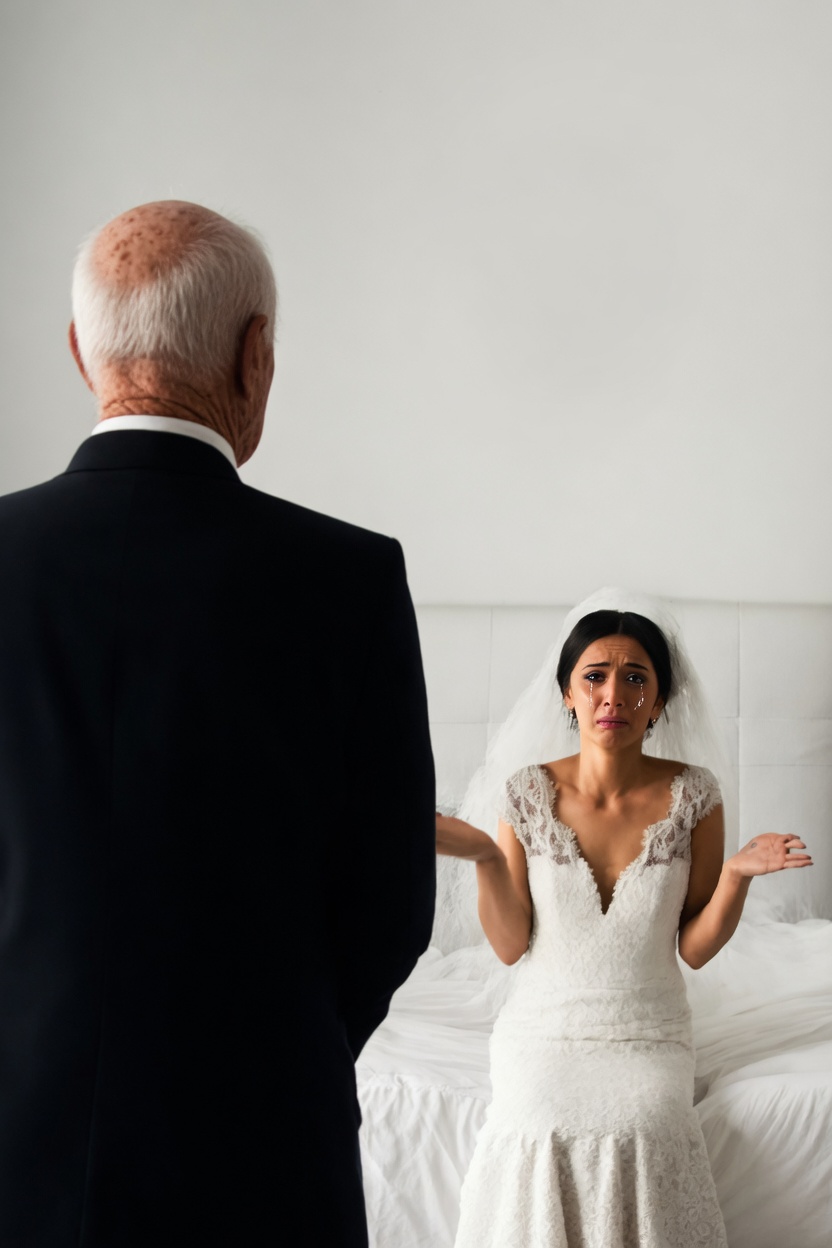
My mother sold me for 5,000 to an elderly single man. I thought that from that moment on my life would be a hell, but as soon as I walked through the door of the bridal bedroom, a truth shocked me…
I was only twenty years old when my mother sold me for five thousand dollars to an elderly single man. In that moment, I believed my life had ended. I thought the door to the bridal bedroom would open into a personal hell. But the truth I discovered that night shattered everything I thought I knew—and changed my destiny forever.
Our ranch in the dusty hills of Oaxaca was a place where hope went to die. The soil was cracked and unforgiving, the cattle thin, and the debts monstrous. After my father died of a sudden fever when I was twelve, Mama was left with three daughters and a mountain of loans from the coyotes who lent money at impossible interest rates. My sisters, aged fourteen and sixteen, still helped in the fields, but it was never enough. Collectors banged on our wooden door every week, their voices like thunder. Mama’s hands trembled constantly now, her eyes sunken from sleepless nights.
Then one sweltering afternoon, Doña Carmen, the village matchmaker, arrived with news that felt like a death sentence.
“There is a man at the municipal hall,” she told Mama in a hushed voice. “Señor Emilio Vargas. Seventy-eight years old, never married, no children. He needs a young wife to care for him in his final years. He offers five thousand American dollars—cash. Enough to pay the debts and keep the ranch.”
I stood frozen in the corner, clutching a faded rebozo. Five thousand dollars. To the outside world it was nothing. To us, it was survival.
“No,” I whispered, then screamed. “Mama, you can’t! I’m not cattle to be sold!”
Tears streamed down Mama’s face as she reached for me. “Elena, mi vida… the collectors said next week they will take the land. Your sisters will starve. This man is old. He won’t live long. You can come back after…”
Her voice broke. I saw the shame in her eyes, the desperate love of a mother who had run out of choices. I wanted to hate her. I wanted to run into the mountains and never return. But in the end, I nodded silently, my heart turning to stone. I felt like a commodity, a sack of corn traded for debt relief.
The wedding was rushed through in the small village church the very next day. No white dress, no flowers, just a simple cream huipil Mama had sewn overnight. Villagers whispered that I was “lucky” to catch an old man with money. Señor Emilio Vargas stood beside me—tall for his age, with silver hair, deep wrinkles carved by decades under the sun, and eyes that seemed strangely calm. He barely spoke during the ceremony. When the priest pronounced us husband and wife, I felt nothing but cold dread.
That night, after a silent dinner at his large but old-fashioned house on the edge of town, he led me to the bridal bedroom. My hands shook as I followed him up the creaking wooden stairs. The air smelled of old books, candle wax, and faint lavender. I had prepared myself for the worst—force, disgust, a life of silent suffering. I clutched the small knife I had hidden in my sleeve, just in case.
Emilio opened the heavy oak door and stepped aside, letting me enter first. The room was surprisingly beautiful: a large carved bed with fresh white linens, soft lamplight, and a bouquet of wildflowers on the nightstand. But what froze me in place wasn’t the room.
It was the photographs.
Dozens of them covered one entire wall—framed images of a young woman who looked exactly like me. Same dark wavy hair, same wide brown eyes, same small birthmark above the left eyebrow. In some photos she was laughing with a baby in her arms. In others, she stood beside a much younger Emilio.
“That’s… my mother?” I whispered, voice trembling.
Emilio closed the door gently and sat down in an old armchair, his movements slow but dignified. He wasn’t the frail, leering old man I had imagined. There was quiet strength in him.
“Yes, Elena,” he said softly, his voice deep and cultured, carrying the accent of someone who had once lived in the capital. “Maria was my daughter. Your mother.”
The world tilted. I grabbed the edge of the bed to keep from falling.
“Impossible,” I gasped. “Mama said my father died when I was twelve. She never mentioned—”
“She didn’t know the full truth,” he interrupted gently. “Sit down, child. This story is long, and I have waited twenty years to tell it.”
I sank onto the bed, heart hammering. Emilio poured two glasses of water from a pitcher and began to speak.
“I was once a successful businessman in Mexico City. Rich, respected. But I made enemies—dangerous ones involved in corruption. When Maria was nineteen, she fell in love with a poor ranch hand—your father, Javier. I disapproved. In my pride, I tried to separate them. Maria ran away with him to Oaxaca. I searched for years but the enemies found me first. They burned my house, killed my wife, and left me for dead. I barely survived. By the time I recovered and traced Maria, she had married Javier and had three daughters. You were the youngest.”
He paused, eyes glistening. “I came to the ranch once, hidden. I watched from afar. Your mother had told everyone I was dead to protect you from my enemies. She feared they would come for her children if they knew the connection. When Javier died, I wanted to help, but revealing myself would have put all of you in danger. The debts grew. I knew the collectors were ruthless.”
“So you… bought me?” My voice cracked with a mix of anger and confusion.
Emilio smiled sadly. “I arranged it through Doña Carmen. I needed a way to bring you here safely, to protect you and your family without raising suspicion. Five thousand dollars was enough to save the ranch but not enough to make people suspect I had real wealth. The marriage? It is legal, but it is a paper shield. I am too old and too ill to be a husband in that way. I wanted a granddaughter to care for me in my last days—and to inherit everything.”
He stood slowly and opened a hidden panel in the wall behind the photographs. Inside was a safe. He turned the dial and pulled out thick folders and a velvet box.
“These are the deeds to three properties in Mexico City, investments worth over two million dollars, and accounts in your name. There is also a letter for your mother explaining everything. My enemies are long dead. The danger is gone.”
I stared at the documents, my hands shaking as I touched the cold paper. Tears I had held back for days finally spilled over.
“All this time… I thought I was being sold into misery.”
Emilio placed a gentle, grandfatherly hand on my shoulder. “You were being brought home, Elena. I am sorry for the pain. I had to make it look real, even to you, in case anyone was watching. Tomorrow we will bring your mother and sisters here. The ranch is safe. You are safe.”
The next weeks unfolded like a dream I was afraid to wake from. My mother arrived, collapsing into Emilio’s arms with twenty years of buried grief and relief. My sisters explored the big house with wide eyes. Doctors came to treat Emilio’s heart condition, and I cared for him—not as a reluctant wife, but as the granddaughter I had suddenly become.
There were thrilling moments too. One night, an old associate from the city appeared, and for a brief time we feared the past had returned. Emilio and I stayed up until dawn making calls, securing protection. In the end, it was only a harmless old friend, but the adrenaline taught me how strong I could be.
Six months later, Emilio passed peacefully in his sleep, holding my hand. At his funeral, I stood tall beside my family as the rightful heir. The money lifted us out of poverty forever. I used part of it to build a proper school in the village and a medical clinic so no other family would have to face the choices my mother did.
Sometimes, late at night, I still walk into that bridal bedroom. The photographs remain on the wall—my mother as a young woman, smiling beside her father. I run my fingers over them and whisper thanks.
I thought I had been sold into hell. Instead, I was rescued by the grandfather I never knew I had. Life, I learned, can turn on a single truth hidden behind an old wooden door. And sometimes, the darkest moments are simply the path leading you home.