My brother Marcus and I used to be the same person in two bodies.
That’s not something I say lightly or romantically. I mean it in the literal, functional sense that people who grow up poor and close in age understand — we shared clothes, we shared a bedroom for seventeen years, we shared a language of shorthand and glances that our mother called the twin thing even though we weren’t twins.
Marcus was two years older, but people mistook us for twins constantly, which Marcus found flattering and I found vaguely annoying in the way that younger siblings find most things about older siblings annoying.
We played on the same baseball team from age eight to fifteen. We got into the same kind of trouble, stayed out of the same kind of worse trouble, and when our father left — I was thirteen, Marcus was fifteen — we closed ranks around our mother the way soldiers close around a fallen comrade. Without discussing it. Without needing to.
Which is why, when Marcus joined the Ironblood Pagan Riders at twenty-four, I didn’t just feel abandoned. I felt amputated.
He’d been riding since he was nineteen, when he bought a wrecked Sportster for eight hundred dollars and spent four months in the garage putting it back together with YouTube tutorials and a borrowed service manual.
I thought it was a phase. He went from one bike to a better one, then to a really good one, and he started spending time with a group of men whose legal first names he may or may not have known. The Ironblood Pagan Riders were not, let me be clear, a charity organization. They were a one-percenter club operating in a mostly rural stretch of the upper Midwest, and they had a reputation in three counties that was not built on bake sales.
I knew this because I had looked them up — obsessively, after Marcus first started mentioning them — and what I found in online forums and local news archives was not reassuring.
Marcus told me I was looking at it wrong. Marcus told me these were good men who’d been misunderstood and misrepresented and that I should meet them before I judged. I told Marcus that I had met them, briefly, at a gas station where two of them had looked at me like I was an insect and one of them had called my girlfriend — who was now my wife — a name I won’t repeat. Marcus said those were prospects and prospects weren’t representative. I said I didn’t care about the taxonomy of the people who were teaching my brother to be someone I didn’t recognize.
We had this argument, in various forms, for eighteen months. Then we had it one final time, in our mother’s kitchen on Thanksgiving, and it ended with Marcus leaving before the turkey came out of the oven and me saying something to his back that I still wish I could take out of the air and destroy.
Six years of silence. Not total — there were a handful of texts, mostly around birthdays and Christmas, the kind of texts you send to prove to yourself you’re not the kind of person who completely cuts off family, even when you are exactly that kind of person. My wife, Dana, tried to broker a reconciliation twice and both times hit a wall — mine, not Marcus’s, though it took me years to understand that.
The fire started in the walls.
Old house, old wiring — we’d bought it three years earlier because it was cheap and in a good school district and we thought we had time to renovate properly. We didn’t have time. The electrician we’d hired had done half the job and then gotten sick and then died, which is the kind of sentence that makes you feel guilty for being frustrated by it, and we hadn’t gotten around to finding someone to finish. Dana smelled something hot at eleven-thirty on a Saturday night. By the time I’d gotten the kids out — we have two daughters, Maya, seven, and Claire, five — the back wall of the kitchen was orange behind the drywall.
We were standing in the front yard in November in pajamas when the first fire truck arrived. I had my daughters pressed against my sides and I was watching my house and thinking in a very calm, very empty way about homeowner’s insurance and where we were going to sleep and the irreplaceable photographs from my mother’s funeral that were in a shoebox in the bedroom closet.
Dana’s sister came and got the girls within the hour. Dana and I stayed until almost three in the morning, watching the firefighters, talking to the fire marshal, standing in the particular fog of shock that makes everything slightly louder and slightly unreal. The house wasn’t a total loss — the back half was devastated, but the front held — but we couldn’t live in it for at least three months. Possibly six.
I called my mother, who was seventy-one and living in a one-bedroom apartment and genuinely could not help, which she apologized for in the specific way that mothers apologize for things that aren’t their fault. I called my college roommate, who lived four states away. I called two neighbors.
At some point — I think it was around two AM — my phone buzzed. I looked at it, expecting another well-wishing neighbor or possibly the insurance company’s emergency line.
It was Marcus.
I heard. We’re coming. Don’t argue.
I stood there in my smoke-smelling pajamas looking at the text and I thought: I haven’t talked to my brother in six years, and I still have no idea how he heard about this at two in the morning within an hour of it happening.
I didn’t argue.
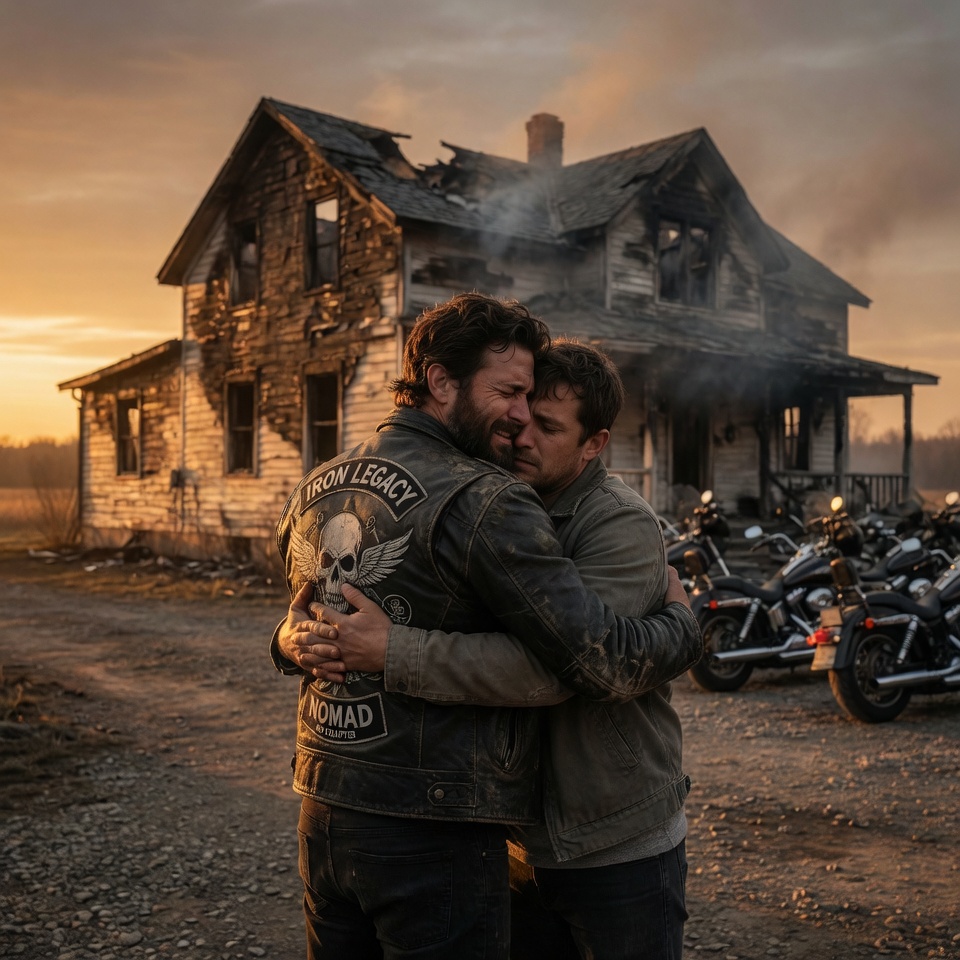
They arrived at dawn. Not just Marcus — Marcus and seven other men in Ironblood Pagan Riders cuts, arriving on trucks and in vans because it was November and cold and even bikers have enough sense not to ride motorcycles in a Wisconsin November if they have somewhere to be. Three of the trucks had trailers. The trailers had tools.
Marcus hugged me in the front yard and I let him, and then I just kept holding on, which surprised both of us. He said nothing for a long time. Then he said, quietly, against my shoulder, “I should’ve called more.”
“Yeah,” I said. “Me too.”
The men he’d brought — and over the course of that day, more arrived, a total of fourteen at peak — went to work on my house with the organized efficiency of people who know exactly what they’re doing. It emerged, over the course of conversations throughout the day, that the Ironblood Pagan Riders had a contractor, two electricians, a plumber, and four men who described their skill set simply as general construction among their membership, and that this was not accidental. Clubs, Marcus explained to me while we stood watching his friend Terrance remove a section of damaged drywall with a speed that suggested long practice — clubs take care of their own and by extension their own’s people, and word had gone through channels that Gunner’s brother had a situation.
Gunner. Marcus’s road name. I hadn’t known it.
“Who called you?” I asked.
Marcus shrugged. “Network. Somebody knew somebody who drove past on the fire trucks. Doesn’t matter how. Matters that we knew.”
By noon they had torn out the damaged section of the kitchen down to studs, assessed the electrical issue, and begun mapping what needed to happen. Dana came back — she’d spent the night at her sister’s with the girls — and stood in the driveway watching men she’d never met gut and evaluate our damaged house, and her expression was a very specific one that I recognized as I have been wrong about something and I’m not entirely sure how to hold that yet.
Terrance, the contractor, sat down with me at the tailgate of his truck and gave me a realistic damage assessment in plain language. He told me what the insurance would likely cover, what it likely wouldn’t, and what a contractor who didn’t know us would charge for the labor. He gave me the number. Then he told me what it was going to cost me, which was nothing, which was a word I had to ask him to repeat.
“We’ll get it done,” he said simply. “Three weeks, maybe four, depending on supplies.”
“I can’t let you—” I started.
“You’re not letting us anything. Marcus says you need it. Marcus is a brother. So.” He shrugged in the way that people shrug when a matter is entirely settled in their mind and they’re just waiting for the other person to catch up.
They were true to Terrance’s word. It took twenty-nine days. Not every day — they had jobs, lives, obligations — but they showed up on weekends and occasional weeknights in groups of two to six, and the work got done. New wiring through the whole back half of the house, not just the damaged section. New drywall. New kitchen cabinets that were, frankly, nicer than the ones that had burned because one of the guys had a connect with a supplier and the supplier had overstock. A backsplash that Dana had pointed at in a magazine once and mentioned offhandedly and which appeared on our kitchen wall without explanation.
Marcus and I talked during those twenty-nine days more than we had in the decade before them. We talked in the way that men often talk best — alongside a task, not face to face, not formally, but in the margins of work. He told me things about the club I hadn’t understood. I told him things about my fear and my anger and my silence that I’d never said out loud to anyone, including Dana. There were hard conversations. There were longer silences. But the silences were the working kind now, not the frozen kind.
I asked him once, directly, about the things I’d read online. The reputation. The history.
He was quiet for a while. Then he said: “There are things I’ve been part of that I wouldn’t walk away from even knowing what I know now, and things I wish had gone different. Same as anybody. Same as you.”
I thought about that. It wasn’t a complete answer. But it was an honest one.
“The man at the gas station,” I said. “Who said that thing to Dana.”
“Kelleher,” Marcus said. “He’s not in the club anymore.” He paused. “He’s not in a lot of things anymore.”
I chose not to pursue that.
The night we moved back into the house — all four of us, girls running through rooms that were measurably better than they’d been before — Marcus sat at our kitchen table and ate Dana’s pot roast and drank two beers and told my daughters that their uncle had missed a lot of their lives and was going to try very hard not to miss any more. Maya, who is seven and takes after Dana in that she processes information by asking twenty direct questions in rapid succession, wanted to know about his motorcycle, his tattoos, his road name, the patches on his vest, and the scar on his chin in approximately that order. Marcus answered all of it with the patience of a man who understood that he’d earned these questions.
Claire fell asleep against his arm on the couch at eight-thirty.
He sat very still for a long time so she wouldn’t wake up.Dana came and stood next to me in the kitchen doorway, and we both looked at that for a while.
“I was wrong,” she said quietly. Not about everything — I knew that and she knew that. But about enough.
“Me too,” I said.
Marcus stayed that night in the guest room, which used to be an office, which now had a functioning closet door and fresh paint and a window that actually closed properly because Terrance had noticed it was warped and fixed it without mentioning it.
In the morning, before he left, he stood by his truck in my driveway and we did the handshake-pull-into-hug that was the physical language of our childhood and I realized I’d thought I might never do that again. Six years is a long time to be amputated.
It turns out the thing can grow back, if you let it.